



FILTERED RESULTS
FILTERS
MCap $2.9T -0.2%24h Vol $64.2B +10%Fear & Greed 70/100Alts Index 59/100
BTC.D 58.8% +0.4%Stable.D 9.2% 0%ETH.D 11.4% +0.1%Others.D 20.6% -0.5%
QNT$174.82+59.89%•SOON$0.2966+38.43%•W$0.0153+21.65%•RAY$2.343+17.42%•WLD$0.5596+16.07%•GRASS$0.6002+15.05%•MARSCOIN$0.1301+14.29%•PYTH$0.0852+13.31%•COW$0.1716+13.16%•SUPER$0.2092+12.4%•
龙虾$0.1023-19.61%•BTW$1.044-15.51%•2Z$0.0686-9.31%•AERO$0.8523-6.11%•STONK$0.2932-6.09%•XPL$0.1110-5.84%•ZAMA$0.0867-4.38%•LTC$71.933-3.64%•ENA$0.2711-3.47%•S$0.0399-3.38%•
•
·
·
FILTERED RESULTS
Riot Repays Coinbase Loan, Ends $200 Million Bitcoin-Backed Facility
Hyperliquid: Next upgrade to raise HIP-4 deployment quota and lower funding rate cap
Bitget Asks THORChain to Block Hacker Address, Protocol Says No
GoPlus Raises Concerns Over THORChain's Decentralization and North Korea Fund Transfers
Why your tokenized stock could stop trading for three months
Whales Accumulate $112 Million in Dogecoin Amid Price Resistance
Centralized Exchanges Experience $3 Billion in Bitcoin Outflows
Crypto ATM Numbers Fall to 2021 Levels Amid Regulatory Crackdown
GoPlus Challenges THORChain’s Decentralization Claims Over DPRK-Linked Fund Flows GoPlus Security...
GoPlus Security Questions THORChain's Decentralization Amid DPRK-Linked Fund Transfers
Hyperliquid trader mk4 holds largest NEAR long position, with unrealized profit of about $17.55 million
Polygon Co-Founder Announces Additional POL Burn and Blockchain Upgrades
Quant (QNT) Rockets 75% Today as Major Banking Catalyst Fuels 180% Weekly Rally
Ethena Backs USDe With Tokenized Stocks on Binance
South Korea rolls out "AI for All" plan, aiming for nationwide coverage
DyorSwap Identifies Fake GIWA Mainnet and Plans User Compensation
The $ BTC ETFs saw $2.39B in net inflows this week.The highest weekly inflows since October...
Analyst: Altcoin market sees strongest expansion since July 2025, with 30-day growth of 12.5%
AMLBot says Bitget hacker routed about 4 BTC through Wasabi CoinJoin after moving funds across...
Upbit's GIWA Project Clarifies Mainnet Status and RPC Security
Bitcoin Price Eyes $100K as Fidelity’s Timmer Flips From His ‘Year Off’ Call
HTX to List PAID (UsePaid) on September 27 at 18:00
Bitwise's NEAR ETF Receives Regulatory Approval Ahead of Launch
Ripple vs. Gold: Is the Tide Finally Turning in XRP’s Favor?
'Crypto Mom' Hester Peirce Exits SEC, Leaving Just Two Commissioners
THORChain Achieves Highest Daily Revenue in Five Months
OpenAI and Anthropic CEOs summoned to appear at Australian AI inquiry hearing
Ethereum Bulls Are Closing In on a Major Breakout: Is This Resistance the Final Barrier?
‘Crypto Mom’ Hester Peirce Resigns From SEC Effective Oct 2
Capital B CEO: Bitcoin Is the Only Asset the U.S. Government Is Unwilling to SellCapital B CEO...
15 Institutions Spoke to Bitwise: More Crypto Buyers May Be Coming
A whale holds a 550,000 SOL long position for a month and a half, currently with an unrealized profit of $22.43 million
Grayscale Files for Zcash Income ETF With Planned Biweekly Payouts
THORChain responds to criticism over "handling hacker funds": a decentralized, permissionless protocol cannot refuse
OKX Founder Criticizes THORChain's Decentralization Claims
Slow Fog's Yuxian Critiques THORChain's Response to Security Incidents
Beijing police crack cross-border telecom fraud case, impersonating police to induce international students to transfer funds and exchange for USDT, freezing 780,000 yuan in involved funds
ETH breaks above $2,700, up 0.28% intraday
THORChain Addresses Security Concerns Following Bitget Incident
Ethereum Whale Realizes $72.83 Million Profit from Recent Sales
XRP Community Takes Center Stage in Evernorth’s Nasdaq Plans
An ETH whale took profit on about 30,000 ETH 9 hours ago, selling 112,000 ETH in a week for a $72.83 million profit
Whale 0xd0A4 withdrew 18.34M $ENA($5.13M) from #Gate, #Bybit, #OKX and #Binance...
AMLBot Traces About 4 BTC From Bitget Hack Into Wasabi CoinJoinCrypto compliance and blockchain...
Pump Fun Liquidates 47,994 SOL for $6 Million, Total Sales Exceed $848 Million
Pump fun(@Pumpfun) sold another 47,994 $SOL ($5.83M) 2 hours ago.In total, pump.fun has sold...
Bitcoin up 43.5% in Q3 as Ethereum surges 71%, supported by ETF demand and spot buyingRead...
ZEC hits all-time high, peaking at $1,697.45
193,627,000 $USDC (193,578,593 USD) transferred from Unknown Whale 1 to #Aave...
Bitcoin Price Gains 44% for Second-Best Q3 as Ethereum Jumps 71%
KLEA Crypto Daily: Saturday, September 26, 2026
Coinbase CEO Stands by His $400K Bitcoin Prediction for 2030Coinbase CEO Brian Armstrong...
193,627,346 $USDC (193,650,581 USD) transferred from #Aave to Unknown Whale 1...
GoPlus: Bitget’s $387.5M Hack Exploited the Transaction-Signing Trust Chain, Not Private KeysGoPlus...
OKX founder and CEO Star Xu said THORChain’s TSS vaults are collectively controlled by validators,...
THORChain responded to Bitget CEO Gracy Chen’s request that it refuse transactions from publicly...
Robert Kiyosaki Names 3 Income Types That Separate Rich and Poor
1,256 $BTC (105,882,575 USD) transferred from unknown wallet to unknown wallet...
Researchers Propose Zcash-Style Privacy for Bitcoin Without a Soft Fork
Solana’s Alpenglow Hits Second Testnet, 100ms Finality in Sight
River Exchange Initiates $6.7 Million Lawsuit Against Canadian Bitcoin Miner
SEC clears regulatory hurdle as crypto token buybacks hit record $638 million
Bitget CEO Wants Thorchain to Block Hackers, but There’s a Catch
Top Trending Coins (Today) 1. ASTRO 2. EDEL 3. TRUMP 4. QNT 5. NEAR 6. SUI 7. HYPE 8. ONDO 9. KAS...
Institutions Watched Bitcoin Fall 50%: Yet None of 15 Bitwise Surveyed Investors Cut Exposure
The NFT party is over and everybody now owes storage rent
Magic Eden Legacy Approvals Expose $5.7M in NFTs as Limit…
Anthropic Loses Pentagon Fight Ahead of Anticipated $2 Trillion IPO
Fed proposed stablecoin rule could trigger a 48-hour liquidation run
$55 million Aave stablecoin pool sees just $4.4 million available for withdrawals


Aave's USDT0 stablecoin lending pool on the Monad network displayed a 6.10% annual percentage rate over the weekend, but only about $4.4 million of its $55.9 million supplied balance was unborrowed. For a lender weighing a large withdrawal, that smaller number mattered more than the headline yield.
Aavescan snapshot showed $51.5 million borrowed from the reserve. It followed a Sept. 11 analysis in which Aave service provider TokenLogic documented an earlier sharp retreat in USDT0 deposits. Together, the figures show how an attractive lending rate can coexist with limited room for a cash exit.
That is a consequence of how lending pools work. When suppliers remove tokens while loans remain outstanding, a greater share of the remaining pool is borrowed. Aave's interest-rate curve can then raise returns for the lenders who stay. The rising rate may reflect a shrinking cash buffer even without an increase in borrowing.
The withdrawal balance behind the yield
Aave's withdrawal rules limit suppliers to underlying tokens that are available and have not been borrowed. Cash access here means receiving those stablecoin tokens, rather than redeeming them for fiat currency. A depositor using the position as collateral may face another constraint: withdrawing must leave enough collateral to support the depositor's own loans.
Subtracting the rounded USDT0 supplied and borrowed balances gives approximately $4.4 million, or 7.9% of supply, left unborrowed. That is a pool-wide estimate from a dashboard capture, not an exact transaction quote or cash reserved for one account.
A hypothetical $5 million direct withdrawal would exceed that buffer if no fresh deposits or repayments arrived first. This does not establish that anyone attempted such a withdrawal or that a transaction failed. It shows why the size of an intended exit belongs beside the yield when assessing a lending position.
The same snapshot also shows why the finding should stay specific to the reserve:
| Aave V3 Monad reserve | Supplied | Borrowed | Estimated unborrowed balance | Total supply APR |
|---|---|---|---|---|
| USDT0 | $55.9 million | $51.5 million | $4.4 million | 6.10% |
| USDC | $197.3 million | $180.0 million | $17.3 million | 6.10% |
Source: Aavescan, Sept. 12, 2026, 21:09 UTC. Estimated unborrowed balances are calculated from rounded supplied and borrowed figures.
USDC offered the same displayed APR with a larger absolute cash buffer, although both reserves had more than nine-tenths of their supplied funds lent out. The difference matters for a withdrawal of a fixed dollar amount. USDC's supplied balance also exceeded the $163.7 million in TokenLogic's earlier reserve table. That larger later balance tempers any suggestion of a uniform retreat across Monad's stablecoin markets, although the observations do not establish what caused the additional supply.
In its Sept. 11 report, TokenLogic said USDT0 supply peaked at $167.3 million on Aug. 15 and fell to about $57.2 million over the following roughly three weeks, while debt stayed between $53 million and $62 million. Those are its historical observations, separate from the Sept. 12 snapshot.
Its hourly analysis covered Aug. 8 through Sept. 7. USDT0 spent 261 of 721 hours above its 92% optimal utilization threshold, including 13 hours above 98%. The peak hourly borrowing APR was 27.21%. That was an annualized borrower rate at a point in time, not a lender's realized annual return.
Aave's interest-rate model uses one slope below the optimal utilization point and another above it. As the reserve approaches full utilization, the curve makes borrowing more expensive. The higher rate is intended to encourage borrowers to repay and suppliers to add funds, either of which can restore withdrawal liquidity.
The distinction is consequential. New borrowing can support a higher rate, but withdrawing deposits can also push the rate up by reducing the cash supporting existing loans. A yield increase alone cannot distinguish those paths.
LlamaRisk's later Sept. 11 review recommended raising the USDC and USDT0 Slope1 parameter from 4.40% to 5.00%, a 60-basis-point increase. It kept their 92% optimal utilization point, base rate and second slope unchanged.
A higher curve can improve what suppliers earn, but changing a rate parameter does not itself put cash into the reserve. Execution of the recommendation was unconfirmed at reporting time. TokenLogic's roughly 6.28% projected displayed rate also depended on rebasing incentive campaigns after execution; the Sept. 12 observed total was 6.10% APR.
TokenLogic discloses that it is an active Aave DAO service provider. LlamaRisk says it independently prepared its review and receives part of its funding from the Aave DAO.
Interest and incentives buy different things
The 6.10% headline contained two components. In the Sept. 12 snapshot, USDT0's displayed components were 4.34% protocol APR plus an estimated 1.76% WMON reward APR. USDC's total consisted of 4.07% protocol APR and 2.03% in WMON rewards.
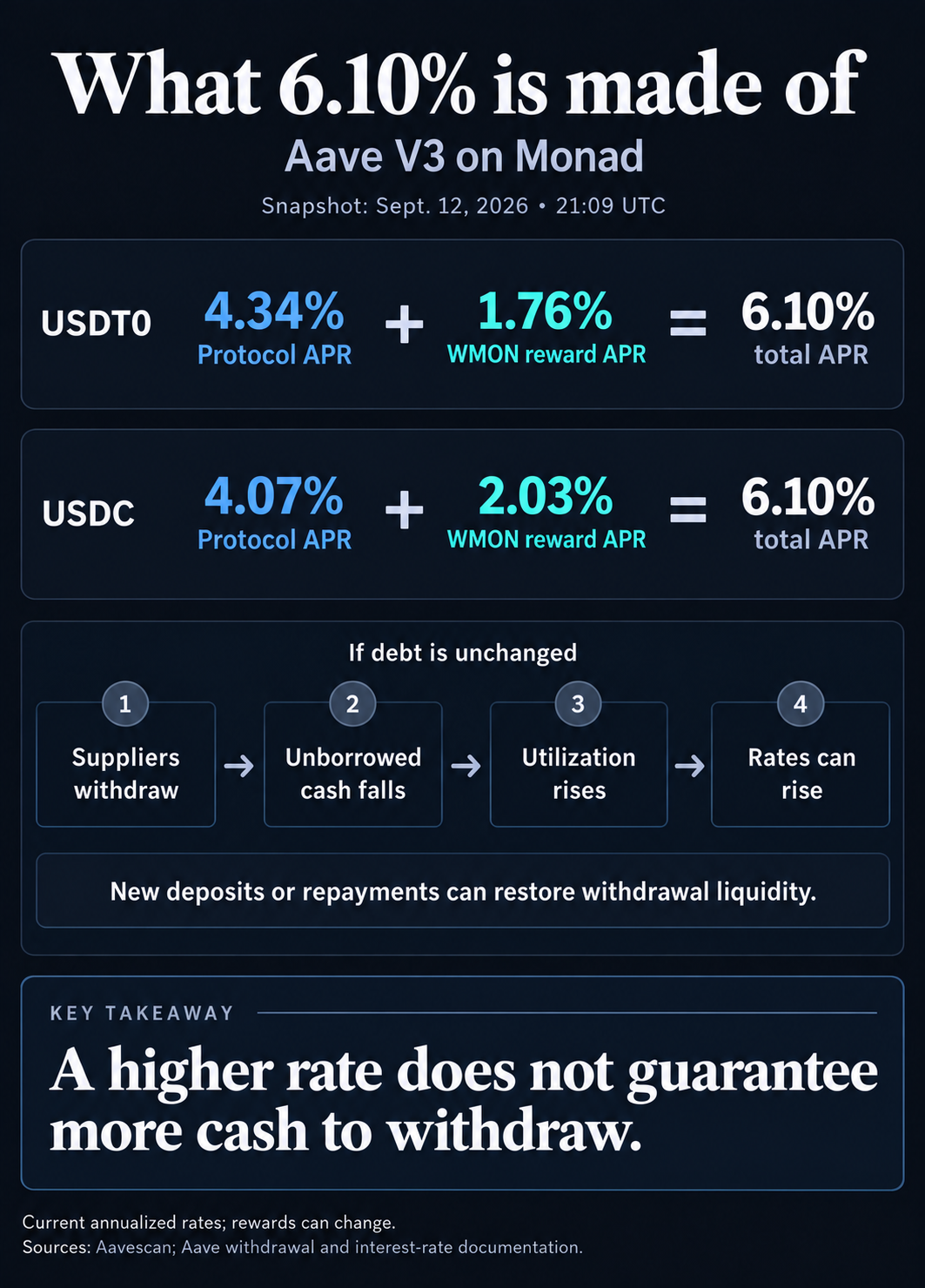
The protocol component comes from lending activity; the reward component comes from an incentive campaign. TokenLogic proposed shifting more compensation toward interest paid by borrowers. It also described an alternative in which the earlier 5.70% target stayed in place while subsidy spending fell. A change in the mix therefore need not translate into the same change in the displayed total.
Morpho offers a useful comparison of that mix. In TokenLogic's Sept. 7 comparison, the Ethereum PayPal USD Main V2 vault showed 2.62% organic APY and 2.96% incentive APR. Sentora RLUSD Main V2 showed 2.53% organic APY and 3.57% incentive APR. The incentive component was material in both examples.
Those historical figures describe different stablecoins and should not be treated as Sept. 12 alternatives to the Monad quote. APR annualizes a rate without compounding; APY includes compounding assumptions. Neither a mixed display nor a past average promises the return a depositor will ultimately receive.
Morpho's reward documentation separates native vault APY, direct and forwarded reward APR, and fees. Its V2 architecture can route assets into Morpho lending markets and other approved yield sources, so native vault yield should not automatically be equated with borrower interest.
Averages introduce another complication. Coin Metrics' Sept. 1 study reported a 4.79% median yield and approximately 5.31% average among Morpho USDC vaults over its preceding 90-day window. Higher-yield outliers lifted the average. That describes a historical distribution across vaults, not a rate available to every USDC lender.
Comparing returns therefore requires the same asset, observation window and treatment of rewards and fees, as well as the underlying exposure. These historical examples explain the components of yield; they do not rank today's withdrawal capacity.
Leaving a vault can still leave money lent out
Aave pools liquidity by asset within a market. Morpho's variable-rate markets pair individual collateral and borrowing assets, while vault curators choose where to allocate deposits. That additional allocation layer makes the withdrawal route part of the comparison.
Morpho's liquidity documentation describes a V2 configuration that draws ordinary withdrawals first from idle tokens and then from one selected market. If idle assets are empty and that market is fully utilized, the withdrawal can revert. This is a documented condition, not evidence that a named vault currently faces it.
There are countermeasures. An allocator can switch the selected market or reallocate funds, and a permissionless mechanism can move available liquidity from an adapter into the vault. These routes depend on the cash available and the vault's configuration.
The in-kind redemption route addresses a different problem. It can replace vault shares with a direct position in an underlying protocol, even when that position remains illiquid. The holder has left the vault but may still lack spendable stablecoins. Penalties and access controls can also affect the route.
For Aave's Monad USDT0 reserve, the next useful signals are therefore deposits, repayments and the unborrowed balance alongside the rate. More cash entering or debt being repaid would make a given withdrawal easier to accommodate. A rising APR alongside a shrinking cash buffer would tell a different story.
The yield breakdown explains who pays the lender. The unborrowed balance and withdrawal route explain immediate cash access. Even borrower-funded interest can rise because other suppliers have left, so a larger organic component alone does not establish more durable demand.
Source: CryptoSlate