



FILTERED RESULTS
FILTERS
MCap $2.9T -0.1%24h Vol $106.1B -1.8%Fear & Greed 74/100Alts Index 51/100
BTC.D 58.3% -0.1%Stable.D 9.2% 0%ETH.D 11.4% 0%Others.D 21.1% +0.1%
NIGHT$0.0420+27.35%•TRAC$0.4996+24.65%•STX$0.3922+24.35%•STONK$0.2919+22.27%•CAP$0.0736+19.18%•MON$0.0321+19.18%•JASMY$0.00602821+15.82%•KAIA$0.0369+9.67%•PROS$0.7374+9.37%•GOMINING$0.3907+8.45%•
AI$0.1811-13.33%•TIBBIR$0.2944-12.76%•BTW$1.158-11.27%•BR$0.7593-10.7%•2Z$0.0584-8.59%•BP$1.207-8.52%•ZRO$1.647-7.31%•MET$0.3031-6.11%•LDO$0.4500-5.7%•SKY$0.0778-5.01%•
•
·
·
FILTERED RESULTS
Bitcoin Enters Its Most Bullish Month After Massive Q3: Uptober or Redtober Next?
Solana’s $100 Support Wall Could Be Setting the Stage for a 10X Move
Korea is Moving its Stocks Onchain, Here’s What it Means
UPDATE: SBI Holdings has completed its acquisition of Japanese crypto exchange Bitbank, making it a
Chainlink Fulcrum Sets Out to Unlock Idle Institutional Collateral
EU Presses Binance Over ‘Reverse Solicitation’ Exemption for Users: Report
Japan’s biggest payment network opens its doors for crypto via Binance Pay
Rethinking RWA: How Long Turned Stocks into Liquidity for the Robinhood Ecosystem
U.S. Judge Dismisses LIBRA and M3M3 Class Action Lawsuit
1,361 $BTC (113,321,786 USD) transferred from unknown wallet to unknown wallet...
Open USD Goes Live as Coinbase, Stripe, Visa, Mastercard Open Minting to Businesses
Analysis: MetaMask Exits 17,000 Validators After Staking Security IncidentMetaMask, one of the...
Institution Liquidates 172,500 ETH, Realizing $124 Million Profit
September Sees $766.4 Million in Exploit and Phishing Losses in Cryptocurrency Sector
Google Released Gemini 4 Argon with Million-Token Context Window and Unlimited Cybersecurity Protection
Bitget Hack Funds Hit Wasabi CoinJoin as DAI Flows to Tron, Freezes Catch Just $318K
Marinade Finance: DAO hit by malicious proposal attack, vulnerability fixed with no fund losses
After PCE, Goldman Sachs "tears up report": No longer predicts Fed rate hike in October, next one may be December
Open Standard Has Launched the OUSD Stablecoin
Base’s Cobalt upgrade adds another rule to affect token balances
Marinade Governance Committee Blocks DAO Takeover Attempts
Marinade Council Prevents DAO Takeover Attempt
LeveX Makes Trading Tournaments Monthly, Opening With a $5,000 Cash Competition
SBI completes full acquisition of crypto exchange Bitbank, bringing it under the SBI Group
Major Financial Firms Officially Launch Open USD Stablecoin
Chainlink Named Oracle for Open Standard’s OUSD Stablecoin
Fact Check: Hackers Locked Elon Musk’s Starlink and Demanded $500M in Bitcoin
Morpho Liquidity Drop Triggers Shift DeFi USDC Vault Exit, No Loss as Deposits Pause
Trader 0xE1Ad withdrew 5,000 $ETH ($13.43M) from #Binance again after 5...
Philippine Central Bank Curbs Bank Transfers to Major Crypto Platform Coins phCoins ph, one of the...
MVRV Z-Score Holds Above Its 365-Day Average: Long-Term Structure Still Favors the...
Global bond yields are hitting multi-decade highs as the U.S. 10Y...
October 2026 Macro Catalyst Outlook
Senate Republicans Formally Introduce 56-Page Crypto Tax…
DATA Foundation CEO Andrea Muttoni said at a16z Crypto Korea Summit that AI doesn't care
Polygon Launches Crypto Checkout for Stablecoin Payments…
50,000 $ETH (135,336,586 USD) transferred from #Binance to Binance Beacon Deposit...
DIG Ventures closes $120 million third fund, focusing on pre-seed and seed-stage AI infrastructure
HSBC Redcoin to Start With Transfers and Payments in Hong Kong
Spot bitcoin ETFs shed $149 million on Wednesday, ending a 9-day inflow streak. Spot
Bybit Users Hold More BTC and ETH as USDT Balances Fall 11%
Bitcoin ETFs draw $6.3B in Q3 as BTC price rises nearly 43%
1,424 $BTC (119,590,416 USD) transferred from unknown wallet to unknown wallet...
ESMA has called for new MiCA rules on staking, lending, borrowing, and access to DeFi
Binance Questioned Over Operations in Europe Without License: FT
Bitcoin Closed September up 6.5%, Ethereum — Nearly 9%
Why Chainlink (LINK) has 70 prices: DEX pool prices explained
Crypto ETF Flows Reverse on September 30 as Bitcoin Funds…
SoftBank completes third $10 billion investment in OpenAI
MetaMask security incident forces Ethereum staking exits, no funds at risk
How Modern Payment Infrastructure Untangles Complex…
Is "Reverse Solicitation" Under Scrutiny? EU Probes Binance’s Services after Wind-Down Order
Pi Network Makes a Mysterious Stablecoin Move: Could Rewards Be Coming to Pioneers?
Solana (SOL) Breakout Incoming: How High Can the Price Go?
DogeOS Launches Testnet to Bring DeFi Apps to Dogecoin
US court blocks victims from 127,000 seized Bitcoin, and petition rules are blamed
EU Regulators Question Binance's Use of MiCA Exemption to Keep Serving European Customers
AllUnity Embraces the Dollar With New MiCA Stablecoin USDAU
BitMart Offered Users Three Refund Options Amid Balance Shortfall
UK-based Lloyds Banking Group said it has completed a live pilot with Visa to settle
Binance Pay Launches USDT Payments at Millions of…
Binance Launches CTUSDT Perpetual Contract with High Leverage
Bitcoin Price Today: BTC Hits $85K, Turns Volatile After Cooler August PCE Print
a16z Crypto Head of Policy Miles Jennings said Genius Act is a foundational layer
Binance Futures to Launch CTUSDT USDⓈ-M Perpetual Contract
BPI Raises Concerns Over MSCI's Non-Operating Company Rules
Zcash Community Approves $8.4 Million in Retroactive Grants After Orchard BugZcash co-founder Zooko...
$CT listed on Binance futures・
EU Regulators Scrutinize Binance Over MiCA ‘Reverse Solicitation’ Use
Three hidden flaws in Uniswap’s StablePair hook drain LP returns


Uniswap’s StablePair fee hook is designed to keep more of the value from rebalancing stablecoin pools with liquidity providers.
Yet the rule deciding which trade counts as a correction depends on a configured reference rate.
StablePair is a Uniswap v4 hook, a contract that changes a pool’s behavior. Its fee logic compares a cached pool price with a reference stored in the hook’s configuration. The design prices trades around that benchmark, leaving providers exposed if a token’s economic value moves away.
Uniswap Labs announced the two Ethereum pools, USDC/USDT and USDC/USDG, on Sept. 10. Its Sept. 16 explanation noted that Providers allocating capital now are choosing a fee mechanism alongside the token inventory it requires them to hold.
What the dynamic fee captures
The deployment documentation lists one-for-one reference rates for both pools. The implementation’s fee path uses that stored reference and the pool’s price, without consulting an external market-price feed.
Inside a narrow band around the reference, the fee varies by swap direction to target a consistent bid and ask before price impact. When the pool sits exactly at the reference, both directions pay the configured optimal fee. As it moves toward an edge, the fee in one direction falls while the other rises.
For a simple illustration, assume an optimal fee of one basis point (0.01%). At the reference, a swap with 10,000 input units would pay one input unit in LP fees.
Outside the band, the fee rules split trades by direction. A swap classified as moving farther from the reference pays zero LP fee, while a swap classified as pulling the pool toward it faces a decaying fee.
A trade pushing the pool away can give LPs a favorable price relative to that benchmark. The reverse trade lets an arbitrageur capture the gap by restoring the pool’s price. A single static fee rate charges both directions equally.
StablePair instead offers progressively better terms for the corrective trade as blocks pass.
If a trader accepts the fee, LPs collect it while the trade rebalances the pool. Uniswap Labs says the design captures the “vast majority” of rebalancing profit.
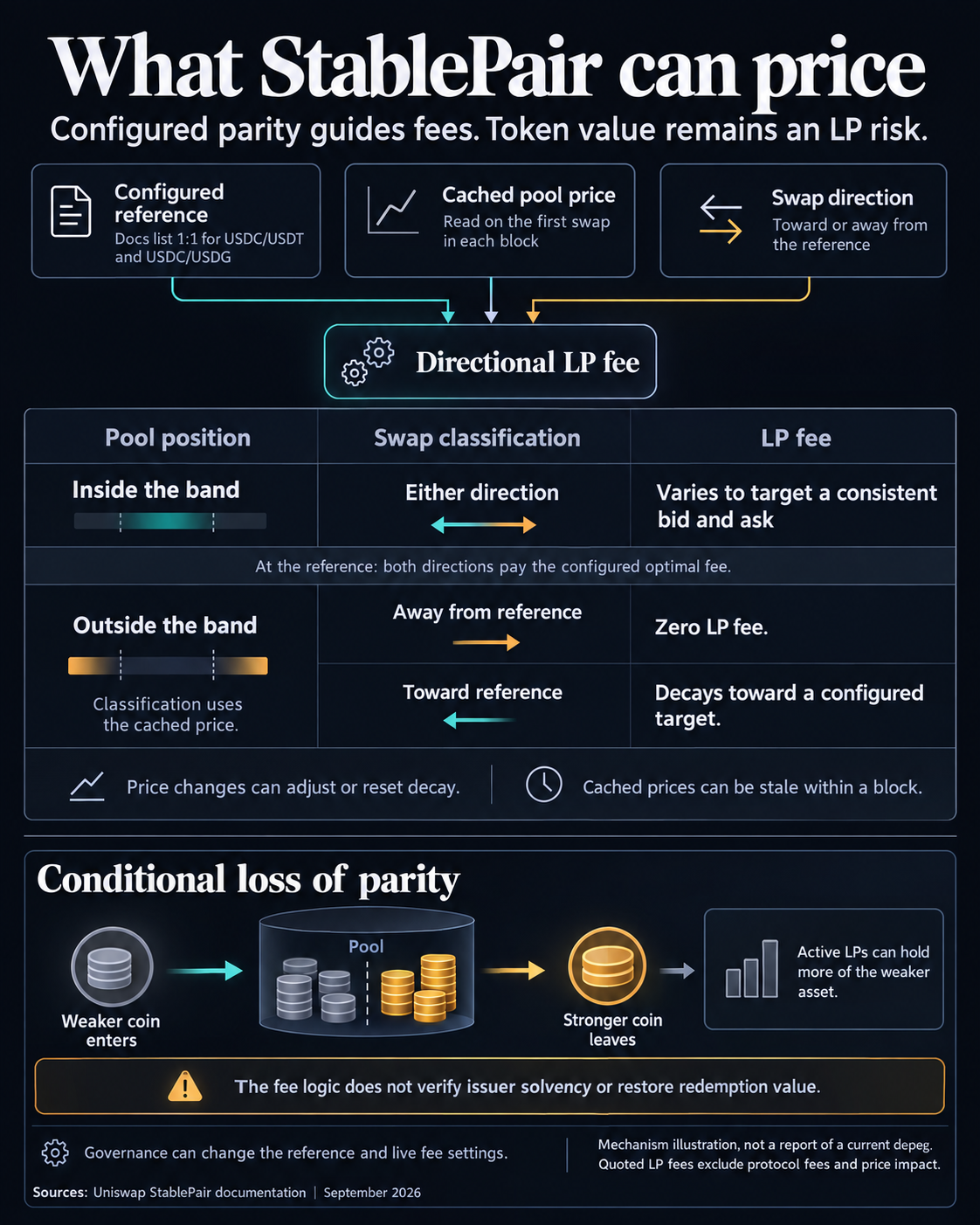
The first swap in each block caches the pool price used for later fee calculations. That removes the same-block fee advantage from splitting corrective swaps, but later trades can face stale inputs. If the live price crosses the reference mid-block, the cached classification can assign fees to the opposite directions until the next block.
Inventory risk and the evidence on returns
The boundary appears when the outside market stops treating the two coins as equal.
Consider a conditional issuer shock that reduces one coin’s external value while the configured reference still assumes one-for-one exchange. Selling that weakening coin for the stronger coin can move the pool farther from the reference while moving its price closer to the outside market.
A trade the fee rule classifies as moving away from the reference may then reflect price discovery, rather than a temporary imbalance.
The fee logic cannot verify issuer solvency or restore redemption value. This scenario is hypothetical and should not be read as a report of a current depeg, exploit, or loss in either StablePair pool.
If an LP holds 10,000 hypothetical coins and their external value falls from $1 to $0.90 each, that inventory is worth $9,000, a $1,000 decline before fees. Capturing income from rebalancing trades does not by itself reimburse that change in token value.
Trades can also change what the provider owns. Selling the weaker coin into available liquidity removes the stronger coin and leaves active LP positions with more of the weaker asset. An away-from-reference trade charged zero LP fee contributes no LP fee to offset that added exposure.
The amount exchanged still depends on available liquidity, the provider’s chosen range, and price impact. StablePair's zero-fee classification also depends on the cached price, so it should not be read as a rule that every sale of a weakening coin is always free.
On Sept. 30, the Uniswap interface’s Stats panels showed the USDC/USDT StablePair pool with about $6.1 million in total value locked and $117.9 million in 24-hour volume around 15:59 UTC. The USDC/USDG pool displayed about $2.6 million and $8.7 million, respectively, around 15:57 UTC.
A same-pair reference was available: the Ethereum USDC/USDT v3 pool charging 0.01% displayed about $34.2 million in TVL, $15 million in 24-hour volume, and $1,100 in 24-hour fees around 16:02 UTC.
The observations were not synchronized, the pools have different fee rules and liquidity conditions, and the StablePair panels supplied no comparable absolute fee total or realized position-level return.
In economic terms, testing that return claim would require comparable periods and active liquidity ranges, fee income, and inventory valuation. Volume alone cannot show how much better an LP did than in another pool or by holding the assets.
Governance controls the benchmark, with limits on the hook
Under Uniswap’s documented role model, governance controls live fee configurations, implementation upgrades, and role administration.
Changing the reference changes the benchmark used to classify and charge swaps. The deployment page directs integrators to read live configuration from the hook because governance can change parameters.
Separate limits apply to what an upgrade can do. The hook’s permanent address permissions exclude remove-liquidity callbacks and custom accounting deltas.
According to Uniswap’s security documentation, upgrades cannot use those capabilities to block LP withdrawals or alter swap amounts to skim additional fees. The ability to withdraw does not guarantee the market value of the tokens received.
Uniswap says OpenZeppelin reviewed a non-upgradeable predecessor’s core fee mechanism from Feb. 9 to 13, 2026, and resolved the splitting issue through block caching. The later upgradeability and role model were outside that review.
For LPs, StablePair changes the price of supplying liquidity for rebalancing. The remaining economic decision is whether the assets still justify the reference around which that liquidity is supplied, and whether earned fees compensate for the inventory ultimately held.
Source: CryptoSlate