



FILTERED RESULTS
FILTERS
MCap $2.8T -0.4%24h Vol $50.4B +7.7%Fear & Greed 61/100Alts Index 57/100
BTC.D 59.7% +0.5%Stable.D 9.4% 0%ETH.D 11.0% +0.1%Others.D 19.9% -0.6%
S$0.0653+41.93%•BAT$0.1613+23.73%•GRASS$0.7572+17.83%•W$0.0203+15.64%•CARDS$0.3172+15.25%•STRK$0.1165+12.87%•PLUME$0.0212+12.64%•ETHFI$0.7466+10.67%•CHIP$0.0681+10.38%•CFX$0.0687+10.31%•
APEPE$0.00000129-11.27%•BP$1.115-9.2%•KAIA$0.0519-9.13%•DRV$0.5065-7.49%•Q$0.0289-6.99%•AKE$0.0261-4.53%•IMX$0.1926-3.81%•NIGHT$0.0492-2.94%•SAND$0.0656-2.91%•PYTH$0.0771-2.36%•
•
·
·
FILTERED RESULTS
Ledger Investigates Hardware Implant Reports Linked to Southeast Asian Reseller
CFTC Unveils New Framework for Crypto Trading Amid Legal Concerns
Bought a Ledger From a Reseller? 5 Checks After the $86…
Everyone wants SCOTUS to take up prediction markets: State of Crypto
XRP Ledger developers disclosed a decade-old payment engine bug that could have minted
Some Kraken futures limit orders can still fill after a successful cancel
US threatens to block weapons supplies to Ukraine over attacks on...
Ledger Confirms Draining Cases Linked to CryptoBilis-Sold Devices
Bitcoin Price Eyes $85K, but Momentum Has Yet to Show Up
Ledger Reports $72 Million in Losses Linked to Compromised Devices from Reseller CryptoBilis
Tokenized Stocks Show Real Demand But Remain Volatile and Illiquid, IMF Finds
Saylor teases Strategy Bitcoin buying after ending September with STRC buybacks
Tokenization Hits $65 Billion, but the IMF Warns of New Vulnerabilities
Bitcoin ETF Weekly Outflows Hit 3-Month High, Ethereum Funds Extend Losing Streak
Bitcoin hedge funds face a liquidation trap when their collateral is split across markets
BTC breaks above $84,000, up 0.16% on the day
Starknet (STRK) traded at $0.1128, up 50.47 percent, at…
4,499 $BTC (377,172,944 USD) transferred from unknown wallet to unknown new...
*S&P 500 OPENS UP 1.1%, NASDAQ GAINS 1.3% ...
Bitcoin, Ethereum and Solana ETFs All in the Red for October
Papertrade Addresses Price Manipulation Concerns Amid Protocol Adjustments
Kyrgyzstan Orders Liquidation of Gold-Backed Stablecoin Issuer and Crypto Exchange
Liquid Bitcoin Redemptions Remain Frozen Amid Reserve Coverage Issues
Papertrade Implements Stricter Trading Limits Following Manipulation Claims
Clarity's failure could speed crypto innovation while shielding incumbents
Tokenized stocks can carry the same rights without the same trading protections
Liquid Network peg-outs remain frozen 35 days after Elements exploit drained nearly 4,000...
PaperTrade responds to fairness and manipulation concerns: queue mechanism ensures fairness, some users manipulating BBO could not sustain profits
Liquid Network at 86% Backing as Bitcoin Redemption Freeze Drags On
President Trump declares 'energy ceasefire' between Russia and Ukraine
Analyst: Bitcoin may need to break through $84,000–$85,000 to determine its next move
Trump Says Russia And Ukraine Have Reached ‘Energy Ceasefire’...
IMF Reports Lower Liquidity and Higher Volatility for Tokenized Stocks Compared to Traditional Stocks
PeckShield Links $3.89 Million Ledger Wallet Theft to Binance Deposits
Bybit's Weekly Platform Updates General• Keynote with Ben: new products + upgrades on Oct 13• Ask ...
Ledger supply chain attack suspected of spreading to Europe, user reports hardware implant found in device from official reseller
Ripple ETFs Defy Crypto Slump With Another Green Week but XRP Price Sinks
ESMA Wants Proof Tokenised Collateral Can Be Cashed Out in a Crisis
XRP ETFs extend a 13-week inflow streak as Bitcoin, Ethereum and Solana funds shed $1.25 billion
Trump Announces 'Energy Ceasefire' Agreement in Russia-Ukraine War
Cheaper AI Could Make Computing Power More Expensive — Grayscale
Tom Lee says Ethereum "should top $5,000" by the end of 2026...
More Orange: Saylor Hints at Growing Strategy’s 848K Bitcoin Stash
SpaceXAI Official Account Renamed to SpaceX Super Intelligence
XRP Ledger Reveals Long-Standing Bug That Could Have Minted Trillions
XRPL Fixes Decade-Old Bug That Could Have Minted Trillions of XRP RippleX and the XRP Ledger...
*US MARCH CONSUMER CONFIDENCE 91.8; EST. 88.0 ...
New iPhone spyware can hunt for crypto wallets and extract their data every 15 seconds
One Year After Crypto’s $19 Billion Liquidation,…
Coldcard Investigates Phishing Post From Official X Account After Earlier Seed-Generation...
*US FEB. JOB OPENINGS 6.882M; EST. 6.918M ...
Coldcard X Account Hit by Phishing Scam After $100M Fiasco
U.S. Treasury Secretary Confirms No Expected Military Conflicts Before Midterm Elections
US Bitcoin ETFs Experience Significant Withdrawals Amid Market Reversal
China Announces They Will Build A New National Blockchain Network, Alongside A National Integrated...
US Treasury Secretary Bessent: Trump expects no military conflict before midterm elections
IMF finds demand for tokenized stocks, says the market is still volatile, illiquid
How Zcash Plans to Hide Your Keys From AI and Quantum Attacks
Strangely Rational — Week in Review
What happens when crypto trades stocks while Wall Street sleeps?
Market Overview: BTC : $83032 ETH : $2502.27 BNB : $748.63 SOL : $109.39 Market Cap :Total :...
A whale placed a $22.89 million BTC buy order on Binance spot at $82,975
Stablecoins Win Over Nearly Half of Asia-Pacific Consumers: Visa Study
*CHINA MARCH CAIXIN MANUFACTURING PMI 50.8; EST. 51.6 ...
*S&P 500 CLOSES 2.9% HIGHER, NASDAQ CLIMBS 3.8% ...
Bank of England Announces New Framework for Sterling Stablecoins
Strive CEO Hints at Upcoming Bitcoin Accumulation Data Release
Following Michael Saylor? Strive CEO posts chart hinting at possible BTC accumulation disclosure next week
Asia's weekly TOP10 crypto news: Kyrgyzstan Shuts Down USDKG, South Korea Tightens Cross-Border...
Coinbase’s Texas move gets a shareholder suit dismissed over Delaware-era claims


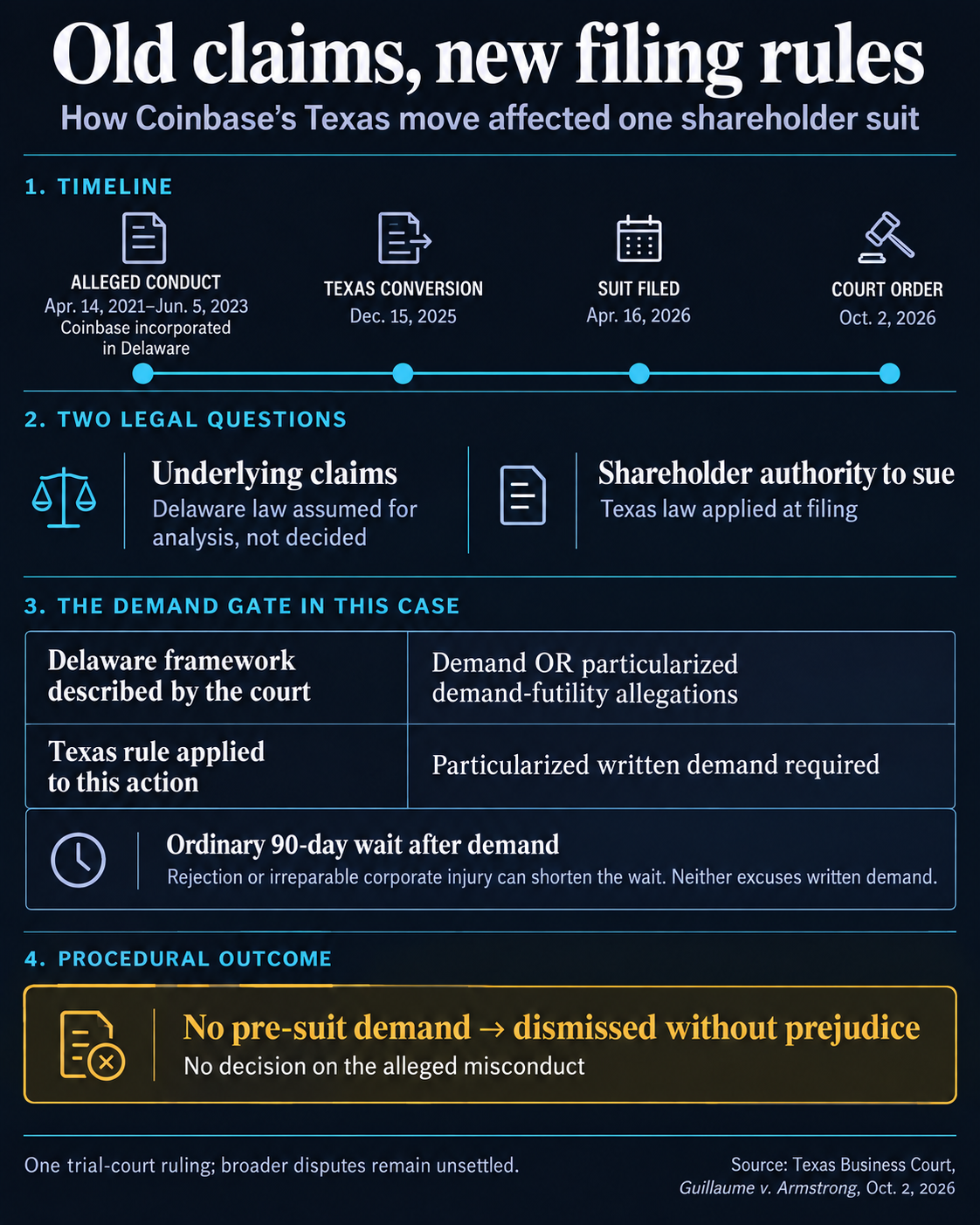
Coinbase’s move to Texas changed the rule a shareholder had to satisfy before suing its directors over alleged conduct from the company’s Delaware years. In an October 2 ruling, the Texas Business Court dismissed Gary Guillaume’s derivative action because he had not first demanded that Coinbase take action on the claims.
The dismissal was without prejudice, and the court did not decide whether the alleged misconduct occurred. Its consequential finding concerned who could pursue claims belonging to Coinbase: Texas’s demand requirement applied to the shareholder’s authority to sue, even though the court assumed without deciding that Delaware law governed the underlying claims.
On October 9, Coinbase CEO Brian Armstrong praised the precedent as encouraging more companies to incorporate in Texas and thanked Greg Abbott. That endorsement came a week after Judge Andrea K. Bouressa signed the order. The immediate lesson for public shareholders is that the law governing a company’s past conduct and the law governing their ability to challenge it can diverge after reincorporation.
Why older claims faced Texas’s demand rule
A derivative action lets a shareholder pursue a claim on the corporation’s behalf. The claim belongs to the company, and the shareholder seeks to exercise authority ordinarily held by its board. That distinction explains why the first dispute here concerned permission to bring the action rather than the directors’ alleged wrongdoing.
The parties agreed that Guillaume filed his suit on April 16, 2026, alleging misconduct between April 14, 2021, and June 5, 2023. Coinbase was incorporated in Delaware during that earlier period. Its Texas conversion became effective on December 15, 2025, several months before the suit was filed.
Under the Delaware framework described in the opinion, a derivative plaintiff can make a demand or plead that doing so would be futile. Futility requires particularized allegations about individual directors, examining whether they received a material personal benefit, face a substantial likelihood of liability, or lack independence from someone who benefited or faces such liability. At least half the relevant board must satisfy the test.
Guillaume tried that route. He did not make a pre-suit demand.
For this action involving a public company, Texas required a particularized written demand identifying the disputed conduct and requesting suitable corporate action. The October 2 opinion described an ordinary 90-day wait after demand, with derivative proceedings permitted from the 91st day. Corporate rejection of the demand or irreparable injury to the corporation can shorten the waiting period. Both exceptions leave the written-demand requirement in place.
Guillaume’s futility allegations could not substitute for the written request Texas required. The missing demand was enough to end this action before the court reached its merits.
Guillaume argued that Delaware law should apply because the claims arose before Coinbase’s Texas move. Bouressa accepted that premise about the underlying claims for purposes of the analysis, without resolving it.
She then considered a separate question: which state’s law governed the shareholder’s authority to file those claims for Coinbase?
The court’s answer turned on the company’s incorporation when the shareholder exercised that authority. A corporate claim can arise under one state’s law, while a later effort to pursue it derivatively is governed by another state’s rules. The opinion reasoned that a shareholder does not acquire a vested right, when a corporate claim arises, to bring it personally on the corporation’s behalf at some later date.
That reasoning gives reincorporation consequences beyond future board decisions. In this case, the December 2025 conversion affected the route for challenging alleged conduct dating back to 2021.
Coinbase’s conversion disclosures supplied Guillaume with another argument. He relied on language preserving eligible shareholders’ standing and ability to bring derivative claims concerning earlier conduct, subject to continued ownership.
The opinion’s treatment of that language was narrower than Guillaume’s interpretation. The court said it did not promise that Delaware law would continue to govern shareholder authority after conversion. The disclosures also expressly said Texas law would govern Coinbase’s affairs following the move.
Bouressa further found that Guillaume offered no argument or evidence showing how losing the option to plead demand futility adversely affected his ability to sue. He had not shown that making a demand was impossible, irreparably harmful or prejudicial, or that the futility option gave him a particular advantage.
The court also found no evidence that Coinbase had successfully contracted around the Texas requirement.
Concentrated votes, a different accountability route
The governance backdrop makes that distinction matter. Coinbase’s November 2025 information statement said the Armstrong- and Fred Ehrsam-associated consenting group held approximately 78.40% of voting power at the October 31, 2025 record date. The group approved the conversion by written consent on November 4.
Coinbase said a committee of Christa Davies and Paul Clement, whom the board found independent and disinterested, evaluated Delaware, Nevada and Texas before recommending Texas. The board unanimously approved the move.
The company cited greater litigation predictability, potential savings on defense costs, indemnification and insurance, and Texas’s crypto-friendly environment.
The consent figure describes approval in 2025. In its April 24, 2026 proxy, Coinbase reported March 31 voting-power figures of 49.6% for Armstrong, 18.9% for separately listed Armstrong-associated entities and trusts with an independent trustee, and 10.6% for Ehrsam. The figures use SEC beneficial-ownership rules, including qualifying options. Class B shares carry 20 votes each, compared with one for Class A.
Coinbase’s February 2026 annual filing described Armstrong and the independent trustee collectively as able to exercise majority voting rights. Its July 30 quarterly filing reported no material changes to the annual risk factors, without supplying a new individual voting-power percentage.
Source: CryptoSlate