



FILTERED RESULTS
FILTERS
MCap $2.8T -0.6%24h Vol $79.9B +53%Fear & Greed 69/100Alts Index 51/100
BTC.D 59.3% -0.5%Stable.D 9.4% 0%ETH.D 10.9% -0.1%Others.D 20.4% +0.6%
RSR$0.00213055+29.44%•SAFE$0.1350+16.74%•STONK$0.1521+11.65%•Q$0.0315+9.19%•BTW$1.777+7.09%•RENDER$2.113+5.85%•PYTH$0.0825+5.44%•STX$0.4145+5.16%•CAP$0.0960+4.05%•TWT$0.5257+3.3%•
STRK$0.0852-26.56%•PONS$0.2848-17.69%•CHIP$0.0583-13.84%•CASHCAT$0.1065-13.58%•CFX$0.0582-13.33%•KAIA$0.0455-12.64%•ENA$0.2100-12.01%•USELESS$0.1773-11.69%•NEAR$5.124-11.44%•ORCA$2.092-11.4%•
•
·
·
FILTERED RESULTS
Bitdeer AI Signs Agreement for 60 MW Data Center in Malaysia
Bearish Options Dominate Bitcoin Trading Volume Amid Price Fluctuations
Robinhood Chain Achieves $15 Billion in Stock Token Trading in First 100 Days
NEAR Protocol Sees 16% Surge Amid Record Trading Activity
China's Leadership Advocates for National Blockchain Network Without Tokens
Binance Launches AI Trading Interface for Global Users
Morgan Stanley Projects Tokenized Assets Market Could Reach $10 Trillion by 2030
Bitcoin Trading Remains Volatile Amid Market Pressures
Crypto PACs report $2.7M spending blitz on House races as midterms loom
Binance has rolled out its AI-powered personalized trading interface to all global
1,268 $BTC (104,661,635 USD) transferred from unknown wallet to unknown new wallet...
Stellar’s $3.5 Billion RWA Surge Leaves XRP Ledger, Solana and Avalanche Playing Catch-Up
USDC Sees $40.2 Billion in Trading on Decentralized Exchanges During Q3 Weekends
Evernorth Holdings Shares Rise 5% in Nasdaq Debut Following SPAC Merger
Cardano Eyes a 960% Rally as On-Chain Activity Heats Up, Echoing Its 2020 Breakout
Bitcoin Achieves First Bullish EMA Crossover in 3.5 Years
Hyperliquid’s Secret Weapon? OKX Founder Points to Its Order-Matching Design
Russia's Moscow Exchange to launch Bitcoin, Ethereum, and USDT trading December...
Bitcoin Price Faces CPI Reckoning as Analysts Eye $81,300 Support
Critical XRPL Flaw Could Have Let Hackers Mint 18 Trillion XRP, Here’s More
Solana Moves Deeper Into Wall Street With Atomic Settlement System
Crypto Token Unlocks Reach $155M as CRO Leads Weekly Releases
Ripple-Backed Evernorth Hits Nasdaq Holding 473 Million XRP Worth Far Less Than It Paid
SEC proposes crypto custody framework for advisers and funds that would permit self-custody and state trust company custodians
MoFo's Financial Markets & Innovation #34
Internet Computer (ICP) Pumps 14% Daily: More Gains Ahead?
A7 to unveil a service that will re-invent the international payments market
Solana’s offline-signing proposal would keep approvals valid after failed transactions
Senegal Launches Bitcoin Mining Pilot Amid Debt Restructuring Efforts
Stormrake Reports $8 Million in Blocked Payments Due to Debanking in Australia
Cryptobilis Founder Reveals Company Was Sold Months Before Exploit
Aptos has launched an opt-in encrypted mempool on its mainnet, allowing users to conceal
Bitmine Now Holds 4.9% of Ethereum Supply After Adding…
Jeonbuk Bank Breaks Ground With Bitcoin-Backed Lending
1inch to Host Groundwork Forum in Washington, D.C. to Discuss DeFi Policy
Crypto Marketing Agency ICODA Ranks the Crypto Media Outlets ChatGPT, Perplexity and Claude Cite Most
XRPL branded ‘cheap’ for paying infinite XRP exploiter just $250K
Argentina's Central Bank Maintains Ban on Crypto Integration in Banks
How Bitcoin and Cryptocurrency Could Change Money, Banking,…
Polymarket Whale Loses $147K Eagles Bet After a Last-Second 57-Yard Kick
Australia Seeks Longer CFD Safeguards as Retail Losses Exceed $458M
NEAR Price Prediction: Can the Token Reach $10 This Cycle?
elonmusk SAYS "NO CRYING IN THE CASINO" ...
Bitcoin Miners Seek $50 Billion for AI Transition
Ontology Resumes Mainnet Operations Following Extended Security Suspension
UK High Court rules Chinese law applies to Bitcoin recovery in Qian Zhimin case; victims may miss out on huge appreciation
Financial Stability Board: Global stablecoins have yet to be tested under severe stress, calls for stronger cross-border monitoring
Trader Nudges Hyperliquid ETH, Nets $1.28M on Papertrade
Kraken Expands Into the UAE After Clearing Dubai’s Final Regulatory Hurdle
FSB Flags Stablecoin and AI Risks Ahead of G20 Meeting
Polkadot Outlines User Acquisition Strategy Built Around dotUSD
Eclair merges fixes for Lightning flaws that could burn Bitcoin in fees
Uniswap (UNI) Price Eyes $12 as CME Futures Near Launch
BNY Expands Digital Asset Custody Platform to Select…
Bitcoin Spooked? Crypto Fear and Greed Index Drops to Pre-Rally August Lows
Bitcoin Experiences Decline as Market Sentiment Shifts to Neutral
Derive Proposes Treasury Funding for US-Regulated Derivatives Initiative
Ledger Says All Confirmed Cases in Suspected $87M Drain Tied to Reseller CryptoBilis
Ontology Halts L1 Blockchain for 41 Hours Over an Unknown Threat
Bitcoin drops 2.2% as Ukraine, Iran strikes send oil toward one-month high
Derive Foundation Seeks Approval for US-Regulated Derivatives Initiative
Palantir's Europe head warns the region is 'missing the boat' on AI just as it did with the internet
Bitcoin’s Fixed Supply Could Slow Growth, Willy Woo Warns
Crypto Forks Explained: Do You Need a Full Coin to Receive…
Strategy’s Latest 8-K Tests Whether Bitcoin Buying…
NEXTPredict Secures $3 Million Conference Against JFK Flight Cancellations for $12,000
Australia Moves to Apply Retail CFD Safeguards to…
Sui Network Invests $30 Million in DATA Amid Chain Retirement Plans
NEXTPredict Paid $12,000 to Hedge Its Conference on a Prediction Market
Tokenized stocks can carry the same rights without the same trading protections


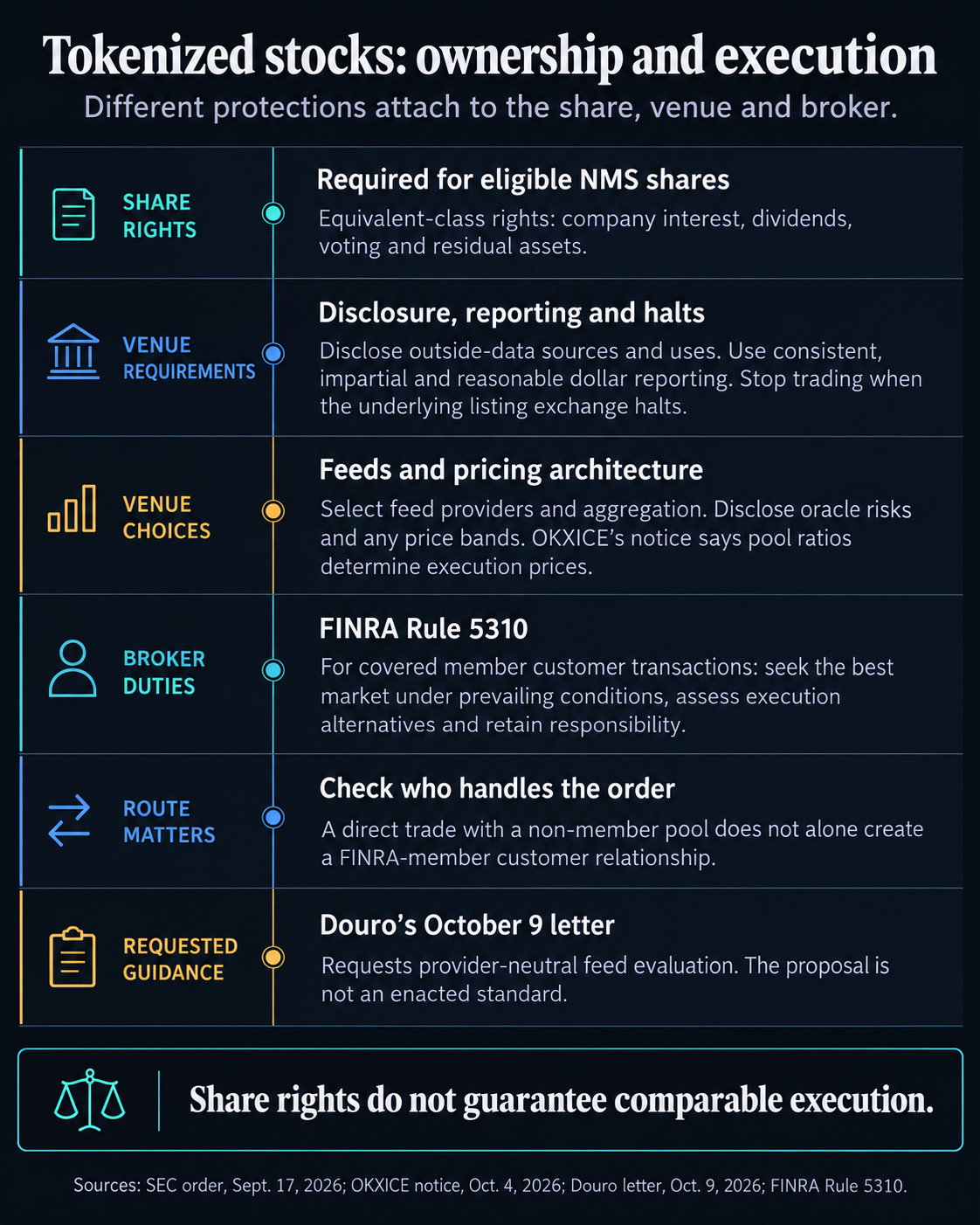
Tokenized stocks eligible for the SEC’s September exemption must carry equivalent shareholder rights, yet their trading venues can operate outside key Regulation NMS protections. Investors therefore need to examine both what the share represents and how their order is priced and handled.
Market-data provider Douro Labs asked SEC staff in an October 9 submission for provider-neutral principles to assess external price feeds and use them for dollar reporting. Douro contributes to Pyth Network and develops and operates Pyth Pro, giving it a commercial interest in the standards under discussion.
The order requires venue disclosures and safeguards. FINRA-member brokers retain applicable best-execution duties when they handle covered customer transactions.
The September 17 order grants temporary, conditional relief from the definition of an exchange to venues offering permissioned automated market maker pools for eligible tokenized National Market System (NMS) stock. These pools use software to let approved participants trade against committed assets. The order also provides separate dealer-definition relief for certain liquidity providers using their own capital.
Its scope is narrower than the tokenized-stock label. Third-party securities providing synthetic exposure, including tokenized linked securities and security-based swaps, are excluded, as are rights and warrants. Eligibility depends on the defined security and the venue’s compliance with the order.
For eligible shares, the venue must verify the same rights and privileges as traditional stock of an equivalent class. Those include an interest in the company, dividends, voting rights and a share of residual assets on liquidation. A claim to those rights concerns what the investor owns; execution concerns the terms on which the investor buys or sells it.
A venue meeting the exemption’s conditions is outside the exchange, alternative trading system and trading-center framework for the relevant Regulation NMS rules. That includes Rule 611’s protection against venue trades at prices worse than certain protected quotations elsewhere. Those protections and a broker’s best-execution duty are separate, however, and the order preserves applicable anti-fraud and anti-manipulation laws and participants’ separate regulatory obligations.
Tokenized stocks: what external price data controls
The order’s market-data provision requires a venue to explain whether and how it uses external data or oracles, the services that bring outside information to blockchain applications. Its public notice must identify providers and sources, explain the purposes of the data and describe oracle use. Other items cover known material risks, including oracle manipulation, and any reference-price bands or other risk controls.
The order also requires concurrent stoppages when the underlying stock halts on its primary listing exchange, participant notifications, operational-event remediation, accessible records, trading limits and restrictions on venue credit.
The order does not prescribe a single provider, minimum contributor count, common aggregation method, confidence threshold or uniform response to stale prices.
Douro wants staff to supply a framework for assessing those choices. Its proposed criteria emphasize independent contributors involved in price formation, aggregation designed to resist manipulation, public contributor identities and calculation methods, and comparison with external market benchmarks. The letter also proposes disclosures about confidence, staleness and responses when data becomes uncertain or unavailable.
There already are binding conditions around reporting. Venues must publish free, machine-readable dollar-denominated data covering transactions in the preceding 30 days, updated within ten minutes of each transaction. Conversion must use consistent, impartial and reasonable methods commonly applied by market participants. Trading-interest and transaction records also must state dollar prices.
An existing SEC staff FAQ uses similar dollar-conversion language for pairs trading on exchanges and alternative trading systems. Douro’s request addresses a different issue: how venues should evaluate feed quality.
How venue notices describe different feed roles
OKXICE’s October 4 notice illustrates why identifying an external provider is only the start. It describes AMM execution prices determined by pool asset ratios, while external price data serves other functions: displaying stock values, detecting underlying-market trading halts and reporting stablecoin-paired transactions in dollars.
The notice identifies Massive.com for stock prices and trading-halt data and affiliated OKX INC for stablecoin price indices. It also says OKXICE applies no additional circuit breakers or reference-price bands beyond the stoppages it describes.
The notice lists Circle’s dollar-pegged USDC among its payment assets. A stablecoin-price input converts the trade into dollars for reporting; pool ratios determine the execution price.
The notice separately describes outside volume data submitted to the venue’s smart contracts for trading-limit checks. Price information and volume inputs therefore control different parts of the trade.
TSV LLC’s September 23 notice provides a different kind of disclosure. It says operations had not commenced as of that notice, outlines intended external-data uses including halt detection and price-divergence monitoring, and says a production market-data provider had not yet been selected. The disclosed functions are prospective as of that notice.
Best execution for tokenized stocks remains a broker duty
For a FINRA member handling a covered customer transaction, Rule 5310 requires reasonable diligence to find the best market and obtain a price as favorable as possible under prevailing conditions. It applies when the firm acts as an agent and when it trades as principal.
The assessment considers the market’s character, transaction size and type, the markets checked, quotation accessibility and the customer’s order terms. The rule’s execution review also considers speed, the likelihood of executing limit orders, costs and customer needs. It is broader than checking whether a pool price matches one external reference.
A member cannot transfer that duty to another person. Automated, non-discretionary order routers and internalizers using regular and rigorous review instead of individual order reviews must conduct the relevant reviews at least quarterly, by security and order type, and compare current arrangements with competing markets. Material execution-quality differences require changes to routing or a justification for retaining it.
Sparse pricing information calls for particular diligence, written procedures and documented compliance under Rule 5310.
Who handles the customer’s order matters
The customer’s instructions and the firm’s role matter. An unsolicited instruction to route an order to a particular market limits the best-execution determination beyond that instruction, while prompt processing and compliance with the order terms remain required. The duty also covers applicable customer orders routed from another broker for handling and execution. Merely filling another broker’s customer order against the member’s quote falls outside that routed-order duty.
Investors interacting directly with a non-member pool should establish whether a FINRA member is handling a covered customer transaction before relying on those broker protections. The venue’s exemption conditions and applicable anti-fraud protections continue to matter in either route.
FINRA’s Regulatory Notice 26-15 sought comments on modernizing guidance under the existing principles-based standard. Its distinction between best execution and trade-through protection helps explain why venue relief and a member’s customer duties operate separately.
What tokenized-stock investors can compare
Investors can read a venue notice for more than a provider’s name. Does outside data set the execution price, support a displayed valuation, convert a transaction for reporting or trigger a halt? Does a disclosed price band actually constrain trading, and what happens if its reference becomes stale or unavailable? Where a broker handles the order, how does it compare the execution with alternatives?
Douro’s October 9 request gives SEC staff a concrete framework to consider. For investors comparing tokenized stocks, the practical test is whether the venue’s data, pricing controls and any broker’s execution review support the trade they expect.
Source: CryptoSlate