



FILTERED RESULTS
FILTERS
MCap $2.8T -0.3%24h Vol $52.9B +13%Fear & Greed 61/100Alts Index 55/100
BTC.D 59.7% +0.5%Stable.D 9.4% 0%ETH.D 11.0% +0.1%Others.D 19.9% -0.6%
CKB$0.00206113+42.4%•S$0.0608+25.94%•W$0.0217+22.89%•GRASS$0.8077+21.96%•PLUME$0.0225+18.99%•CARDS$0.3172+15.25%•BAT$0.1601+15.03%•币安人生$0.6327+12.79%•EIGEN$0.2690+12.02%•FIL$1.247+10.93%•
APEPE$0.00000129-11.27%•BP$1.115-9.2%•KAIA$0.0521-8.68%•DRV$0.5065-7.49%•Q$0.0289-6.99%•PONS$0.3453-6.79%•AKE$0.0261-4.53%•NIGHT$0.0486-3.97%•IMX$0.1927-2.72%•SAND$0.0656-2.71%•
•
·
·
FILTERED RESULTS
Wells Fargo Reports Tuesday: Will Its Kraken Crypto Talks…
Coinbase and Robinhood Futures Arms Now Hold More Client Money Than the US Retail Forex Pool
London Man Gets 2.5 Years for SIM-Swap Crypto Theft
Hackers Allegedly Steal Up to $93 Million via Compromised Ledger Reseller
Amazon reportedly in talks to acquire AI startup Decart for about $7 billion
Solana’s 200ms Slot Upgrade Is Live, but First Epoch…
Top Trending Coins (Today) 1. TAUFA 2. TRUMP 3. S 4. STRK 5. NEAR 6. HOODCAT 7. W 8. PENGU 9. QTC...
*CANADA JAN. GDP RISES 0.1% M/M; EST. 0.0% ...
User Exposes Hidden Hardware Implant in European Ledger Wallet
XRP’s next Wall Street expansion comes with an unexpected complication from Ripple
XRP Ledger Fixed a Bug From 2015 That Could Have Created…
Solana Dominates Tokenized Equities Trading with 65% Market Share
Monetary Authority of Singapore Places Hyperliquid on Investor Alert List
Russia’s Moscow Exchange Pilots Crypto Trading for December Launch
Ledger Confirms Hardware Implant as Tampered Wallet Reports Allegedly Spread to Europe
Lightning apps using unpatched LDK risk Bitcoin theft from a reconnect lie
Ledger Investigates Hardware Implant Reports Linked to Southeast Asian Reseller
CFTC Unveils New Framework for Crypto Trading Amid Legal Concerns
Bought a Ledger From a Reseller? 5 Checks After the $86…
Everyone wants SCOTUS to take up prediction markets: State of Crypto
XRP Ledger developers disclosed a decade-old payment engine bug that could have minted
Some Kraken futures limit orders can still fill after a successful cancel
US threatens to block weapons supplies to Ukraine over attacks on...
Ledger Confirms Draining Cases Linked to CryptoBilis-Sold Devices
Bitcoin Price Eyes $85K, but Momentum Has Yet to Show Up
Ledger Reports $72 Million in Losses Linked to Compromised Devices from Reseller CryptoBilis
Tokenized Stocks Show Real Demand But Remain Volatile and Illiquid, IMF Finds
Saylor teases Strategy Bitcoin buying after ending September with STRC buybacks
Tokenization Hits $65 Billion, but the IMF Warns of New Vulnerabilities
Bitcoin ETF Weekly Outflows Hit 3-Month High, Ethereum Funds Extend Losing Streak
Bitcoin hedge funds face a liquidation trap when their collateral is split across markets
BTC breaks above $84,000, up 0.16% on the day
Starknet (STRK) traded at $0.1128, up 50.47 percent, at…
4,499 $BTC (377,172,944 USD) transferred from unknown wallet to unknown new...
*S&P 500 OPENS UP 1.1%, NASDAQ GAINS 1.3% ...
Bitcoin, Ethereum and Solana ETFs All in the Red for October
Papertrade Addresses Price Manipulation Concerns Amid Protocol Adjustments
Kyrgyzstan Orders Liquidation of Gold-Backed Stablecoin Issuer and Crypto Exchange
Liquid Bitcoin Redemptions Remain Frozen Amid Reserve Coverage Issues
Papertrade Implements Stricter Trading Limits Following Manipulation Claims
Clarity's failure could speed crypto innovation while shielding incumbents
Tokenized stocks can carry the same rights without the same trading protections
Liquid Network peg-outs remain frozen 35 days after Elements exploit drained nearly 4,000...
PaperTrade responds to fairness and manipulation concerns: queue mechanism ensures fairness, some users manipulating BBO could not sustain profits
Liquid Network at 86% Backing as Bitcoin Redemption Freeze Drags On
President Trump declares 'energy ceasefire' between Russia and Ukraine
Analyst: Bitcoin may need to break through $84,000–$85,000 to determine its next move
Trump Says Russia And Ukraine Have Reached ‘Energy Ceasefire’...
IMF Reports Lower Liquidity and Higher Volatility for Tokenized Stocks Compared to Traditional Stocks
PeckShield Links $3.89 Million Ledger Wallet Theft to Binance Deposits
Bybit's Weekly Platform Updates General• Keynote with Ben: new products + upgrades on Oct 13• Ask ...
Ledger supply chain attack suspected of spreading to Europe, user reports hardware implant found in device from official reseller
Ripple ETFs Defy Crypto Slump With Another Green Week but XRP Price Sinks
ESMA Wants Proof Tokenised Collateral Can Be Cashed Out in a Crisis
XRP ETFs extend a 13-week inflow streak as Bitcoin, Ethereum and Solana funds shed $1.25 billion
Trump Announces 'Energy Ceasefire' Agreement in Russia-Ukraine War
Cheaper AI Could Make Computing Power More Expensive — Grayscale
Tom Lee says Ethereum "should top $5,000" by the end of 2026...
More Orange: Saylor Hints at Growing Strategy’s 848K Bitcoin Stash
SpaceXAI Official Account Renamed to SpaceX Super Intelligence
XRP Ledger Reveals Long-Standing Bug That Could Have Minted Trillions
XRPL Fixes Decade-Old Bug That Could Have Minted Trillions of XRP RippleX and the XRP Ledger...
*US MARCH CONSUMER CONFIDENCE 91.8; EST. 88.0 ...
New iPhone spyware can hunt for crypto wallets and extract their data every 15 seconds
One Year After Crypto’s $19 Billion Liquidation,…
Coldcard Investigates Phishing Post From Official X Account After Earlier Seed-Generation...
*US FEB. JOB OPENINGS 6.882M; EST. 6.918M ...
Coldcard X Account Hit by Phishing Scam After $100M Fiasco
U.S. Treasury Secretary Confirms No Expected Military Conflicts Before Midterm Elections
Some Aave loans sit near liquidation with collateral that can take hours to cash out


Some Aave loans backed by yield-bearing collateral had narrow liquidation buffers in LlamaRisk’s Oct. 9 snapshots. Every top PT-AUSD supplier on Monad carried debt, while two syrupUSDC positions accounted for about 97% of supplied syrupUSDC on Arc. Cashing out the collateral involves a market sale or, for Arc holders choosing Ethereum redemption, a withdrawal queue that can take hours.
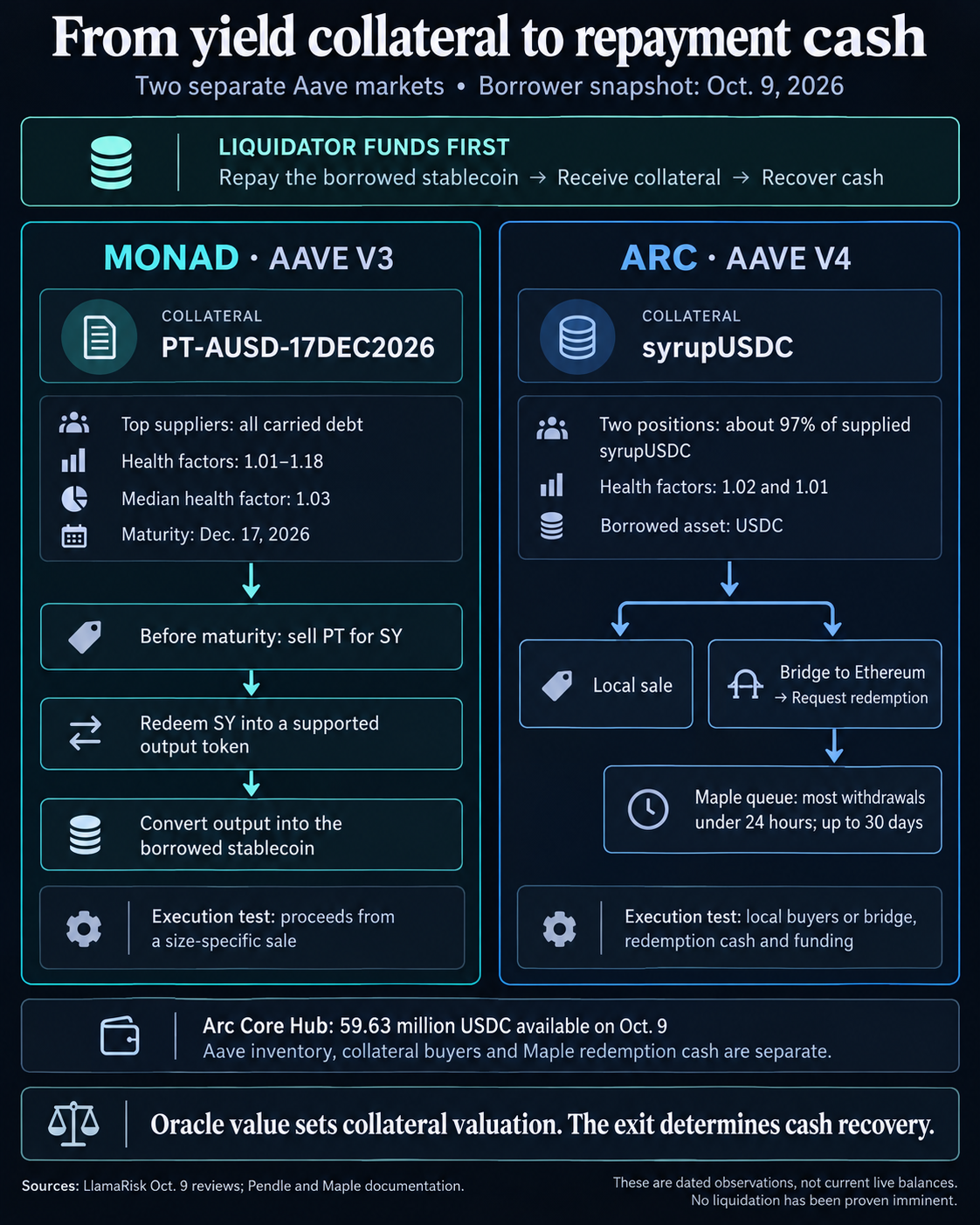
The two markets present separate versions of the same cash-flow problem. If a borrower becomes eligible for liquidation, a liquidator supplies the borrowed stablecoin, receives collateral and then recovers cash from it. December PT-AUSD requires a sale before maturity. Arc syrupUSDC offers a local sale or a bridge to Ethereum for redemption. An oracle valuation establishes collateral value within Aave; the exit determines what the liquidator can recover.
The Oct. 9 reviews of Monad and Arc recommend larger caps, making the economics of those exits consequential as borrowers seek room to grow.
Aave’s health factor compares collateral value, adjusted for liquidation thresholds, with debt. A position becomes eligible for liquidation below 1. The top Monad PT suppliers had health factors between 1.01 and 1.18, with a median of 1.03, in the Oct. 9 snapshot. USDC was their dominant debt asset, followed by USDT0.
Those readings leave a narrow valuation cushion for part of the cohort. They also reflect why borrowers pair correlated collateral and debt: smaller relative price changes can support higher leverage. Aave notes that lower health factors may be appropriate for correlated assets.
During liquidation, someone repays the borrower’s debt and receives collateral plus an incentive. The liquidator weighs the collateral’s realizable proceeds against the debt repaid, transaction and conversion costs, and the cost of financing any redemption wait. The health factor measures proximity to eligibility; a sale quote measures the exit.
Monad’s PT-AUSD Aave loans need a sale before maturity
The Monad collateral is PT-AUSD-17DEC2026, a Pendle principal token representing a claim on AUSD at its Dec. 17 maturity. The redemption entitlement is in the accounting asset. Receiving one AUSD still requires any conversion needed to obtain the USDC or USDT0 borrowed against it.
LlamaRisk reported that the reserve’s 30 million PT supply cap was fully utilized on Oct. 9 and recommended increasing it to 60 million PT. These limits measure token capacity. A larger cap would allow more collateral into Aave; its successful exit would still depend on buyers or redemption.
Before maturity, Pendle’s documented liquidation route sells PT into SY, its standardized yield wrapper, then redeems SY into a supported output token. After maturity, PT can be redeemed into SY without that market sale. Any further conversion into the borrowed stablecoin remains part of the route.
The Oct. 9 review describes the Pendle pool as 47% PT and 53% SY. A large PT sale draws from the opposite side of the pool, so a useful exit estimate needs the intended sale size, output and price impact across the full conversion.
Pricing adds another constraint. LlamaRisk says the December PT uses a linear discount oracle on AUSD/USD. Pendle’s linear-discount documentation describes a predictable path toward maturity independent of AMM prices. That valuation can follow its curve while a liquidator’s sale price depends on the market’s willingness to absorb seized PT.
LlamaRisk’s Oct. 2 launch recommendation specified a 95% liquidation threshold and a 2.62% bonus for the stablecoin E-mode, alongside a 93% borrowing limit. A liquidator has to compare the incentive applicable at execution with the actual cost of turning PT into the debt token.
Arc’s syrupUSDC Aave loans rely on buyers or a redemption queue
The Arc comparison concerns syrupUSDC, a bridged share in Maple’s Ethereum yield-bearing vault. In the Oct. 9 Arc review, the two largest positions held approximately 97% of the supplied syrupUSDC at health factors of 1.02 and 1.01. All outstanding debt among syrupUSDC suppliers was USDC.
A few positions can therefore dominate demand for that collateral’s exit. The concentration refers to supplied syrupUSDC, while the stablecoin available to Aave lenders sits in a separate reserve.
Arc had substantial Aave liquidity at the snapshot: 143.45 million USDC added to the Core Hub, 83.82 million drawn and 59.63 million available. That available balance is debt-token inventory in Aave. Buyers of syrupUSDC and cash available for Maple redemptions determine other parts of the unwind.
LlamaRisk’s September Arc assessment, using Sept. 23 liquidity data, found one local Uniswap V4 syrupUSDC/USDC venue whose proceeds saturated near $500,000 as its USDC side was exhausted. The sale ran into the venue’s available cash inventory.
The same assessment described no native Arc redemption. A holder could sell locally or bridge to Ethereum and then request redemption. It estimated the bridge transfer alone at two to five minutes under normal conditions, with throughput around $10 million an hour. Maple’s withdrawal queue adds a separate wait.
Maple’s withdrawal terms make the timing constraint explicit: requests enter a first-in, first-out queue and are processed as liquidity becomes available. Most withdrawals take under 24 hours, but they can take up to 30 days. Its contract architecture explains why entitlement to a pool’s value can exceed immediately available withdrawal cash.
For a liquidator using that route, Ethereum redemption and Arc debt repayment are separate stages. The funder needs USDC to repay the Aave loan before the collateral’s later exit pays them back. Bridge capacity, redemption cash and financing duration each affect whether the unwind is economical.
Arc’s shared Hub connects lender exposure with cap growth
LlamaRisk’s Arc onboarding recommendation values syrupUSDC through Chainlink’s syrupUSDC/USDC exchange rate and capped USDC/USD using a CAPO adapter. The exchange-rate input follows the Ethereum vault’s exit value. Local trading depth determines how much of that value a sale can realize.
The recommendation also specifies a 92% collateral factor and a dynamic liquidation bonus capped at 4%. The applicable bonus varies with the liquidation conditions. Its maximum provides a ceiling on the incentive against which a liquidator weighs exit costs.
The Maple Spoke draws from the same Arc Core Hub USDC reserve as the Main Spoke. Aave’s earlier Hub design discussion explains shared solvency inside a Hub: Spoke-level limits constrain exposure, while the Hub remains the common liquidity and accounting venue. Applied to the described Arc arrangement, that architecture places Maple Spoke exposure within the Core Hub’s shared solvency. Monad’s V3 market and Ethereum’s separate Hub configurations have different boundaries.
LlamaRisk’s Oct. 9 Arc proposal would increase the Maple Spoke’s USDC draw cap from 23 million to 46 million USDC and its syrupUSDC add cap from 25 million to 50 million shares. The draw cap was fully utilized and the add cap 87.8% utilized in that review. Share-token capacity requires its own valuation before comparison with dollar debt.
Those caps set maximum collateral or borrowing capacity; additional exposure depends on subsequent deposits and borrowing.
For lenders assessing these Aave loans, the test is concrete: compare recoverable collateral proceeds at the relevant liquidation size with the debt repaid and total exit costs, then identify who funds any redemption delay. The liquidation incentive affects how much collateral the liquidator receives. Monad’s PT requires a market sale before December maturity. Arc requires local buyers or an Ethereum exit with sufficient bridge capacity, redemption cash and financing.
Source: CryptoSlate