



FILTERED RESULTS
FILTERS
MCap $2.9T +0.1%24h Vol $87.8B -2.2%Fear & Greed 73/100Alts Index 59/100
BTC.D 58.9% +0.1%Stable.D 9.1% 0%ETH.D 11.3% 0%Others.D 20.7% -0.1%
ORCA$2.385+16.24%•FLUID$2.055+15.63%•CAP$0.0735+13.38%•NIGHT$0.0504+11.74%•FIL$1.159+9.38%•OKB$133.05+9.2%•LIT$4.012+8.51%•KAIA$0.0409+8.15%•NEAR$5.287+8.05%•VELO$0.00597577+7.12%•
BR$0.4000-12.73%•STRK$0.0525-10.29%•SAND$0.0674-9.3%•PROS$0.7528-8.73%•AKE$0.0316-8.47%•MINA$0.1440-8.09%•MON$0.0307-7.59%•SKY$0.0893-7.17%•SOON$0.3381-6.02%•TRAC$0.4192-5.37%•
•
·
·
FILTERED RESULTS
Tom Lee: Crypto market has entered a bull cycle, BMNR outperformed ETH in the first 9 months of this year
Analyst: BTC spot trading volume shows modest recovery, but demand is not yet enough to support new highs
US Congressman Proposes Ban on Candidates Trading Their Own Election Contracts on Prediction Markets
GLM-5.3 Launches on Amazon, Zhipu Opens Overseas Revenue-Sharing Channel
Whale 0xf7AD, who bought 654,288 $UNI ($5.96M) at an average price of $7.17 over the past month,...
Hunter Biden responds again to LAPTOP token controversy: wallet records can prove it was not a scam
Andre Cronje: NFTs Should Be More Than JPEG Wrappers, Flying Tulip Brings Perpetual Options to NFT Form
The Next Big Risk for U.S. Treasuries: A Futures "Technical Switch" Could Amplify the Next Selloff
Google Nears $1 Billion Nuclear Power Deal with Constellation
Canary Capital said today that its proposed Staked INJ ETF, under ticker INJC, is
Ripple Targets Turkey’s $200 Billion Crypto Market Amid Lira Pressure
Crypto PAC Fairshake Endorses 32 Congressional Candidates for 2026 Midterm Elections
The Cost of Missing Out: Why Bitcoin Market Timing Fails
Hong Kong Financial Secretary: Will submit amendment bill within this year to establish licensing regime for virtual asset trading and custody
"AI Stock God" Leopold's Four Options Expire In-the-Money, Earning About $45.6 Million in Two Weeks
CZ on "Every dip is an opportunity": Accurate prediction was pure coincidence, but he remains bullish
CFTC issued no-action relief allowing DCMs to turn certain existing contracts that
Kraken parent joins Singapore Gulf Bank, opening 24/7 institutional dollar rails
Crypto PAC Fairshake announces support for 32 House representatives, plans to spend over $100 million
Analysis: Bitcoin fails to break September-end high in two attempts, retreats after nearing $87,000
Grayscale Research Highlights Concentrated Gains in Bitcoin's Price Performance
Morgan Stanley Adds About 28 BTC This Morning, Total Holdings Value Tops $900 Million
Grayscale Research Head: BTC's Best Trading Days Are Hard to Predict, Timing the Market May Carry High Opportunity Cost
Smart money that bet on UNI in September appears to take profit, depositing all 654,288 UNI into Coinbase two hours ago
Peter Brandt Hints at Bullish XRP Pattern With a Coffee Cup Chart
SEC proposes reforming accredited investor rules; DCG founder Barry Silbert's suggestion from 15 years ago may finally come to fruition
Polymarket Releases Protocol V2: Rebuilding Prediction Market Smart Contract Infrastructure, Plans to Switch New Markets Starting November 2
Ansem: The market cap gap between BTC and gold will keep narrowing; this cycle resembles the 2020-2021 DeFi expansion
129,300,000 $USDC (129,300,000 USD) transferred from Unknown Whale 1 to #Aave...
KLEA Crypto Daily: Monday, October 05, 2026
CZ: Growing Up Poor Was One of My Sources of Motivation On September 25, 2026, Binance founder CZ...
Solana Treasury Company DFDV Added About 26,200 SOL Last Week, Total Holdings Exceed 2.56 Million
Musk's Net Worth Tops $1 Trillion Again After Three Months
BlackRock and multiple UAE funds in talks to join OpenAI's latest $30 billion funding round
Probability of Fed keeping rates unchanged in October at 77.3%
Crypto Fear and Greed Index Index Value : 73 Sentiment : Greed BTC Price : $85818 ...
Ripple’s Schwartz Slams Fee Metric as 100x XRP Fee Hike Is Floated
TOKEN2049 Singapore Set to Attract 25,000 Attendees Amid Bitcoin Rally
Inside the CFTC’s New Rules for Crypto Asset Markets
129,300,000 $USDC (129,279,958 USD) transferred from #Aave to Unknown Whale 1...
Plume Opens Onchain Door to Fidelity’s $28B Bond Giant
Crypto Elite Gather in Singapore as Bitcoin’s Rally Buoys Bulls
Strive CEO Says ASST Can Outrun Strategy in the Next Bitcoin Bull Market
CFTC makes its biggest move yet to bring offshore crypto trading back to the US
Brazil Moves Its Crypto Banking Cut-Off to 6 November as…
Strive Adds $169M Bitcoin in Its Biggest Buy in Four Months
Brazil Calls Its Own Betting Laws Unconstitutional as Shutdown Begins
Polymarket Launches Protocol V2 with Enhanced Features and Upcoming Market Transition
BTC breaks above $86,000, up 0.87% on the day
ESMA 2027 Annual Work Programme
Strategy Estimates a $20.91 Billion Q3 Bitcoin Gain –…
Crypto PAC announces support for 32 House candidates in US midterms
THORChain Co-founder Defends Protocol's Decentralization Amid Criticism
DeFi Development Corp Adds $3 Million in Solana as SOL Buys Slow
Novig Says Trading Jumped 94% After Sydney Sweeney’s Viral Ad
$MON added to Robinhood assets・
A Florida Woman Used Claude as a Diary. An Anthropic Employee Read It and Reported It to Police
Binance Introduces 1:1 Conversion Between US Stocks and Tokenized bStocks
XRP Ledger’s Permission Delegation Did Not Go Live on…
Binance Launches Retail AI Assistant, Repackages Existing Trading Tools
OKX and ICE File to Trade 63 Tokenized NYSE Stocks
ZachXBT infiltrates $1B crypto syndicate to expose Lazarus Group
US credit spreads eased on October 2 after widening beyond the weakest borrowers
Brazilian Markets Spike After Bolsonaro’s First-Round Election Win
FinCEN withdraws proposed crypto mixing rule over ‘legitimate activity’ concerns
CFTC Approves Fast Track for Stock-Index Perpetual Conversions
Why a 4chan Bitcoin Prophecy Says Today Is the End of Crypto Winter
CFTC Opens Door to More Perpetual Futures in U.S. Crypto Markets
250,000,000 $USDC (249,960,000 USD) minted at USDC Treasury...
Aave hikes GHO borrow rates to rescue depleted stablecoin pools


Aave’s Ethereum Core market lists a 4.5% borrowing rate for GHO, aligning the stablecoin’s borrowing cost with the savings rate TokenLogic reported on Oct. 2.
The next test is whether the change brings USDC or USDT into the reserves available to savers who choose to convert withdrawn GHO into USDC or USDT.
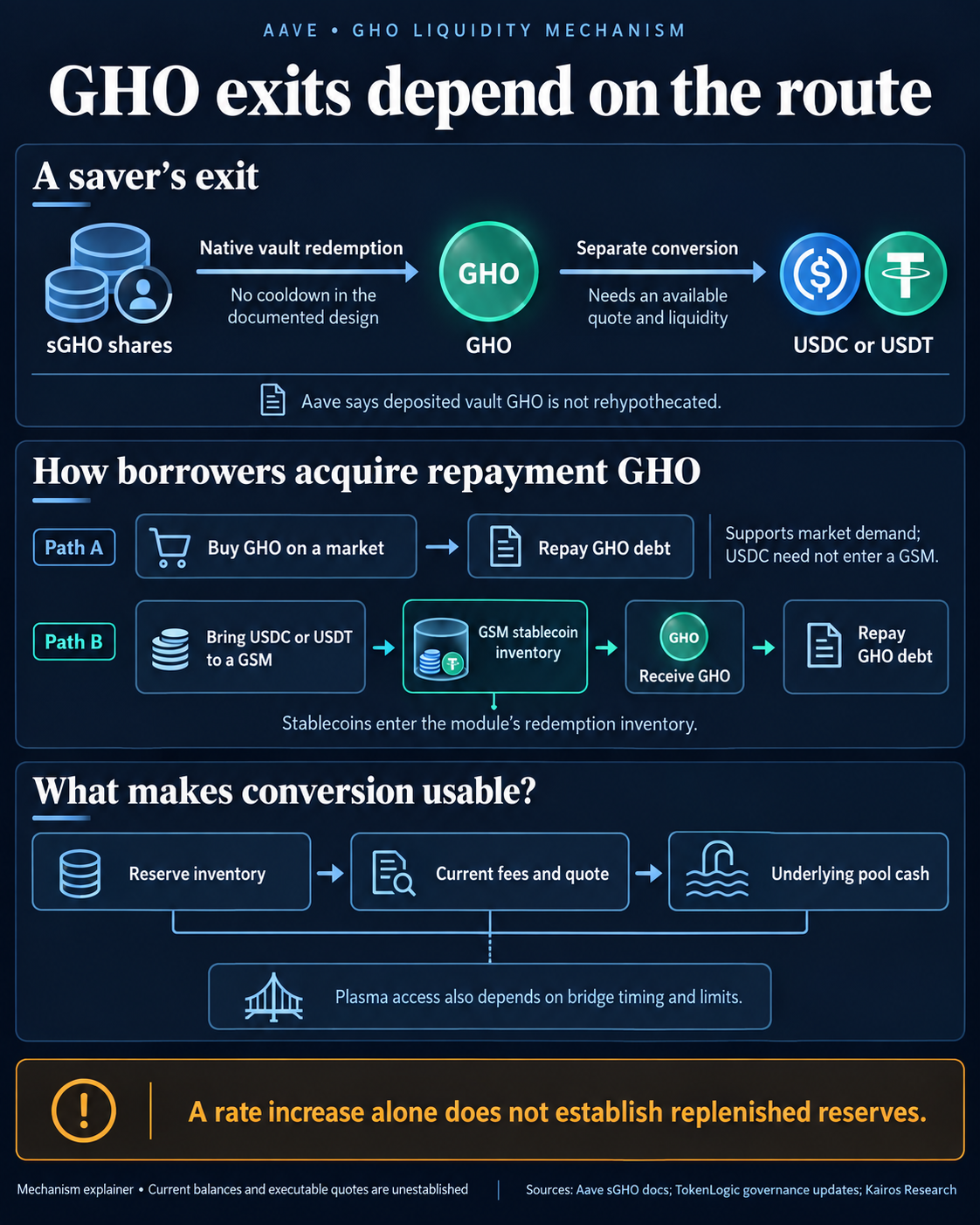
Aave describes its savings token (sGHO) as redeemable instantly into GHO, so a holder who wants USDC needs a separate conversion. A higher borrowing rate can change the incentive to repay, but the route used to acquire that repayment GHO determines whether stablecoins enter the reserves.
The DAO service provider reported a depleted USDC GHO Stability Module (GSM) on Oct. 2, and said the rate increase should help replenish reserves if borrowers obtain repayment GHO through the modules.
The effect on reserves depends on borrowers bringing stablecoins into those modules, and the new rate alone does not demonstrate improved USDC conversion liquidity.
Aavescan’s Core GHO data dated Oct. 5 displays a 4.5% borrow APR. Its daily snapshots show 4.25% at midnight UTC on Oct. 3 and 4.5% at midnight on Oct. 4 and Oct. 5, locating the change between daily readings.
TokenLogic’s Oct. 2 notice proposed moving Core from 4.25% to 4.5%. It said borrowers could previously pay 4.25% to acquire GHO on Core and earn 4.5% in sGHO, leaving the DAO to fund the 25-basis-point difference. At an unchanged savings rate, the new Core rate eliminates that stated gap.
That alignment is specific to Core and the 4.5% savings rate reported on Oct. 2.
TokenLogic proposed a 3% base rate, up from 2.75%, and a 4.25% APR at optimal utilization, up from 4%. Aavescan’s Prime page displayed 4.17% on Oct. 5 at 86.35% utilization, versus 4.22% in its midnight snapshot.
Repayment replenishes reserves only through the right route
TokenLogic describes two ways a borrower needing GHO can acquire it: buy on the secondary market, or exchange USDC or USDT through a GSM.
Buying GHO can support its market price, while bringing stablecoins into a GSM adds the inventory that another GHO holder can later redeem against.
That makes a fall in outstanding debt an incomplete measure of conversion liquidity, since repayment can occur without USDC reaching a module. Improved conversion liquidity requires stablecoins entering the reserve, beyond any change in GHO debt.
Core’s midnight snapshots recorded 116 million GHO borrowed on Oct. 2 and 115.8 million on Oct. 5.
Aave’s native sGHO documentation says users deposit GHO, receive vault shares, and redeem those shares for GHO without a cooldown. It also says deposited funds are not rehypothecated.
Aave also documents a pause state and user-specific withdrawal limits. Those conditions affect live vault availability, separately from the inventory and liquidity needed to exchange the resulting GHO.
The RemoteGSM architecture, described by TokenLogic in March, makes the inventory distinction explicit. Governance-approved facilitators supply preminted GHO to a GhoReserve, and GSMs draw and restore it under assigned limits.
Room to distribute GHO is separate from the stablecoin inventory available for redemption. A higher limit can permit incoming swaps, but users still have to deliver the USDC or USDT.
Aave Labs’ institutional proposal reported 19.2 million USDT on Ethereum and 40.7 million on Plasma as of Sept. 24, totaling 59.9 million USDT. It excluded USDC instances because their redeemable balances were negligible.
TokenLogic’s Oct. 2 update reported approximately 22.5 million USDT in a USDT GSM without labeling the network scope. Comparing that figure with the earlier Ethereum-plus-Plasma total would not establish an aggregate decline. Neither statement supplies matched Oct. 5 balances.
Plasma provides a potential route to USDT inventory beyond Ethereum through Chainlink CCIP. Its usefulness depends on the time needed to bridge GHO and turn the module’s assets into usable stablecoins.
Kairos Research’s September analysis, using Sept. 8 readings, reported 40.6 million in nominal Plasma GSM redemption inventory against 38.6 million in underlying lending-pool cash.
Kairos also estimated at least 9.7 hours of rate-limit time to move 40 million GHO to Plasma under the bridge settings it measured. That assumed a full initial bucket and no competing traffic, and excluded message delivery and subsequent conversion steps.
Fees require the same care. TokenLogic’s September parameter notice proposed 15-basis-point USDC redemption fees on Ethereum, Monad and Arbitrum, a 10-basis-point Ethereum USDT fee and zero mint fees.
Its implementation language does not establish current executed fees. A usable exit depends on the current quote, inventory, and underlying liquidity together.
Institutional funding adds a duration test
Aave Labs seeks a 25-million-GHO facilitator and a separate route borrowing up to $25 million of USDC or USDT against DAO balance sheet assets. The planned initial balance-sheet route would use no GSM conversion inventory, and Aave Labs said on Oct. 1 that the proposal had advanced to Snapshot.
For the GHO route, the proposal prioritizes matched sGHO inflows, then secondary-market liquidity, then GSM reserves. TokenLogic’s Sept. 30 response adds a condition: matched inflows must last at least as long as the borrower’s draw.
That condition connects the rate story to the exit story. A matched inflow can provide lending currency while preserving GSM inventory at conversion, but TokenLogic argues that the funding must persist for the loan’s duration to resolve the liquidity pressure.
The duration condition applies to the proposed funding arrangement, while Aave describes deposited GHO in the native savings vault as held without rehypothecation.
Evidence of success would be stablecoin inventory arriving and remaining available for conversion, with executable routes that account for fees, pool cash, and cross-chain access.
Larger reserves or durable matched inflows could make exits easier. The higher Core APR establishes a change in borrowing cost, while its liquidity benefit depends on where the repayments and new deposits send the money.
Source: CryptoSlate