



FILTERED RESULTS
FILTERS
MCap $2.9T -0.2%24h Vol $44.7B -3.1%Fear & Greed 65/100Alts Index 57/100
BTC.D 59.2% +0.5%Stable.D 9.2% 0%ETH.D 11.4% +0.1%Others.D 20.2% -0.6%
BEAM$0.00265811+25.58%•AKT$0.7992+17.24%•PROS$0.8248+14.97%•RAIN$0.0119+13.7%•AXS$1.342+12.43%•SENT$0.0241+10.92%•RUNE$0.8098+10.52%•DRV$0.4134+9.66%•PUMP$0.00666176+9.58%•IOTA$0.0595+9.44%•
BR$0.4591-20.64%•BTW$1.179-18.64%•STONK$0.1996-14.92%•AI$0.1145-14.87%•SUPER$0.2425-6.62%•PONS$0.3862-6.18%•CARDS$0.2464-5.95%•ZRO$1.967-5.57%•CAP$0.0659-4.62%•GRASS$0.6844-4.46%•
•
·
·
FILTERED RESULTS
Security firm: Revenue Family involved in malicious authorization to steal users' USDG
Trump Taps Jay Clayton, the SEC Chair Who Sued Ripple, to Lead AI Push
What Could Decide Bitcoin’s Q4? The Fed, Bond Yields, and One Crucial Price Level
Tokenized Stocks on Solana Reach $12.4 Billion in Trading Volume in 2026
NEAR Intents Recovers Full $3.8M Stolen in Omni Contract Exploit
Japan Sanctions Garantex as Russia Crypto Crackdown Expands…
Drift Hack Victims Get Their Money Back, 1 Cent at a Time
sunrise ENABLES ACCESS TO $SHIB (Shibtoken) MEMECOIN ON solana LaunchOnSF AND Pumpfun NOW...
Banking Group Sues to Block Crypto's 'Side Door' Into the Banking System
Lido’s proposed staking route needs over 13 times the default entry bond
3x Bitcoin and Ether futures funds clear SEC listing hurdle
Russia Uses Digital Ruble for Salaries After $192,000…
$6 million in wstETH drained from a Base vault controlled by an anonymous 3-of-7 SafeRead...
$6M Vanishes From Crypto Vault Controlled by 7 Mystery Signers
Binance Founder Comments on SAFU Fund's Bitcoin Profit
Base Vault Hack: $6M in wstETH Drained After Attacker Gains Whitelist Access
Billionaire Grant Cardone: Tech giants issued US$66 billion in high-yield debt to seize the AI market; yields will fall if expectations miss
Binance's SAFU Fund Surpasses $1.27 Billion in Bitcoin Holdings
Bybit's weekly platform updates General• ByPicks is live: free picks across crypto, sports and...
'Uptober' Starts Green as Bitcoin ETFs Draw $134 Million
America’s Middle Class Is Getting Crushed: Where Does Bitcoin Fit?
Ethereum's zkAPI Breaks the Link Between AI Prompts and Payers
IMF Releases $138 Million to El Salvador Despite Missed…
Greenfield Files Regulatory Complaint Against Safe Ecosystem Foundation with Swiss Authorities Over Governance Issues
Hyperliquid broker HyperLink completes $2.5 million funding round with participation from Alliance and others
RWA Foundation Reports $6.2 Billion Tokenized Credit Market Amid Holder Growth
‘More Orange Than Ever’: Saylor Stirs Strategy Bitcoin Buy Speculation
CoinW Lists SI Perpetual Contract with Up to 50x Leverage
Strive CEO Indicates Potential Increase in Bitcoin Holdings
Crypto poured years into new products. The next challenge is keeping users
Is Bitcoin’s $85K Consolidation the Calm Before the Storm Amid Rising Middle East Tensions?
The same Fed rate hike can help stablecoins and hurt Bitcoin borrowers
Trump taps intel chief Jay Clayton to lead new Super Intelligence Force
Open Standard's OUSD Stablecoin Sees Rapid Growth of $626.3 Million in First Week
Best Altcoins To Buy And Hold Till 2030: Standard Chartered’s Geoffrey Kendrick Names Top 4
Anchorage Digital Cuts 17% of Staff Months After $4.2B…
*US MARCH NONFARM PAYROLLS RISE 178K M/M; EST. +60K*US MARCH UNEMPLOYMENT RATE 4.3%; EST. 4.4%*US
Open Standard's OUSD Stablecoin Achieves $666.3 Million Market Cap Shortly After Launch
Binance Founder Zhao Changpeng Claims Net Worth Significantly Lower Than Forbes Estimate
Michael Saylor Reveals Bitcoin Tracker Data, Suggesting Increased Holdings
Ostium Rebuilds Its Trading Stack After a Faked Price Drained $23.75M
The Clarity Act stalled. Bankers aren’t hitting the brakes yet on crypto dealmaking
'We Have Identified You, Sir': Near Intents Recovers $3.8 Million After 48-Hour Ultimatum
Up and Onwards – Week In Review
Binance will hold some Brazil crypto deposits until users explain where the money came from
Binance Co-Founder Zhao Changpeng Addresses Controversy Over Merchandise Gift to Reporter
Asia's weekly TOP10 crypto news: Japan Launches New Tax System to Boost Detection of Undeclared...
Top 10 Cryptocurrencies by Weekly Growth — Who Became Market Leader?
Japan adds Garantex to list of Russia sanctions over Ukraine war
Two Bitcoin OGs who bought 1,346 $BTC($115M now) 13 years ago have moved 0.0005 $BTC ($43) after...
In a new feature, The New York Times dispatched a reporter to Abu Dhabi to shadow @cz_binance...
MGX Invests $2 Billion in Binance, Valuing the Cryptocurrency Exchange at $75 Billion
Binance Founder Zhao Changpeng Discusses Time in California Prison
Japan Imposes Sanctions on Garantex, Freezing Assets of Moscow-Based Crypto Exchange
CZ Responds to New York Times Report: Giving Away Merchandise Was Only Promotion, Not Bribery
Data: HYPE, ENA and other tokens to see major unlocks next week, with HYPE unlocking about $339 million
Analyst Explains What Can Trigger DOGE’s Next Double-Digit Surge
Address that sold ETH at $2,709 average price withdraws about $8.85 million in ETH from OKX
Bitget User Protection Fund Replenished to 3,705 BTC Valued at $316 Million
Shallow $ BTC correction this cycle kept Long-term holders in profit. As per...
Andrew Tate Lost $727K on Leverage But Made $7M Just Holding HYPE
Xie Jiayin: Bitget's 19 major assets have a reserve ratio of 131%, user protection fund increased to $316 million
Coinbase CEO: AI agents may outnumber humans in transactions....
Bitcoin address dormant for 13 years makes test transfer, holdings value grows from $240,000 to $115 million
Weekly: Uptober Kicks Off, $766M in Crypto Losses in September, Potential Bitget IPO, and Trump’s Super Intelligence
Account that profited $17 million from NEAR and INJ swaps MU, INTC, and DRAM for CBRS on Hyperliquid
Base Chain Vault Attack Results in Losses of Approximately 6 Million USD
Open USD Launches With $1 Billion in Backing and Chainlink as Its Data Oracle
PUMP Soars 16% in 24 Hours, Bitcoin Reclaims $85K: Weekend Watch
Vitalik-inspired AI payment system can send expired deposits to its treasury


The Ethereum Foundation's Oct. 1 announcement that zkAPI is running on mainnet gives the private AI-payment design coauthored by Davide Crapis and Vitalik Buterin a concrete financial-control test: how does a user get unspent money back when the billing server stops cooperating?
zkAPI, a billing system for metered APIs, documents an onchain withdrawal route that does not require the server's clearance. But a user's ability to recover a balance depends on which spending state they hold and whether they can start an exit in time. The implementation's pause powers and expiring notes put boundaries around that control.
Open Anonymity built the implementation with the Ethereum Foundation. Crapis and Buterin published the underlying design on Feb. 11; the foundation's October announcement credits the team that turned it into software and contracts. Etherscan records the announcement-linked vault's creation on Sept. 30, a day before the announcement.
The announcement describes its linked vault as holding USDC credits. The current mainnet manifest identifies that same vault as native ETH, with balances accounted for in whole gwei. Its explorer activity also shows ETH-valued deposits and close payouts.
CryptoSlate's February coverage examined the proposal. The mainnet implementation now gives withdrawal rights, deadlines and settlement dependencies practical significance.
Two routes out of a prepaid balance
Under the current protocol, a deposit funds a note. The wallet keeps the private spending state locally and uses proofs to authorize metered service. Individual API requests do not each move money onchain. As usage is settled, the server signs a successor state representing the remaining balance. The practical dividing line is between an unused spending state and a predecessor that has already authorized a request: the latter can be challenged if used to seek an escape payout.
That arrangement makes the spending state central to recovery. The vault can check a withdrawal proof against its rules, while the wallet must still possess the information needed to prove the balance it wants to withdraw. Preserving the note and its recovery records is essential to proving a withdrawal balance after an interruption.
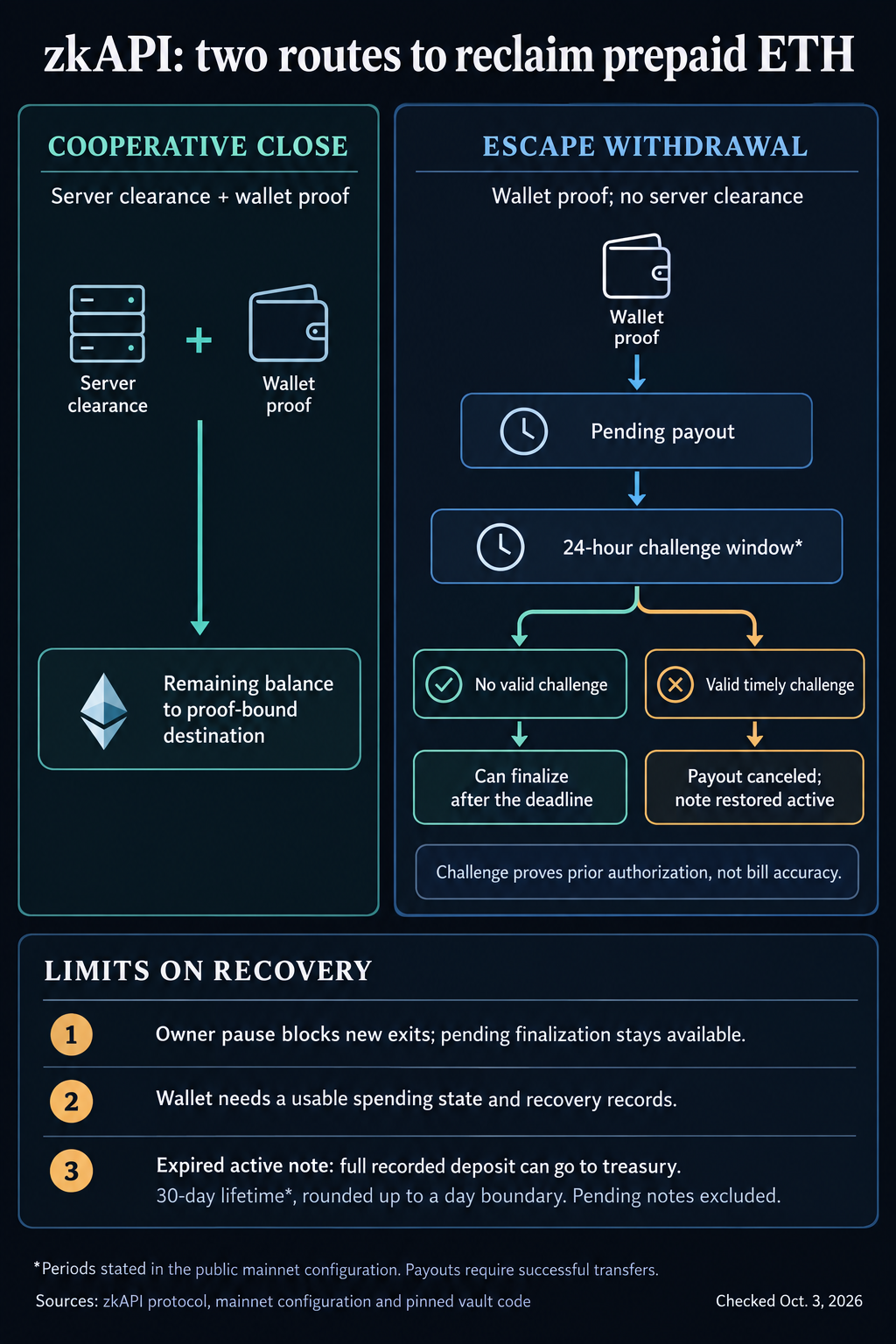
The cooperative route, called mutual close, begins with server clearance. A separate server signing key authorizes the withdrawal, and the wallet includes that signature inside its proof. The vault checks the proof and pays the remaining balance to a destination bound into it. That destination can differ from the address that originally funded the note.
The second route is the escape withdrawal. A wallet can initiate it without the clearance signature. The vault removes the note from the active set and records a pending payout rather than immediately handing over the money.
The public mainnet configuration specifies a challenge period of 86,400 seconds, or 24 hours. If no valid challenge succeeds before the deadline, finalization pays the recorded balance to the user's destination and the deposit-minus-balance share to the treasury, provided the transfers succeed.
A server outage therefore does not automatically eliminate the documented withdrawal path. A user with a usable spending state can seek an exit without obtaining fresh clearance. The waiting period gives the system time to detect an attempt to withdraw from a state that has already authorized service.
Each spending state has a nullifier, a cryptographic identifier used to prevent reuse. To challenge an escape, a challenger supplies an original request proof with the same nullifier as the attempted withdrawal. The proof establishes that the state already authorized usage.
The vault code identified by the mainnet configuration preserves the request's historical active root for that check. A valid challenge submitted before the deadline cancels the pending payout and restores the note to the active set. It does not impose a separate monetary penalty.
The challenge protects settlement against withdrawing from an already-used state. It establishes prior authorization, while the accuracy of the provider's measured bill remains a separate question. Restoring a note also leaves any missing successor signature unresolved.
That difference matters in a dispute. The escape route removes the need for the server's withdrawal clearance, but it does not let a user choose an arbitrary balance and have the contract accept it. If the state being used for an exit already authorized a request, a valid challenge can send the note back into the recovery process.
When usage has already been authorized, provider accounting and a server-signed next state remain part of recovering the remaining balance. A successful challenge reactivates the note without resolving the contested bill or guaranteeing a refund.
Pause powers, expiry and the value of the balance
That vault code gives the owner a pause switch. Deposits, mutual close and initiation of new escape withdrawals all check it. An exit that needs no server clearance can still be prevented from starting while the vault is paused.
Already-pending escape finalization does not have that pause gate. Neither do challenges or expiry claims. A user who has successfully initiated an escape is therefore in a different position from one who still needs to start it.
The code provides these powers; no use of the pause switch is established here. For a user seeking a refund during an interruption, the owner's pause control remains an availability dependency.
Expiry creates another deadline. The mainnet manifest specifies a 30-day note lifetime, but the vault code rounds deposit time plus that lifetime upward to a one-day boundary. A note's actual expiry can therefore fall later than exactly 30 elapsed days.
Once an active note expires, the code permits it to be closed through an expiry claim that sends its full recorded deposit to the treasury. That rule is different from a normal withdrawal, where the proved remaining balance goes to the user. A note already in pending withdrawal status does not qualify for the active-note expiry claim.
For funds still in an active note, prepaid cloud AI creates a time-limited claim. State recovery and timely close-out affect whether the user reaches the withdrawal path before the note becomes eligible for the treasury claim.
ETH denomination also affects what the user owns between sessions. According to the native billing documentation, the deposit is neither a stable-dollar balance nor a swap into USDC. Its dollar reference value changes with ETH's price.
Dollar-denominated inference is charged through a price quote. The browser and server verify a pinned Chainlink ETH/USD round in finalized chain state, bind that quote into the authorization and keep the accepted rate fixed through settlement and recovery. Measured dollar usage is converted into a capped charge in whole gwei, rounded upward.
Freezing an accepted quote prevents a restart or recovery attempt from repricing that existing authorization. It does not stabilize the dollar value of the user's remaining ETH. For someone prepaying for cloud inference, the service bill and the underlying balance have different denominations.
The trust that remains
The mainnet manifest selects OA-org key issuance with OpenRouter inference. Provider usage receipts and the billing server's signed successor states remain operational parts of settlement. Ethereum supplies the exit mechanism, while a trustworthy chain view, compatible proof software, retained wallet data and timely challenger operation remain necessary dependencies.
The cryptographic setup carries a separate assumption. The manifest points to the note-bound Groth16 circuit and setup artifacts described in the repository. The setup documentation says the keys were generated by one party and no multiparty ceremony has taken place. Matching artifact hashes establishes which files are being used, while the destruction of setup secrets remains a separate trust assumption.
The manifest describes the integration as experimental and not production-audited. Those disclosures limit the assurance attached to the implementation. Mainnet availability alone does not demonstrate that every live recovery scenario will work.
The inference provider still sees prompt content, and network metadata can permit correlation. Billing privacy leaves those content and network questions separate from withdrawal rights.
For prepaid AI funds, control ultimately rests on completing an exit from a usable balance before the active note expires. The escape route gives users an alternative to server clearance; its practical value depends on state recovery and the availability of the vault when they need it.
Source: CryptoSlate