



FILTERED RESULTS
FILTERS
MCap $3T +1.7%24h Vol $106.4B +9.4%Fear & Greed 72/100Alts Index 47/100
BTC.D 58.8% +0.1%Stable.D 9.0% -0.1%ETH.D 11.3% -0.1%Others.D 20.9% +0.1%
BP$1.487+23.22%•BTW$1.422+22.6%•SUPER$0.2323+13.2%•AAVE$186.59+12.54%•PURR$0.1621+10.81%•JASMY$0.00567849+9.59%•ZRO$1.879+9.51%•HUMA$0.0330+8.25%•SKY$0.0850+8.16%•CVX$2.346+7.53%•
STONK$0.2313-20.63%•AI$0.1487-17.91%•QNT$253.78-12.94%•ENA$0.2472-8.75%•MARSCOIN$0.1279-8.7%•PLUME$0.0190-8.69%•NEAR$5.021-7.87%•TIBBIR$0.2716-7.85%•KMNO$0.0419-5.97%•牛来$0.1004-5.74%•
•
·
·
FILTERED RESULTS
South Korea advances tokenized securities rules ahead of 2027 rollout
XRP Outflows Spike Above 320M, Echoing August Rally Setup
Zano exploiter created 36.9M unauthorized ZANO before blockchain rollback
Upbit to List POD Trading Pairs Against KRW, BTC and USDT South Korea’s largest crypto exchange,...
Core Lightning Issues Urgent Security Warning for Bitcoin Node Operators
UPBIT Introduces Dolphin (POD) Cryptocurrency with Multiple Trading Options
SlowMist: Aave v3 Loop Safe Module Exploited, Approximately 114.09 ETH StolenSlowMist issued a...
$POD listed on Upbit spot (KRW)・
Researchers link a $459,000 Tradewiz wallet drain on Solana to a previously active customer...
Upbit to list POD token on KRW, BTC, and USDT markets
IMF approved a $138 million disbursement to El Salvador under its $1.4 billion
The $459,000 Bot Hacker Was a Customer First, Researchers Say
Kinetiq Ends kPoints, Switches to Paid Claims; KNTQ Drops 23%
Trump: U.S. Government May Consider Taking Stakes in OpenAI and Anthropic
Core Lightning warns attackers are targeting unpatched Bitcoin nodes
Kinetiq Concludes kPoints Program Amid Decline in KNTQ Value
Robinhood is still working through SEC's innovation exemption for tokenized stocks,
U.S. Government May Explore Investment in AI Firms OpenAI and Anthropic
Tom Lee: ETH Could Be Much Higher Than $10,000 in the Next 12 MonthsAt Korea Blockchain Week on...
649 $BTC (55,613,987 USD) transferred from unknown wallet to #Binance...
US SOL spot ETFs see single-day total net outflow of $5.9079 million
Ethereum spot ETFs saw a total net outflow of $55.3727 million yesterday, marking 3 consecutive days of net outflows
Spot Bitcoin ETFs recorded $2.65 billion in net inflows in September,ir
Bitcoin spot ETFs saw total net inflow of $103 million yesterday, with BlackRock's IBIT leading at $196 million
Crypto Market Sees $102 Million in Liquidations, Short Sellers Hit Hardest
Ethereum’s zkAPI brings privacy-preserving API payments to mainnet
US Treasury Sanctions Russian Shadow Banking Network A7 Network Over $17 Billion in Fund...
Bitfinex Lists 17 Macro Catalysts That Could Move Bitcoin in October
Bithumb to Introduce US Korean Won Trading Pair
Security Vulnerability in Aave V3 Loop Safe Module Leads to Theft of 114.09 ETH
NEW: SlowMist flagged that a Safe module used for Aave v3 loops was exploited for roughly 114.09
250,000,000 $USDC (249,990,000 USD) minted at USDC Treasury...
Porsche Closes Web3 Project Initiated in 2023
$US listed on Bithumb spot・
250,000,000 $USDC (250,004,999 USD) minted at USDC Treasury...
Bitwise and Franklin Templeton Clients Invest $7.24 Million in XRP
Maven 11 Capital bought back 40,000 HYPE today after selling 115,000 a week ago
IMF Approves $139 Million for El Salvador After Waiver for Bitcoin BreachAccording to Bloomberg,...
Bitget restores $300M fund after absorbing $388M security breach
Maven 11 sold 115,000 $HYPE ($10.79M) at an average price of $93.84 a week ago.As $HYPE dropped,...
NEAR Intents Identifies Hacker and Demands Return of Stolen Funds
SEC proposes new rules allowing investment advisers and regulated funds to self-custody...
NEAR Intents says it has identified the hacker, issues 48-hour ultimatum to return funds
With unrealized profit of $1.15 million, a whale bought 654,300 UNI over the past month
New NEAR community proposal aims to cut token issuance rate from 2.5% to 1.6% within 24 months
DogeOS Opens Public Testnet, Bringing EVM Apps to Dogecoin
SEC Proposes Letting Advisers and Funds Self-Custody Crypto Assets
NEAR Protocol Proposes Changes to Token Issuance and Staking Yield
MANTRA Chain Launches Governance Vote for Community Funding Initiatives
Whale 0xf7AD bought 654,288 $UNI ($4.69M) through Flowdesk at an average price of $7.17 over the...
Payments Giant Fiserv Launches Digital Asset Platform, With Bank of North Dakota’s Roughrider Coin...
NEAR Intents Issues Ultimatum to Attacker Following $3.8 Million Exploit
Arkham Intelligence Reports on Bitcoin Holdings of Strategy Company
Arkham Says It Tracks 78% of Strategy’s 847,666 Bitcoin Holdings
Institution Liquidates DeFi Investments, Faces $9.61 Million Loss
Uniswap's Robinhood Chain Deployment Accounts for 53% of Its September Revenue
110,000,000 $USDT (109,974,150 USD) transferred from Tether Treasury to #Bitfinex...
Coinbase Report: BTC Profit-Taking Hits Yearly High, Demand Cools
SEC moves to clear custody hurdle for advisers offering crypto
Payment Giant Fiserv Launches Digital Asset Platform, Introduces Roughrider Coin for North Dakota Banks
Bitkub Launches Support for Tether's USDT on Aptos Network in Thailand
Wyoming and NYDFS Sign Memorandum of Understanding on Digital Asset Regulatory Cooperation
Crypto hackers have taken $2.7 billion in 2026 and the losses are alarmingly concentrated
110,000,000 $USDT (109,978,495 USD) transferred from #Bitfinex to Tether Treasury...
IMF Demands 4 Major Bitcoin Reforms for El Salvador to Unlock $1.4B Loan
VanEck ETF wallet sells roughly $10.76 million in assets via Gemini, including BTC and ETH
RWA Foundation Reports Tracking Over 10,000 Tokenized Real-World Assets
Glassnode: Bitcoin's $85,000 sell wall has been absorbed by buying
XRP Sentiment Turns Bearish as Bullish-to-Bearish Ratio Hits 0.67
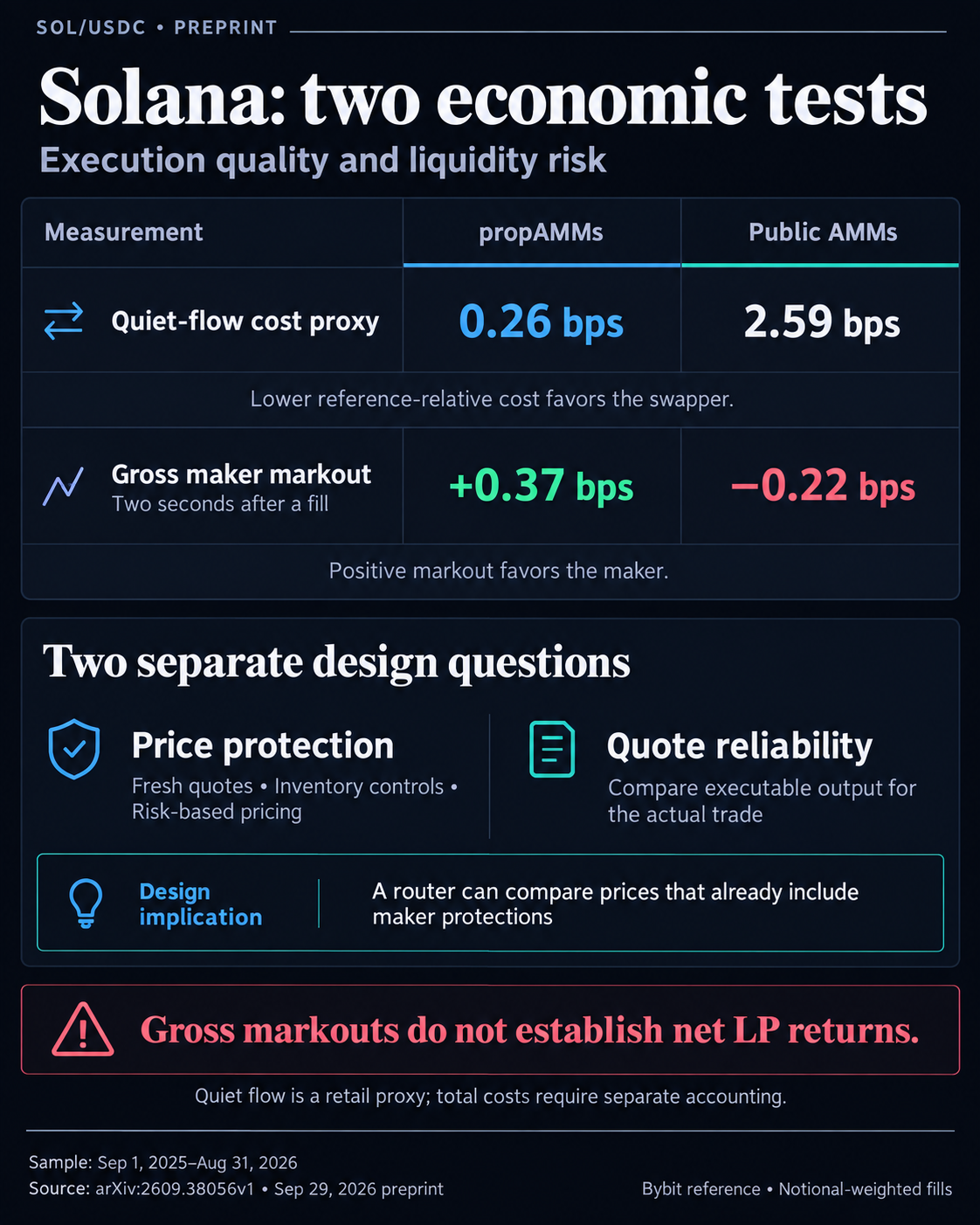
PropAMMs lower Solana trade costs, and public pool returns crash


A trader can get a better Solana (SOL) swap price while a passive pool depositor remains exposed to traders picking off stale quotes, and a Sept. 29 preprint measures that divide.
For quiet-market SOL/USDC fills, propAMMs, pools controlled by professional operators, had a reference-relative execution cost proxy of 0.26 basis points versus 2.59 for public automated market makers (AMMs).
The study covers Sept. 1, 2025, through Aug. 31, 2026, with shorter Base and Monad samples. It weights fills by notional against Bybit's size-weighted top-of-book USDT microprice, converted with its USDC/USDT midpoint. Its authors list ETH Zurich and Category Labs affiliations.
A swapper wants more tokens for the same input, while a depositor supplies the inventory others trade against and needs compensation for the risks that inventory carries. Low execution cost can attract the first participant without being a sufficient investment case for the second.
Swap prices and depositor returns on Solana
Across its Solana sample, the paper reports two-second gross maker markouts of +0.37 basis points for propAMMs and −0.22 for public AMMs. A markout compares a fill with a later reference price, and a positive number favors the maker.
Quiet-flow execution asks how much a trader gives up against a relatively stable reference. The proxy requires less than 1 basis point of reference movement from five seconds before to one second after a fill.
Maker markouts ask what happens to a trade's value after the pool accepts it. Mixing the measures would turn evidence about pricing and adverse selection into a profitability claim the numbers cannot support.
When an outside market moves first, a pool still offering an old price can sell too cheaply or buy too dearly. An arbitrageur brings the prices back into line, but the correction comes through a trade against the liquidity already sitting in the pool.
Loss-versus-rebalancing research treats that arbitrage cost as one component of LP economics. Returns also reflect asset exposure and fees earned, so an investment assessment needs a position, a holding period, and the income and costs attributable to it.
Trading fees need to be allocated correctly, while inventory changes, hedging, operating expenses and transaction costs also matter when applicable. The short horizon leaves that accounting unresolved, and venue averages cannot establish that professional pools caused aggregate passive-LP losses.
Depositors need a return assessment that includes this wider balance sheet, and swappers can benefit from liquidity whose operator actively manages pricing risk.
Jump Crypto's April account describes propAMMs, including its own BisonFi, adapting prices and available liquidity to inventory, quote freshness, and the quality of incoming flow. Jump is an interested operator, and implementations differ.
A maker holding too much of an asset can discourage trades that add more of it, while a stale price can justify withdrawing depth or widening a fee. A routing path associated with adverse selection can receive different terms from flow the maker considers less risky.
Economically, those controls can allow a maker to quote more tightly when it expects less risk. Requiring every counterparty to receive identical terms would remove one way of distinguishing that risk. The price an ordinary swapper ultimately receives would still need to be measured.
Jupiter's AMM integration documentation shows that a dedicated signer identifies trades originating at its frontend, describing that flow as retail and non-toxic. However, identifying origin is different from independently establishing that every trade is harmless to the maker.
Private market-making logic can sit behind public settlement. The ability to defend a price may help a firm offer cheaper liquidity, while access to that price depends on the actual route and counterparty.
Quote reliability is a separate test
For Tessera on Base, execution averaged 1.08 basis points worse by trade and 0.56 by volume than reconstructed previous-block-end quotes. Researchers call the block-timed fee pattern “spoofing.”
The researchers compare reconstructed pool output with execution, leaving individual screen quotes outside the measure. The observed pattern provides no direct evidence of operator intent. Better execution relative to a market reference and worse execution relative to an earlier quote can coexist.
In a March 20 report, routing provider 0x described Base prices deteriorating between quote selection and settlement through block timing and spread changes. Its operators were unnamed, so that report cannot identify Tessera as the subject. 0x also stated a policy of cutting off sources until execution issues are remedied.
If an advertised output attracts the order but a different output is delivered, competition on the advertised number can reward the wrong venue. The question becomes whether routers compare what a trader can receive under the conditions of that transaction.
Jump argued that routers selecting executable prices when transactions run can largely close the display-to-fill gap. The useful design implication is that a maker could retain inventory, freshness, and counterparty protections, provided the router compares outputs that already include them.
Jupiter's current Swap API overview describes competition between routing engines and a mechanism that sidelines underperforming sources. Its integration guide also requires quote/execution parity tests against the same pool snapshot.
A parity check measures agreement on one snapshot, but persistence through later updates is a separate question. Competition between engines also leaves open whether each venue is reconsidered within an executing transaction.
Comparing executable output offers a design direction, but its effectiveness would need to be measured.
For a meaningful comparison, the executable output must reflect the same trade size, caller, current pool state, and applicable charges. Otherwise, a price available to one routing path can be mistaken for a price available to another.
Jupiter documents a platform swap fee on its Meta-Aggregator path and none on its Router path, while integrator fees and landing arrangements can differ. A protocol-level spread cannot stand in for the amount ultimately received after all applicable charges.
The next useful evidence would compare quoted and delivered output on matched transactions, explain which costs are included, and show how routing treats persistently underperforming sources.
For passive liquidity, a separate position-level return assessment is needed. Better routing can improve the swapper's decision while leaving the depositor's investment question open.
Source: CryptoSlate