



FILTERED RESULTS
FILTERS
MCap $2.9T -0.2%24h Vol $97B -0.2%Fear & Greed 72/100Alts Index 49/100
BTC.D 58.7% 0%Stable.D 9.2% +0.1%ETH.D 11.4% 0%Others.D 20.7% -0.1%
BP$1.487+23.22%•BTW$1.422+22.6%•SUPER$0.2307+15.26%•JASMY$0.00564654+11.1%•AAVE$175.34+8.77%•ZRO$1.845+8.7%•HUMA$0.0330+8.25%•VELO$0.00582963+7.51%•DRV$0.4076+7.31%•AR$4.332+7.12%•
STONK$0.2313-20.63%•AI$0.1487-17.91%•SOON$0.4127-16.95%•QNT$257.81-11.88%•ZBCN$0.00259317-8.52%•ENA$0.2430-8.27%•TIBBIR$0.2716-7.85%•ETHFI$0.7288-6.64%•MARSCOIN$0.1273-6.55%•PLUME$0.0186-6.33%•
•
·
·
FILTERED RESULTS
MANTRA Chain Launches Governance Vote for Community Funding Initiatives
Whale 0xf7AD bought 654,288 $UNI ($4.69M) through Flowdesk at an average price of $7.17 over the...
Payments Giant Fiserv Launches Digital Asset Platform, With Bank of North Dakota’s Roughrider Coin...
NEAR Intents Issues Ultimatum to Attacker Following $3.8 Million Exploit
Arkham Intelligence Reports on Bitcoin Holdings of Strategy Company
Arkham Says It Tracks 78% of Strategy’s 847,666 Bitcoin Holdings
Institution Liquidates DeFi Investments, Faces $9.61 Million Loss
Uniswap's Robinhood Chain Deployment Accounts for 53% of Its September Revenue
110,000,000 $USDT (109,974,150 USD) transferred from Tether Treasury to #Bitfinex...
Coinbase Report: BTC Profit-Taking Hits Yearly High, Demand Cools
SEC moves to clear custody hurdle for advisers offering crypto
Payment Giant Fiserv Launches Digital Asset Platform, Introduces Roughrider Coin for North Dakota Banks
Bitkub Launches Support for Tether's USDT on Aptos Network in Thailand
Wyoming and NYDFS Sign Memorandum of Understanding on Digital Asset Regulatory Cooperation
110,000,000 $USDT (109,978,495 USD) transferred from #Bitfinex to Tether Treasury...
IMF Demands 4 Major Bitcoin Reforms for El Salvador to Unlock $1.4B Loan
VanEck ETF wallet sells roughly $10.76 million in assets via Gemini, including BTC and ETH
RWA Foundation Reports Tracking Over 10,000 Tokenized Real-World Assets
Glassnode: Bitcoin's $85,000 sell wall has been absorbed by buying
XRP Sentiment Turns Bearish as Bullish-to-Bearish Ratio Hits 0.67
Galaxy: 69.2% of "retail" accounts on Polymarket's international platform lost money, with cumulative losses of $338.9 million
Castle Labs: On-chain perpetual DEX trading volume share rises to 12.33%
Bloomberg: Anthropic to Launch IPO as Early as Mid-November, Valuation Could Reach $1.8 Trillion to $2 Trillion
IIF: Global Debt Rises to $365 Trillion, Stablecoins Become New Buyers of US Treasuries
Bitcoin Sell Wall at $85,000 Absorbed by Buy Orders, Says Glassnode
35,000,000 $XRP (52,425,783 USD) transferred from #Ripple to unknown wallet...
Variant Fund Investment Partner: Crypto Market Bottom Likely Appeared in July; Three Asset Categories to Benefit from Market Recovery
142,100,000 $USDC (142,088,632 USD) transferred from Unknown Whale 1 to #Aave...
Osmosis Proposes Destruction of 17.4 Million OSMO Tokens
After 15.4 Years of Dormancy, an Address Moves 20.43 BTC Worth $1.7 Million
An address has accumulated 12,134.13 ETH worth $32.41 million and deposited it into Aave
Arthur Hayes: Hyperliquid Still Leads Perp DEXs, but Risk-Reward Has Changed Flop Labs CEO Arthur...
KLEA Crypto Daily: Thursday, October 01, 2026
Trump to Attend Third Dinner for Meme Coin TRUMP, Event Scheduled for November 22
IMF approves $139 million disbursement to El Salvador, grants waiver over breach of bitcoin accumulation limits
Fed mouthpiece: Fed Vice Chair hints more time may be needed before another rate hike
Crypto Fear and Greed Index Index Value : 72 Sentiment : Greed BTC Price : $84879 ...
Arbitrum: September revenue exceeded $5 million, setting a historical record
Tokenized Real-World Assets Reach $46.2 Billion Across 36 Blockchains
Ethereum Foundation Launches zkAPI for Privacy Payments
142,100,000 $USDC (142,084,653 USD) transferred from #Aave to Unknown Whale 1...
Evernorth Won Shareholder Vote, Putting 473 Million XRP Near Nasdaq
Bitwise NEAR ETF Attracts $9 Million in Inflows on Third Day of Trading
Bitcoin Core Dev Peter Todd to Oversee MARA’s Private Mempool Service
Report: Binance Under EU Review Over Continued Operations After MiCA Miss
US factory costs spike, threatening Bitcoin’s rally above $85,000
SEC proposes new rules allowing investment advisers and regulated funds...
Microsoft Denies Connection to Unauthorized Clippy-Themed Token
Prediction Markets Hit $68B in a Month as Sportsbook Stocks Sink
SEC Proposes New Crypto Custody Rules to Expand Investor Choice
Altcoins Could Fall 30% to 50% if Bitcoin Dominance Keeps Rising, Warns Analyst
Trump Memecoin Investors Set for Third White House-Linked…
Wall Street arrived in NEAR just as a $4 billion-a-month app got hacked
New York, Wyoming Crypto Deal Targets 6-Month Licensing Fast Track
1,035 $BTC (87,510,970 USD) transferred from unknown wallet to #Kraken...
Zcash Drops 21% From Recent High—Here’s Why the Rally May Not Be Over
SEC Proposes New Self-Custody Guidelines for Investment Advisers Handling Cryptocurrency
SEC Allows Limited Crypto Self-Custody Under Proposed…
NEAR Governance Proposal Targets Lower Token Issuance and Dilution
Metamask Pulls Validators as Meager ETH Theft Sounds Big Alarm
Trump to host 3rd ‘exclusive’ memecoin event amid corruption claims
Ethereum Foundation launched zkAPI on mainnet, based on a design co-authored by
End of Crypto’s Speculative Era Is Greatly Exaggerated Again
Cardano (ADA) Ends September With Massive Gains: But Major Bearish Signals Are Flashing
SEC Proposes Tailored Crypto Custody Rules for Advisers and Funds
XRP is becoming collateral for real loans and the first market is already dominated by whales
Porsche Ends Web3 Project, Retains NFT Ownership for 911 Token Holders
SEC Proposes Rules to Clear Up How Advisers and Funds Can Hold Crypto
Galaxy Finds 69% of Polymarket Retail Accounts Lost Money
Crypto hackers have taken $2.7 billion in 2026 and the losses are alarmingly concentrated


Crypto firms and users have lost nearly $2.7 billion to security incidents this year, with North Korea-linked thefts exceeding $1 billion.
Blockchain security firm CertiK recorded 658 incidents through September, with about $420.4 million of stolen assets frozen or returned. That leaves adjusted losses of roughly $2.26 billion and an average loss of $4.1 million per incident.
September sharply altered the year's tally. Losses reached about $766.5 million, surpassing April's $651.3 million and making it the costliest month of 2026. Bitget's $387.5 million breach and the $318.7 million Liquid Network incident accounted for more than $700 million of the damage.
The surge has left the annual total increasingly dependent on a small number of outsized attacks. It has also brought state-linked theft deeper into the industry's security calculations after blockchain analytics firm Elliptic said suspected North Korean hackers have taken more than $1 billion in crypto this year.
Mega-hacks are reshaping the annual toll
September propelled Bitget and Liquid Network to the top of CertiK's 2026 incident ranking, widening the gap between the largest breaches and hundreds of smaller attacks.
Bitget alone represents about 14.4% of CertiK's year-to-date losses. Liquid Network ranks second, followed by KelpDAO at $291.3 million, Drift Protocol at $285.3 million, and an unidentified victim at $284.8 million.
Those five incidents account for about $1.57 billion, or almost 59% of the $2.68 billion recorded so far this year.
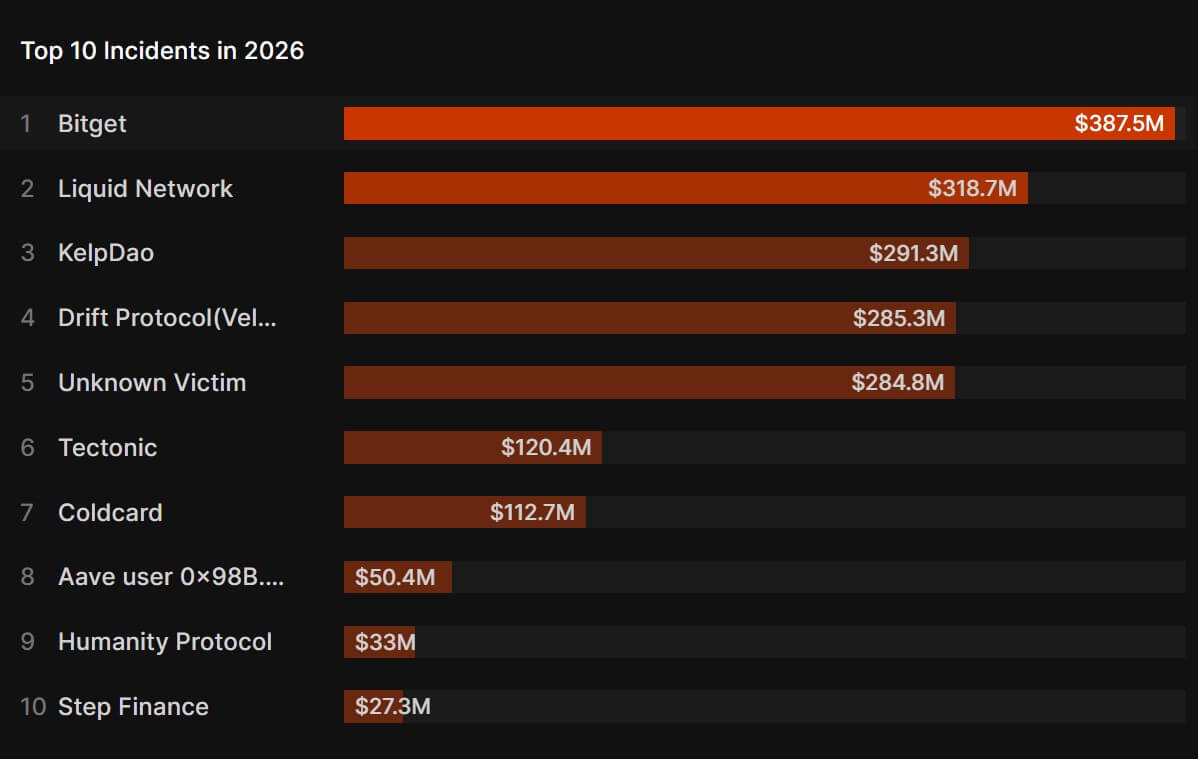
That concentration means a single compromise at a large exchange, protocol, or infrastructure provider can materially change the industry's annual loss profile. For context, Bitget and Liquid Network together contributed roughly $706 million, equivalent to more than a quarter of all gross security losses tracked by CertiK in 2026.
September's figures further illustrate the imbalance. Beyond those two attacks, the month's remaining incidents contributed only a fraction of its $766.5 million total.
Meanwhile, some of the damage from these attacks has since been reversed. CertiK counts $420.4 million of assets as frozen or returned this year, reducing its adjusted loss figure to $2.26 billion. Liquid Network recovered a large portion of the assets involved in its incident, while other attacks have also resulted in partial or full returns.
So, the gap between gross and adjusted losses has widened as exchanges, issuers, security firms and blockchain operators move faster to identify and restrict stolen funds.
However, that recovery capacity does not eliminate the immediate cost to affected businesses. Large breaches can force operators to suspend services, replenish customer balances, rebuild infrastructure and commit capital before stolen assets are recovered.
Meanwhile, the attacks are also spreading across different parts of the crypto market. CertiK's annual data show incidents involving multiple blockchains have generated the greatest dollar losses, while Ethereum has recorded the largest number of security events.
The threat has extended beyond software. CertiK recorded 52 so-called wrench attacks during the first half of 2026, up from 39 in the same period last year. Exposure from those physical attacks climbed to $124.2 million from $10.5 million, while the average amount involved increased to about $2.4 million from roughly $270,000.
North Korea’s crypto theft machine crosses $1 billion in 2026
The growing size of individual breaches has amplified the impact of one of crypto’s most persistent adversaries.
Elliptic said the Bitget incident pushed the value stolen in attacks it attributes to North Korea above $1 billion in 2026, spanning more than 51 suspected incidents. The blockchain analytics firm assessed the Bitget breach as highly likely to be linked to the Democratic People’s Republic of Korea, citing laundering behavior, infrastructure shared with earlier attacks and other indicators.
Measured against CertiK’s $2.68 billion industrywide gross-loss figure, Elliptic’s North Korea tally equals more than 37% of security losses recorded this year.
Elliptic previously linked the roughly $286 million Drift Protocol exploit to North Korean actors. Drift is also among CertiK’s five largest incidents of 2026, putting suspected DPRK operations behind more than one of the year’s biggest crypto thefts.
The concentration extends a campaign that has generated billions of dollars for North Korea over the past decade.
Elliptic estimated last year that DPRK-linked hackers had stolen more than $6 billion in crypto since 2017, with governments and international organizations saying the proceeds help finance the country’s nuclear weapons and ballistic-missile programs.
North Korean hacking groups initially built a reputation by attacking banks and conventional financial infrastructure before increasingly targeting cryptocurrency businesses, where large pools of transferable assets can move across borders without relying on the traditional banking system.
The US Treasury designated Lazarus Group and related groups in 2019, describing them as state-sponsored operations controlled by North Korea’s Reconnaissance General Bureau.
Some of crypto’s largest historical breaches have since been attributed to the country. US authorities tied Lazarus to the roughly $620 million Ronin Bridge theft in 2022, while Treasury said the group used crypto mixers to launder proceeds from the $100 million Atomic Wallet attack and other hacks.
The escalation peaked in February 2025 when attackers stole about $1.46 billion from Bybit, the largest confirmed crypto theft on record. The FBI formally attributed that breach to North Korea, while Elliptic tracked the subsequent movement of funds through thousands of addresses, cross-chain services and laundering platforms.
Those laundering techniques have become more elaborate as exchanges, stablecoin issuers and blockchain analytics firms improve their ability to freeze and trace stolen assets. Elliptic said North Korean operators increasingly use repeated cross-chain transfers, mixers and less-monitored networks to break the transaction trail.
That leaves North Korea as one of the biggest variables in crypto’s 2026 security bill as the state-backed actors increasingly threaten the emerging industry.
Source: CryptoSlate