



FILTERED RESULTS
FILTERS
MCap $2.9T -0.3%24h Vol $45B -2.4%Fear & Greed 65/100Alts Index 55/100
BTC.D 59.3% +0.6%Stable.D 9.2% 0%ETH.D 11.4% +0.1%Others.D 20.1% -0.7%
BEAM$0.00261602+24.42%•AKT$0.7896+17.2%•PROS$0.8248+14.97%•STRK$0.0559+14.85%•RAIN$0.0119+13.7%•SENT$0.0246+13.12%•AXS$1.346+12.53%•PUMP$0.00670469+11.42%•BAT$0.1059+11.21%•RUNE$0.8101+10.36%•
BR$0.4591-20.64%•BTW$1.179-18.64%•STONK$0.1996-14.92%•AI$0.1145-14.87%•SUPER$0.2422-7.54%•PONS$0.3838-6.01%•CARDS$0.2464-5.95%•GRASS$0.6903-5.95%•ZRO$1.978-5.24%•CAP$0.0655-5.06%•
•
·
·
FILTERED RESULTS
Japan Sanctions Garantex as Russia Crypto Crackdown Expands…
Drift Hack Victims Get Their Money Back, 1 Cent at a Time
sunrise ENABLES ACCESS TO $SHIB (Shibtoken) MEMECOIN ON solana LaunchOnSF AND Pumpfun NOW...
Banking Group Sues to Block Crypto's 'Side Door' Into the Banking System
3x Bitcoin and Ether futures funds clear SEC listing hurdle
Russia Uses Digital Ruble for Salaries After $192,000…
$6 million in wstETH drained from a Base vault controlled by an anonymous 3-of-7 SafeRead...
$6M Vanishes From Crypto Vault Controlled by 7 Mystery Signers
Binance Founder Comments on SAFU Fund's Bitcoin Profit
Base Vault Hack: $6M in wstETH Drained After Attacker Gains Whitelist Access
Billionaire Grant Cardone: Tech giants issued US$66 billion in high-yield debt to seize the AI market; yields will fall if expectations miss
Binance's SAFU Fund Surpasses $1.27 Billion in Bitcoin Holdings
Bybit's weekly platform updates General• ByPicks is live: free picks across crypto, sports and...
'Uptober' Starts Green as Bitcoin ETFs Draw $134 Million
America’s Middle Class Is Getting Crushed: Where Does Bitcoin Fit?
Ethereum's zkAPI Breaks the Link Between AI Prompts and Payers
IMF Releases $138 Million to El Salvador Despite Missed…
Greenfield Files Regulatory Complaint Against Safe Ecosystem Foundation with Swiss Authorities Over Governance Issues
Hyperliquid broker HyperLink completes $2.5 million funding round with participation from Alliance and others
RWA Foundation Reports $6.2 Billion Tokenized Credit Market Amid Holder Growth
‘More Orange Than Ever’: Saylor Stirs Strategy Bitcoin Buy Speculation
CoinW Lists SI Perpetual Contract with Up to 50x Leverage
Strive CEO Indicates Potential Increase in Bitcoin Holdings
Crypto poured years into new products. The next challenge is keeping users
Is Bitcoin’s $85K Consolidation the Calm Before the Storm Amid Rising Middle East Tensions?
The same Fed rate hike can help stablecoins and hurt Bitcoin borrowers
Trump taps intel chief Jay Clayton to lead new Super Intelligence Force
Open Standard's OUSD Stablecoin Sees Rapid Growth of $626.3 Million in First Week
Best Altcoins To Buy And Hold Till 2030: Standard Chartered’s Geoffrey Kendrick Names Top 4
Anchorage Digital Cuts 17% of Staff Months After $4.2B…
*US MARCH NONFARM PAYROLLS RISE 178K M/M; EST. +60K*US MARCH UNEMPLOYMENT RATE 4.3%; EST. 4.4%*US
Open Standard's OUSD Stablecoin Achieves $666.3 Million Market Cap Shortly After Launch
Binance Founder Zhao Changpeng Claims Net Worth Significantly Lower Than Forbes Estimate
Michael Saylor Reveals Bitcoin Tracker Data, Suggesting Increased Holdings
Ostium Rebuilds Its Trading Stack After a Faked Price Drained $23.75M
The Clarity Act stalled. Bankers aren’t hitting the brakes yet on crypto dealmaking
'We Have Identified You, Sir': Near Intents Recovers $3.8 Million After 48-Hour Ultimatum
Up and Onwards – Week In Review
Binance will hold some Brazil crypto deposits until users explain where the money came from
Binance Co-Founder Zhao Changpeng Addresses Controversy Over Merchandise Gift to Reporter
Asia's weekly TOP10 crypto news: Japan Launches New Tax System to Boost Detection of Undeclared...
Top 10 Cryptocurrencies by Weekly Growth — Who Became Market Leader?
Japan adds Garantex to list of Russia sanctions over Ukraine war
Two Bitcoin OGs who bought 1,346 $BTC($115M now) 13 years ago have moved 0.0005 $BTC ($43) after...
In a new feature, The New York Times dispatched a reporter to Abu Dhabi to shadow @cz_binance...
MGX Invests $2 Billion in Binance, Valuing the Cryptocurrency Exchange at $75 Billion
Binance Founder Zhao Changpeng Discusses Time in California Prison
Japan Imposes Sanctions on Garantex, Freezing Assets of Moscow-Based Crypto Exchange
CZ Responds to New York Times Report: Giving Away Merchandise Was Only Promotion, Not Bribery
Data: HYPE, ENA and other tokens to see major unlocks next week, with HYPE unlocking about $339 million
Analyst Explains What Can Trigger DOGE’s Next Double-Digit Surge
Address that sold ETH at $2,709 average price withdraws about $8.85 million in ETH from OKX
Bitget User Protection Fund Replenished to 3,705 BTC Valued at $316 Million
Shallow $ BTC correction this cycle kept Long-term holders in profit. As per...
Andrew Tate Lost $727K on Leverage But Made $7M Just Holding HYPE
Xie Jiayin: Bitget's 19 major assets have a reserve ratio of 131%, user protection fund increased to $316 million
Coinbase CEO: AI agents may outnumber humans in transactions....
Bitcoin address dormant for 13 years makes test transfer, holdings value grows from $240,000 to $115 million
Weekly: Uptober Kicks Off, $766M in Crypto Losses in September, Potential Bitget IPO, and Trump’s Super Intelligence
Account that profited $17 million from NEAR and INJ swaps MU, INTC, and DRAM for CBRS on Hyperliquid
Base Chain Vault Attack Results in Losses of Approximately 6 Million USD
Open USD Launches With $1 Billion in Backing and Chainlink as Its Data Oracle
PUMP Soars 16% in 24 Hours, Bitcoin Reclaims $85K: Weekend Watch
Japan Imposes New Sanctions on Russia, Adds Crypto Exchange Garantex to Asset Freeze ListOn October...
Liquid Capital Founder Cautions Against Shorting Bitcoin Amid Market Pullback
Ethena Team Wallet Withdraws Over $68 Million in ENA Tokens from Centralized Exchanges
Blockaid detects ongoing exploit on Base vault, ~$2.02M drained across 4 txs after new contract...
Data: Base Chain Vault Attack Losses Expand to About $6 Million
SolanaFndn'S therealchaseeb SAYS RobinhoodCrypto CHAIN NEEDS TO DROP arbitrum "L2S CAN’T...
Lido’s proposed staking route needs over 13 times the default entry bond


Lido’s proposed route for running larger Ethereum validators would require a 32 ETH entry bond, compared with 2.4 ETH for its existing default route. That higher collateral can become more efficient once enough stake is allocated to the validator, but an operator’s profile and place in the funding queue determine how useful the advantage is.
The October 1 deployment plan outlines Community Staking Module 0x02, a separate module for permissionless operators alongside the existing 0x01 route. It would support compounding validators with up to 2,048 ETH of effective stake, compared with 32 ETH for existing-route validators. Each validator is identified by a key.
The route remains on Hoodi testnet, with mainnet expected in Q4 2026. The deployment post describes preparations for mainnet and puts the module’s Staking Router parameters to a later vote. The July 20 approval of the launch proposal and September 1 testnet announcement were earlier milestones, rather than mainnet activation.
Measured as operator fees per ETH bonded, the new route reaches parity with a first existing default key near 747 ETH under equal yield and performance. But an operator spreading a 32 ETH budget across existing default keys raises that modeled threshold to about 1,330 ETH. These are fee-efficiency comparisons before costs, penalties and funding delays.
The proposed bond is 32 ETH for the first key and 30 ETH for each additional key. Under Lido’s existing 0x01 default profile, the amounts are 2.4 ETH and 1.3 ETH respectively.
The distinction between collateral and stake matters. The bond is the operator’s security deposit, held as stETH to cover losses and charges. The protocol supplies the validator’s stake separately. Posting a 32 ETH bond does not mean buying the validator’s delegated ETH or receiving a guaranteed allocation.
Ethereum’s EIP-7251 permits validators with 0x02 withdrawal credentials to compound, with a maximum effective balance of 2,048 ETH while retaining 32 ETH as the minimum activation balance. Lido’s bond curve follows the number of keys, so an existing 0x02 key would need no additional collateral as its stake grows.
At the maximum balance, the first key’s bond would equal 1.5625% of delegated stake, or 0.5 ETH of collateral per 32 ETH operated. The subsequent-key ratio would be about 1.465%. Those ratios describe a fully funded validator; a key operating with only its initial stake has a much larger collateral burden.
Operators would receive a 2% share of staking rewards, with 8% allocated to the treasury. The deployment setting giving operators 100% of the module fee means they receive that entire 2% slice. It is neither a 2% staking APR nor a claim on all validator rewards.
Why 747 ETH is only the first comparison
CryptoSlate’s calculations below hold gross staking yield, qualifying performance and operating duration equal. Existing-route portfolios are assumed fully funded and fee-eligible throughout the comparison period. They compare operator fees before infrastructure costs, gas, penalties and the bond’s own stETH returns.
If y is the gross staking yield over the comparison period and S is effective stake, proposed first-key fee income per ETH bonded is 0.02 × S × y ÷ 32. The existing first default key produces 0.035 × 32 × y ÷ 2.4. Equating them gives 746.67 ETH, or approximately 747 ETH.
The 747 ETH figure measures first-key fees per ETH of collateral, using different amounts of operator capital. It assumes both validators are funded and fee-eligible for the same period.
A 32 ETH budget can instead cover the bond for 23 existing default keys, using 31 ETH of bond and covering 736 ETH of delegated stake if all keys receive funding. One proposed-route key matches that portfolio’s total operator fees at 1,288 ETH. It matches fees per ETH actually bonded at about 1,330 ETH, because the existing portfolio posts only 31 ETH.
Verified profiles change the result again. Lido’s operator economics table gives Independent Community Stakers, or ICS, a 1.5 ETH first bond and 1.3 ETH thereafter, with a 6% reward share for their first 16 keys and 3.5% after. Verified independent clusters using distributed validator technology, or IDVTC, have a 1.5 ETH first bond and 0.5 ETH thereafter, earning 3.5% for their first 64 keys and 2% after. These profiles require eligibility; the proposed module has one permissionless profile.
| Existing-route profile | Keys and bond within a 32 ETH budget | Fully funded existing stake | New first-key stake for equal fees per ETH bonded |
|---|---|---|---|
| Default | 23 keys; 31 ETH | 736 ETH | About 1,330 ETH |
| Verified ICS | 24 keys; 31.4 ETH | 768 ETH | About 2,022 ETH |
| Verified IDVTC cluster | 62 keys; 32 ETH | 1,984 ETH | 3,472 ETH, above the 2,048 ETH ceiling |
The table divides fees by required bond actually posted. Default and ICS portfolios leave 1 ETH and 0.6 ETH unspent. Divide both alternatives by the same 32 ETH budget instead, and their total-fee crossovers are 1,288 ETH and 1,984 ETH respectively. Returns on spare capital are outside this fee-only model.
The ICS portfolio therefore leaves little room below the proposed validator ceiling for a fee-efficiency advantage. The modeled DVT cluster stays ahead throughout the available balance range. Neither result establishes net profitability, because the operational setups can have different costs.
Additional keys also need their own comparison. At the margin, a proposed 30 ETH bond versus an existing default 1.3 ETH bond gives a theoretical fee-efficiency crossover around 1,292 ETH, rather than the first-key 747 ETH figure.
Funding and penalties determine the net result
The October plan specifies a 16-position top-up queue. A key first receives its initial 32 ETH through the deposit queue, then enters a separate first-in, first-out queue for further funding.
Under Lido’s queue mechanics, top-ups serve the head in multiples of 2 ETH, limited by available stake. A partly filled key remains at the head until its remaining capacity is filled. Later keys cannot move ahead for top-ups, and a full queue throttles new initial deposits.
The proposed module cap is 2% of Lido stake. That constrains module allocation; it does not promise any operator a full validator.
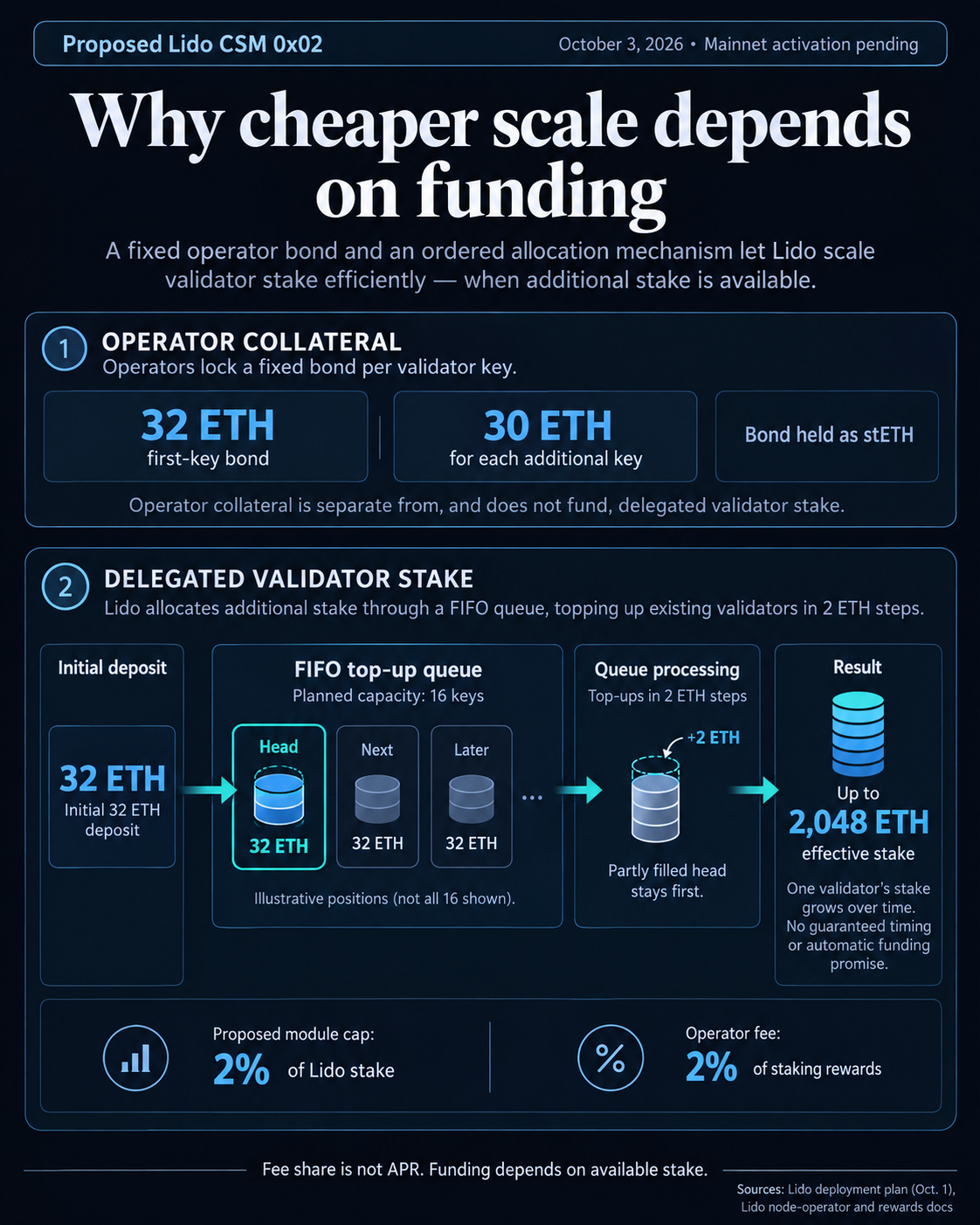
These rules turn a balance comparison into a timing question. An operator that eventually reaches 2,048 ETH may spend much of the comparison period waiting or running a smaller balance. The relevant figure is average reward-eligible effective stake over that period. Existing-route keys also need funding and activation, so the table’s fully funded portfolios are conditional benchmarks.
Compounding can help balances grow, but the module proposal itself makes capital efficiency dependent on current effective balance, module capacity and protocol inflows. A maximum-balance calculation cannot establish how quickly an operator will reach it.
Lido’s reward rules separate operator fees from the stETH rebase earned on collateral. Adding bond returns changes the total-income comparison. Comparing returns per ETH bonded requires the same bond-return rate and period before that stream can cancel out between alternatives.
Performance also affects payment. A validator below the threshold earns no operator rewards for that frame, while its bond can continue rebasing. Missing collateral must be restored before rewards are claimable.
The proposed configuration uses a 28-day frame, 3% performance leeway and a three-strike threshold with a six-frame strike lifetime. Balance-scaled penalties reach 16.512 ETH for bad-performance ejection and 6.4 ETH for delayed exit at a full 2,048 ETH balance. The exit-delay charge follows a four-day deadline and is settled after withdrawal.
A net comparison must add bond returns and subtract infrastructure, gas and assessed penalties, using actual funded time and reward eligibility. Fewer keys may change operating costs, but the parameters alone cannot price that difference.
Ahead of mainnet activation and the module-specific router vote, the useful signals are the final fee and cap settings, available funding and progress through the queue. The proposed route offers default operators a conditional path to better fee efficiency at scale; verified operators have stronger existing alternatives, and the lower-bond 0x01 route continues alongside it.
Source: CryptoSlate