



FILTERED RESULTS
FILTERS
Fear & Greed 73/100Alts Index 59/100
BTC.D 58.8% +0.5%Stable.D 9.2% 0%ETH.D 11.6% +0.2%Others.D 20.4% -0.7%
SOON$0.4157+34.55%•GRASS$0.7663+30.37%•ZBCN$0.00251906+24.37%•PUMP$0.00590197+19.92%•QNT$268.46+14.3%•NIGHT$0.0323+13.18%•AAVE$165.36+10.98%•ICP$3.418+10.37%•ETHFI$0.7717+9.35%•AVAX$11.406+7.53%•
NMR$12.210-17.31%•LIT$3.723-16.15%•HBAR$0.1027-15.32%•MARSCOIN$0.1401-10.95%•PONS$0.4897-9.75%•AI$0.1982-9.26%•BR$0.8281-8.92%•CASHCAT$0.1677-7.61%•VIRTUAL$0.7670-7.51%•DASH$60.738-7.24%•
•
·
·
FILTERED RESULTS
Project Eleven Acquires Riva Labs to Enhance Post-Quantum Security Capabilities
Stride Proposes Orderly Shutdown of Its Liquid Staking Chain
Zano Network Stabilizes After 30-Day Blockchain Rewind to Fix Inflation Bug...
RobinhoodApp ANNOUNCES PERPS ARE ROLLING OUT FOR U.S. TRADERS ...
618 $BTC (51,432,007 USD) transferred from Coinbase Institutional to unknown wallet...
Robinhood Launches Cryptocurrency Perpetual Contracts in the US
749 $BTC (62,330,840 USD) transferred from unknown wallet to Coinbase Institutional...
Robinhood To Offer Perps In-App Using Bitstamp: Press Release ...
Robinhood Introduces AI Trading Agents and New Trading Features
SEC charged Cryptoaiml Ltd., Cryptoaiml Capital Foundation, as well as TSAI Pro Ltd.
Bitcoin Was the Asset. Now Institutions Are Building Around It
5,035 $BTC (418,671,285 USD) transferred from Coinbase Institutional to unknown...
CryptoQuant says a bitcoin correction could be near after traders' unrealized profit
Robinhood adds AI agents, perps and weekend trading in push to win active traders
Hut 8 locks in $1B credit line, but faces 40% liquidity rules
1,551 $BTC (129,069,580 USD) transferred from unknown wallet to Coinbase...
Aztec relaunches privacy wallet on its Ethereum Layer 2
1,816 $BTC (151,093,512 USD) transferred from unknown wallet to Coinbase...
UPDATE: Coinbase has responded to Paul's allegations, saying it is "not hiding a series of hacks"
Tokenized Stocks Hit $3.6B as Avalanche and Solana Split the Market
250,000,000 $USDC (250,019,125 USD) minted at USDC Treasury...
Bitcoin Futures Notional Value Hits Two-Year Low
Kentucky Rep. James Comer is expanding his insider-trading-in-prediction-markets probe
873 $BTC (72,554,673 USD) transferred from unknown wallet to Coinbase Institutional...
Bitcoin bitcoin:native is testing a key long-term holder supply cluster around
BNB Chain Gains Nearly 1 Million Stablecoin Holders in a Week
2,057 $BTC (171,426,833 USD) transferred from unknown wallet to Coinbase...
Coinbase Faces $25M Loss Claim From Crypto Investor
Bitwise has launched Bitwise NEAR ETF
Bitcoin drops to $82,000 on US data, and inflation fear is blamed
749 $BTC (62,578,820 USD) transferred from unknown wallet to Coinbase Institutional...
Pakistan explores using landfill methane to generate energy as the...
Spark Finance Achieves 190% Loan Growth, Dominates DeFi Lending Market
NEW: Coinbase Ventures and CMCC Global closed a strategic funding round with trading firm Raven at a
Ethereum Gets Another Privacy Boost as Aztec Brings Back zk.money
Sequoia, Tiger Global Circle Kalshi in Fresh $1B Funding Talks: Report
2,000 $BTC (168,859,537 USD) transferred from unknown wallet to #Bitfinex...
Bitwise launches the first U.S. spot $NEAR ETF under ticker $NRR...
Trader "Dicedicedice", who suspiciously bet on the U.S. striking Iran by Feb. 28 and made $120K...
150,000,000 $USDT (150,043,500 USD) transferred from Tether Treasury to unknown...
Cboe and S&P Dow Jones Indices are exploring tokenized options as...
PRESIDENT TRUMP CONSIDER JAY CLAYTON FOR AI CZAR, PREVIOUS SEC CHAIRMAN WHO LAUNCHED SECURITIES...
Polymarket has named former Goldman Sachs Partner Lisa Mantil as Head of Institutional
Cboe's New S&P Deal Opens the Door to Tokenized Options
Sept 29 Update:#Bitcoin ETFs:1D NetFlow: +511 $BTC(+$42.99M)7D NetFlow: +15,196...
Bitcoin Could Reach $400,000 by 2030, Says Coinbase CEO Brian Armstrong
Bitget Reports 131% Reserve Ratio Following Security Incident
700 $BTC (59,031,992 USD) transferred from #Antpool to #Binance...
Morgan Stanley is moving deeper onchain, launching an internal lab to...
Ric Edelman Urges 10-40% Bitcoin Allocation, Sees $500K Price by 2030
Bitcoin market update /w Bitfinex, Moca Network goes live
Another whale (0x96de) withdrew 7,500 $ETH($20.5M) from #Binance in the past 30...
Bitcoin Kingpin Michael Saylor of Strategy Has Something New to Sell You
Volmex Finance Introduces Bitcoin Implied Volatility Perpetual Futures on Hyperliquid
Pakistan Pursues Bitcoin Mining and Methane Capture Initiatives Separately
XRP Surges 50% in a Month as Open Interest Soars to Highest Since August 2025
688 $BTC (58,075,022 USD) transferred from unknown wallet to #Antpool...
Belarus registers its first two crypto banks, allowing fiat deposits,...
Boeing Fell 7% After the FAA Held Back 737 MAX 10…
Bitget Resumes Withdrawals After $388 Million Security Breach
MoonPay has begun full-scale operations in South Korea, outlining new work with
Whale bc1qsz, linked to BIT.com (Matrixport), deposited 1,000 $BTC ($83.94M) into #Binance again an...
Kalshi Seeks $1 Billion at $40 Billion Valuation as Sequoia, Wellington, Tiger Global and Dragoneer...
Bitwise Launches First US Spot Near ETF After Token Nearly Triples Since August
447,824 $HYPE (39,563,029 USD) transferred from #HyperCore to #Kinetiq...
Ondo expands tokenized stocks with Korean equities for overseas...
BlackRock Predicts Stablecoins Will Facilitate AI Agent Payments
CRV Jumps Over 10% to $0.38 as Trading Activity Increases
Top Trending Coins (Today) 1. QNT 2. PENGU 3. NEAR 4. HBAR 5. GRASS 6. ZEC 7. TRUMP 8. AAVE 9....
Will proposed faster block times really fix Ethereum’s biggest market losses?


Ethereum developers are weighing Ethereum Quick Slots for Hegotá, a proposed faster block rhythm that would reduce waiting without expanding the network's per-second capacity. EIP-8198, or Quick Slots, remains Proposed for Inclusion rather than scheduled, and neither its eight-second draft parameter nor the 10-second alternative has been adopted.
That makes validator performance the deciding issue. Shorter slots could refresh onchain prices sooner and accelerate confirmations and finality, but validators would have less time to receive, check and attest to each block. The proposal's market benefits are modeled; its effect on the slowest operators remains the evidence Ethereum still needs.
The Hegotá meta-EIP lists Quick Slots as Proposed for Inclusion, while Ethereum's official roadmap says most of the upgrade's scope remains undecided. Developers are choosing whether to spend performance headroom on lower latency while preserving the broad participation that gives Ethereum its decentralization.
Ethereum Quick Slots: a faster clock with the same per-second capacity
The canonical EIP-8198 draft uses eight seconds as a placeholder, down from Ethereum's current 12-second slot. It also says the exact target should follow performance characterization and may change before deployment.
Ethlabs favors a more conservative first move. Its updated Hegotá position advocates 10-second slots first, with later cuts only as evidence of safety accumulates. An open sponsor rewrite likewise proposes 10 seconds, but it has not been merged into the canonical EIP.
The possible outcomes therefore extend beyond an eight- versus 10-second choice. Hegotá could start at 10 seconds, retain the draft's eight-second parameter, or leave the 12-second schedule unchanged if testing shows that a cut would be unsafe.
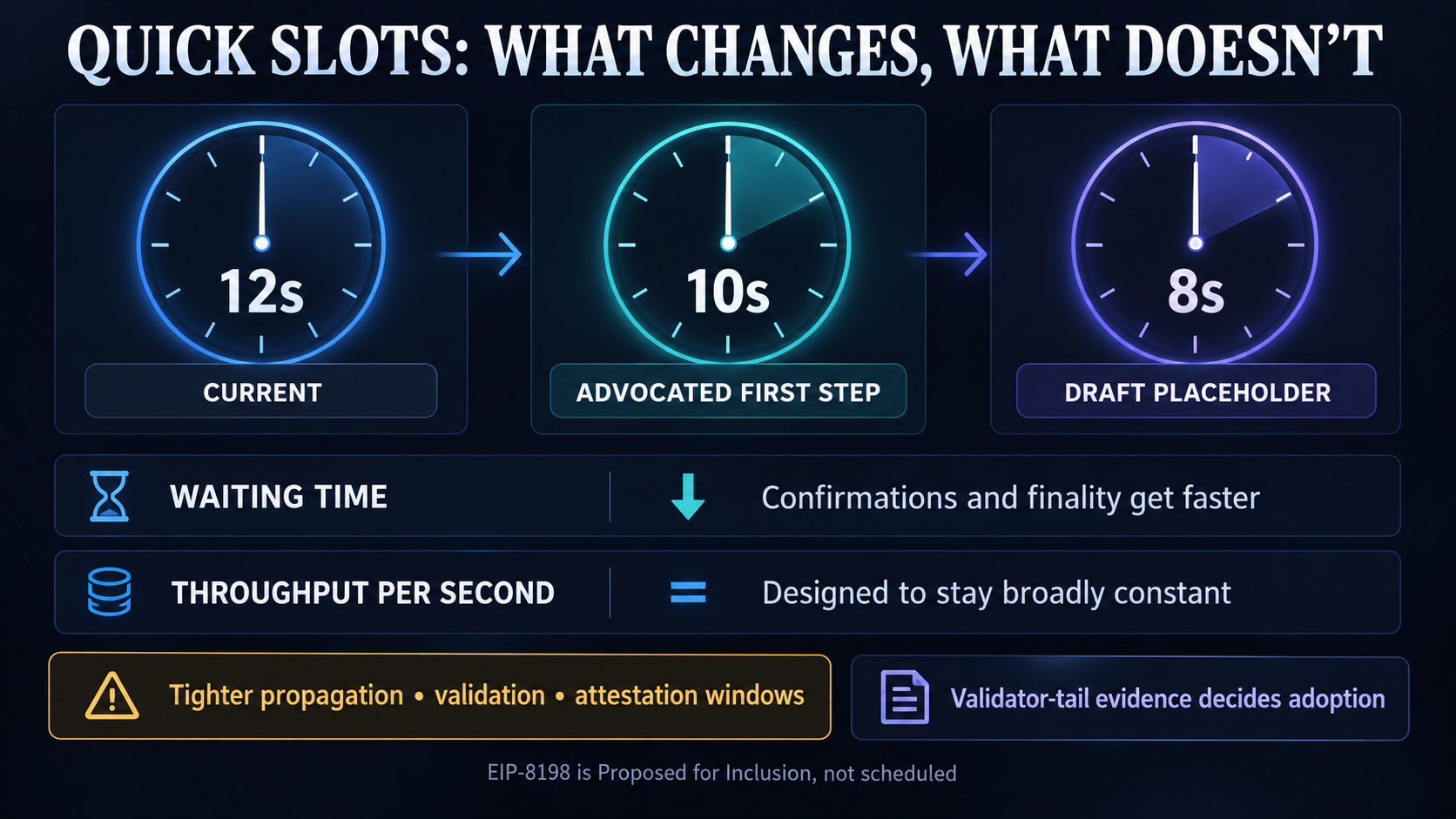
Under either shorter target, capacity per second stays broadly level only if the gas limit and maximum blob count per block fall in proportion to slot duration. Smaller blocks would arrive more frequently. Users could receive a first confirmation sooner, onchain markets could update more often, and systems that inherit Ethereum's cadence could react faster. Normal validator gas-limit voting would resume after the transition, and integer rounding could make blob capacity slightly lower rather than perfectly constant.
Keeping 32 slots in an epoch would also shorten epoch-based finality in wall-clock time. Under the draft's eight-second assumptions, EIP-8198 estimates finality falling from about 13 minutes to about 8.5 minutes. That is a proposal estimate, not an observed result from production Ethereum.
The same distinction applies to the draft's claim that a 12-to-eight-second change would reduce arbitrage losses by roughly 18%. The figure comes from a model in which those losses scale with the square root of the time between blocks. Ethereum has not operated an eight-second production regime that could demonstrate the result.
Independent work supports the direction more strongly than the exact magnitude. An empirical study of automated market maker losses found that faster blocks reduce losses to arbitrageurs, but the effect varied materially by trading pair. A newer jump-diffusion model found that sudden price jumps create a floor that shorter intervals do not eliminate.
Fresher prices could improve spreads and liquidity-provider economics while compressing some surplus available to searchers, builders and proposers. Yet fees, liquidity, volatility, jumps and burned base fees affect who captures the change. A separate Ethereum Research analysis shows why lower nominal arbitrage does not translate mechanically into a uniform 18% gain for users or liquidity providers.
Validator tails decide whether the trade works
Smaller blocks reduce peak payload size, but a faster cadence raises computational and bandwidth demands per second. Validators also face tighter absolute windows for propagation, validation and attestation aggregation. Average performance cannot settle the decentralization question because the network must remain usable for operators in slower regions, on weaker hardware and with varied client configurations.
An analysis of mainnet attestation timing found potential headroom for a shorter schedule alongside a meaningful tail. Some attestations in its sample arrived after the aggregation deadline contemplated for a six-second design, and timings differed across clients, operators and configurations. The study was exploratory and does not establish the safety of six, eight or 10 seconds.
Separate post-Pectra research found propagation delay strongly associated with reorg risk near the attestation boundary. Those observations support a distributional risk: reducing the timing margin could burden slower or poorly configured validators more than well-provisioned peers. They do not quantify validator reward losses under EIP-8198 or prove that either proposed target would centralize the network.
The proposal itself acknowledges incomplete knowledge about blob propagation, attestation aggregation, local block building and validator hardware. Developers have also linked Quick Slots to work on faster execution-payload broadcast, treating propagation improvements as part of the safety case rather than a later optimization.
The Ethereum Foundation Protocol cluster's Hegotá assessment placed Quick Slots in B tier after research teams offered stronger support than delivery-focused engineering teams. The practical requirements behind that split are clear: a complete specification, a full-spec prototype, a downstream-effects assessment and confirmation that Quick Slots will not complicate Ethereum's planned decoupled-consensus architecture.
Those requirements turn Hegotá's decision into an empirical test. A 10-second first step could deliver a measurable latency gain and defer a harder cut if client simulations and devnets show broad validator resilience. Eight seconds could remain the draft's ambition rather than the first deployment. If timing tails or reorg behavior worsen enough to favor larger operators, the market-quality benefit would carry a decentralization cost.
Ethereum Quick Slots could offer fresher markets, shorter transaction-inclusion waits and faster finality without increasing throughput. Broad validator resilience remains the condition that must be demonstrated before the faster clock is worth adopting.
Source: CryptoSlate