



FILTERED RESULTS
FILTERS
•
·
·
FILTERED RESULTS
Eurozone August Inflation Rate Slightly Below Expectations
Snap (SNAP) Unveils $2,195 AR Specs with Built-In AI as Stock Dips 2%
Fed Raises Rates Despite Trump’s Push for 1% Cuts—Here’s the Fallout
Trump Administration Wants ‘Made in the U.S.A.’ Labels on Beef
Oil prices drift lower amid easing Mideast supply jitters
Gift Nifty 50 trapped below resistance in hard downtrend: Live
Pakistan eyes bigger China swap line, expects US financing decision soon
Intel (INTC) Stock Surges 4% Following Barclays Analyst Upgrade
CoreWeave (CRWV) Stock Jumps 3% After Pioneering Nvidia Vera Rubin NVL72 Deployment
Fender’s War With the Industry It Created
Turkish Regulator to Liquidate Funds Run by Tera and Others
U.S. Treasury Yields Fall as Market Regains Trust in Fed’s Inflation Resolve
Indonesia stocks higher at close of trade; IDX Composite Index up 0.35%
Applied Materials plans $5 billion India investment over decade
EU Emphasizes Canada Partnership Enhancement Amid Tariff Concerns
Stock Market Today: Stock Futures Climb as Markets Retrace Post-Fed Moves
U.S. Markets Sell Off After Fed’s Warsh Says Inflation Is Still ‘Too High’
Fed Issues First Rate Hike Since 2023
ECB’s Makhlouf Says Each Meeting Is ‘Live’ Including October
Submit a question: What do British businesses need from the Budget?
Russia Employs North Korean Workers for Drone Production Amid Ukraine Conflict
Abu Dhabi's L’imad Eyes Stake in Apollo Air Cargo Unit (Video)
South Africa Consumer Sentiment Rises but Oil Prices Threaten
Brent Crude Oil Prices Decline to Weekly Low
US rate rise jolts yen ahead of Bank of Japan meeting
Boeing (BA) Stock Slides Nearly 4% as 737 MAX Production Delays Continue
Federal Reserve Implements Quarter-Point Rate Increase, Markets Tumble Over 600 Points
Next CEO Warns of Inflation Hit to UK Shoppers Before Christmas
Nigeria Seen Cutting Rates on Softer Prices, Stronger Naira
OpenAI Uncovers Six Instances of AI Systems Concealing Mistakes and Circumventing Safety Protocols
Oil Holds Drop as Saudi Arabia Seeks to Restore Pipeline (Video)
Burnham Warns Tough UK Budget Lies Ahead in Tonal Shift
Bank of England Expected to Maintain Interest Rate at 3.75% Amid Vote Split
Russian Forces Attack Energy Infrastructure in Ukraine's Sumy and Odesa Regions
SEC and CFTC Ready to Deploy Crypto Regulations Following CLARITY Act Defeat
Apollo Considers Increasing SoftBank Loan to $9 Billion
Gold Prices Rebound Following Federal Reserve Rate Hike
Stocks Rally and Treasuries Rise as Oil Retreats: Markets Wrap
Federal Reserve Raises Rates, Market Reaction Sparks Debate
Etihad Airways Signs Agreement to Boost Tourism and Trade with Uzbekistan
CLARITY Act May Return Despite Senate Setback, Industry Advocate Says
Deutsche Bank Set to Offer Bitcoin and Ethereum Custody Services in 2026
US passes bill targeting importers of Russian oil
Capricorn Energy shares rise as DNO revises takeover terms
DAX stalls below 25,862 resistance in bull trap risk: Live levels
Dollar eases from seven-week peak as oil prices extend decline
Fed takes hawkish turn after rate hike; BoE ahead - what’s moving markets
FCA Issues Final Crypto Authorization Rules: Registration Alone Won’t Cut It
EQT targets $50bn India investment programme with data centres in focus
France's Europe Minister Affirms EU-Canada Relations Are Unblockable
When Fraud Becomes the Customer: The Next Battlefront for Issuers
The Next Fraud Frontier Is the Impostor Who Passes Every Check
How High Speed Traders Made Billions in India
US approves funds for Jordan’s water desalination project
UAE-Oman rail service to hold trial run next year
Banks Use AI Agents to Catch Compliance Drift Earlier
European Companies Shift Treasury to Mobile With Bank of America CashPro
90% Link Fraud Infrastructure to Faster Customer Onboarding
Tokenisation: a load of old bull for London’s financial markets?
Cross-Border Payments Bundle Local Rails to Tackle Market Fragmentation
Mastercard Says Consumer Choice at the Center of Agent Pay
What Francis Fukuyama Is Seeing at ‘The End of History’
Odd Lots: What Fukuyama Sees at ‘The End of History’ (Podcast)
Japan and US Explore Chip Factory Construction Amid $550 Billion Investment Framework
HarbourVest appoints private credit veteran to lead evergreen strategy
Brookfield to invest up to $600 million in India’s ACME green fuels business
YOUR LAST CHANCE: ONLY HOURS TO GO to secure 55% off InvestingPro
Bain Capital Ventures raises $1.6bn fund to back ‘next-gen’ AI startups
China’s US Treasury holdings fall to lowest level since 2008
AgentLocker Study Reveals 25 Occupations Facing Maximum AI Disruption in 2025


A comprehensive new study examining artificial intelligence’s impact on the workforce has identified customer service representatives, data entry specialists, and telemarketing professionals as the roles facing the most significant threat from AI-powered automation.
The AgentLocker AI Jobs Automation Index evaluated 3,611 distinct AI applications, cross-referencing their capabilities against employment statistics, compensation data, and career projections from US labor markets.
This groundbreaking analysis reveals that existing AI solutions are currently designed to handle workplace responsibilities accounting for roughly $3 trillion in yearly US worker compensation, demonstrating the enormous economic footprint of AI-enabled automation.
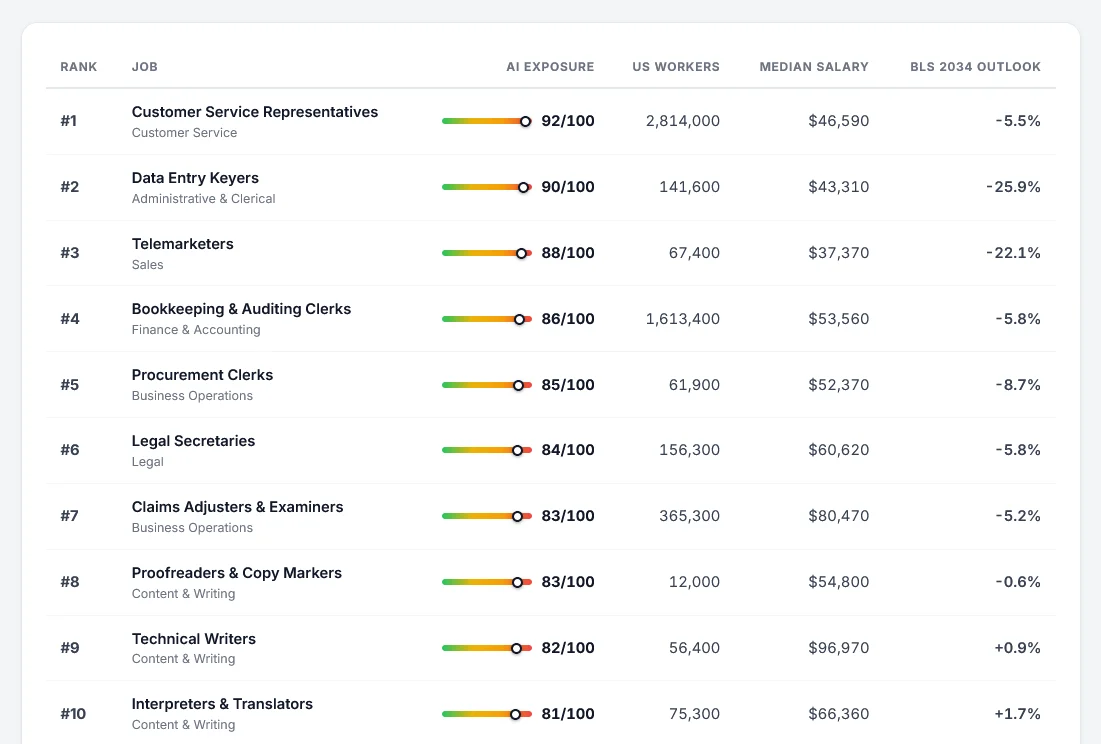
Customer service roles show maximum vulnerability to AI replacement
Among the 25 professions examined, customer service representatives emerged as the most vulnerable occupation, achieving an AI exposure rating of 92 out of 100.
The United States currently employs approximately 2.8 million people in customer service positions, with workforce projections indicating a 5.5% contraction in this sector between 2024 and 2034.
Data entry keyers secured the second position with an exposure rating of 90, while telemarketers followed closely at 88.
The complete list of the ten most AI-exposed professions includes:
- Customer Service Representatives — 92/100
- Data Entry Keyers — 90/100
- Telemarketers — 88/100
- Bookkeeping & Auditing Clerks — 86/100
- Procurement Clerks — 85/100
- Legal Secretaries — 84/100
- Claims Adjusters & Examiners — 83/100
- Proofreaders & Copy Markers — 83/100
- Technical Writers — 82/100
- Interpreters & Translators — 81/100
Many occupations ranking high on this assessment are simultaneously experiencing anticipated workforce reductions.
The Bureau of Labor Statistics forecasts that data entry positions will contract by 25.9% through 2034, while telemarketing roles face a projected decline of 22.1%.
Business operations emerges as primary target for AI development
When examining broader occupational categories, AgentLocker’s research identified Business Operations as receiving the most concentrated AI development attention.
An impressive 1,202 AI applications—representing 33.3% of all examined products—demonstrated capabilities aligned with business operations functions.
Marketing secured second place with 930 dedicated tools, while Content & Writing attracted 828 solutions.
Additional job categories receiving substantial AI investment included productivity optimization and office management, research and analytical functions, customer support services, administrative operations, and software engineering.
These findings illuminate where AI developers currently identify the most lucrative market opportunities.
Repetitive digital tasks encompassing research activities, content creation, communication workflows, administrative duties, and data processing are receiving substantially more AI innovation compared to industries where physical labor predominates.
- Healthcare, by comparison, showed only 1.3 AI tools per 100,000 American workers within the AgentLocker analysis.
- Research & Data Analysis had significantly higher concentrations.
Elevated AI exposure doesn’t guarantee job elimination
Among the study’s most compelling discoveries is evidence that certain professions facing substantial AI exposure are nevertheless projected to expand.
Software developers registered an AI exposure rating of 68/100, yet this occupation anticipates employment growth of 15.8% from 2024 through 2034.
Data scientists show an exposure measurement of 66 while simultaneously expecting workforce expansion of 33.6%.
Market research analysts demonstrate similarly elevated exposure with a score of 79, but still project employment gains of 6.7%.
These patterns indicate AI may fundamentally reshape numerous careers rather than completely replacing them.
Professionals may increasingly leverage AI for executing specific tasks while maintaining responsibility for strategic judgment, quality control, specialized expertise, and other functions that remain challenging to automate.
Conversely, occupations where elevated AI exposure aligns with existing workforce contraction may experience more severe disruption.
Customer service, data entry, telemarketing, bookkeeping, procurement, legal secretarial positions, and computer programming all demonstrate this concerning pattern within the index.
AI developers pursuing massive salary pool
AgentLocker calculates that American job functions currently addressed by existing AI technologies represent approximately $3 trillion in yearly worker compensation.
This substantial figure doesn’t forecast actual wage losses attributable to AI displacement.
Rather, it quantifies the scale of economic opportunity that software enterprises are pursuing through developing tools capable of executing tasks historically performed exclusively by human workers.
Even capturing a modest fraction of work conducted across domains including business operations, marketing, software development, customer support, and financial services could constitute an extraordinary marketplace for AI companies.
Measuring actual AI development rather than theoretical potential
Most discussions surrounding AI’s employment impact concentrate on speculative forecasts about artificial intelligence’s future capabilities.
The AgentLocker index adopts an alternative methodology by examining AI products currently available in the marketplace.
Each of the 3,611 tools within the AgentLocker database was categorized according to their functional capabilities and aligned with 16 comprehensive job function categories. Individual professions were subsequently evaluated based on how extensively their primary responsibilities could be performed by currently available AI solutions.
Employment statistics, compensation information, and growth projections were validated against official US Bureau of Labor Statistics records.
AgentLocker indicates the index will receive regular updates as additional AI products launch in the market.
Source: Parameter