



September Market Split: Nasdaq Climbs on AI Momentum While Dow and Russell 2000 Tumble


Key Takeaways
- The Nasdaq Composite climbed 1.8% in September, reaching a fresh record on September 22, while the S&P 500 slipped 0.4%.
- Blue-chip stocks struggled as the Dow Jones Industrial Average tumbled approximately 4.3%, with the Russell 2000 declining 5.4%.
- Bond market volatility intensified as the 2-year, 10-year, and 30-year Treasury yields jumped to levels not seen in decades.
- According to UBS analysis, AI-related investments and equity appreciation now represent 80% or more of overall US economic expansion.
- Meta, Advanced Micro Devices, and Intel led the Nasdaq’s September performance with substantial gains.
September delivered divergent results across major market benchmarks, with artificial intelligence stocks providing crucial support to certain segments. While the S&P 500 edged down 0.4% during the month amid climbing bond yields, the index remains just 1.9% beneath its August record.
The ninth month of the year typically presents challenges for equity investors. Historical data dating back to 1950 shows the S&P 500 averages a 0.6% loss in September.
The Nasdaq Composite bucked the trend with a 1.8% advance, setting a fresh all-time high on September 22 and finishing the month at 26,861.06 points.
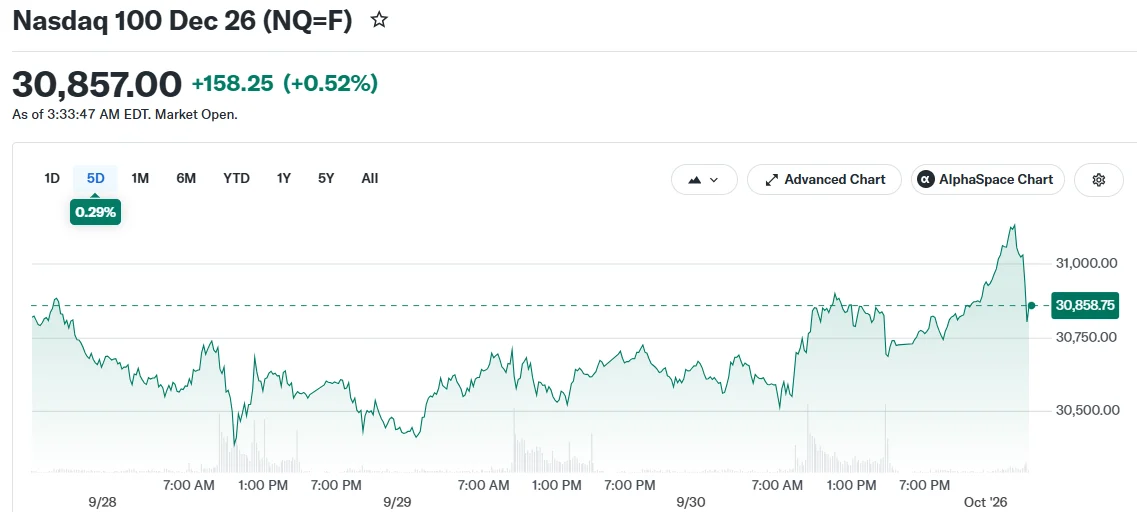
Technology heavyweights including Meta and AMD powered the Nasdaq’s upward trajectory. Chip manufacturers were among the strongest contributors to the index’s performance.
Blue Chips and Small-Caps Lag as Technology Dominates
The positive momentum wasn’t universal across market segments. The Dow Jones Industrial Average suffered a sharp 4.3% decline throughout September.
Meanwhile, the Russell 2000 index of smaller-capitalization companies plunged 5.4%. Steve Sosnick, chief strategist at Interactive Brokers, characterized the market dynamics succinctly: “It’s AI or bust.”
Sosnick also pointed out that even with the Nasdaq and S&P 500 showing relative strength versus other benchmarks, underlying vulnerabilities exist.
Treasury market movements significantly influenced September’s trading patterns. Both the 2-year and 10-year yields increased by approximately 50 basis points.
The 30-year bond yield surged nearly 40 basis points from late August levels. This marked the most significant concurrent move across all three maturities since September 2022.
The surge in borrowing costs has dampened initial public offering activity. Smart-ring manufacturer Oura delayed its planned market debut this week.
Additional companies such as Holtec Nuclear and Bamboo Insurance have attributed postponed listings to unfavorable market dynamics.
Anthropic has allegedly moved its anticipated public offering from October to November. The offering had been projected as the fourth quarter’s largest IPO.
Artificial Intelligence Investment Dominates Economic Expansion
Arend Kapteyn, chief economist at UBS, indicated that AI-focused capital expenditure combined with wealth effects from appreciating AI equities currently account for 80% or more of US GDP growth.
“It just looks like AI is neutralizing everything, at least on an aggregate level,” Kapteyn stated.
UBS increased its projection for AI-related capital investment in the coming year by $200 billion to reach $1.4 trillion total. Kapteyn observed that expenditure outside artificial intelligence sectors is “running at zero.”
This narrow concentration introduces significant vulnerabilities. Kapteyn highlighted that appreciating AI stock valuations have bolstered consumer expenditure, particularly among affluent demographics.
Should the AI investment theme falter, economic consequences could manifest through dual channels: declining capital investment and diminished household spending.
UBS does identify evidence that benefits are beginning to extend beyond technology sectors. Kapteyn explained that each dollar allocated to AI infrastructure this quarter typically generates approximately $1.50 in subsequent quarterly investment, with just one-third returning to tech.
Examining individual equity performance, Intel surged 34.32% during September, topping the Nasdaq’s gainers. AMD advanced 29.96%, while Meta jumped 26.70%.
Marvell Technology and Astera Labs similarly recorded strong double-digit appreciation throughout the month.
However, several stocks experienced significant declines. Axon Enterprise plummeted 25.42%, representing the steepest loss among major names.
Intuit, Paychex, DoorDash, and Autodesk each suffered double-digit percentage losses in September.
Market strategists anticipate continued turbulence in October. The Federal Reserve’s upcoming monetary policy announcement and evolving US-Iran geopolitical tensions represent potential catalysts.
Projections for another interest rate increase have moderated following comments from New York Fed President John Williams suggesting policymakers aren’t compelled to act hastily on additional tightening.
Source: Parameter