



FILTERED RESULTS
FILTERS
MCap $2.9T -0.2%24h Vol $116.8B -25%Fear & Greed 73/100Alts Index 59/100
BTC.D 58.8% +0.5%Stable.D 9.2% 0%ETH.D 11.6% +0.2%Others.D 20.4% -0.7%
GRASS$0.7549+28.92%•PUMP$0.00587913+21.99%•ZBCN$0.00247711+21.85%•SOON$0.4040+17.82%•NIGHT$0.0324+14.72%•QNT$260.56+13.39%•AAVE$166.42+13.05%•ICP$3.434+12.38%•ETHFI$0.7797+10.04%•AVAX$11.432+9.34%•
HBAR$0.1030-16.37%•NMR$12.433-14.33%•MARSCOIN$0.1426-9.56%•AI$0.1982-9.26%•BR$0.8281-8.92%•ALGO$0.1250-7.27%•BTW$1.302-6.08%•Q$0.0235-5.94%•VIRTUAL$0.7735-5.94%•ZAMA$0.0753-5.71%•
•
·
·
FILTERED RESULTS
5,035 $BTC (418,671,285 USD) transferred from Coinbase Institutional to unknown...
CryptoQuant says a bitcoin correction could be near after traders' unrealized profit
Robinhood adds AI agents, perps and weekend trading in push to win active traders
Hut 8 locks in $1B credit line, but faces 40% liquidity rules
1,551 $BTC (129,069,580 USD) transferred from unknown wallet to Coinbase...
Aztec relaunches privacy wallet on its Ethereum Layer 2
1,816 $BTC (151,093,512 USD) transferred from unknown wallet to Coinbase...
UPDATE: Coinbase has responded to Paul's allegations, saying it is "not hiding a series of hacks"
Tokenized Stocks Hit $3.6B as Avalanche and Solana Split the Market
250,000,000 $USDC (250,019,125 USD) minted at USDC Treasury...
Bitcoin Futures Notional Value Hits Two-Year Low
Kentucky Rep. James Comer is expanding his insider-trading-in-prediction-markets probe
873 $BTC (72,554,673 USD) transferred from unknown wallet to Coinbase Institutional...
Bitcoin bitcoin:native is testing a key long-term holder supply cluster around
BNB Chain Gains Nearly 1 Million Stablecoin Holders in a Week
2,057 $BTC (171,426,833 USD) transferred from unknown wallet to Coinbase...
Coinbase Faces $25M Loss Claim From Crypto Investor
Bitwise has launched Bitwise NEAR ETF
Bitcoin drops to $82,000 on US data, and inflation fear is blamed
749 $BTC (62,578,820 USD) transferred from unknown wallet to Coinbase Institutional...
Pakistan explores using landfill methane to generate energy as the...
Spark Finance Achieves 190% Loan Growth, Dominates DeFi Lending Market
NEW: Coinbase Ventures and CMCC Global closed a strategic funding round with trading firm Raven at a
Ethereum Gets Another Privacy Boost as Aztec Brings Back zk.money
Sequoia, Tiger Global Circle Kalshi in Fresh $1B Funding Talks: Report
2,000 $BTC (168,859,537 USD) transferred from unknown wallet to #Bitfinex...
Bitwise launches the first U.S. spot $NEAR ETF under ticker $NRR...
Trader "Dicedicedice", who suspiciously bet on the U.S. striking Iran by Feb. 28 and made $120K...
150,000,000 $USDT (150,043,500 USD) transferred from Tether Treasury to unknown...
Cboe and S&P Dow Jones Indices are exploring tokenized options as...
PRESIDENT TRUMP CONSIDER JAY CLAYTON FOR AI CZAR, PREVIOUS SEC CHAIRMAN WHO LAUNCHED SECURITIES...
Polymarket has named former Goldman Sachs Partner Lisa Mantil as Head of Institutional
Cboe's New S&P Deal Opens the Door to Tokenized Options
Sept 29 Update:#Bitcoin ETFs:1D NetFlow: +511 $BTC(+$42.99M)7D NetFlow: +15,196...
Bitcoin Could Reach $400,000 by 2030, Says Coinbase CEO Brian Armstrong
Bitget Reports 131% Reserve Ratio Following Security Incident
700 $BTC (59,031,992 USD) transferred from #Antpool to #Binance...
Morgan Stanley is moving deeper onchain, launching an internal lab to...
Ric Edelman Urges 10-40% Bitcoin Allocation, Sees $500K Price by 2030
Bitcoin market update /w Bitfinex, Moca Network goes live
Another whale (0x96de) withdrew 7,500 $ETH($20.5M) from #Binance in the past 30...
Bitcoin Kingpin Michael Saylor of Strategy Has Something New to Sell You
Volmex Finance Introduces Bitcoin Implied Volatility Perpetual Futures on Hyperliquid
Pakistan Pursues Bitcoin Mining and Methane Capture Initiatives Separately
XRP Surges 50% in a Month as Open Interest Soars to Highest Since August 2025
688 $BTC (58,075,022 USD) transferred from unknown wallet to #Antpool...
Belarus registers its first two crypto banks, allowing fiat deposits,...
Bitget Resumes Withdrawals After $388 Million Security Breach
Boeing Fell 7% After the FAA Held Back 737 MAX 10…
MoonPay has begun full-scale operations in South Korea, outlining new work with
Whale bc1qsz, linked to BIT.com (Matrixport), deposited 1,000 $BTC ($83.94M) into #Binance again an...
Kalshi Seeks $1 Billion at $40 Billion Valuation as Sequoia, Wellington, Tiger Global and Dragoneer...
Bitwise Launches First US Spot Near ETF After Token Nearly Triples Since August
447,824 $HYPE (39,563,029 USD) transferred from #HyperCore to #Kinetiq...
Ondo expands tokenized stocks with Korean equities for overseas...
BlackRock Predicts Stablecoins Will Facilitate AI Agent Payments
CRV Jumps Over 10% to $0.38 as Trading Activity Increases
Top Trending Coins (Today) 1. QNT 2. PENGU 3. NEAR 4. HBAR 5. GRASS 6. ZEC 7. TRUMP 8. AAVE 9....
Cboe and S&P Dow Jones Indices opened door to tokenized S&P-linked options
ZEC has dropped more than 18% from its recent high.Whale 0x362a opened a 5x long on 4,135...
Cboe Extends Exclusive S&P 500 Index Options License Through 2051, Explores Tokenized Options...
Rep. Comer Targets 3 Platforms in Expanded Prediction Market Probe
Coinbase Wallet Adds Polymarket to Its Crypto App Ecosystem
4,951 $BTC (415,696,748 USD) transferred from unknown wallet to unknown wallet...
SEC Files Lawsuits Against Cryptoaiml and TSAI for Alleged $15 Million Fraud
Bitget reopened BTC withdrawals, In the first hour, 3,326 BTC (~$276M) left the...
Aztec Labs Relaunches zk.money Privacy Wallet on New…
Anthropic Lost $42 Billion Last Year. It Wants to Go Public at $2 Trillion
Crypto regulation at SEC, CFTC to come down to 3 commissioners following key resignation
Glassnode Alpha Lab


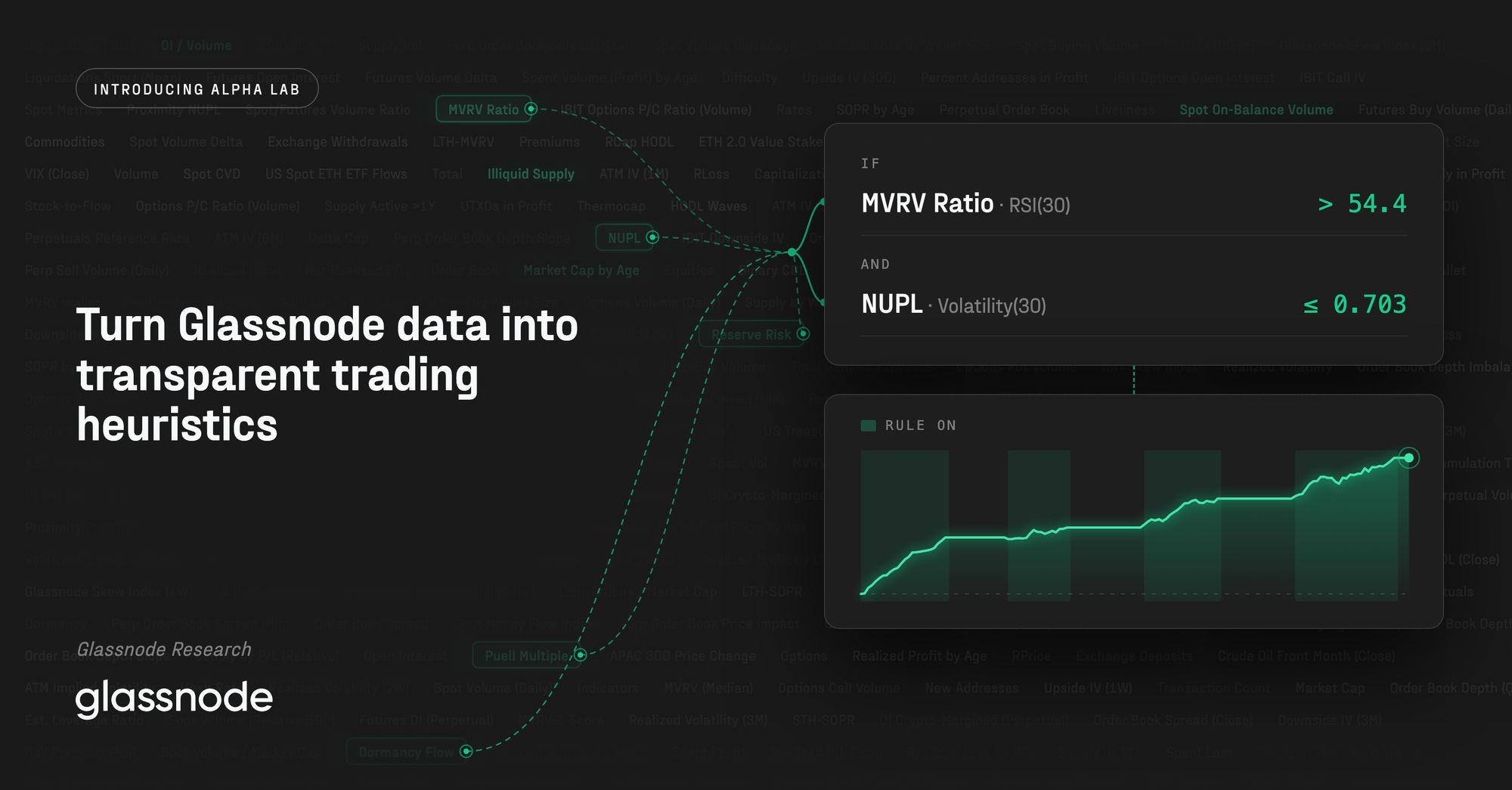
Crypto investors have access to more data than ever. On-chain activity, exchange flows, derivatives positioning, spot markets, order books and network fundamentals can each reveal a different part of the market.
That breadth is one of Glassnode’s greatest strengths. It can also create a difficult first question: Where should I start?
When a catalogue contains thousands of metrics, finding the small set that matters for a specific investment decision can become a research project of its own. Experienced quantitative teams can build pipelines to test combinations, transformations and thresholds. For many investors, however, moving from a chart in Studio to a systematic decision rule still requires too much time, code and specialist knowledge.
We built Glassnode Alpha Lab to close that gap.
Alpha Lab is a quantitative research platform that searches Glassnode’s data for simple, human-readable trading heuristics. Tell the application what you want to identify, choose the market data you want to investigate, and the research engine tests which combinations have historically been most useful.
The goal is straightforward: turn a large metric universe into a focused set of ideas that an investor can understand, challenge and incorporate into their own research process.

Start with the investment question
Which Glassnode metrics have historically helped identify good buying opportunities in Bitcoin?
From there, the user chooses the metrics the platform should explore, from on-chain and spot data to futures, options and order-book signals, and decides what the search should prioritize. This could be stronger risk-adjusted returns, measured through the Sharpe ratio, or greater absolute performance.
The question sets the asset and the objective; the labeling defines the truth. Every day in the available history is marked as a good buying opportunity or not, based on what the market actually did next. Each selected metric is then expanded into many transformed versions of itself, and the task becomes a simple statistical one: which of those readings were present on the good days and absent on the rest?
Decision trees are built to answer exactly that: every branch is a threshold that separates the good days from the rest. Hundreds are grown together, with an optimizer continually adjusting how they are built. Every attempt is scored the way a trader would score it: on how the resulting strategy would have performed.
The engine then extracts the strongest findings as heuristics rather than returning a black-box prediction. Because each tree is kept deliberately shallow, every path through it that ends in a "yes" is already a concise rule: one or two metric conditions describing a zone where good days clustered. Each zone is then judged on how often it was right and on how much history it rests on.
A result might take the form of:
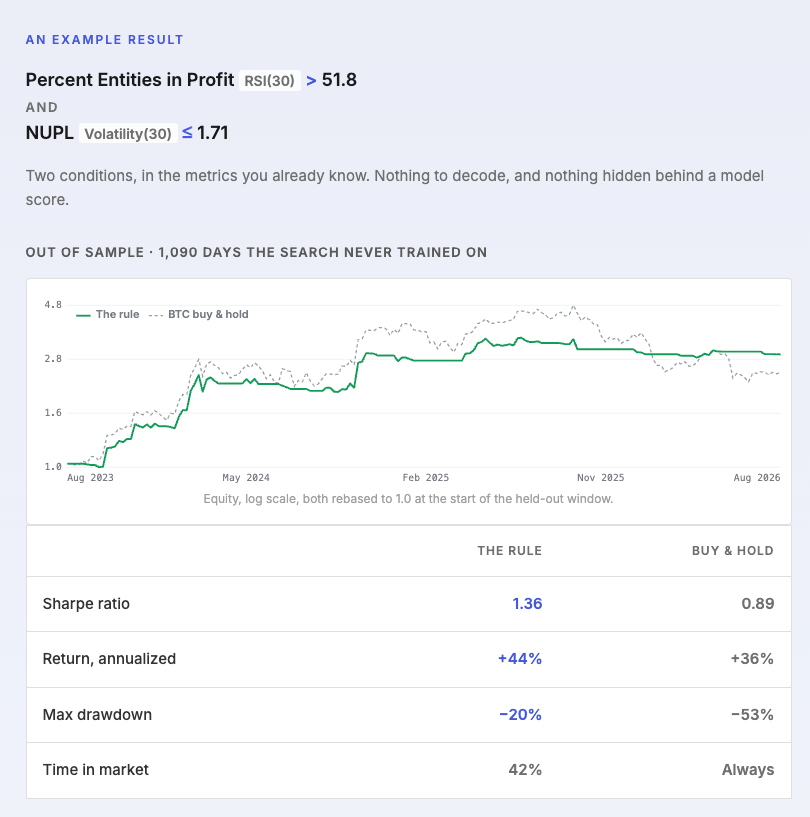
“When this transformed metric is below X, and this transformed metric is above Y, this is the prime area to improve risk-adjusted return on BTC”
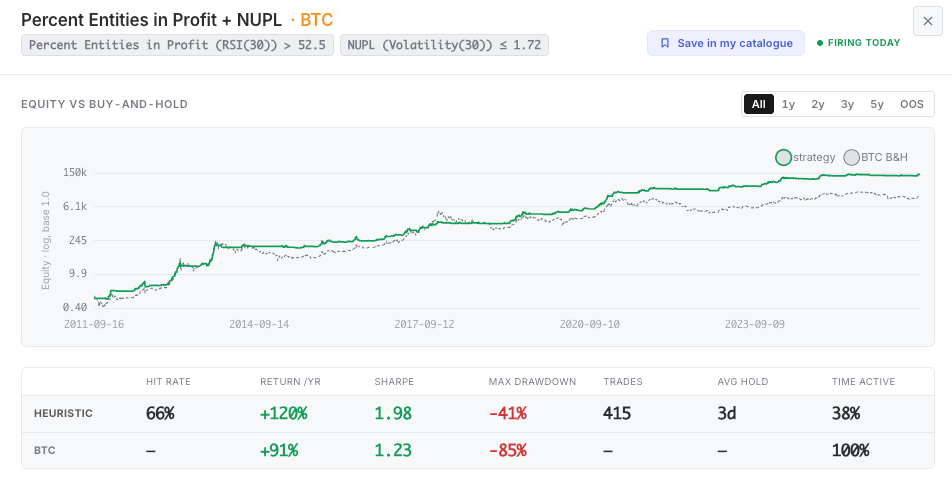
Each rule is accompanied by the evidence needed to evaluate it, including historical return, Sharpe ratio, maximum drawdown, hit rate, trading frequency and an equity curve. Users can compare the rule with the underlying asset, inspect different time horizons and see whether its conditions are firing on the latest available data. It helps surface promising relationships while keeping the underlying logic visible.
Three ways to research
Different investors want different levels of control. The product provides three ways into the same research engine.
Easy mode: Go from a question to ranked heuristics
Easy mode is designed for speed and accessibility. Choose an asset, select whether you want to investigate buying or short opportunities, pick the metrics to scan and set the search effort. Alpha Lab runs the workflow above in the background and returns the most promising rules as readable signal cards — viewable as metric pairs or decomposed into single-metric rules, and filterable to an investor's preferences, for example drawdown, risk-adjusted return, hit rate or a particular evaluation period.
The workflow is iterative by design. Users can refine the metric set, rerun the search and compare the new results with previous attempts. That turns a one-off screen into a structured discovery loop: form a hypothesis, test it, learn from the result and narrow the search.
Advanced mode: Inspect every step
Advanced mode exposes all the steps behind the search. Users can control the feature space by selecting both the source metrics and the transformations applied to them, including z-scores, RSI, moving averages, volatility and percentile-based features. Transformation windows can be adjusted to test how the same underlying metric behaves across different horizons.
They can also define what the model should learn. The research application includes default labelling for long and short opportunities, but users can paint custom zones directly onto the price history.
This opens the door to more specific questions:
- Which metrics have historically characterized local bottoms?
- What tends to appear near market tops?
- Which features are associated with a volatility regime or a parabolic move?
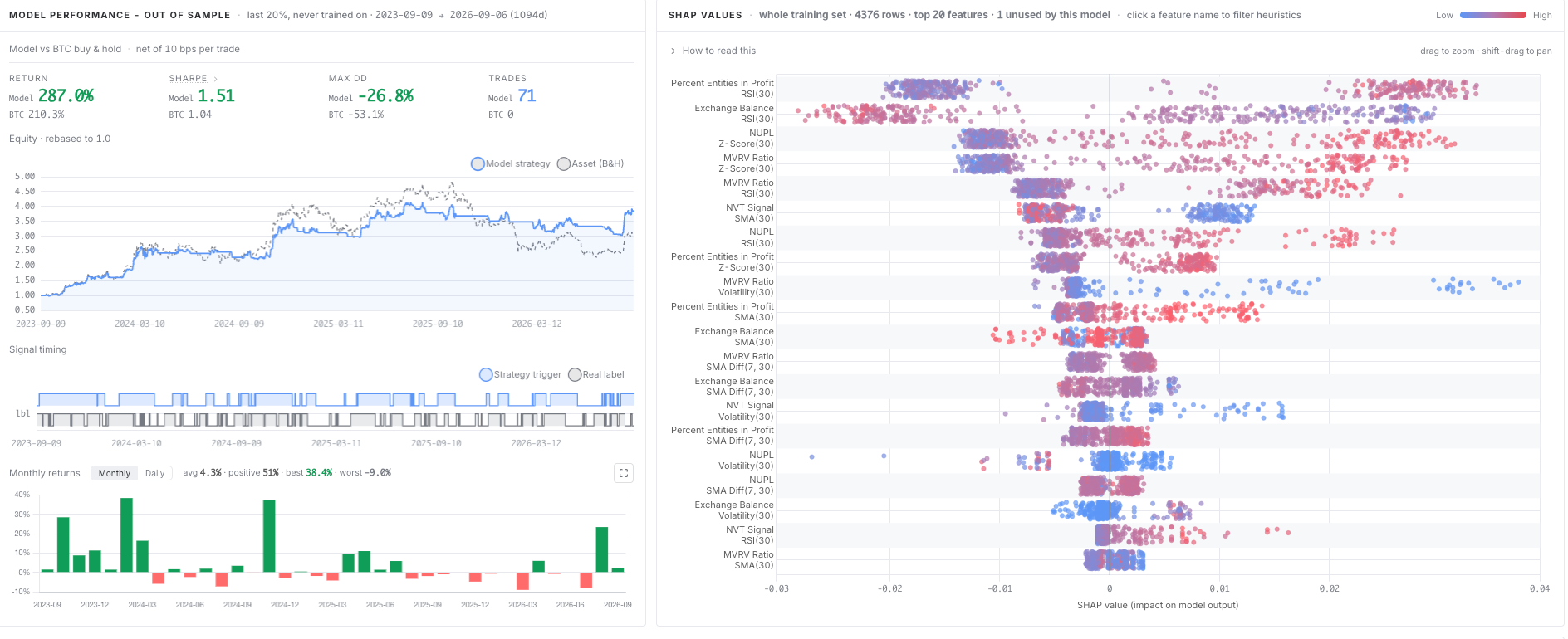
Once the search is complete, Advanced mode shows the path from model to rule. Users can compare machine-learning models, inspect feature influence, review the full heuristic table and analyze individual rules in detail.
The platform also supports stress-testing of heuristic. If a result only works at one exact threshold or lookback window, that is a warning sign. A more credible relationship should remain reasonably stable when nearby parameters change.
Alpha Lab makes that sensitivity visible, helping researchers distinguish a potentially durable pattern from a finely tuned historical accident.
Agents mode: Put Autoresearch to work
Some research questions are better treated as a loop than as a single query.
Through Alpha Lab’s MCP server, compatible AI agents can access the same metric catalogue and optimization engine as the human interface.
An investor can give an agent a research objective, such as exploring groups of metrics until it finds a rule that improves risk-adjusted performance relative to a benchmark and let it run, evaluate and refine successive searches.
This is a natural use case for agentic research. The objective can be defined, the outcome can be measured, and every candidate can be checked against a consistent evaluation framework.
The agent handles the repetition; the investor retains control of the question, assumptions and final judgment. The strongest findings can then be handed back to the visual interface for deeper inspection or saved into a working catalogue.
From discovery to a living catalogue
Alpha Lab’s Catalogue contains strategies that have already been identified and saved by the Glassnode team. Users can browse by asset, direction and risk or performance characteristics, then study how a rule behaved across its full history, out-of-sample period and live window after it was catalogued.
Investors can also save relevant findings to My Catalogue, creating a focused research universe for their own team.
Over time, that working set becomes more than a list of backtests. The platform can surface rules whose recent behavior has weakened, flag overlapping strategies, and help identify gaps in coverage. It also benefits from a Lindy effect: the longer a strategy continues to perform in a live trading environment, on data it has never seen before, the greater the confidence that its behavior is robust rather than a product of overfitting.

The Market Pulse provides another view of the same research base. It aggregates which catalogued long and short rules are currently active, offering a compact read of how the selected body of evidence is leaning—while preserving the ability to inspect the individual rules behind that view.
Together, these features connect discovery with ongoing monitoring. The question shifts from “Did this work historically?” to “Is it still behaving as expected?”
A research process built on sound methodology
Alpha Lab follows robust quantitative-research practices designed to reduce overfitting and test whether a result generalizes beyond the data used to discover it. The methodology builds on proprietary research workflows developed at Glassnode for the Bitcoin Sharpe Signal, informed by more than three years of live track record.
The search is a random forest run over a fixed budget of trials. Tree depth stays capped at two, which limits complexity and keeps each rule readable as two conditions.
Validation runs in three stages. Walk-forward validation trains models on earlier data and evaluates them on later periods, preserving the chronological order of the market.
An out-of-sample holdout reserves the most recent 20% of history, excluded from the search and used only for independent evaluation.
Once a rule is catalogued, live evaluation tracks it on newly arriving data that could not have influenced its selection.
Reported performance is net: return and Sharpe ratio both include slippage assumptions.
Together, shallow models, walk-forward analysis, out-of-sample testing, parameter-sensitivity checks and live monitoring help distinguish potentially stable relationships from overfitted historical results. They do not guarantee future performance, but they provide a more disciplined foundation for evaluating each heuristic.
Who Alpha Lab is for
Alpha Lab is built for investors who believe Glassnode data can strengthen their process but want a faster path from exploration to evidence.
For discretionary investors, the product can reveal which metrics and thresholds deserve attention before a market decision.
For quantitative researchers, it provides a configurable environment for feature discovery, model comparison and robustness testing.
For teams experimenting with AI agents, the platform offers a measurable autoresearch loop grounded in the same data and evaluation framework used by the human interface.
The modes are different, but the purpose is the same: make Glassnode’s data easier to turn into research that is focused, transparent and actionable.
Join the beta
Glassnode Alpha Lab is currently available in beta to a limited group of clients. We are looking for research teams and investors who want to test the product against real workflows and help shape what comes next.
If you would like early access, speak with your Glassnode representative or contact the team to join the beta.
Alpha Lab is a research product. Its outputs are based on historical data and do not constitute investment advice or a guarantee of future performance.
Source: Glassnode