



FILTERED RESULTS
FILTERS
MCap $2.9T -0.4%24h Vol $64.2B +10%Fear & Greed 70/100Alts Index 59/100
BTC.D 58.9% +0.5%Stable.D 9.2% 0%ETH.D 11.4% +0.1%Others.D 20.5% -0.6%
QNT$164.24+56.5%•SOON$0.2781+27.8%•MARSCOIN$0.1391+21.99%•W$0.0155+21.45%•WLD$0.5744+18.46%•GRASS$0.6009+15.41%•SUPER$0.2139+14.62%•COW$0.1716+13.16%•PYTH$0.0873+12.44%•GRAM$1.618+10.8%•
龙虾$0.1023-19.61%•BTW$1.044-15.51%•XPL$0.1105-8.63%•STONK$0.2932-6.09%•2Z$0.0680-5.69%•AERO$0.8511-5.55%•ZAMA$0.0868-5.05%•PROM$6.332-4.7%•VET$0.00926593-3.79%•STRK$0.0411-3.54%•
•
·
·
FILTERED RESULTS
US Senator Lummis: The Clarity Act rejected by Democrats had empowered the Treasury to combat money laundering through offshore exchanges
SEC’s Hester Peirce Wants Zero-Knowledge Proofs to Fix KYC System
Asia’s Weekly TOP10 Crypto NewsSouth Korea Calls for KRW Stablecoin Liquidity Safeguards, Hana Bank...
$83 Million In Stolen XRP From Bitget Hack Moving On-Chain
Only 9 of the Top 50 Altcoins Have Beaten Bitcoin Since Its Peak: Picking the Winners Is Brutal
Tokenized Stocks Gain a Coalition Defending Shareholder Rights
XRP Price Prediction: $2.90 Bull, $0.85 Bear
Hyperliquid to Increase Deployment Limits in Upcoming Network Upgrade
Riot Repays Coinbase Loan, Ends $200 Million Bitcoin-Backed Facility
Hyperliquid: Next upgrade to raise HIP-4 deployment quota and lower funding rate cap
Bitget Asks THORChain to Block Hacker Address, Protocol Says No
GoPlus Raises Concerns Over THORChain's Decentralization and North Korea Fund Transfers
Why your tokenized stock could stop trading for three months
Whales Accumulate $112 Million in Dogecoin Amid Price Resistance
Centralized Exchanges Experience $3 Billion in Bitcoin Outflows
Crypto ATM Numbers Fall to 2021 Levels Amid Regulatory Crackdown
GoPlus Challenges THORChain’s Decentralization Claims Over DPRK-Linked Fund Flows GoPlus Security...
GoPlus Security Questions THORChain's Decentralization Amid DPRK-Linked Fund Transfers
Hyperliquid trader mk4 holds largest NEAR long position, with unrealized profit of about $17.55 million
Polygon Co-Founder Announces Additional POL Burn and Blockchain Upgrades
Quant (QNT) Rockets 75% Today as Major Banking Catalyst Fuels 180% Weekly Rally
Ethena Backs USDe With Tokenized Stocks on Binance
South Korea rolls out "AI for All" plan, aiming for nationwide coverage
DyorSwap Identifies Fake GIWA Mainnet and Plans User Compensation
The $ BTC ETFs saw $2.39B in net inflows this week.The highest weekly inflows since October...
Analyst: Altcoin market sees strongest expansion since July 2025, with 30-day growth of 12.5%
AMLBot says Bitget hacker routed about 4 BTC through Wasabi CoinJoin after moving funds across...
Upbit's GIWA Project Clarifies Mainnet Status and RPC Security
Bitcoin Price Eyes $100K as Fidelity’s Timmer Flips From His ‘Year Off’ Call
HTX to List PAID (UsePaid) on September 27 at 18:00
Bitwise's NEAR ETF Receives Regulatory Approval Ahead of Launch
Ripple vs. Gold: Is the Tide Finally Turning in XRP’s Favor?
'Crypto Mom' Hester Peirce Exits SEC, Leaving Just Two Commissioners
THORChain Achieves Highest Daily Revenue in Five Months
OpenAI and Anthropic CEOs summoned to appear at Australian AI inquiry hearing
Ethereum Bulls Are Closing In on a Major Breakout: Is This Resistance the Final Barrier?
‘Crypto Mom’ Hester Peirce Resigns From SEC Effective Oct 2
Capital B CEO: Bitcoin Is the Only Asset the U.S. Government Is Unwilling to SellCapital B CEO...
15 Institutions Spoke to Bitwise: More Crypto Buyers May Be Coming
A whale holds a 550,000 SOL long position for a month and a half, currently with an unrealized profit of $22.43 million
Grayscale Files for Zcash Income ETF With Planned Biweekly Payouts
THORChain responds to criticism over "handling hacker funds": a decentralized, permissionless protocol cannot refuse
OKX Founder Criticizes THORChain's Decentralization Claims
Slow Fog's Yuxian Critiques THORChain's Response to Security Incidents
Beijing police crack cross-border telecom fraud case, impersonating police to induce international students to transfer funds and exchange for USDT, freezing 780,000 yuan in involved funds
ETH breaks above $2,700, up 0.28% intraday
THORChain Addresses Security Concerns Following Bitget Incident
Ethereum Whale Realizes $72.83 Million Profit from Recent Sales
XRP Community Takes Center Stage in Evernorth’s Nasdaq Plans
An ETH whale took profit on about 30,000 ETH 9 hours ago, selling 112,000 ETH in a week for a $72.83 million profit
Whale 0xd0A4 withdrew 18.34M $ENA($5.13M) from #Gate, #Bybit, #OKX and #Binance...
AMLBot Traces About 4 BTC From Bitget Hack Into Wasabi CoinJoinCrypto compliance and blockchain...
Pump Fun Liquidates 47,994 SOL for $6 Million, Total Sales Exceed $848 Million
Pump fun(@Pumpfun) sold another 47,994 $SOL ($5.83M) 2 hours ago.In total, pump.fun has sold...
Bitcoin up 43.5% in Q3 as Ethereum surges 71%, supported by ETF demand and spot buyingRead...
ZEC hits all-time high, peaking at $1,697.45
193,627,000 $USDC (193,578,593 USD) transferred from Unknown Whale 1 to #Aave...
Bitcoin Price Gains 44% for Second-Best Q3 as Ethereum Jumps 71%
KLEA Crypto Daily: Saturday, September 26, 2026
Coinbase CEO Stands by His $400K Bitcoin Prediction for 2030Coinbase CEO Brian Armstrong...
193,627,346 $USDC (193,650,581 USD) transferred from #Aave to Unknown Whale 1...
GoPlus: Bitget’s $387.5M Hack Exploited the Transaction-Signing Trust Chain, Not Private KeysGoPlus...
OKX founder and CEO Star Xu said THORChain’s TSS vaults are collectively controlled by validators,...
THORChain responded to Bitget CEO Gracy Chen’s request that it refuse transactions from publicly...
Robert Kiyosaki Names 3 Income Types That Separate Rich and Poor
1,256 $BTC (105,882,575 USD) transferred from unknown wallet to unknown wallet...
Researchers Propose Zcash-Style Privacy for Bitcoin Without a Soft Fork
Solana’s Alpenglow Hits Second Testnet, 100ms Finality in Sight
River Exchange Initiates $6.7 Million Lawsuit Against Canadian Bitcoin Miner
MetaMask and Consensys split exposes the gap between Ethereum adoption and ETH demand


Consensys announced plans on Sept. 9 to operate MetaMask separately from its Ethereum infrastructure business, giving the consumer wallet and the protocol builder distinct management and investment priorities. For holders of ether, the split puts a practical question at the center of the growth story: how much activity will reach the networks that use ETH?
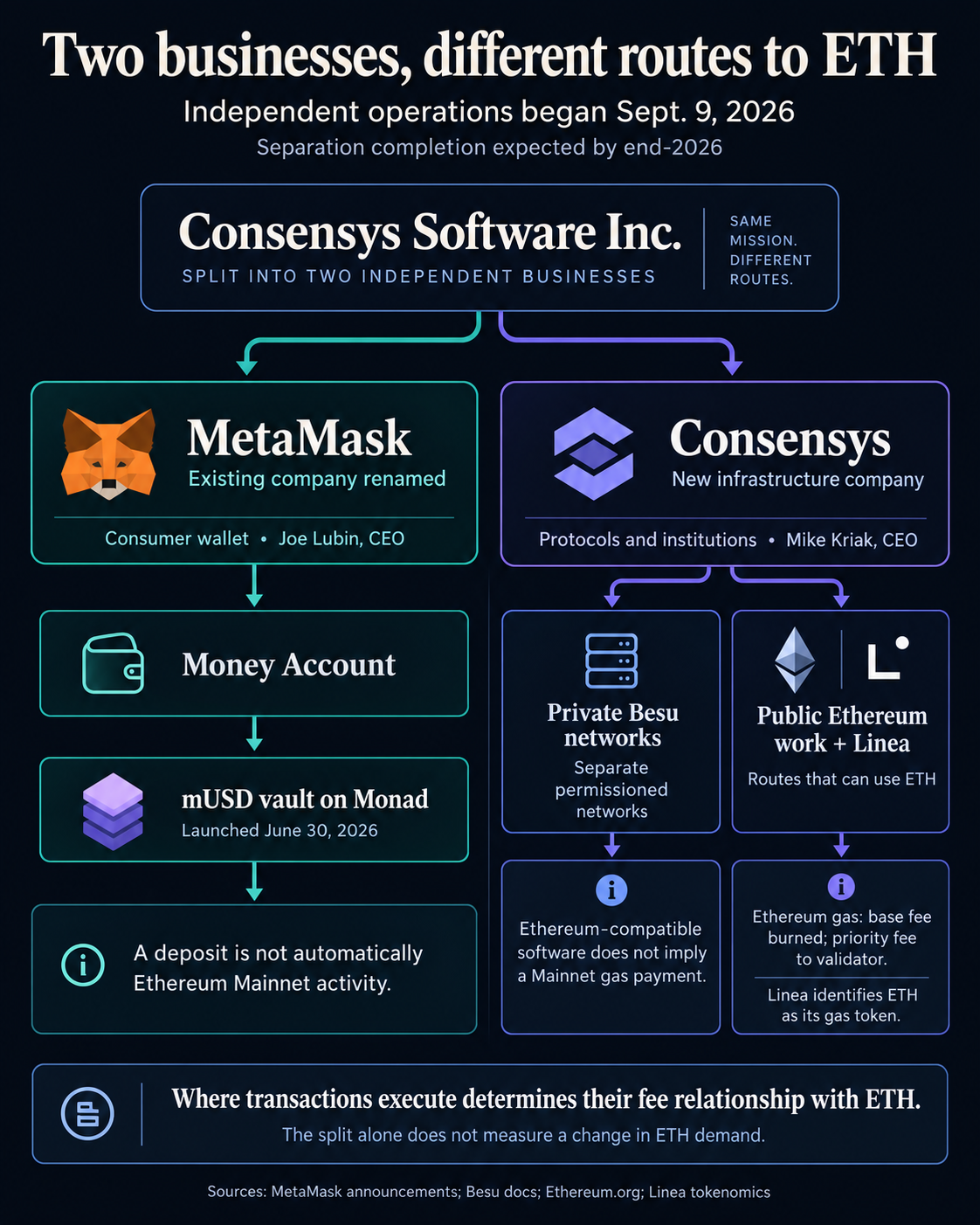
The clearest example is already inside MetaMask. Its Money Account runs on a separate blockchain, Monad, while the new Consensys will include software used for both public Ethereum and private institutional networks. The economic effect depends on where transactions happen and who receives the fees.
Under the announced structure, the existing Consensys Software Inc. continues as MetaMask. Its protocols and institutional infrastructure operations become a newly formed company carrying the Consensys name, including the Linea blockchain and software such as Besu and Teku. Joe Lubin leads MetaMask as chairman and CEO and serves as executive chairman of Consensys, whose CEO is Mike Kriak.
The businesses are set to operate independently, according to MetaMask's announcement, with the separation expected to be completed by the end of 2026. MetaMask says the change requires no action from users and does not change their app, assets, keys or access.
The wallet has its own economics
A wallet is the interface through which users choose what to hold, trade and spend. That position gives its operator a business opportunity separate from the blockchain's transaction charges.
MetaMask's swaps guide makes the distinction visible in its fee breakdown. It lists a 0.875% MetaMask fee separately from the network fee and the exchange rate quoted for the trade. Those are different payments for different parts of the same transaction.
The wallet's fee is therefore not a measure of Ethereum's fee income. A larger volume of fee-paying swaps could expand the wallet business, but the effect on ETH still depends on the networks used, the work each transaction requires and the fee conditions there.
Money Account adds another route. Introduced on June 30, it converts deposits into the mUSD stablecoin and uses Monad as its home network. MetaMask says deposits enter a DeFi vault that allocates funds across lending markets. Veda provides the infrastructure and Steakhouse curates the vault.
This lets the consumer proposition center on a dollar balance and financial functions rather than on holding ETH. Customer sales of ether or departures from Ethereum remain unestablished. Counting every Money Account deposit as new demand for Ethereum block space would conflate the two networks.
The product's yield also belongs in a different category from an ordinary wallet balance. MetaMask says returns are variable and the account is not a bank account or insured deposit product. Smart-contract, liquidity and protocol risks can lead to losses. Keeping control of signing keys does not remove the risks of the contracts a user chooses to enter.
The institutional side raises a similar distinction at the network level.
Besu is part of the infrastructure portfolio identified in the separation. Its private-network documentation defines a permissioned network as separate from Ethereum Mainnet and Ethereum testnets. Such networks typically have their own chain identifier and use proof-of-authority consensus, in which approved validators run the network.
An institution can therefore use Ethereum-compatible software without making each transaction an Ethereum Mainnet transaction. The software relationship is real; a Mainnet gas bill requires activity on Mainnet.
That is a different mechanism from the fee sponsorship CryptoSlate examined in August. A sponsor paying a user's Ethereum gas bill changes who supplies the ETH, while the network charge remains. Moving execution to a separate network changes which system processes the transaction in the first place.
The distinction helps separate four activities that can otherwise be bundled into a single adoption headline:
| Activity | Economic route | What it establishes for ETH |
|---|---|---|
| MetaMask swap | Wallet fee plus a separate network fee | The wallet fee alone does not measure Ethereum demand |
| Money Account deposit | mUSD vault on Monad | The deposit is not automatically Ethereum Mainnet activity |
| Private Besu transaction | Separate permissioned network | Use of Ethereum software does not imply a Mainnet gas payment |
| Ethereum Mainnet transaction | ETH gas, divided between base fee and priority fee | Direct use of ETH for network execution |
Private infrastructure can be commercially important while having a different relationship with ETH from a public network.
The routes that still benefit ETH
MetaMask remains Ethereum-first while supporting multiple ecosystems, and the new Consensys retains public-network work alongside its institutional business. Those commitments preserve routes through which growth can benefit Ethereum's native asset.
On public Ethereum, gas is paid in ETH. The base fee is burned, removing that ETH from supply, while the priority fee goes to the validator. Activity that uses this system has a direct fee relationship with the asset even when a wallet makes the process easier for the user.
Linea, which remains with the infrastructure business, offers another stated route. Its July 2025 tokenomics document identifies ETH as its gas token and describes a design allocating 20% of gas fees after Ethereum Layer 1 costs to ETH burning, with the remainder used for LINEA burning.
That historical design is not a current measurement of how much ETH is being burned. It does, however, explain why the institutional and protocol business cannot be treated as uniformly detached from ETH. Public networks, private networks and the consumer wallet have different economic connections to the asset.
For investors, the useful next evidence is the distribution of actual activity: which networks handle transactions, what fees they generate and how much of those fees reaches Ethereum or uses ETH. For MetaMask users, the immediate question is simpler: which service they are using, what it charges and which risks sit behind the balance shown on screen.
The separation gives the two businesses distinct operating mandates. Ethereum's software can reach more users and institutions through both. How much of that growth benefits ETH will be determined by the transactions and fees that follow.
Source: CryptoSlate