



FILTERED RESULTS
FILTERS
MCap $2.9T -0.4%24h Vol $64.2B +10%Fear & Greed 70/100Alts Index 59/100
BTC.D 58.9% +0.5%Stable.D 9.2% 0%ETH.D 11.4% +0.1%Others.D 20.5% -0.6%
QNT$164.25+56.3%•SOON$0.2857+31.86%•W$0.0155+21.45%•MARSCOIN$0.1369+18.77%•WLD$0.5674+17.24%•GRASS$0.6114+16.75%•SUPER$0.2134+14.37%•PYTH$0.0866+13.58%•COW$0.1716+13.16%•RAY$2.243+11.35%•
龙虾$0.1023-19.61%•BTW$1.044-15.51%•XPL$0.1101-8.46%•2Z$0.0687-8.38%•STONK$0.2932-6.09%•AERO$0.8535-5.23%•ZAMA$0.0870-4.9%•PROM$6.342-4.14%•ENA$0.2728-3.74%•VET$0.00928236-3.63%•
•
·
·
FILTERED RESULTS
SEC’s Hester Peirce Wants Zero-Knowledge Proofs to Fix KYC System
Asia’s Weekly TOP10 Crypto NewsSouth Korea Calls for KRW Stablecoin Liquidity Safeguards, Hana Bank...
$83 Million In Stolen XRP From Bitget Hack Moving On-Chain
Only 9 of the Top 50 Altcoins Have Beaten Bitcoin Since Its Peak: Picking the Winners Is Brutal
Tokenized Stocks Gain a Coalition Defending Shareholder Rights
XRP Price Prediction: $2.90 Bull, $0.85 Bear
Hyperliquid to Increase Deployment Limits in Upcoming Network Upgrade
Riot Repays Coinbase Loan, Ends $200 Million Bitcoin-Backed Facility
Hyperliquid: Next upgrade to raise HIP-4 deployment quota and lower funding rate cap
Bitget Asks THORChain to Block Hacker Address, Protocol Says No
GoPlus Raises Concerns Over THORChain's Decentralization and North Korea Fund Transfers
Why your tokenized stock could stop trading for three months
Whales Accumulate $112 Million in Dogecoin Amid Price Resistance
Centralized Exchanges Experience $3 Billion in Bitcoin Outflows
Crypto ATM Numbers Fall to 2021 Levels Amid Regulatory Crackdown
GoPlus Challenges THORChain’s Decentralization Claims Over DPRK-Linked Fund Flows GoPlus Security...
GoPlus Security Questions THORChain's Decentralization Amid DPRK-Linked Fund Transfers
Hyperliquid trader mk4 holds largest NEAR long position, with unrealized profit of about $17.55 million
Polygon Co-Founder Announces Additional POL Burn and Blockchain Upgrades
Quant (QNT) Rockets 75% Today as Major Banking Catalyst Fuels 180% Weekly Rally
Ethena Backs USDe With Tokenized Stocks on Binance
South Korea rolls out "AI for All" plan, aiming for nationwide coverage
DyorSwap Identifies Fake GIWA Mainnet and Plans User Compensation
The $ BTC ETFs saw $2.39B in net inflows this week.The highest weekly inflows since October...
Analyst: Altcoin market sees strongest expansion since July 2025, with 30-day growth of 12.5%
AMLBot says Bitget hacker routed about 4 BTC through Wasabi CoinJoin after moving funds across...
Upbit's GIWA Project Clarifies Mainnet Status and RPC Security
Bitcoin Price Eyes $100K as Fidelity’s Timmer Flips From His ‘Year Off’ Call
HTX to List PAID (UsePaid) on September 27 at 18:00
Bitwise's NEAR ETF Receives Regulatory Approval Ahead of Launch
Ripple vs. Gold: Is the Tide Finally Turning in XRP’s Favor?
'Crypto Mom' Hester Peirce Exits SEC, Leaving Just Two Commissioners
THORChain Achieves Highest Daily Revenue in Five Months
OpenAI and Anthropic CEOs summoned to appear at Australian AI inquiry hearing
Ethereum Bulls Are Closing In on a Major Breakout: Is This Resistance the Final Barrier?
‘Crypto Mom’ Hester Peirce Resigns From SEC Effective Oct 2
Capital B CEO: Bitcoin Is the Only Asset the U.S. Government Is Unwilling to SellCapital B CEO...
15 Institutions Spoke to Bitwise: More Crypto Buyers May Be Coming
A whale holds a 550,000 SOL long position for a month and a half, currently with an unrealized profit of $22.43 million
Grayscale Files for Zcash Income ETF With Planned Biweekly Payouts
THORChain responds to criticism over "handling hacker funds": a decentralized, permissionless protocol cannot refuse
OKX Founder Criticizes THORChain's Decentralization Claims
Slow Fog's Yuxian Critiques THORChain's Response to Security Incidents
Beijing police crack cross-border telecom fraud case, impersonating police to induce international students to transfer funds and exchange for USDT, freezing 780,000 yuan in involved funds
ETH breaks above $2,700, up 0.28% intraday
THORChain Addresses Security Concerns Following Bitget Incident
Ethereum Whale Realizes $72.83 Million Profit from Recent Sales
XRP Community Takes Center Stage in Evernorth’s Nasdaq Plans
An ETH whale took profit on about 30,000 ETH 9 hours ago, selling 112,000 ETH in a week for a $72.83 million profit
Whale 0xd0A4 withdrew 18.34M $ENA($5.13M) from #Gate, #Bybit, #OKX and #Binance...
AMLBot Traces About 4 BTC From Bitget Hack Into Wasabi CoinJoinCrypto compliance and blockchain...
Pump Fun Liquidates 47,994 SOL for $6 Million, Total Sales Exceed $848 Million
Pump fun(@Pumpfun) sold another 47,994 $SOL ($5.83M) 2 hours ago.In total, pump.fun has sold...
Bitcoin up 43.5% in Q3 as Ethereum surges 71%, supported by ETF demand and spot buyingRead...
ZEC hits all-time high, peaking at $1,697.45
193,627,000 $USDC (193,578,593 USD) transferred from Unknown Whale 1 to #Aave...
Bitcoin Price Gains 44% for Second-Best Q3 as Ethereum Jumps 71%
KLEA Crypto Daily: Saturday, September 26, 2026
Coinbase CEO Stands by His $400K Bitcoin Prediction for 2030Coinbase CEO Brian Armstrong...
193,627,346 $USDC (193,650,581 USD) transferred from #Aave to Unknown Whale 1...
GoPlus: Bitget’s $387.5M Hack Exploited the Transaction-Signing Trust Chain, Not Private KeysGoPlus...
OKX founder and CEO Star Xu said THORChain’s TSS vaults are collectively controlled by validators,...
THORChain responded to Bitget CEO Gracy Chen’s request that it refuse transactions from publicly...
Robert Kiyosaki Names 3 Income Types That Separate Rich and Poor
1,256 $BTC (105,882,575 USD) transferred from unknown wallet to unknown wallet...
Researchers Propose Zcash-Style Privacy for Bitcoin Without a Soft Fork
Solana’s Alpenglow Hits Second Testnet, 100ms Finality in Sight
River Exchange Initiates $6.7 Million Lawsuit Against Canadian Bitcoin Miner
SEC clears regulatory hurdle as crypto token buybacks hit record $638 million
Narrowing price cushions leave Bitcoin loans vulnerable to 4.7% price dips as Aave weighs higher leverage


Aave governance has advanced a proposal that would give Bitcoin-backed borrowers materially more leverage while leaving less room before liquidation.
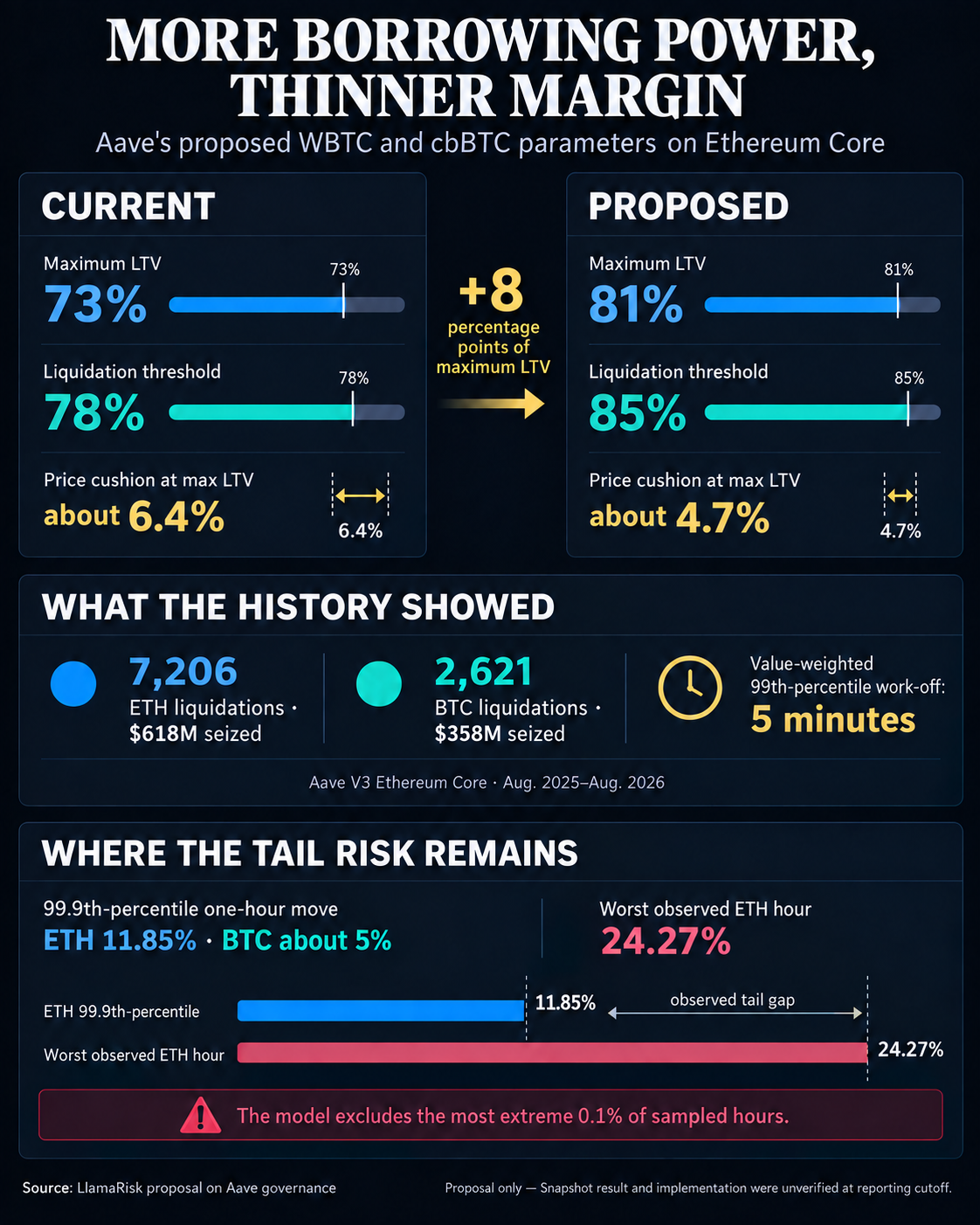
The proposal from risk service provider LlamaRisk would let users on Aave V3 Ethereum Core borrow as much as $0.81 against each $1 of WBTC or cbBTC collateral, up from $0.73. The liquidation threshold would rise from 78% to 85%.
LlamaRisk said on Sept. 21 that the proposal had advanced to Snapshot and voting would begin in less than 24 hours. The vote result and any implementation remained unverified at the reporting cutoff, so the higher limits are proposed parameters rather than live settings.
The case rests on one year of liquidation data showing that economically meaningful positions generally cleared within minutes. That history was recorded under existing parameters. It supports an argument for greater capital efficiency but cannot establish how the proposed settings would perform during the next extreme move.
Eight more cents of Bitcoin borrowing power
Loan-to-value, or LTV, sets the maximum debt that collateral can support. At 73% LTV, $100 of WBTC or cbBTC can support up to $73 of debt before reserve caps, available liquidity, asset eligibility and account-level constraints. At 81%, the same collateral could support up to $81.
The liquidation threshold marks the point where a position becomes eligible for liquidation. On Ethereum Core, the proposal would raise that threshold for WBTC and cbBTC from 78% to 85%.
| Ethereum Core BTC parameter | Current | Proposed |
|---|---|---|
| Maximum LTV | 73% | 81% |
| Liquidation threshold | 78% | 85% |
| Collateral-price decline from maximum LTV to liquidation | About 6.4% | About 4.7% |
The raw distance between LTV and the liquidation threshold would fall from five percentage points to four. The last table row expresses that distance as a collateral-price decline relative to the threshold, assuming debt remains unchanged and Bitcoin is the moving leg. Raising both parameters still narrows the borrower’s price cushion because the borrowing limit moves closer to the new liquidation line.
The changes extend beyond Ethereum Core. The proposal would raise Arbitrum WBTC’s ordinary LTV by five percentage points and Base cbBTC’s by eight points. Ethereum Core WETH, wstETH and weETH would each receive a 0.5-point LTV increase. Selected liquidation thresholds would also rise, while Base cbBTC’s liquidation bonus would fall from 7.5% to 6%. A separate Base cbBTC stablecoin E-Mode would move to 82% LTV and an 85% liquidation threshold.
These figures describe maximum capacity per dollar of eligible collateral. They do not quantify how much debt users would add. The proposal does not disclose a complete current dataset of collateral-enabled balances, debt attributed to each affected asset and account health factors. Total reserve supply would overstate usable collateral because some supplied tokens may be ineligible, disabled as collateral or unconnected to debt. Historical seized volume likewise does not reveal the live distribution of positions.
Minutes of liquidation history meet an hour-long tail model
LlamaRisk studied liquidation behavior from August 2025 through August 2026 across Ethereum Core, Arbitrum and Base.
On Ethereum Core, the analysis counted 7,206 ETH liquidations that seized $618 million and 2,621 BTC liquidations that seized $358 million. For both collateral families, the value-weighted 99th-percentile time a liquidation call spent at or below its execution price was five minutes.
That statistic measures a liquidation work-off window. It is different from saying that 99% of transactions executed within five minutes of an oracle update. Large positions can require several calls because a single liquidation generally repays only part of the debt.
The study separately measured processing after price-feed publications during the February and October 2025 stress windows. Its table reports that 100% of seized volume cleared within five minutes of the feed publication that made liquidation profitable in every listed market during those two events.
February produced no recognized deficit. October produced $0.39 million of event-level bad debt against roughly $128 million, although LlamaRisk said none affected the ETH- or BTC-family collateral analyzed for this proposal. The result suggests that liquidator response was not the binding constraint in those episodes; it does not recreate those events under the proposed higher leverage.
The model then combines a one-hour price excursion with each reserve’s liquidation bonus to derive a ceiling for the liquidation threshold. In the detailed table, the 99.9th-percentile adverse one-hour move was 11.85% for ETH and about 5% for BTC.
That percentile omits the most extreme 0.1% of one-hour observations in the two-year sample. The same record contained much larger moves: a worst one-hour ETH decline of 24.27% and a worst BTC decline of 10.72% in the detailed table. The proposal’s summary gives 11.15% for the BTC worst hour, an internal discrepancy, but either BTC figure is more than twice the roughly 5% percentile input.
The gap defines the residual risk. LlamaRisk’s framework assumes that regular oracle publications and responsive liquidators prevent a maximally leveraged position from sitting untouched for a full hour. A move beyond the percentile can become more damaging if price feeds stall, liquidation activity slows or market depth deteriorates at the same time.
The percentile therefore calibrates a protocol bad-debt buffer rather than a borrower protection level. A maximally borrowing BTC position could reach the proposed liquidation threshold after an approximately 4.7% collateral-price decline under the simplified single-asset calculation, even though the protocol model uses a roughly 5% BTC excursion plus the liquidation bonus to assess post-liquidation coverage.
The proposal leaves BTC thresholds below the model ceiling to account for depth, caps and concentration risks that price history does not capture. ETH receives less room: WETH is set at the model ceiling, while wstETH and weETH sit one point inside their ceilings.
The Bitcoin LTV vote weighs speed against leverage
Aave’s governance choice is whether observed liquidation performance under current parameters justifies allowing future positions to run closer to liquidation.
For Bitcoin collateral on Ethereum Core, the exchange is clear at the borrower level. Maximum LTV would rise eight percentage points, while the simplified collateral-price cushion at maximum leverage would shrink from about 6.4% to 4.7%. Existing borrowers would not automatically add debt, but the new limits would permit new or adjusted positions to carry more.
The protocol-level case is more favorable than the borrower-level cushion alone suggests. In LlamaRisk’s sample, economically meaningful liquidations were processed quickly, and the two studied stress windows left no bad debt on the reviewed ETH- and BTC-family collateral. The model also incorporates the liquidation bonus and keeps recommended BTC thresholds below its calculated ceiling.
Its limits are equally specific. Historical execution does not measure an outage that coincides with an exceptional price move. The worst one-hour declines in the same dataset exceeded the percentile inputs by a wide margin, and the model cannot remove liquidity, concentration or oracle risk.
The aggregate credit effect also remains unknown. Calculating it would require current collateral-enabled balances for every affected asset and market, the debt those positions already carry, their collateral settings and their health-factor distribution. The published proposal supplies the parameter change, not that full position-level dataset.
The forum says an implementation AIP would follow only after a positive Snapshot result. Until a vote and AIP establish the final values, the 81% Bitcoin LTV remains a governance proposal.
LlamaRisk’s study makes a measurable case that fast liquidation work-off can support greater collateral efficiency. The unresolved question is how much confidence Aave should place in that history when the danger lies in the hour that combines an unusually large market move with impaired pricing, liquidation or market depth.
Source: CryptoSlate