



FILTERED RESULTS
FILTERS
MCap $2.9T -0.8%24h Vol $121.7B +25%Fear & Greed 72/100Alts Index 43/100
BTC.D 58.9% +0.2%Stable.D 9.2% +0.1%ETH.D 11.3% -0.1%Others.D 20.6% -0.2%
SAND$0.0648+45.18%•NIGHT$0.0483+24.44%•CARDS$0.2493+22.4%•GALA$0.0025786+14.17%•ATH$0.00659162+12.89%•STONK$0.2589+11.93%•MANA$0.0988+11.36%•APE$0.1631+10.18%•MINA$0.1618+8%•WLD$0.5382+7.96%•
2Z$0.0456-18.68%•MARSCOIN$0.1066-15.71%•SOON$0.3687-13.98%•PONS$0.4433-12.19%•BR$0.6682-11.58%•BP$1.360-8.56%•QNT$229.63-8.07%•CASHCAT$0.1550-7.97%•PUMP$0.00532427-7.24%•PENGU$0.00882827-6.11%•
•
·
·
FILTERED RESULTS
US Community Bank Group Sues OCC, Challenging Trust Bank Charters for Crypto Firms
South Korea proposes rules to bring stocks, bonds and funds onchain from February...
Shiba Inu (SHIB) Explained: Burn Mechanisms, Tokenomics,…
North Dakota’s Roughrider Coin Goes Live on Fiserv and Solana
Arbitrum Suspends New Stylus Activations Amid Security Concerns
Microsoft’s X Account Hijacked to Promote Clippy Meme Coin
🏴 CryptoPunks Rally Again
Chainlink SWIFT Deal Could Put LINK Closer to Thousands of Banks
Independent Community Bankers of America Sues OCC Over Trust Licenses for Cryptocurrency Firms
Bank group sues U.S. regulator over granting crypto trust charters
California Subpoenas OpenAI Over AI Models That Hacked Their Way Out of a Test
Strategy Moves $297M in Bitcoin After Latest Purchase; Should Traders Be Concerned?
Uniswap Dominates Tokenized Stock Trading with $17.1 Billion in Volume
Dormant Bitcoin Wallet Holding 600 BTC Awakens After 14 Years as Price Hits $87,000
250,000,000 $USDC (250,009,749 USD) minted at USDC Treasury...
Crypto Price Predictions: Bull Market Targets for BTC, ETH, SOL, and XRP
Ethereum Foundation and OA Launch zkAPI for Private AI Payment
Ethereum’s $2,800 Test Will Set the Tone for Altcoins This October
Bitcoin’s $85,000 sell wall is gone and traders are now betting on $100,000
Backpack SECURITIES-ISSUED $BLK, TOKENIZED BLACKROCK, GOES LIVE ON solana VIA sunriseNOW ON...
Backpack Securities Launches Tokenized BlackRock Shares on Solana
CryptoPunks Are Heating Back Up
Aave Founder Warns EU MiCA Review Could Restrict DeFi Access
September and October Usher in the Most Bullish Bitcoin Price Predictions — Details
Community Bankers Sue OCC Over Crypto Firms’ Bank Charter Path
European crypto users have ‘more faith’ in regulated firms under MiCA: Bitpanda co-CEO
Tesla Delivered 486,532 Cars in Q3 – 24,558 Above the…
BlackRock’s $195.6 million Inflow Push Bitcoin ETFs Back Into Green
Dehradun Trader Allegedly Duped of Rs 1.5 Crore in Crypto Scam
Powerus Goes Public on Nasdaq and Launches Tokenized Shares on Solana
Ethereum Now Lets You Pay for AI Without Revealing Who You Are
Drift opens claims for stolen funds compensation, initial payout rate around 1% of losses
NY Man Pleads Guilty in $5 Million Senior Fraud Scheme Involving Crypto
Lummis Says Democrats Opposed CLARITY Act Over Customer Protections
Crypto hackers exploit third-party Aave tool to steal 114 ETH
Circle Pushes Back on MiCA's Bank-Deposit Mandate for Stablecoins
US Midterms: Stand With Crypto Backs Bipartisan Slate After Senate Bill Fails
278,000,000 $ENA (65,549,627 USD) transferred from unknown wallet to unknown wallet...
Anchorage Digital Lays Off 17% of Workforce Amid Cryptocurrency Market Downturn
Large Stake of $1 Million in SOL Boosts New Solana Validator
SEC Proposes New Custody Standards for Crypto Assets
966,000 $SOL (114,103,817 USD) staked at unknown wallet...
NEAR Intents Ends Exploit Probe After $3.8 Million Is Returned
NEW: Institutional crypto bank Anchorage Digital has reportedly laid off roughly 17% of its staff,
This AI Is Already Fooling People on Video Calls Into Thinking Its Human, Company Says
Ethereum Long Positions Cluster at $2,538 Amid Market Activity
Client Alert: $320 Million Crypto Heist—What It Means for Asset Recovery and Who Pays
Bitcoin Crashes Below $84K as Crypto Liquidations Near $600M
SEC Proposes Rules That Could Change How Funds Custody Crypto
Iran has just struck an oil tanker conducting an outbound transit of the Strait of...
SEC Proposes Last-Resort Crypto Self-Custody for Advisers and Funds
Meet the New Bitcoin Treasury Firm That Already Plans to Sell BTC
U.S. Sanctions Hamas Network Over $2M Crypto Funding
Drift Hack Victims Can Redeem DFX at About 1 Cent Per…
Hester Peirce Leaves SEC After Advocating for Digital Assets
Ethereum Foundation Launches zkAPI for Enhanced Privacy in API Payments
Porsche scraps NFT project with floor price down 96%
BTC falls below $84,000, down 1.61% intraday
Bitcoin on Pace for Third Straight Weekly Gain on ETF Demand
Absa Bank Becomes First African Bank to Offer Bitcoin Custody Services
Aave Proposes Legal Entity to Hold Protocol IP for the DAO
Hester Peirce Ends SEC Commissioner Tenure on October 2
Blast to wind down Ethereum L2 after costs outpace revenue
Fidelity Considers Expanding Access to Ethereum Tokenized Money Market Fund
US jobs data revised lower after Fed rate hike
Pi Network (PI) in October: 3 AIs Speculate What Will Happen With the Price
SEC Proposes New Crypto Custody Framework for Advisers and Funds
Evernorth’s Nasdaq XRP treasury is approved, but its real buying power isn’t the $300 million expected
Anchorage Digital Reduces Workforce by 17% Amid Industry Challenges
Stablecoin issuers have replaced 40% of China’s lost US Treasury demand


Stablecoin issuers are emerging as a new source of demand for US government debt as foreign official holdings lose ground.
Tether and Circle have increased their Treasury securities and repurchase-agreement holdings by about $200 billion over the past five years, equivalent to more than 40% of the decline in China’s Treasury holdings over the same period, researchers at the Federal Reserve Bank of San Francisco said.
The shift is beginning to alter the investor base underpinning the world’s largest government bond market. Stablecoin issuers’ Treasury holdings have risen more than tenfold in five years as demand for dollar-linked digital tokens expanded, while China has continued a retreat from US debt that began more than a decade ago.
Stablecoins gain ground as foreign governments retreat
The rise of crypto-linked buyers comes as the composition of US creditors undergoes a longer-term change that could affect how cheaply Washington can finance its deficits.
Foreign investors held more than half of outstanding Treasury securities around 2008, but their share had dropped to roughly 30% by early 2026, the San Francisco Fed said. Within that group, foreign governments have declined even more sharply in relative importance, accounting for just above 40% of foreign Treasury demand by early 2026 compared with nearly all of it at their peak in the 1970s.
China has been central to that shift. Its Treasury holdings peaked in late 2013 and had fallen by more than half by mid-2026 as Beijing diversified its reserve assets.
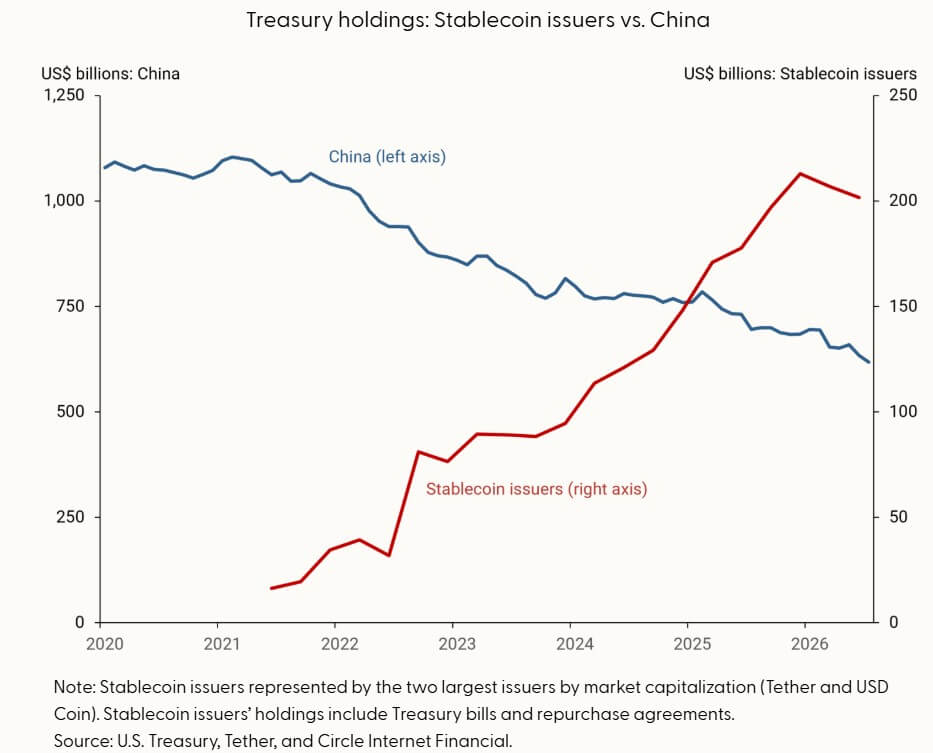
Private investors have taken a larger role as official foreign demand weakened, potentially making Treasury financing more sensitive to interest-rate changes and perceptions of US fiscal risk. Unlike central banks, which may hold Treasuries for reserve-management purposes, private investors can demand higher yields when risks rise or competing returns increase.
Stablecoin issuers add a different source of demand because their business model requires large pools of liquid dollar assets backing tokens that customers can redeem at par.
Tether’s USDT and Circle’s USDC accounted for more than 80% of stablecoin market capitalization as of mid-August, the Fed researchers said. Both issuers hold substantial amounts of short-term Treasury securities, along with cash, bank deposits, and repurchase agreements, to meet redemption demands.
Their growth has already made them significant participants at the short end of the Treasury market. Since 2023, stablecoin issuers have added more short-term Treasury holdings than Japan, the largest foreign holder of US government debt, according to the research.
That demand is also large enough to measurably affect short-term government bond yields, the San Francisco Fed said, citing research from the Bank for International Settlements.
The China comparison has a maturity gap
Stablecoins cannot fully replace the type of demand China has withdrawn because the two investor groups operate in different parts of the Treasury market.
China’s reductions have been concentrated largely in longer-dated US debt, while stablecoin issuers predominantly buy Treasury bills and other highly liquid, short-maturity assets. That means growing stablecoin reserves can deepen demand for bills without necessarily creating an equivalent buyer for longer-term notes and bonds.
The distinction comes as the US faces heavier financing requirements. Federal debt held by the public has risen from about 35% of gross domestic product in 2006 to roughly 100% today, increasing scrutiny of the investor base willing to absorb new issuance.
Regulation could reinforce stablecoins’ preference for the shortest maturities.
The GENIUS Act, adopted in 2025, created a federal framework requiring approved US payment stablecoin issuers to fully back outstanding tokens with eligible liquid reserves.
Proposed implementing rules include Treasury bills, notes and bonds with remaining maturities of 93 days or less, alongside cash, bank deposits and certain Treasury-backed repurchase agreements.
That structure effectively links growth in regulated dollar stablecoins with incremental demand for highly liquid US government securities.
For issuers, the economics can also be attractive. Customers hold tokens that generally do not pay them the yield earned on reserve assets, while issuers can collect interest from the Treasury securities backing those tokens.
As circulation expands, reserve portfolios and the associated interest income can rise with them.
Global stablecoin adoption could funnel more capital into T-bills
The next phase will depend on whether stablecoins continue attracting users outside the traditional crypto trading market.
The San Francisco Fed pointed to growing use of stablecoins for cross-border payments and as dollar-denominated stores of value in countries with volatile currencies. Usage relative to economic output is particularly high in Africa, the Middle East and Latin America, with much of the activity crossing national borders.
That creates a channel through which a stablecoin user abroad can indirectly finance US government borrowing. A customer acquiring dollar tokens creates additional reserve liabilities for the issuer, which can in turn purchase Treasury bills to back them.
Extending the industry's recent growth rate would lift those holdings toward $400 billion by 2030, though the Fed researchers cautioned that the estimate carries substantial uncertainty. Regulation outside the US, competing digital-payment products and new bank technology could all slow stablecoin adoption.
Those competitive pressures will determine how much of the next wave of dollar-based payments ultimately flows through stablecoin issuers and into Treasury markets.
Banks developing cheaper cross-border settlement tools could capture some of that demand, while stablecoin companies expanding into remittances and payments would need to keep increasing liquid reserves as circulation grows.
Source: CryptoSlate