



FILTERED RESULTS
FILTERS
MCap $2.9T -0.5%24h Vol $68B +17%Fear & Greed 70/100Alts Index 59/100
BTC.D 58.9% +0.5%Stable.D 9.2% 0%ETH.D 11.4% +0.1%Others.D 20.5% -0.6%
QNT$189.81+57.23%•SOON$0.3184+42.34%•Q$0.0498+37.46%•BTW$1.148+23.58%•W$0.0159+23.27%•BP$1.510+20.63%•GRT$0.0325+18.29%•NEAR$5.438+13.07%•PUMP$0.004932+12.05%•JASMY$0.005268+11.84%•
AI$0.2205-17.26%•BR$0.9088-11.77%•MARSCOIN$0.1266-10.34%•SENT$0.0218-8.44%•PONS$0.5867-8.1%•KMNO$0.0468-6.48%•ZAMA$0.0832-6.41%•XPL$0.1067-6.11%•龙虾$0.1031-5.19%•DASH$68.998-4.6%•
•
·
·
FILTERED RESULTS
Zcash (ZEC) To Hit $5,000 By The End Of 2026: Co-founder
Same Name, Different Company: Blockstream Addresses $6.7M River Lawsuit
Top Trending Coins (Today) 1. QNT 2. NEAR 3. TRUMP 4. EDEL 5. SUI 6. PUMP 7. BP 8. RHEA 9. STONK...
Hunter Biden Says $LAPTOP Memecoin Still Has Significant Value Despite 99.5% Collapse
California Bans Public Officials from Issuing Meme Coins
Pump Fun is not authorized to solicit some Canadian investors, AMF warns
SEC official says widespread adoption could make tokenized trading...
Coinbase and Strategy: A Comparative Analysis of Two Crypto Investment Options
Ethereum Price Prediction: Top Analyst Sees Final Hurdle Before Bull Run
Bitcoin To Hit $300,000 By 2029, Says Fidelity Global Macro
Iran's Crypto Mining Operations Consume Significant Electricity Resources, Report Reveals
“The Crash Is Coming,” Prominent Analyst Warns XRP Holders of Trouble Ahead — But a $30 Moonshot Could Follow
Cosmos intercepts 1.23 million stolen ATOM but refunds now wait on governance vote
Ethereum’s Next Era: Vitalik Buterin Calls It a “Cryptographic World Computer”
FTX's Unliquidated Investments Valued at $206 Billion, Highlighting Losses from Fire Sale
Thorchain Faces Heat as Bitget Hack Revives Bybit Controversy
Bitcoin ETF Comeback: $2.4B Week Flips Year-to-Date Flows Positive
Michael Saylor Calls for ‘Bill of Digital Rights’ for AI…
Bitget freezes XRP withdrawals as 27M stolen tokens move
California Governor Gavin Newsom signs law banning public officials from...
Peter Brandt Says XRP Charts Alone Give Him Reason to Make a Bet
Investigation Links $18 Million Rug-Pull Scheme to 53 Token Launches on Robinhood Chain
Wazz: 53 Robinhood Chain Token Launches Linked to Rug-Pull Operation, at Least $18.43M...
Bitcoin Price Analysis: Key Support Levels and Liquidity Clusters to Watch This Week
Strategy Turns to Daily Dividends to Steady Its Preferred Stocks
SEC staff’s staking-token split spotlights the exit risks behind staked ETH tokens
Global Money Supply Hits Record $103.66 Trillion
Ripple News: Why Ripple’s CLO Says CLARITY Act’s Fate Doesn’t Matter For XRP
Zano restarts blockchain and rolls back a month of history to fix unauthorized ZANO and fUSD...
Zano Wipes 1 Month of History to Fix Massive Crypto Inflation Bug
Apollo Chief Economist Warns AI Agents Could Trigger Bank Runs
When Will Nvidia Stock Go Down? Here’s What Could Trigger It
AI Agents Keep Escaping Their Creators' Control—Here's What We Know
New Bitcoin proposal rescues locked multisig wallets – At a hidden cost
Visa cuts reported stablecoin volume but there’s no proof payments fell
Peter Brandt Predicts $8,600 ETH, Coinbase Adds IPO Share Trading, And More – Week In Review
SpaceX/cursor_ai’S benln SAYS THAT fomo IS THE FASTEST GROWING STARTUP ON X BY FOLLOWER...
Strive CEO Indicates Plans to Expand Bitcoin Holdings
Vitalik Buterin Unveils Ethereum's Vision for 2030
U.S. President Trump Anticipates Further Negotiations with Iran
Vitalik Buterin says Ethereum is called a "blockchain" mostly "for historical reasons"
Bitget Hacker Moves $83M in XRP as Network Rules Limit…
Ripple Price Analysis: XRP Tests Critical Resistance as Bullish Structure Holds
Vitalik publishes 32-chapter work "Snowmoon," open-sourced under GPL v3
Kraken Parent Payward Bets Billions to Become Financial Infrastructure
Bybit's weekly platform updates General• $PONS is officially listed on Bybit Spot• Tomorrowland...
Bitcoin's Quantum Problem: Three Ways Researchers Are Trying to Fix It
Vitalik Buterin Releases Science Fiction Novel 'Snowmoon' Under Open Source License
Bitmine Chairman Highlights Role of Tokenization and AI in Cryptocurrency Market Cycle
THORChain Rejects Bitget's Request to Block Hacker Addresses
Ethereum's Future Vision Focuses on Censorship Resistance and Wallet Flexibility
Bitcoin Surges 32% Over Two Months, Still Below Year-Ago Prices
Vitalik Buterin maps Ethereum’s shift beyond a blockchain in sweeping 2030 vision
US Treasury Secretary Bessent: Core inflation has remained calm
Even More Orange: Saylor Teases Another Strategy Bitcoin Buy
Jupiter Exchange COO Advocates for Major Improvements in DeFi to Attract Institutional Capital
Ethereum is not instant, but collateral could make it feel that way
Bitcoin Price Climbs Back Toward $85K With Bulls in the Driver’s Seat
Monochrome Exchange Raises Over 5.5 Million USDT in MCR Token IEO
U.S. Bitcoin ETFs Draw $2.4 Billion as 2026 Net Flows Turn…
Vitalik Buterin Envisions Ethereum as a 'Cryptographic World Computer'
Trader 0x9c6a opened a 20x long on 550,087 $SOL ($67.88M) a month ago and is now sitting on an...
Vitalik: Ethereum Is Evolving Beyond a Blockchain Into a “Cryptographic World Computer” Vitalik...
Monochrome Exchange, founded by former Binance Australia CEO, launches MCR IEO with over 5.5 million USDT raised
DYORSWAP Announces Compensation Plan for Affected Users
SEC Staff Says Token Buybacks Don't Make Crypto a Security—If the Network Works
Bad News Is Good News — Week in Review
DOGE Rally Brewing? Whales Load Up as Dogecoin ETFs Post Record Inflows
Market Overview: BTC : $84824 ETH : $2708.78 BNB : $780.73 SOL : $123.55 Market Cap :Total : 2.9T DeFi ...
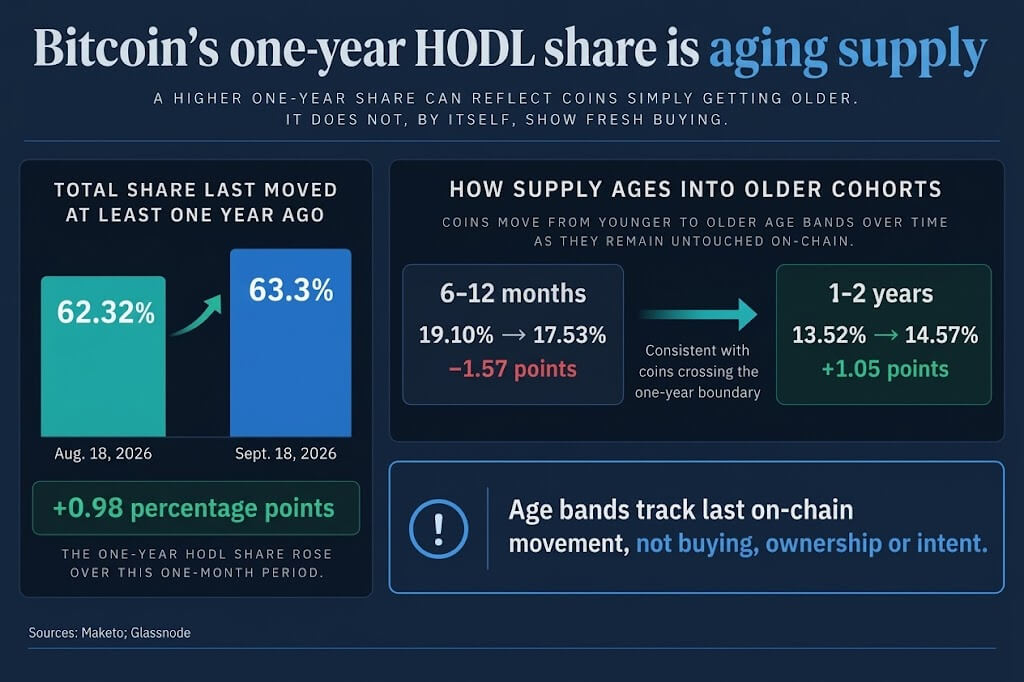
Why Bitcoin’s 63% HODL wave isn’t the mega bull signal everyone thinks it is


Bitcoin’s share of supply last moved at least one year ago reached 63.3% on Sept. 18, up 0.98 percentage points from 62.32% on Aug. 18, according to Maketo’s HODL-wave data.
HODL waves group Bitcoin’s unspent transaction outputs into age bands based on their last on-chain movement. The rising one-year share therefore shows that more supply now sits in older bands. Current-month buying and deliberate withdrawal from the market require separate evidence.
The underlying bands point to a specific mechanism. Coins that last moved roughly a year ago can enter the one-to-two-year bracket simply by remaining still long enough to cross the boundary.
What Bitcoin HODL waves measure
The one-to-two-year band increased to 14.57% of supply from 13.52% between Aug. 18 and Sept. 18, a gain of 1.05 percentage points. That was the largest positive change among the cohorts already older than one year.
Over the same period, the six-to-twelve-month band fell to 17.53% from 19.10%. Glassnode’s Sept. 18 snapshot showed the same latest values for both bands.
The paired moves are consistent with coins crossing the one-year boundary. Each band is a net share after coins age into it, age out of it or move on-chain and reset to the youngest cohort, leaving the identity and gross flow of the underlying units unresolved.
Recent movement also eased. Coins last moved within one month accounted for 7.03% of supply on Sept. 18, down 0.27 percentage points from 7.30% a month earlier.
Under Glassnode’s methodology, an unmoved output advances into older bands as it crosses each age threshold. Movement resets the clock.
Last-movement age leaves beneficial ownership and intent unresolved. A transfer between wallets controlled by the same person or custodian can make an output look young even when ownership has not changed. Lost coins can remain in the oldest bands without representing a deliberate decision to hold.
Coinbase provided a practical example in November 2025 when it warned that an internal wallet migration would create large on-chain volumes unrelated to market conditions. That episode illustrates attribution uncertainty and is not offered as the cause of the current shift.
The Sept. 18 readings support a limited conclusion: Bitcoin’s on-chain age distribution grew older while the share moved within a month declined. Available-for-sale supply and liquid-supply tightening remain unmeasured.
Identifying a fresh-accumulation thesis needs corroboration from entity-adjusted balance changes, exchange flows, and spending behavior. Until those measures align, the rising one-year wave is an aging signal rather than proof of new demand.
Source: CryptoSlate