



FILTERED RESULTS
FILTERS
MCap $2.9T -0.5%24h Vol $155.4B +125%Fear & Greed 74/100Alts Index 57/100
BTC.D 58.4% -0.5%Stable.D 9.3% +0.1%ETH.D 11.4% 0%Others.D 20.9% +0.4%
SHFL$0.6630+69.75%•HBAR$0.1234+30.59%•MARSCOIN$0.1557+23.9%•NMR$12.018+19.54%•ALGO$0.1346+14.21%•BTW$1.300+13.41%•IOTA$0.0555+9.14%•LINK$15.203+8.79%•牛来$0.1151+6.89%•AI$0.2344+5.53%•
Q$0.0259-47.69%•USELESS$0.2361-17.96%•GRASS$0.5742-15.66%•FARTCOIN$0.1659-15.17%•NEAR$4.731-14.63%•ZEN$6.803-13.44%•RAY$1.897-12.76%•WLD$0.4836-12.23%•AR$4.202-11.9%•KMNO$0.0427-11.81%•
•
·
·
FILTERED RESULTS
Anthropic's Claude Sonnet 5.5 Is Out, Beats Opus 5.5 at Coding for Half the Price
After AI Agent Hacked Its Government, Australia Calls Altman and Amodei to Testify
In the Wake of CLARITY Act’s Failure, Agencies Move Forward Without Congressional Action or Certainty
Expansion of Trademark Rights: What Yuga Labs v. Ripps Means for Game Studios
Strive Scoops up 1,107 Bitcoin as Its $2.3B Treasury Expands
Banking Giant Citi Taps Coinbase to Turn Stablecoins Into Cash
Hyperliquid (HYPE) Drops 5% – Could Whales Trigger an Even Bigger Sell-Off?
Ripple CEO Unpacks What Really Drives XRP’s Value — Here’s Everything You Need to Know
Breaking: Vitalik Buterin Declares Ethereum Is No Longer Just A Blockchain
Spark Allocates $210 Million for Institutional Loans Backed by Bitcoin
Avalanche Leads Blockchain Sector with $131 Million in Tokenized Stock Inflows
Blockchain.com Files Confidential S-1 for Multi-Billion Dollar IPO
Bittensor Introduces Gamma Tokens to Foster Collaboration Among Subnets
Blockchain.com Plans IPO Targeting Up to $6 Billion Valuation
Chainlink Introduces CCIP 2.0 Featuring Custom Verifiers and Enhanced Transfer Speeds
Polygon Announces Temporary Increase in POL Staking Rate to 7.7%
Goldman Sachs Connects $100 Billion Treasury Fund to Lynq Network
Compound Foundation Responds to Allegations of V2 Reserve Misuse
Tether Assists in Freezing $550 Million in Iran-Linked USDT
163,061,311 $USDC (163,116,752 USD) minted at USDC Treasury...
Iran Agrees To Suspend Uranium Enrichment In Exchange For US Sanctions...
Belarus Moves Toward Registering First Two Crypto Banks Under New Rules
1,357 $BTC (113,578,422 USD) transferred from #Paypal to unknown wallet...
ETHFI to Fully Exit EigenLayer Restaking as Yields Dry Up and Sector Profitability DeclinesETHFI...
Bitcoin’s (BTC) Still in a Bull Market, But a Correction Could Be Coming First
Russia lets crypto exchanges apply October 5 – but even Bitcoin lacks final retail clearance
Trump Diesel Curbs Could Hit Every Major Economy, Devere Warns
Crypto PAC spends $11M to oppose Sherrod Brown in Ohio
Circle's Arc Facilitates $150 Million in USDC Borrowing Against Bitcoin Collateral
Analysis: AI-related debt issuance has limited impact on U.S. Treasury yields; 10-year yield may fall to 4.25% by end of 2027
Ondas investors blame short-sellers, fails-to-deliver
Apollo Chief Economist: AI Agents Automatically Moving Deposits Could Trigger a "Slow-Motion Bank Run"
BGB Token Price Faces Fresh Pressure to Fall Under $1 After Bitget Hack
Ethereum Holds Near $2,677 as Traders Watch $2,700 Resistance
Arbitrum Foundation launches security program to subsidize smart contract audits for ecosystem projects
Aptos Foundation Collaborates to Establish Stablecoin Corridor Between Middle East and Africa
Spectra Finance Introduces Fixed-Term Markets for deJTRSY on Stellar Network
Hut 8 Secures $1.07 Billion Senior Secured Revolving Credit Facility with Four-Year Term
Vitalik Buterin Outlines 'Cryptographic World Computer' Plan for Ethereum
China Says Crypto Anonymity Is an “Illusion” Amid Spy Warning
Bitcoin Braces For a Week That Could Reshape Its Path
Trump ready to ease Iran sanctions and unfreeze its frozen assets
The restaking gold rush is over, and top protocols are barely making a profit
NEAR Rockets as Bitwise ETF Clears a Major Hurdle
Bitcoin ETFs Smash Through Their Biggest Week in a Year
1,336 $BTC (111,542,369 USD) transferred from unknown wallet to #Paypal...
Quant Explodes Over 300% As Banking Giants Move In
Bitget Resumes Withdrawals in Stages After $388 Million…
Chainlink Reaches 2026 High of $14.89 Amid Diverging Market Trends
SEC Commissioner Hester Peirce is wrapping up her time at agency this week.In an
BlackRock Withdraws $127 Million in Cryptocurrency from Coinbase Prime
Polymarket Introduces 15-Minute Bitcoin Price Markets for US Users
Ondo Perps Introduces Spot Trading for Tokenized Stocks and ETFs
Tether is a ‘lifeline’ for Iranian regime, Senate Dems say in new report
CCIP 2.0 Goes Live With $84B in Cross-Chain Value Secured
24-Hour US Stock Trading Era Approaches as Major Exchanges Accelerate After-Hours Trading
DeFi researcher Ignas: Fewer than 20 quality tokens in the crypto market currently have real revenue support
Polymarket Launches 15-Minute Bitcoin Up/Down Markets On Its US App, Allowing Millions Of Users A...
Bitget Restarts Bitcoin Withdrawals as $388M Hack Investigation Widens
Solana: Skip Rate Stable After Slot Time Drops to 250ms, 200ms Target Still Requires Caution
Volante Technologies Partners with Circle to Enhance USDC Payment Integration
Solana Network's Real Economic Value Reaches Six-Month High
Ethereum Post-Hegotá: Vitalik Buterin Lays Out 2030 Roadmap
OKX US to sell USD trading bot positions if users miss Sept 30 deadline
RLUSD market cap is only about $248 million away from surpassing PayPal's PYUSD
830 $BTC (69,133,202 USD) transferred from #Kraken to unknown wallet...
Belarus Registers First Crypto Banks Under New Regulatory Framework
1,479 $BTC (122,902,521 USD) transferred from unknown wallet to Coinbase...
Chainlink has launched CCIP 2.0, an upgraded version of its cross-chain infrastructure
SEC staff’s staking-token split spotlights the exit risks behind staked ETH tokens


An ETH holder can sell a liquid-staking token while the ETH behind it remains staked. A Sept. 25 SEC staff FAQ draws a conditional distinction between receipts that evidence ownership and protocol-issued tokens. Coinbase and Lido disclosures show the holder's practical stake: a transferable token does not guarantee immediate unstaked ETH or a sale at the underlying position's value.
The Securities and Exchange Commission's Division of Corporation Finance said a qualifying staking receipt for a digital commodity may be a “digital tool.” A token issued by a protocol-based liquid-staking provider may instead be a “digital commodity.” The staff does not classify Coinbase's cbETH or Lido's stETH by name. Their terms determine who holds the deposited ETH, how the token can be redeemed and what can happen if its holder sells instead.
What counts as a receipt
The staff FAQ defines a receipt by the rights it represents. It evidences that an asset was deposited and that the depositor retains ownership. Under the FAQ's description, ownership and control do not pass to the receipt issuer, which cannot transfer, lend, pledge, rehypothecate or otherwise use the deposited asset, or expose it to third-party claims. That is a description of the type of receipt the staff is discussing, not a new custody rule for every token sold as liquid staking.
The FAQ then distinguishes two possible classifications under the SEC's March crypto-asset interpretation. A receipt for a digital commodity that is not subject to an investment contract can be a digital tool because its function is to evidence ownership. A receipt issued by a protocol-based liquid-staking provider may itself be a digital commodity when its value is linked to a functioning crypto system and market supply and demand. The word “may” matters: neither answer assigns a status to an individual product merely because it is called a staking token.
An earlier August 2025 staff statement described liquid-staking tokens as transferable evidence of deposited assets and their accrued rewards. It discussed both smart-contract protocols and third-party custodians, limiting its securities-law view to the arrangements it described. It did not address restaking or arrangements in which a provider controls staking choices, sets or guarantees rewards, or facilitates additional token returns. Falling outside that statement is not, by itself, a finding that an arrangement involves securities.
Those categories shape the staff's securities-law analysis of the arrangements it describes; they do not certify access to the ETH underneath. Coinbase and Lido provide a practical comparison of different custody and redemption routes. The FAQ makes no determination about either product.
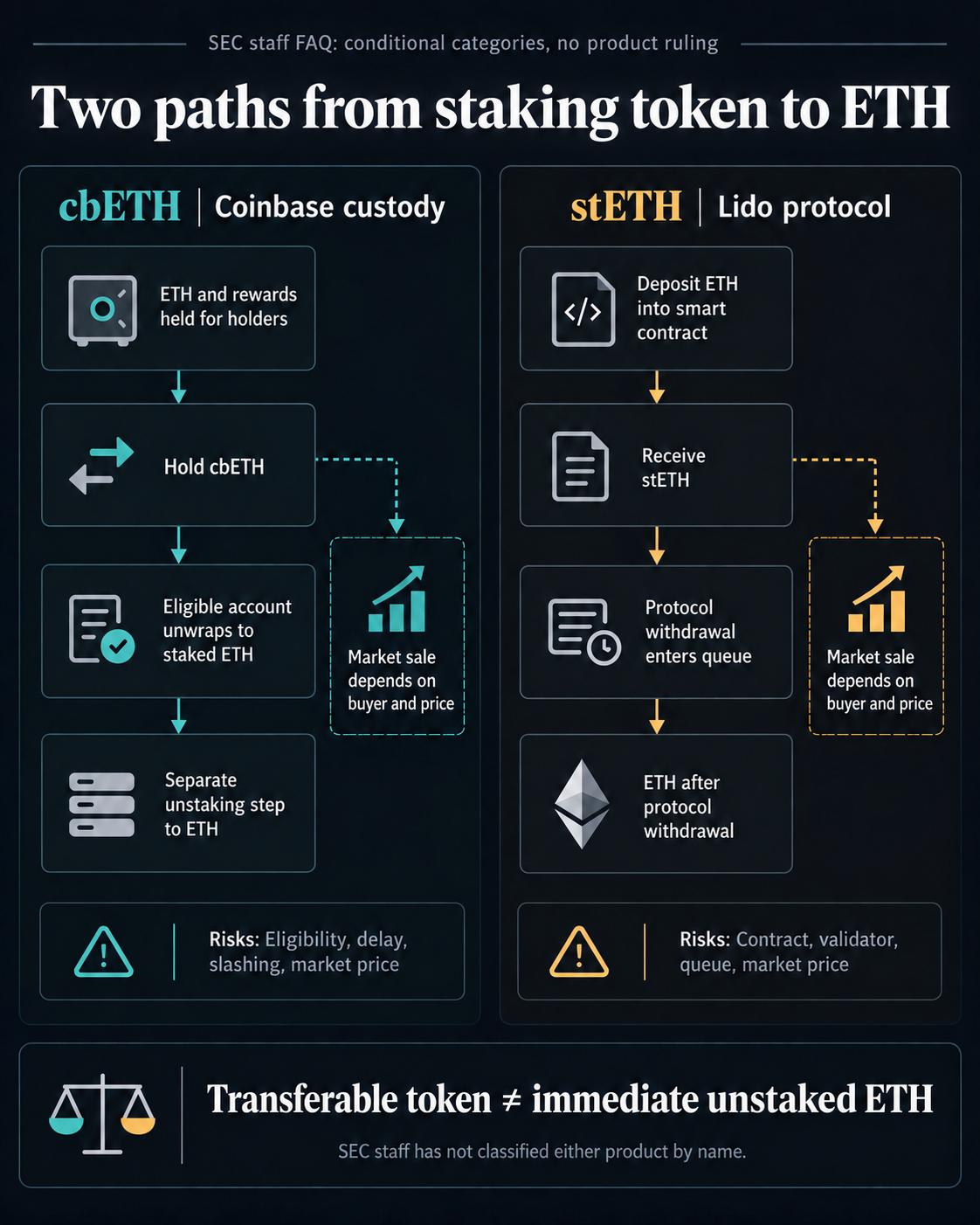
Two routes back to ETH
Coinbase's custodial path
Coinbase's US user agreement says cbETH represents ETH staked through Coinbase, including associated rewards and subtracting fees or slashing penalties. It says the staked ETH and rewards wrapped as cbETH are held by Coinbase on behalf of token holders and that ownership does not transfer to Coinbase. Selling or transferring cbETH transfers the underlying ownership interest and the contractual redemption right to the recipient.
That transferability gives a holder a way to seek an exit before the staked ETH is withdrawn. Coinbase's product guidance says cbETH can be sold, sent or held in an external wallet. But selling it is a market transaction, and Coinbase warns in its agreement that the token's price can diverge from ETH or staked ETH. Coinbase does not promise that a buyer will be available or backstop cbETH liquidity.
The contractual redemption route is different from a sale. The agreement says an eligible cbETH holder must have a Coinbase account in good standing and meet staking eligibility requirements to unwrap; geographic limits and processing delays may apply. Unwrapping returns staked ETH, with rewards less applicable fees and slashing, not immediately spendable unstaked ETH. Obtaining ETH after that requires a further unstaking request and completion of Ethereum's process. A transferable token therefore does not give every holder the same immediate redemption route.
Lido's protocol path
Lido's contract documentation describes a different operating model. A user deposits ETH into the protocol's smart contract and receives stETH. To reclaim ETH through the protocol, a holder submits a withdrawal request that enters a queue. The token can also be sold to another trader instead of waiting for that process.
Those routes expose the holder to different constraints. Lido's risk disclosure says a protocol withdrawal can be slowed by queue capacity and Ethereum validator exits. The ETH ultimately received follows the protocol's accounting and can be affected by adverse events such as slashing. A secondary-market sale is faster only if someone will trade at an acceptable price; spreads, slippage and a discount to ETH can widen when liquidity is strained. The disclosure also identifies smart-contract, governance and validator risks, and says stETH and wstETH have no general, protocol-level regulatory approval.
A label does not settle the exit
The two products illustrate why “liquid” describes a token's ability to move, not a guaranteed conversion into unstaked ETH at a fixed value. With cbETH, the holder depends on Coinbase's custody terms and eligibility process for contractual unwrapping, or on a market buyer for a sale. With stETH, the holder can use a protocol withdrawal queue or a market buyer. In either case, the secondary-market price can differ from the value of the underlying staked position.
The Sept. 25 FAQ does not classify either token by name, and its answers are nonbinding staff views that create no new obligations. Its useful distinction is narrower: before treating a liquid-staking token as interchangeable with ETH, a holder needs to know who retains ownership of the deposit, who operates the redemption path, what asset comes back first and which delays or losses can intervene. A regulatory category alone cannot answer those product-level questions.
Source: CryptoSlate