



FILTERED RESULTS
FILTERS
MCap $2.9T -0.6%24h Vol $67.6B +16%Fear & Greed 70/100Alts Index 59/100
BTC.D 58.9% +0.5%Stable.D 9.2% 0%ETH.D 11.4% +0.1%Others.D 20.5% -0.6%
SOON$0.3270+49.2%•QNT$183.42+47.74%•Q$0.0498+37.46%•BTW$1.148+23.58%•BP$1.510+20.63%•W$0.0152+15.93%•PUMP$0.00506353+13.44%•GRASS$0.6299+12.32%•PYTH$0.0853+10.32%•JASMY$0.00525139+9.79%•
AI$0.2205-17.26%•BR$0.9088-11.77%•XPL$0.1052-10.37%•KMNO$0.0453-9.35%•MARSCOIN$0.1280-8.99%•SENT$0.0222-8.29%•PONS$0.5944-8.07%•ZAMA$0.0838-6.4%•2Z$0.0664-6.24%•CASHCAT$0.1731-5.2%•
•
·
·
FILTERED RESULTS
Bitcoin ETF Comeback: $2.4B Week Flips Year-to-Date Flows Positive
Michael Saylor Calls for ‘Bill of Digital Rights’ for AI…
Bitget freezes XRP withdrawals as 27M stolen tokens move
California Governor Gavin Newsom signs law banning public officials from...
Peter Brandt Says XRP Charts Alone Give Him Reason to Make a Bet
Investigation Links $18 Million Rug-Pull Scheme to 53 Token Launches on Robinhood Chain
Wazz: 53 Robinhood Chain Token Launches Linked to Rug-Pull Operation, at Least $18.43M...
Bitcoin Price Analysis: Key Support Levels and Liquidity Clusters to Watch This Week
Strategy Turns to Daily Dividends to Steady Its Preferred Stocks
SEC staff’s staking-token split spotlights the exit risks behind staked ETH tokens
Global Money Supply Hits Record $103.66 Trillion
Ripple News: Why Ripple’s CLO Says CLARITY Act’s Fate Doesn’t Matter For XRP
Zano restarts blockchain and rolls back a month of history to fix unauthorized ZANO and fUSD...
Zano Wipes 1 Month of History to Fix Massive Crypto Inflation Bug
Apollo Chief Economist Warns AI Agents Could Trigger Bank Runs
When Will Nvidia Stock Go Down? Here’s What Could Trigger It
AI Agents Keep Escaping Their Creators' Control—Here's What We Know
New Bitcoin proposal rescues locked multisig wallets – At a hidden cost
Visa cuts reported stablecoin volume but there’s no proof payments fell
Peter Brandt Predicts $8,600 ETH, Coinbase Adds IPO Share Trading, And More – Week In Review
SpaceX/cursor_ai’S benln SAYS THAT fomo IS THE FASTEST GROWING STARTUP ON X BY FOLLOWER...
Strive CEO Indicates Plans to Expand Bitcoin Holdings
Vitalik Buterin Unveils Ethereum's Vision for 2030
U.S. President Trump Anticipates Further Negotiations with Iran
Vitalik Buterin says Ethereum is called a "blockchain" mostly "for historical reasons"
Bitget Hacker Moves $83M in XRP as Network Rules Limit…
Ripple Price Analysis: XRP Tests Critical Resistance as Bullish Structure Holds
Vitalik publishes 32-chapter work "Snowmoon," open-sourced under GPL v3
Kraken Parent Payward Bets Billions to Become Financial Infrastructure
Bybit's weekly platform updates General• $PONS is officially listed on Bybit Spot• Tomorrowland...
Bitcoin's Quantum Problem: Three Ways Researchers Are Trying to Fix It
Vitalik Buterin Releases Science Fiction Novel 'Snowmoon' Under Open Source License
Bitmine Chairman Highlights Role of Tokenization and AI in Cryptocurrency Market Cycle
THORChain Rejects Bitget's Request to Block Hacker Addresses
Ethereum's Future Vision Focuses on Censorship Resistance and Wallet Flexibility
Bitcoin Surges 32% Over Two Months, Still Below Year-Ago Prices
Vitalik Buterin maps Ethereum’s shift beyond a blockchain in sweeping 2030 vision
US Treasury Secretary Bessent: Core inflation has remained calm
Even More Orange: Saylor Teases Another Strategy Bitcoin Buy
Jupiter Exchange COO Advocates for Major Improvements in DeFi to Attract Institutional Capital
Ethereum is not instant, but collateral could make it feel that way
Bitcoin Price Climbs Back Toward $85K With Bulls in the Driver’s Seat
Monochrome Exchange Raises Over 5.5 Million USDT in MCR Token IEO
U.S. Bitcoin ETFs Draw $2.4 Billion as 2026 Net Flows Turn…
Vitalik Buterin Envisions Ethereum as a 'Cryptographic World Computer'
Trader 0x9c6a opened a 20x long on 550,087 $SOL ($67.88M) a month ago and is now sitting on an...
Vitalik: Ethereum Is Evolving Beyond a Blockchain Into a “Cryptographic World Computer” Vitalik...
Monochrome Exchange, founded by former Binance Australia CEO, launches MCR IEO with over 5.5 million USDT raised
DYORSWAP Announces Compensation Plan for Affected Users
SEC Staff Says Token Buybacks Don't Make Crypto a Security—If the Network Works
Bad News Is Good News — Week in Review
DOGE Rally Brewing? Whales Load Up as Dogecoin ETFs Post Record Inflows
Market Overview: BTC : $84824 ETH : $2708.78 BNB : $780.73 SOL : $123.55 Market Cap :Total : 2.9T DeFi ...
Kalshi Loses Again as Sixth Circuit Lets States Regulate Its Sports Contracts
DYORSWAP: Compensation Plan for GIWA Fake Chain Scam Released
Monochrome Exchange (@Monochrome_EN), founded by Jeff Yew (@jeffyew_), co-founder and former CEO of...
From Tokyo To Washington, Bond Yields Are Breaking Records
Bitcoin Price Prediction For October: One Level Stands Between Rally And Reversal
Ethereum Introduces Decoupled Consensus Protocol for Faster Transaction Finality
French investigators probe alleged Verasity VRA token manipulation and €50M Dubai real...
Bitcoin 7-day average hashrate drops to three-week low as miners shift to AI computing
Senate stalls Digital Asset Market Clarity Act after months of bipartisan negotiations...
Amazon Stock Could Hit $1,000 by 2036, Forecast Shows
Michael Saylor Hints at Increased Bitcoin Holdings with New Bitcoin Tracker Update
How months of work on the Clarity Act all fell apart
QNT Leads Altcoin Rally, BTC Price Aims at $85K Again: Weekend Watch
Prediction markets promised better information and hired Hollywood
US Senator Lummis: The Clarity Act rejected by Democrats had empowered the Treasury to combat money laundering through offshore exchanges
SEC’s Hester Peirce Wants Zero-Knowledge Proofs to Fix KYC System
Why newly granted federal approval won’t save these 3 crypto banks


The Office of the Comptroller of the Currency advanced three stablecoin-focused firms toward federal trust-bank status on Sept. 18, using a recognizable regulatory perimeter across the decisions for Agora, Catena and Bastion.
The decisions strengthen the case that the OCC is building a repeatable pathway for narrow, uninsured trust banks. That pathway still carries execution and legal risk: Agora and Catena need final approval before opening, Bastion must complete a conversion, proposed stablecoin rules remain unfinished, and state supervisors continue to contest the breadth of the OCC’s approach.
The competitive significance follows from that combination. Federal trust status can reduce regulatory fragmentation and bring related services under one supervisor, but repeated conditional approvals make the charter itself less likely to be a self-sufficient moat. Final approval, distribution, capital, reserve relationships and operating performance become the harder tests.
What the OCC actually approved
The Agora decision and Catena decision grant preliminary conditional approval for de novo national trust banks. Both applicants remain in organization and must complete pre-opening work before the OCC grants final approval and permission to commence business.
The Bastion decision follows a different route. Bastion Platforms Trust Company already operates under a New York trust charter. The OCC conditionally approved its conversion into Bastion Platforms National Trust Company, subject to conditions and a conversion completion acknowledgement before it begins operating under the national charter.
The distinction separates regulatory progress from operational authority. Agora and Catena are organizing new federal institutions. Bastion is converting an existing state trust company. The cited materials do not state firm opening dates for any of the three.
Agora and Catena must send OCC chartering staff a letter at least 60 days before a scheduled opening. Their approvals expire if they fail to raise capital within 12 months or open within 18 months. Bastion’s approval automatically terminates if the conversion is not completed within six months, unless the OCC grants an extension under extenuating circumstances.
Across the three decisions, the OCC applies a shared trust-company framework rather than granting identical business permissions. Each institution must limit its operations to trust-company activities and related services, and each must stay outside the Bank Holding Company Act definition of a bank.
The resulting institutions are not ordinary insured commercial banks. Bastion’s decision expressly says it will not take deposits and will not be insured by the Federal Deposit Insurance Corporation. Agora’s letter says the proposed bank will not be an insured depository institution. Catena’s decision treats the institution as an uninsured national bank and states that payment stablecoins are not deposits and cannot be represented as FDIC-insured.
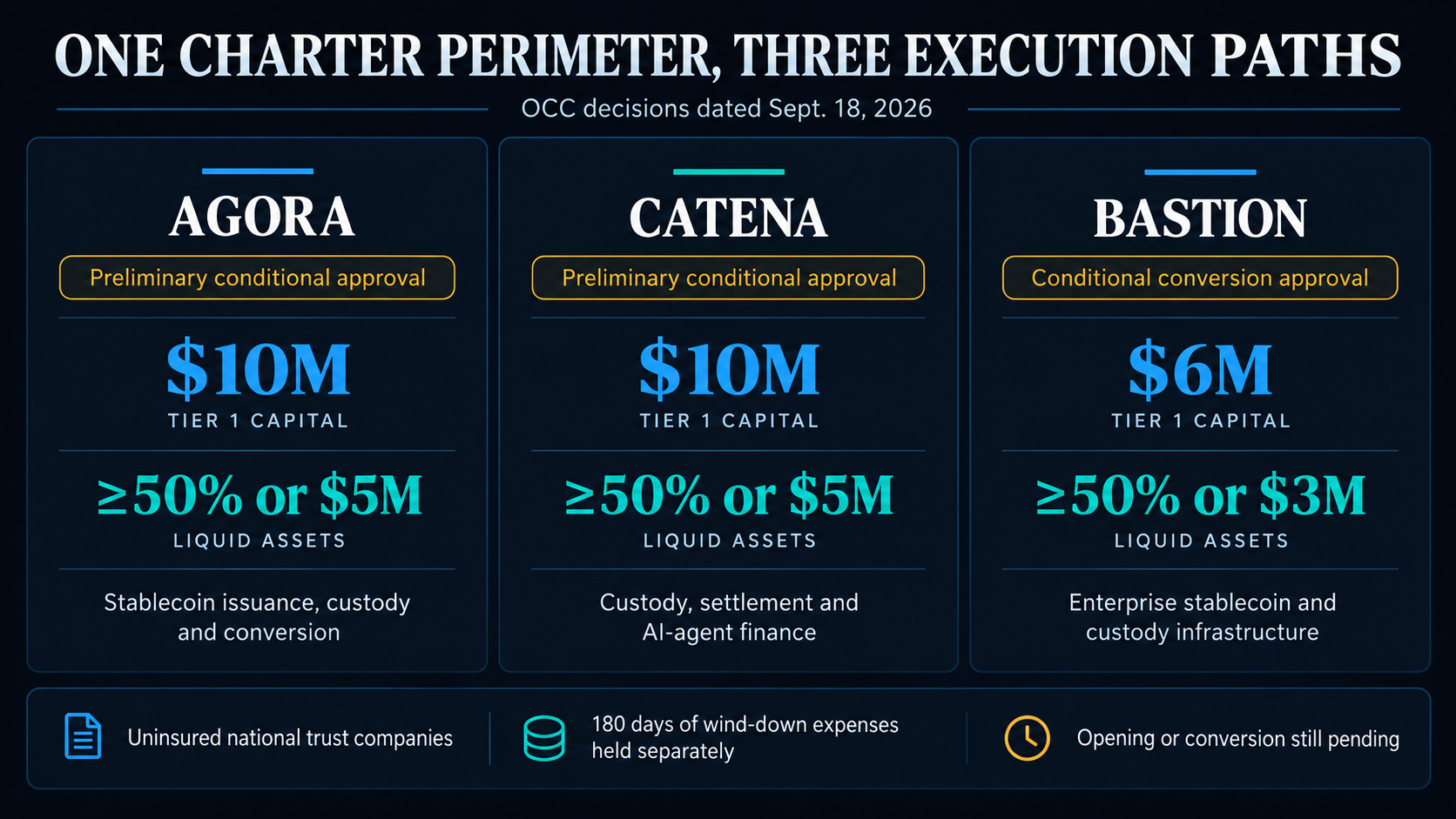
The capital requirements show both the common architecture and applicant-specific calibration. Agora and Catena must each maintain at least $10 million in tier 1 capital, with the greater of 50% of tier 1 capital or $5 million held in eligible liquid assets. Bastion must maintain at least $6 million in tier 1 capital, with the greater of 50% or $3 million liquid. Each institution must reassess its capital and liquidity quarterly and hold more if its risk profile requires it.
A separate condition requires all three to maintain eligible liquid assets equal to 180 days of fixed and variable operating expenses applicable to a distressed wind-down. Those assets cannot be double-counted against the liquidity supporting the capital condition. The requirement applies during the first three years of operation under the relevant federal charter.
| Applicant | OCC action | Capital and liquidity floor | Proposed focus | Status in cited materials |
|---|---|---|---|---|
| Agora | Preliminary conditional approval for a new national trust bank | $10 million tier 1; greater of 50% or $5 million liquid | Stablecoin issuance and reserves, custody, payments and advisory services | Final approval pending; no firm opening date stated |
| Catena | Preliminary conditional approval for a new national trust bank | $10 million tier 1; greater of 50% or $5 million liquid | Custody, trust and investment management, plus linked conversion, clearing and execution | Final approval pending; no firm opening date stated |
| Bastion | Conditional approval to convert a New York trust company | $6 million tier 1; greater of 50% or $3 million liquid | Custodial wallets, conversion, white-label issuance and issuer services | Conversion completion pending; no firm opening date stated |
The OCC also requires advance notice and a written determination of no objection before significant changes to each business plan. Compliance, audit, information-security and governance work remains part of the path to opening or conversion completion.
Why charter access looks more repeatable
The Sept. 18 decisions sit inside a larger pattern. The OCC’s decision index records digital-asset trust-bank actions involving Bridge, Foris DAX, Coinbase, Laser Digital, Wise, World Liberty and others. The agency’s digital-asset applications page shows additional applicants in the pipeline.
In August, Comptroller Jonathan Gould said 23 of 40 new-charter applications received over roughly 18 months involved digital assets. That volume does not predict final approval for any applicant, but it shows the Sept. 18 trio belongs to a cohort rather than standing as an isolated experiment.
The agency’s 2026 trust-bank rule, effective April 1, further clarified that national trust banks may conduct permissible non-fiduciary activities alongside fiduciary services. The OCC continues to assess the statutory authority for proposed activities case by case, so a recognizable pathway still produces applicant-specific decisions.
Proposed GENIUS Act implementing rules point toward more common reserve, capital and liquidity expectations for federal stablecoin issuers. Those rules remained proposed as of Sept. 22. They describe a possible standardized federal layer rather than a final operating regime.
The legal foundation also remains contested. The Conference of State Bank Supervisors has challenged the breadth of the OCC’s trust-charter and preemption approach and discussed possible future litigation if states conclude that charters exceed the National Bank Act’s limits. That statement does not establish a filed case, but it shows why a repeatable administrative process should not be confused with settled law.
The baseline thesis is therefore comparative. The three decisions repeat core boundaries, capital concepts, wind-down liquidity, supervisory notice and pre-opening controls. The wider decision record and pending pipeline show the OCC applying that framework to more firms. A federal trust charter remains costly and demanding, yet the permission set increasingly resembles infrastructure that multiple qualified applicants can seek.
A common perimeter leaves ample room for different businesses.
Agora proposes to combine dollar-backed stablecoin issuance and reserve maintenance with digital-asset custody, custody-linked payments and settlement, and fiduciary investment advice for institutional and business custody customers. The OCC decision says Agora intends to move AUSD issuance from Agora Bermuda only after the bank is established. The planned cutover would transfer underlying assets and accounts, with the bank acquiring and assuming reserve assets and associated liabilities.
The transition remains prospective. Agora’s AUSD product page continued to identify Agora Bermuda as issuer as of Sept. 22. The page also describes reserve management, custody and partner relationships that help define Agora’s route to distribution. Agora’s approval announcement states that final approval remains pending.
Catena’s proposed bank targets another customer set. Its approved plan includes fiduciary and non-fiduciary custody, fiduciary investment management and trust services, and non-fiduciary conversion, clearing and execution linked to assets held in those relationships. Catena’s company announcement positions the stack around AI agents and the businesses deploying them. The AI focus is Catena’s strategy, not an OCC characterization.
Bastion’s model centers on enterprise infrastructure. The approved conversion perimeter includes fiduciary custodial wallets, conversion for custody customers, white-label stablecoin issuance, and technology and operational services for other authorized issuers. Bastion says enterprise clients can use custody, payments and issuance tools while third-party firms may remain issuer of record. Its announcement describes a federal conversion that would consolidate capabilities now delivered through an existing state trust charter, other licenses and partnerships.
These differences identify the remaining sources of competitive advantage. A charter can create national regulatory reach and combine permissible services under one supervisor. It cannot supply customers, liquidity, reserve partners, enterprise integrations or a successful launch.
Earlier CryptoSlate analysis treated federal trust charters as potentially scarce strategic assets. Coverage of Agora’s then-pending application and the rise of narrow crypto banks emphasized both national reach and the structure’s limits. A separate look at the GENIUS Act’s competitive effects argued that early federal access could favor well-capitalized issuers.
The Sept. 18 evidence narrows the scarcity argument. Three same-day decisions share a familiar perimeter, a common supervisory architecture and defined routes toward opening or conversion. They also preserve differences in capital calibration, customer focus and business model.
Execution now carries more weight. Agora and Catena must turn preliminary approval into permission to open. Bastion must finish its conversion. All three must maintain capital and wind-down liquidity while persuading customers that their particular combination of custody, issuance, settlement and controls is worth adopting.
The federal trust charter remains valuable in that market. Its role increasingly resembles an entry requirement, while the durable moat has to be built through distribution, liquidity and execution.
Source: CryptoSlate