



FILTERED RESULTS
FILTERS
•
·
·
FILTERED RESULTS
Ripjar Enhances AI Capabilities for Customer Screening Solutions
Oman Launches National Fintech Strategy to Boost Financial Innovation
Should You Buy Alphabet (GOOGL) Stock Before Gemini 4 Drops?
How Trump is unintentionally helping the world’s climate
KB Securities Partners with Securitize and Optimism for Tokenized Securities in Korea
The chart that inspired California’s billionaire tax campaign
Pine Labs to Deploy 1 Million Soundboxes to Enhance Digital Payments in Rural India
CMC Markets Launches ChatGPT Integration for UK Clients
Tencent launches payments app for ‘China-maxxing’ foreign tourists
Global bond sell-off deepens as oil climbs back to $105
U.S. stock futures extend declines amid bond market selloff, Trump-Xi summit
SoftBank raises $11.1 billion in world’s biggest high-yield corporate bond sale
Dollar hovers near 2-month peak, Swiss Franc falls, Norwegian crown rises
Meta (META) Stock Surges 20% Following Muse AI Agent Debut
Palantir (PLTR) Stock Surges Near 52-Week Peak Following Defense Contract Win
See How Elon Musk’s Sunbelt Investments Are Reshaping His Business Empire
Hellman & Friedman weighs $10bn sale of Applied Systems
MLB ups private equity ownership limit to 20% per franchise
Blackstone shelves $3bn CFO deal amid investor concerns
Paul Weiss adds three Weil partners to private equity team in New York
Lone Star considers debt restructuring or sale of Italian coffee-machine maker Evoca
Iress Joins ASX Australian Liquidity Centre
Netflix (NFLX) Stock Tumbles as YouTube Dominates TV Viewing Time
Pollen Street explores strategic options including potential take-private
Stocks Fall as Oil Gains Fuel Further Bond Selling: Markets Wrap
Juniper Square, Nasdaq eVestment launch AI tool for private markets fundraising teams
ASIC Enhances AI Trading Safeguards and Streamlines Regulations
Micron (MU) Stock Drops 2% Before Earnings Report, But Analysts Remain Optimistic
US Dollar Reaches Highest Value Against Swiss Franc Since May 2025
Tariffs and AI concerns have yet to derail global investment activity, says Blackstone
Ifo's Fuest Says German Economic Recovery Is Continuing (Video)
Europe gas off multi-week lows as Middle East peace talks hit impasse
Gold prices edge lower amid higher oil prices, bond yields
Amazon to pour $3 billion into India quick commerce push - report
U.S. 30-year bond yield rises to highest since 2004 as selloff deepens
How the world’s biggest bond managers are investing in a tumultuous market
Washington is guarding against the wrong dollar threat
UK Banks Successfully Pilot Tokenised Deposit Transactions
Swedish Central Bank Signals Potential Policy Rate Increases
Zambia Disinflation Sets Stage for Fourth Interest-Rate Cut
Crude Oil Surges Past $105 Amid Diplomatic Deadlock and Export Ban Speculation
Paramount Skydance (PSKY) Stock Drops Amid Elon Musk Investment Speculation
BOE’s Lombardelli Warns Hikes More Likely as Iran War Continues
Amazon Launches CloudWatch Omni for Enhanced Application Monitoring
Swedish Central Bank Indicates Need for Higher Policy Rate to Control Inflation
Orlen Sees Headway in Reactor Talks With Polish Tycoon
Meta Platforms (META) Stock Surges as Muse AI Integration Takes Center Stage at Connect Event
Abortion Pills, Vaccines and Food Safety: F.D.A. Nominee Heidi Overton Faces Senate Confirmation Hearing
After a Summer of Disruptions, Here Are the 7 New Rules for Air Travel
The ‘Monster’ Behind Russia’s Global Effort to Evade Western Sanctions
German Institutes Double GDP Forecast as Outlook Brightens
Russia to Make Miners Pay for Increased War Spending Via New Tax
Gift Nifty 50 breaks support at 23,075 in free fall: Live levels
Exclusive-Amazon bets $3 billion on India’s fast-delivery boom, sources say
Footprint Secures $25 Million in Series B Funding for Financial Crime Compliance Solutions
Historic Airport Greeting: Trump Extends Unprecedented Welcome to Chinese President Xi
Delivery Hero chief reverses exit plan after Uber secures takeover deal
European Stocks Fall as Bonds Sell Off Globally and Oil Climbs
Federal Reserve Official Suggests Possible Rate Hike Amid Inflation Concerns
Stock Market Today: Government Bond Selloff Widens
Rising Yields Place Higher Burden on Earnings: JPMorgan (Video)
Norges Bank Hikes for Second Time as Riksbank Picks Hawkish Hold
Christian Dior shares surge 16% on Arnault family’s €469.05 cash offer plan
BMW stock: Is its cheap valuation enough for a buy ahead of next week’s CMD?
Bank of England may tighten policy if energy prices stay high
Fed’s Williams says it is reasonable to see another US rate hike this year
China Urges New Zealand to Cease Allegations
ECB’s Schnabel Says Energy Shock Is ‘Much More Persistent’
UK and Germany among economies most exposed to China, new modelling shows
Gold Retreats as Surging Oil Prices and Robust Economic Data Signal More Fed Rate Increases


Key Takeaways
- Gold declined to approximately $4,280 per ounce following the previous day’s significant downturn
- Crude oil rallied after Iran’s leader indicated the Strait of Hormuz would remain restricted to free passage
- American business expansion hit a five-year high in the latest activity data
- Five-year Treasury note yields exceeded 5% for the first time in nearly two decades
- Interest rate derivatives now indicate expectations for a minimum of three Fed hikes before May 2025
Precious metals continued their downward trajectory on Thursday, with gold extending its retreat following Wednesday’s notable selloff. The yellow metal faced mounting headwinds from escalating crude prices, dollar strength, and climbing government bond yields.
During Asian market hours, spot gold hovered around $4,280 per ounce. This represented a continuation of weakness after the previous session’s 1.7% decline.
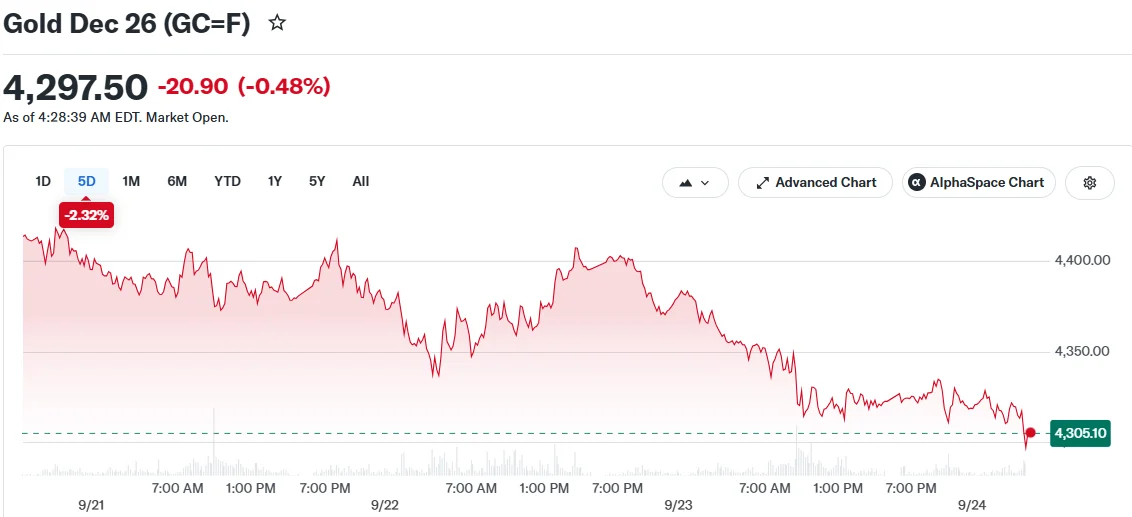
The broader precious metals complex displayed mixed performance. Silver declined approximately 0.6% to settle near $64 per ounce. Meanwhile, platinum posted modest gains alongside palladium, which also edged into positive territory.
Iranian Statement Lifts Energy Markets
Energy commodities rallied following remarks from Iranian President Masoud Pezeshkian during his United Nations address. The Iranian leader declared that his country would maintain restrictions on free transit through the Strait of Hormuz as long as American sanctions and blockade measures persist.
While expressing openness to diplomatic engagement, Pezeshkian emphasized Iran’s refusal to yield to coercive pressure. He reiterated that Tehran has no ambitions to produce nuclear weapons, while simultaneously asserting Iran’s sovereign right to pursue nuclear capabilities for civilian and economic purposes.
These statements emerged just twenty-four hours after President Donald Trump characterized recent discussions between American and Iranian delegations at the UN gathering as “very good.”
Notwithstanding this diplomatic optimism, substantial obstacles remain before any comprehensive agreement between Washington and Tehran can be reached.
Since hostilities between the United States and Iran erupted in late February, gold has surrendered nearly 20% of its value. The corresponding spike in energy expenses has played a pivotal role in undermining precious metals valuations.
Resilient Economy Drives Bond Yields Upward
Gold remains highly reactive to Federal Reserve monetary policy signals in the current environment. Market participants are closely monitoring whether sustained energy cost inflation will compel the central bank to implement additional borrowing cost increases.
Elevated interest rates typically exert downward pressure on gold valuations. Because the metal generates no yield, it becomes comparatively less appealing when alternative investments deliver superior returns.
American government bonds experienced substantial selling following better-than-anticipated economic indicators and an underwhelming debt offering. Yields throughout the maturity spectrum surged to levels not witnessed in approximately twenty years.
The five-year Treasury note yield breached the 5% threshold for the first time since 2007. This development intensified the downward momentum in gold markets.
American commercial activity registered its most robust expansion in over five years. The S&P Global flash composite purchasing managers’ index for September advanced to 58.4, marking the strongest reading since July 2021.
Vigorous demand stimulated increases in both new orders and workforce additions at manufacturing facilities and service sector companies nationwide.
Federal Reserve Governor Michael Barr indicated that additional rate increases would probably be necessary. He emphasized this policy trajectory as essential for returning inflation to the central bank’s 2% objective.
His observations aligned with cautionary messages from fellow Fed officials throughout the week. Multiple policymakers have acknowledged that inflationary forces are demonstrating greater persistence than initially anticipated.
Interest rate swap markets currently reflect expectations for no fewer than three rate hikes by April 2025. This projection represents an upward revision compared to forecasts issued earlier in the week.
The US Dollar Index maintained stability after four consecutive sessions of appreciation. The greenback touched its strongest position in approximately two months.
The combination of strengthening economic indicators, ascending bond yields, elevated energy prices, and dollar resilience continues to constrain gold performance. Investors will maintain focus on forthcoming Federal Reserve communications and macroeconomic releases for additional clarity regarding the monetary policy trajectory.
Source: Parameter