



FILTERED RESULTS
FILTERS
MCap $2.8T -1.8%24h Vol $117.4B +70%Fear & Greed 74/100Alts Index 59/100
BTC.D 58.8% -0.1%Stable.D 9.4% +0.2%ETH.D 11.4% 0%Others.D 20.4% -0.1%
Q$0.0498+37.46%•QNT$222.82+28.61%•BTW$1.148+23.58%•BP$1.510+20.63%•HBAR$0.1134+19.65%•GRT$0.0317+12.93%•MARSCOIN$0.1458+12.04%•XDC$0.0345+11.3%•ALGO$0.1270+7.89%•PUMP$0.00476863+6.48%•
AI$0.2205-17.26%•RAY$2.002-14.31%•USELESS$0.2494-14.08%•FARTCOIN$0.1692-14.02%•PONS$0.5323-13.55%•JTO$0.5583-12.5%•BR$0.9088-11.77%•UNI$8.880-11.17%•ZEN$7.104-10.85%•SENT$0.0208-10.52%•
•
·
·
FILTERED RESULTS
Hong Kong Expands Financial Reporting Oversight to Crypto Firms
Ark Invest: AI Makes Vulnerabilities Easier to Discover and Exploit, Bitcoin and Hardware Wallets May Be First in Line
California Bans Public Officials From Issuing Meme Coins Under New Newsom Law
Bitget Resumes BTC Withdrawals Four Days Following $387.5M Hack
$KII listed on Bybit futures・
Hong Kong regulators expand financial reporting oversight to licensed crypto firms
Apple Ordered to Pay $5.7 Billion in Landmark Patent Case
A whale's ETH long position has an unrealized profit of $14.06 million, and it opened a new short position of 650 BTC
Live updates: Bitcoin sinks below $83,000 as Iran talks stall and oil climbs
Binance Adds 5 Stocks on Binance Stock Trading - 2026-09-28Starting from 2026-09-28 13:30 (UTC), Bin...
How Settlemint and Utila Are Securing Institutional Tokenized Assets
QNT and HBAR Defy Altcoin Crash, BTC Drops Below $83K: Market Watch
$18.4M Allegedly Extracted Across 53 Robinhood Chain Token Launches
Bitget CEO Details How Attackers Stole Approximately $380MIn a September 28 livestream, Bitget CEO...
GoPlus: Another Meme RUG Factory Exposed on Robinhood Chain, with Over $9 Million in Volume
Crypto scammers built an entire fake blockchain to steal over $2 million
Bitcoin rally takes a breather ahead of key U.S. employment data: Crypto Week Ahead
Capital B Buys 13 BTC, Bitcoin Treasury Hits 3,538 BTC
Analysis: Bitcoin shorts pay to bet on further declines, futures positions near yearly lows
Bitcoin bears pay to bet on further declines as futures positions near yearly lows
Circle co-founder Sean Neville has stepped down from stablecoin issuer's board,
617 $BTC (51,109,319 USD) transferred from Coinbase Institutional to unknown wallet...
Capital B acquired 13 bitcoin:native for $1.1 million, bringing its total holdings to
Scammers steal $2M in ETH as fake GIWA network fools DYORSWAP
Strategy Inc. Surpasses First Abu Dhabi Bank in Market Capitalization Amid Bitcoin Investments
What Crypto Is Actually Building While Prices Rise
106,335,859 $USDT (106,394,450 USD) transferred from #OKEX to unknown wallet...
$84,000 Fulcrum: Why Bitcoin is Refusing to Break
Bitcoin Braces for a Volatile Week as Key U.S. Economic Data Looms
Bitcoin Rally Wobbles as Macro Risks Overshadow ETF Demand
Bitcoin drops under $83K as liquidity hunting keeps bulls from targeting yearly open
799 $BTC (66,381,984 USD) transferred from unknown wallet to Coinbase Institutional...
Gate.io's Traditional Finance Desk Achieves $17 Billion in September Trading Volume
Bitget has resumed phased withdrawals after its $387.5 million exploit, with 6,878
XRP ETFs Hoard 1.18 Billion XRP as Ripple Readies a 1 Billion Unlock
736 $BTC (61,072,188 USD) transferred from unknown wallet to Coinbase Institutional...
'It's Really Not Just a Blockchain Anymore': Buterin's 2030 Ethereum Vision
XRP Breaches the $1.50 Wall: Is $2 in the Bag?
Circle’s CFO and a Co-Founder Depart, With $1.05M Exit Package for the CFO
Stablecoin payments firm RedotPay says it received a "clean" audit opinion from a Big
bitget ANNOUNCES IT “HAS BEGUN THE PHASED RESUMPTION OF WITHDRAWALS FOLLOWING THE SECURITY...
MEXC responds to user's ~$340,000 asset theft, has set up a special task force to provide solutions
Separately, @ai_9684xtpa reported that 2,042.28 BTC, worth about $169 million, has been transferred...
Bitget Reopens BTC Withdrawals After September 24 Security IncidentBitget said it has begun a...
Bitcoin ETFs Experience $2.4 Billion Inflow in Record Week
Bitwise Advances Spot NEAR ETF Toward NYSE Arca Listing, Sending NEAR to a One-Year HighRead...
Money supply across the US, eurozone, China and Japan hit a record...
Bitget starts phased withdrawal resumption following $388 million exploit
Xie Jiayin Responds to Bitget's First Security Incident in 8 Years: Hackers Exploited a Vulnerability in a Third-Party Security Product, Independent Review Launched with Security Firms
Bitcoin ETFs draw $2.4B in biggest inflow week since October 2025
Crypto ETF Flows: Bitcoin, Ether and Solana Funds Add $308M…
Donald Trump Oval Office Speech Today at 2 PM: What to Expect
Bitget has opened BTC withdrawal services as scheduled
The CLARITY Act failed because Democrats opposed President Trump more than they...
Upbit crypto exchange reported a weekly volume of $11.7 billion in week ended Sept.
California Governor Gavin Newsom Signs Law Banning Public…
Quant rises after The Clearing House selects it for On Chain Money Initiative and UK banks...
Bitcoin Price Crashes to $82,780 as Gold and Silver Lose $550B in Hours
4 Major Events to Watch for Bitcoin and Crypto Markets This Week
RedotPay Delays US IPO to 2027 Following Financial Audit and Legal Challenges
XRP Ledger’s Batch Upgrade Slips From September 29 to…
Crypto Sentiment Flipped“F&G has moved from around 30 to 74 in a relatively short period, while...
RedotPay completes financial audit as it presses ahead with U.S. IPO plans
BitMine's MAVAN Emerges as Key Revenue Driver with $357 Million Projection
A newly created wallet "0x80Fa" just withdrew 10,390 $QNT($2.87M) from...
THORChain Rejects Bitget’s Call to Block Attacker Funds After $387.5M HackTHORChain responded to...
Fake GIWA Chain Drained 766 ETH After 1,335 Addresses Bridged Into It
BlackRock Says AI Agents Could Become Crypto’s Next Demand Engine
616 $BTC (51,101,051 USD) transferred from Coinbase Institutional to unknown wallet...
Altcoin demand meets $18B threat as flows move into RWA perps as just 19% of traders keep alts


In the markets Talos tracked, daily volume in RWA perpetual futures tied to equities, commodities and indices rose from less than $1 billion in January to $18.8 billion during Sept. 3-9. That represented 18.5% of futures volume across those venues.
Crypto exchanges built their derivatives businesses around perpetual futures, and the same contract structure now wraps exposure to oil, gold, stocks, indices, and pre-IPO companies.
The Talos data show that crypto-perpetual volume declined over the comparison period while total futures activity in its sample remained roughly flat, with traditional-asset contracts filling the volume gap.
The changing product mix creates a real competitive threat for altcoins. Traders no longer need a new token to find leverage, volatility, or a market that stays open around the clock.
Wallet behavior on Hyperliquid points to mostly separate customer groups, with a smaller group trading across both markets.
Hyperliquid’s traders mostly stay in their lanes
Talos found that traditional asset perps represented 28% of futures volume on Hyperliquid and 24.8% on Binance in its sample. Oil led the weekly increase as Brent crossed $100, showing how crypto venues can capture trading around an event unrelated to cryptocurrency.
CoinDesk Research reported that centralized-exchange volume rose 12.7% month over month to $4.29 trillion in August. Spot increased 18.7%, derivatives rose 11.3%, and traditional-asset perpetual volume increased 2.37% to $602 billion.
Both traditional-asset and crypto activity expanded during that month. Substitution could still occur within a specific venue or account, while the aggregate figures show that the two categories can also grow together.
Hyperliquid's HIP-3 framework lets outside builders deploy markets, including contracts linked to stocks and commodities. DefiLlama divided new wallets into RWA-first and “Other-first” cohorts based on the market of their first Hyperliquid trade.
From Jan. 1 through June 30, DefiLlama classified 169,514 new wallets as RWA-first. They represented 31.7% of new wallets and generated $111.6 billion (31.5%) of the trading volume produced by new users.
The economics of this acquisition cohort differed sharply from its share of activity: RWA-first wallets generated only 8.3% of the main trading fees paid by new users in the study.
RWA-first wallets kept 83.6% of their volume in RWA markets, while Other-first wallets, whose first trade was in crypto or another non-RWA market, sent 22.8% of their volume into RWA markets and produced roughly 40% of RWA-market volume.
| Group | Trading behavior | Reader takeaway |
|---|---|---|
| RWA-first wallets | 31.7% of new wallets, 31.5% of new-user volume | Traditional-asset markets attracted a substantial new cohort, though its capital source remains unknown |
| RWA-first wallets | 83.6% of volume stayed in RWA markets | Most traded primarily in the product category they entered through |
| Other-first wallets | Roughly 40% of RWA-market volume | Existing crypto-platform users crossed into traditional assets, with changes to their crypto positions unmeasured |
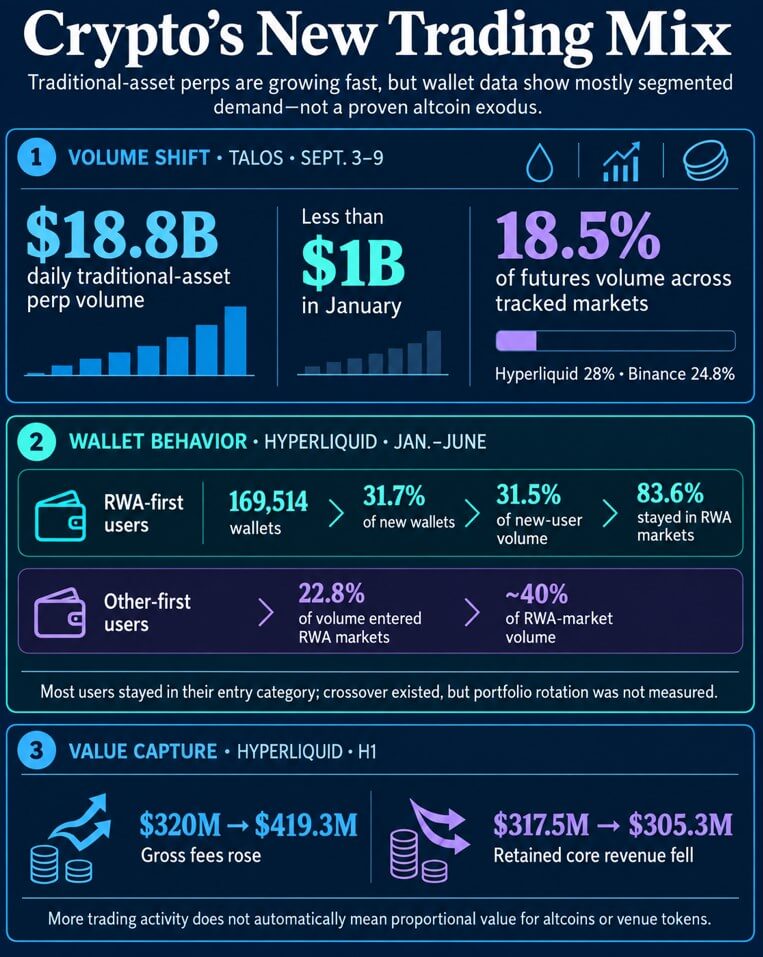
A DefiLlama follow-up found that 80.9% of RWA-first wallets never crossed into the other market, while 82% of Other-first wallets never crossed into RWA markets.
Cross-market activity increased among the most frequent traders who did cross. The user base divides into three broad groups: RWA-first wallets that mostly stay with those products, crypto-first wallets that mostly stay with crypto, and a smaller high-frequency core that treats both as trading opportunities.
Altcoins face a tougher contest for attention
CryptoRank counted 351 new listings across 10 major centralized exchanges in the second quarter, the fewest since the third quarter of 2023. Tokenized assets accounted for 42 additions, while categories associated with the previous speculative cycle lost momentum.
Gate was responsible for 573 removals, nearly 60% of delistings in the first half. MEXC rarely reported delistings and was effectively excluded from that part of the analysis.
Inside CryptoRank's sample, exchange priorities changed as one venue's cleanup dominated removals and reporting gaps limited the cross-exchange picture. RWA trading cannot be blamed for those delistings.
Binance's tokenized-stock figures also show overlap but do not reveal portfolio rotation. Binance Research reported that 58.5% of early bStocks users also used perpetuals, direct equities, or both.
For altcoin holders, the practical risk is competition at the margin. Market makers have finite balance sheets, exchanges have limited promotional capacity, and traders have limited attention. Familiar stocks and commodities now compete with them inside the same apps and collateral systems.
Altcoins have a new competitor for speculative demand. Another example is the HIP-3, which lets outside builders deploy perpetual markets.
Hyperliquid's fee documentation says deployers may retain up to 50% of trading fees generated by their assets. Trading fees directed to the protocol's Assistance Fund are converted automatically into HYPE, Hyperliquid's native token, and the acquired HYPE is burned.
Only a portion of builder-market activity reaches HYPE-related mechanisms. Assistance Fund burns can reduce token supply, while market price still depends on demand, liquidity and the broader market.
Activity and retained economics can move apart
The divergence appeared in first-half figures calculated by 21Shares, which estimated that Hyperliquid's gross fees rose from $320 million in the first half of 2025 to $419.3 million in the first half of 2026. Its measure of core protocol revenue, the fee share flowing back to the platform treasury, fell from $317.5 million to $305.3 million.
Gross fees and core revenue moved in opposite directions as builder-deployed markets captured a larger share of activity.
Crypto perps led the next monthly expansion, as Hyperliquid's total open interest rose from $6.6 billion to $8.8 billion in September. Meanwhile, HIP-3's share declined from 34% to 25%.
Traditional asset trading can fill a crypto-volume gap in one period and grow alongside crypto in another. It can bring in new wallets, give existing users more products, and create fee streams divided among the protocol, builders, and token-linked mechanisms, making exchanges less dependent on crypto's cycles.
For altcoins, the outcome is more ambiguous. Crypto's trading rails can thrive even when demand for the assets that built them grows more slowly.
Source: CryptoSlate