



FILTERED RESULTS
FILTERS
MCap $2.9T +0.1%24h Vol $107.9B -30%Fear & Greed 71/100Alts Index 55/100
BTC.D 58.5% +0.2%Stable.D 9.2% 0%ETH.D 11.4% 0%Others.D 20.9% -0.2%
STONK$0.2919+22.27%•NIGHT$0.0393+21.63%•SOON$0.4893+20.84%•CAP$0.0696+16.31%•STX$0.3631+13.33%•TRAC$0.4223+11.77%•MON$0.0298+10.24%•PROS$0.7374+9.37%•WLD$0.5340+9.18%•KSM$5.165+8.76%•
AI$0.1811-13.33%•LIT$3.881-13.2%•TIBBIR$0.2944-12.76%•BTW$1.158-11.27%•BR$0.7593-10.7%•2Z$0.0591-9.56%•GRASS$0.6905-9.16%•BP$1.207-8.52%•CASHCAT$0.1663-6.84%•SKY$0.0771-6.74%•
•
·
·
FILTERED RESULTS
Dogecoin Is Getting Apps as DogeOS Opens Its Public Testnet
Coinbase-Backed Base Gives Users More Control With Cobalt Upgrade
250,000,000 $USDC (250,044,375 USD) minted at USDC Treasury...
U.S. Treasury Department Sanctions Tren de Aragua ATM Network and Identifies Tron Addresses
1,000 $BTC (83,746,919 USD) transferred from Coinbase Institutional to unknown wallet...
FBI Tells Its Employees to Assume Hackers Have Their Personal Data
Mellow to Wind Down Autopilot as Aerodrome Prepares for Aero Launch
Bitcoin Bull Market Shows Signs of Cooling: CryptoQuant
Standard Chartered sees Ethena’s USDe reaching $40B, ENA hitting $2
Bitcoin Price Holds $83K as Bitfinex Says Leverage Has Cleared
Coinbase-Backed Crypto Group Reveals Midterm Endorsements After Clarity Act Collapse
Base Launches Cobalt Upgrade With New Trading and Tokenization Tools
U.S. Treasury Sanctions 10 TdA-Linked Targets Over ATM Jackpotting
Binance Pay Enables Crypto Spending at PayPay Merchants…
Monarch Wallet Review: How the Multi-Asset Crypto App…
Top Trending Coins (Today) 1. QNT 2. TRUMP 3. EDEL 4. NEAR 5. BP 6. PENGU 7. LIT 8. HYPE 9. BTC...
CFTC Submits Prediction Market Rules to White House for Review
Coinbase's AI Payment Protocol Raises Tax Compliance Concerns in the U.S.
Google releases Gemini 4 Argon, first available to U.S. government and cyber defenders
1,333 $BTC (111,494,358 USD) transferred from unknown wallet to unknown wallet...
Micron beats Q4 estimates with $54.23B revenue and $33.42 adjusted EPS...
US stocks close mixed: MARA down 5.79%, Riot Platforms (RIOT) down 5.31%
What’s Next for Crypto? Experts Weigh in on Regulation, AI, and Litigation
Bitcoin’s Biggest Holders Ramp Up Buying While Retail Traders Remain Flat
Bitcoin Fell After Four US Midterms: Could 2026 Break the Pattern?
Drift Recovers $9.2M of $295M Stolen Funds as Recovery Efforts Continue
Kalshi’s $40 billion growth story hits tough questions about its trading volume
Uniswap Labs Develops OUSD Rewards Hook for Liquidity Providers
133,297 $ETH (356,662,580 USD) transferred from unknown wallet to unknown...
Bitget Hacker Turns to Zcash Privacy Pool After Near Rejects $50M in Swaps
Does America.gov Know Bitcoin Policy as Well as ChatGPT and Claude? We Asked
Cardano, Petrobras Test Blockchain for Renewable Fuel Tracking in Brazil
U.S. Senator Daines Proposes New Crypto Tax Legislation
UK Financial Conduct Authority Opens Crypto Authorization Window Ahead of New Regulations
TRON Releases Mandatory GreatVoyage-v4.8.2.3 Node Upgrade
Sen. Daines Unveils Crypto Tax Bill With Stablecoin Payment Exemption
Cardano Entered Brazil’s Oil Sector: Petrobras Tests Blockchain for Fuel
Aerodrome and Velodrome Merge to Form Aero, Targeting $63 Billion Market
Bitget Hacker Used Custom Withdrawal Tool to Steal $388M…
Bitwise's Matt Hougan took a stab at answering a paradoxical crypto question: Why did
Bloomberg Terminal Introduces Stablecoin Data Dashboard
OpenAI and Synopsys partner to develop chip design AI model GPT-Synopsys
Bitget Restored Its Protection Fund to More Than $300M
🏴 Robinhood Wants Everything
US Government's New AI Chatbot Has a Weird Minecraft Secret
Crypto advocacy group announces picks for US Congress as midterms loom
Base launches Cobalt upgrade with conditional transactions and new B20 asset functions
CBS News Partners with Kalshi for Enhanced Midterm Election Coverage
Visa and Mastercard Join $1 Billion Bet on Stripe-Backed OUSD
Base completes Cobalt upgrade, adds new tools for tokenized assets
Circle Launches Developer Kits for Stablecoin Transactions on Arc Blockchain
Base Introduces Cobalt Upgrade with Conditional Transactions and Seize Functionality
Arc Introduces USDC Funding and Morpho Lending Solutions for Applications
837 $BTC (70,295,838 USD) transferred from unknown wallet to #Coinbase...
4 Assets That Deserve Extra Attention in Your Estate Plan
Zcash (ZEC) Gains 1,000% and Still Has Room to Grow, Grayscale Research Says
Aave’s $50 million lending plan could lose money without a single default
Solana Company $HSDT priced a $15 million stock offering with warrants, selling
DogeOS launches public testnet for a Dogecoin ZK-rollup with EVM...
Chainlink Introduces Fulcrum for Cross-Chain Institutional Buybacks
Ondo Finance Achieves Record $1.26 Billion in Tokenized Stocks' Total Value Locked
XRPL Opens New Lending Protocol Amendment for Validator Vote
BTC Holds Range as Long-Term Holders Account for More Realized Profit
AI ADVERTISING PLATFORM LAUNCHES VIDEO MODEL BUILT FOR ADS AND CLAUDE OPUS 5.5-POWERED AI...
Metaplanet Defends 188 Million-Share Management Option Plan…
CFTC Sends White House New Rules to Cement Its Grip on Prediction Markets
Senate Republicans officially introduce new crypto tax billThe bill...
PIMCO US Treasury bond ETF hits all-time low
DogeOS Launches Public Testnet with EVM-Compatible Smart Contracts for Dogecoin
Bitget’s hackers turn to Zcash after $50 million laundering route gets blocked


Hackers behind Bitget’s $387.5 million breach are turning to Zcash's privacy features to hide the stolen funds as crypto firms increasingly block other escape routes.
About 2,746 ZEC worth roughly $3.9 million was transferred Wednesday into Zcash’s Ironwood shielded pool through three transactions, according to on-chain activity flagged by blockchain investigator ZachXBT. The amount represents about 15% of the 18,917 ZEC stolen from the exchange.
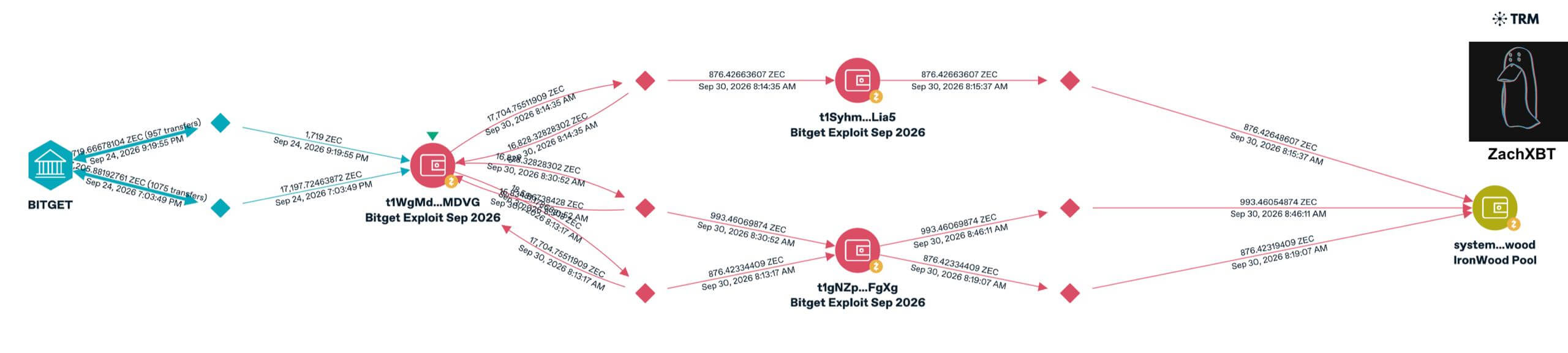
The transfers complicate Bitget’s recovery effort because transactions inside Ironwood can conceal senders, recipients, and amounts, breaking the public transaction trail investigators use to follow stolen assets. Deposits into the pool remain visible, but subsequent movements become considerably harder to link to their origin.
The shift toward Zcash's privacy infrastructure follows attempts by the attackers to move substantially larger sums through cross-chain services, some of which have begun refusing the transactions.
NEAR Intents General Manager Alex Shevchenko said wallets connected to the Bitget theft attempted to process more than $50 million through the protocol. Its SHIELD risk system rejected most of those transactions before execution, while roughly $503,000 was frozen after swaps had begun and about $166,000 successfully passed through.
The rejected assets remained under the attackers’ control, leaving them free to seek alternative routes. The latest Zcash transfers show how that contest is shifting as stolen funds encounter tighter screening across parts of the crypto market.
THORChain volume surges as hackers seek other routes
One alternative has been THORChain, the permissionless cross-chain exchange that has resisted Bitget’s requests to block addresses linked to the theft.
Bitget-linked wallets have repeatedly used the protocol to turn stolen assets into native Bitcoin. Bitquery estimated that about 29,088 ETH, worth roughly $79 million at the time of its analysis, had been sent into THORChain and swapped for Bitcoin through Sept. 29.
As a result, activity on the decentralized exchange has exploded since the breach. THORChain has processed more than $1.5 billion in DEX volume in the days following the incident, compared with roughly $146 million during the week before the attack, according to DeFiLlama data reviewed by CryptoSlate.
The increase has coincided with hacker-linked flows, although total THORChain volume cannot be attributed to the attackers.
THORChain's actions, in contrast to NEAR, highlight a widening divide over how decentralized infrastructure should respond when it identifies stolen assets.
NEAR has argued that permissionless access does not require its liquidity providers to execute known illicit transactions. However, THORChain has maintained that selective censorship would undermine the principles governing its network.
That disagreement has practical consequences for Bitget. Blocking one venue does not freeze assets held in self-custodied wallets. Instead, it forces the attacker to find another source of liquidity, potentially pushing funds toward permissionless exchanges or privacy systems that offer investigators fewer opportunities to intervene.
Bitget absorbs withdrawal rush as operations restart
Meanwhile, Bitget is facing a separate test from its customers as it gradually restores access to funds following the four-day withdrawal freeze.
DeFiLlama data reviewed by CryptoSlate shows more than $700 million has moved out of tracked Bitget wallets since withdrawal channels began reopening, highlighting immediate customer demand to move assets off the exchange. DeFiLlama tracks known exchange wallets, meaning the figure reflects on-chain flows rather than Bitget’s complete internal withdrawal ledger.
Bitcoin accounted for a sizable portion of the initial rush. Bitget said it had processed 9,585 withdrawal requests totaling 4,098 BTC by Sept. 28, hours after reopening Bitcoin withdrawals.
The outflows have continued as the exchange progressively restored other assets. Bitcoin withdrawals reopened Sunday, followed by Ethereum and then USDT across Ethereum, BNB Chain, Solana and Tron. Bitget plans to reopen withdrawals for its remaining cryptocurrencies as well as fiat and peer-to-peer services on Friday.
On Sept. 30, Bitget's Chief Executive Officer Gracy Chen said that the exchange's Protection Fund had also been rebuilt to more than $300 million, restoring a threshold the company had promised to reach after drawing on the fund following the breach.
She said BTC, ETH and USDT withdrawals were already operating and described the business as “gradually back to usual.”
The exchange’s latest proof-of-reserves snapshot provides another measure of its ability to withstand the withdrawals. Bitget reported an overall reserve ratio of 131% across 19 covered assets as of Sept. 29, meaning the assets included in its disclosure exceeded corresponding customer balances by 31%.
Those figures will face a broader stress test when Bitget removes the remaining withdrawal restrictions Friday.
Source: CryptoSlate