



FILTERED RESULTS
FILTERS
MCap $2.9T -0.3%24h Vol $153.2B +122%Fear & Greed 74/100Alts Index 57/100
BTC.D 58.4% -0.5%Stable.D 9.2% 0%ETH.D 11.4% 0%Others.D 21.0% +0.5%
SHFL$0.6630+69.75%•HBAR$0.1270+33.63%•QNT$237.40+26.15%•MARSCOIN$0.1593+25.11%•BTW$1.300+13.41%•ALGO$0.1333+12.12%•XDC$0.0361+11.77%•CASHCAT$0.1903+8.94%•IOTA$0.0552+8.55%•LINK$15.111+7.21%•
Q$0.0259-47.69%•USELESS$0.2405-19.17%•AR$4.225-15.08%•FARTCOIN$0.1681-14.63%•MET$0.3234-14.14%•RAY$1.913-13.77%•ZEN$6.890-13.01%•WLD$0.4918-12.45%•NEAR$4.815-11.86%•ARB$0.2024-11.69%•
•
·
·
FILTERED RESULTS
163,061,311 $USDC (163,116,752 USD) minted at USDC Treasury...
Iran Agrees To Suspend Uranium Enrichment In Exchange For US Sanctions...
Belarus Moves Toward Registering First Two Crypto Banks Under New Rules
1,357 $BTC (113,578,422 USD) transferred from #Paypal to unknown wallet...
ETHFI to Fully Exit EigenLayer Restaking as Yields Dry Up and Sector Profitability DeclinesETHFI...
Bitcoin’s (BTC) Still in a Bull Market, But a Correction Could Be Coming First
Russia lets crypto exchanges apply October 5 – but even Bitcoin lacks final retail clearance
Trump Diesel Curbs Could Hit Every Major Economy, Devere Warns
Crypto PAC spends $11M to oppose Sherrod Brown in Ohio
Circle's Arc Facilitates $150 Million in USDC Borrowing Against Bitcoin Collateral
Analysis: AI-related debt issuance has limited impact on U.S. Treasury yields; 10-year yield may fall to 4.25% by end of 2027
Ondas investors blame short-sellers, fails-to-deliver
Apollo Chief Economist: AI Agents Automatically Moving Deposits Could Trigger a "Slow-Motion Bank Run"
BGB Token Price Faces Fresh Pressure to Fall Under $1 After Bitget Hack
Ethereum Holds Near $2,677 as Traders Watch $2,700 Resistance
Arbitrum Foundation launches security program to subsidize smart contract audits for ecosystem projects
Aptos Foundation Collaborates to Establish Stablecoin Corridor Between Middle East and Africa
Spectra Finance Introduces Fixed-Term Markets for deJTRSY on Stellar Network
Hut 8 Secures $1.07 Billion Senior Secured Revolving Credit Facility with Four-Year Term
Vitalik Buterin Outlines 'Cryptographic World Computer' Plan for Ethereum
China Says Crypto Anonymity Is an “Illusion” Amid Spy Warning
Bitcoin Braces For a Week That Could Reshape Its Path
Trump ready to ease Iran sanctions and unfreeze its frozen assets
The restaking gold rush is over, and top protocols are barely making a profit
NEAR Rockets as Bitwise ETF Clears a Major Hurdle
Bitcoin ETFs Smash Through Their Biggest Week in a Year
1,336 $BTC (111,542,369 USD) transferred from unknown wallet to #Paypal...
Quant Explodes Over 300% As Banking Giants Move In
Bitget Resumes Withdrawals in Stages After $388 Million…
Chainlink Reaches 2026 High of $14.89 Amid Diverging Market Trends
SEC Commissioner Hester Peirce is wrapping up her time at agency this week.In an
BlackRock Withdraws $127 Million in Cryptocurrency from Coinbase Prime
Polymarket Introduces 15-Minute Bitcoin Price Markets for US Users
Ondo Perps Introduces Spot Trading for Tokenized Stocks and ETFs
Tether is a ‘lifeline’ for Iranian regime, Senate Dems say in new report
CCIP 2.0 Goes Live With $84B in Cross-Chain Value Secured
24-Hour US Stock Trading Era Approaches as Major Exchanges Accelerate After-Hours Trading
DeFi researcher Ignas: Fewer than 20 quality tokens in the crypto market currently have real revenue support
Polymarket Launches 15-Minute Bitcoin Up/Down Markets On Its US App, Allowing Millions Of Users A...
Bitget Restarts Bitcoin Withdrawals as $388M Hack Investigation Widens
Solana: Skip Rate Stable After Slot Time Drops to 250ms, 200ms Target Still Requires Caution
Volante Technologies Partners with Circle to Enhance USDC Payment Integration
Solana Network's Real Economic Value Reaches Six-Month High
Ethereum Post-Hegotá: Vitalik Buterin Lays Out 2030 Roadmap
OKX US to sell USD trading bot positions if users miss Sept 30 deadline
RLUSD market cap is only about $248 million away from surpassing PayPal's PYUSD
830 $BTC (69,133,202 USD) transferred from #Kraken to unknown wallet...
Belarus Registers First Crypto Banks Under New Regulatory Framework
1,479 $BTC (122,902,521 USD) transferred from unknown wallet to Coinbase...
Chainlink has launched CCIP 2.0, an upgraded version of its cross-chain infrastructure
23,010 $ETH (61,299,843 USD) transferred from unknown wallet to Coinbase Institutional...
REX Shares and Osprey Funds Update SEI Staking ETF Documents for SEC Approval
Whale Sells 15,000 ZEC for Approximately $23 Million on Hyperliquid
BitMine bought 17,362 $ ETH last week, bringing its total holdings to 6 million...
REX Shares and Osprey Funds Update SEI Staking ETF Filing, Effective Date Set for October 23
New Perpetual Contract Listing: KIIUSDT#Bybit #NewFinancialPlatform...
Bitcoin Falls Lower as Trump's Iran Snub Sends Oil, Yields Higher
Tether Freezes $550 Million in USDT Linked to Iranian Sanctions
Tether Helped Freeze $550M in Iran-Linked USDT, Reveals $4.9B Total Freeze
Senate Investigation Finds Widespread Use of Tether’s USDT in Iran-Linked Wallets
Circle and Volante Technologies are partnering to integrate USDC workflows into
Ledger CTO: Claim that only ~30% of BTC faces quantum risk is questionable
Tom Lee’s Bitmine Hits 6 Million Ether Milestone With $46M Buy
Nvidia Adds $150 Billion to Largest Ever Stock Buyback
Piper Sandler’s Latest Price Target For Google Stock
AMC CEO Criticizes Robinhood Leadership Over SEC Relations and Tokenized Stocks
Bitget CEO Gracy Chen says attacker behind $388 million exploit ran two test
Crypto.com Spinoff OG.com Joins Race for Never-Expiring US Stock Futures
Which Altcoin Is Most Likely to 10x in the Next Bull Cycle? (3 AIs Speculate)
Ethereum’s next scaling leap may come from making everyone stop doing the same work


Ethereum co-founder Vitalik Buterin says advances in cryptography could turn decentralization from a performance cost into a scaling advantage for the network.
In a Sept. 27 essay, Buterin described Ethereum's long-term destination as a “cryptographic world computer,” an architecture in which computation and data can increasingly be distributed across different participants while compact proofs allow others to cheaply verify that the work was performed correctly.
The shift would mark a departure from the traditional blockchain model in which every node downloads transactions and repeats much of the same computation. Instead, Ethereum could push more work across a wider network of specialized participants without requiring every validator to reproduce it, potentially allowing decentralization itself to contribute to performance.
“Perhaps the most important shift” is that decentralization is moving beyond being a burden accepted for safety and robustness and can, in limited cases, become a performance strength, Buterin wrote. Distributed networks can store larger quantities of data and run more computation in parallel, including work around the transaction mempool.
That revives one of Ethereum's earliest ambitions. Developers in the mid-2010s considered distributing different pieces of computation across participants much as centralized systems divide workloads between servers. The obstacle was verification: dividing the work created the additional problem of establishing that every participant had performed its portion correctly.
Modern cryptographic proofs increasingly provide that missing layer, Buterin said, while their computational overhead continues to decline.
From repeated computation to verified work
The change is part of a broader overhaul that Buterin argues will make Ethereum around 2030 qualitatively different from the blockchain systems that emerged with Bitcoin.
Ethereum's future verification model would rely increasingly on data sampling and succinct cryptographic proofs rather than requiring every validator to download and independently execute everything. Consensus is also moving toward a more optimized proof-of-stake design, while block construction is being divided among multiple participants instead of being controlled by a single producer.
Zero-knowledge technology is already central to that direction. Ethereum's proposed L1 zkEVM model would allow a specialized prover to execute a block and generate a proof of correct execution, which other nodes could verify much more cheaply than re-executing every transaction themselves. The technology remains under active research and has not been integrated into production Ethereum clients.
The result, if the roadmap works as intended, would be a network where doing work and checking work become increasingly separate functions.
Buterin argues that separation could allow Ethereum to retain the security benefits of broad verification while tapping distributed infrastructure for more computation, storage and potentially privacy. Infrastructure surrounding Ethereum could also compete more aggressively on latency even if the base chain itself never approaches the response times of centralized servers.
He described the eventual system as a hybrid combining traditional blockchain properties with cryptographic verification, privacy and decentralized components operating away from the base chain.
Applications may have to change with it
The transition could also alter the economics of building applications on Ethereum.
On a conventional blockchain, developers largely think about the amount of data or computation an application consumes. Buterin expects the structure of that computation to become increasingly important as Ethereum attempts to parallelize work across different participants.
Applications that package large amounts of interdependent computation into one serial transaction could become comparatively expensive, while workloads separated into well-defined components that can be parallelized, aggregated or pruned could become cheaper.
That would give developers an incentive to design applications around independent dependencies rather than treating Ethereum as a single machine on which arbitrary computation is executed sequentially.
Over time, Buterin suggested, Ethereum could converge toward a model where information needed for ordering and state changes that cannot be rearranged remains onchain, while much of the surrounding computation is processed and aggregated before reaching a block.
Such a model would push Ethereum closer to being a coordination and verification layer for distributed computation rather than a system in which the base chain itself performs every operation.
The distinction remains largely prospective. Ethereum's roadmap contains several research efforts aimed at reducing what ordinary validators must store or compute, while many of the technologies needed for the broader architecture remain unfinished.
State becomes the harder constraint
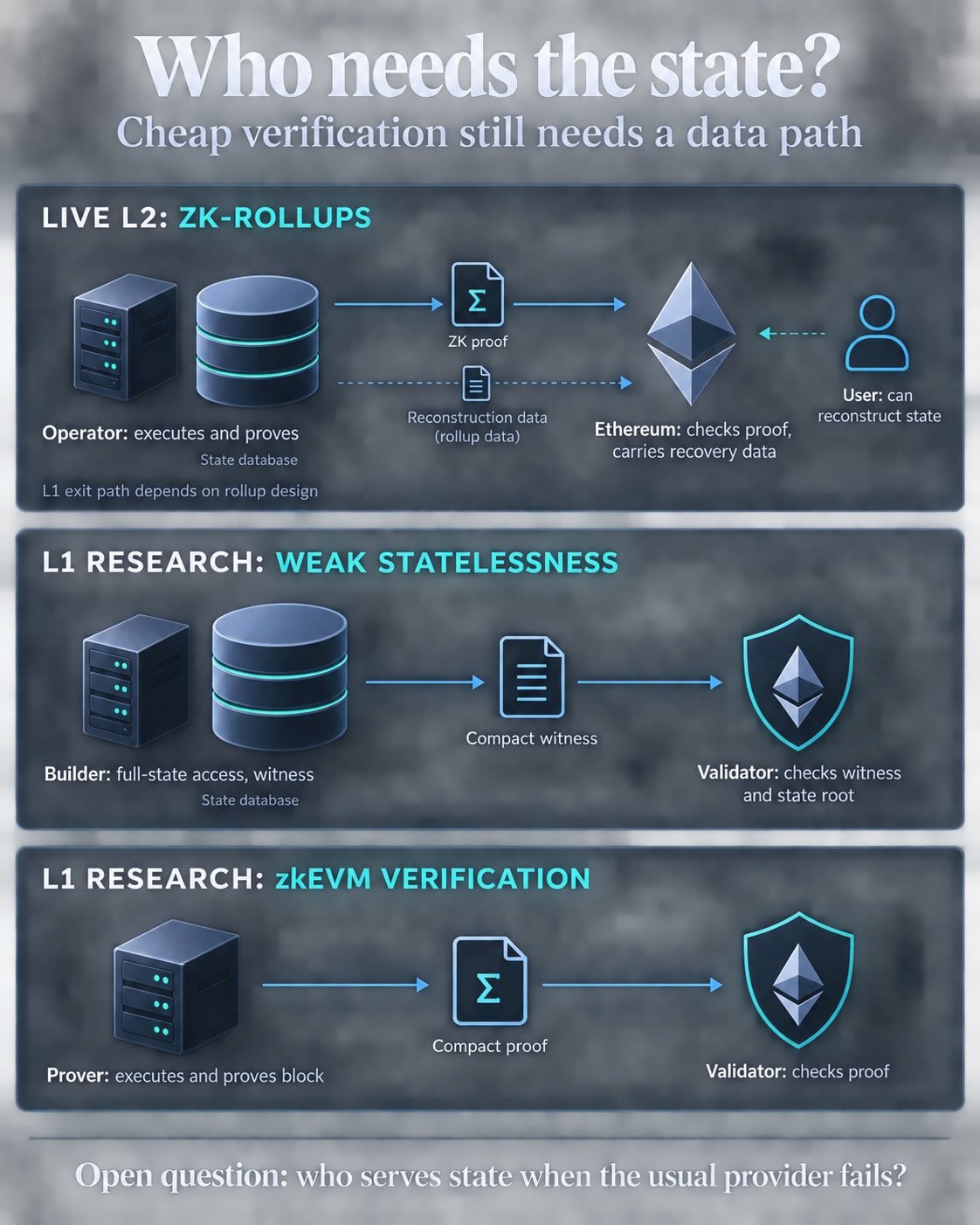
Making computation verifiable does not remove the need to obtain the data on which that computation depends.
Buterin identified managing and parallelizing access to Ethereum's growing state as the more systemically difficult challenge facing the architecture. State includes the account balances, smart-contract storage and other information required to determine what the network currently looks like before another transition can be calculated.
Ethereum researchers are pursuing several approaches to reduce that burden. Weak statelessness, for example, would allow most validators to verify blocks without maintaining the full state database, while block producers retain access to the state needed to construct blocks and generate witnesses. The proposal remains in research and depends on other changes to Ethereum's architecture.
That means cryptographic proofs can make the result of computation dramatically cheaper to check without making the upstream requirement for data disappear. The network must still develop reliable ways to store, retrieve and parallelize access to state as more work is divided among participants.
Buterin said Ethereum has potential approaches to the problem, though designs will need to evolve alongside the applications eventually running on the network.
The transition is already moving into Ethereum's protocol roadmap. Buterin said Hegotá, currently planned for 2027, could be the network's last “normal” fork recognizable to developers from Ethereum's earlier era. Later upgrades are expected to lean increasingly on recursive proofs, automated formal verification, optimized consensus and quantum-resistant cryptography.
PeerDAS has begun that transition, he said. What follows will test whether Ethereum can distribute substantially more computation without recreating the old requirement that every participant repeat the same work, and whether its state infrastructure can keep pace with the cryptography making that division possible.
Source: CryptoSlate