



FILTERED RESULTS
FILTERS
MCap $2.9T -0.3%24h Vol $63.1B -30%Fear & Greed 70/100Alts Index 59/100
BTC.D 59.3% -0.1%Stable.D 9.2% +0.1%ETH.D 11.4% 0%Others.D 20.1% 0%
PROS$0.8248+14.97%•FET$0.2532+13.84%•RAIN$0.0119+13.7%•BEAM$0.00259775+13.11%•HNT$0.5684+11.74%•ADA$0.2718+11.38%•STRK$0.0584+10.11%•VIRTUAL$0.8714+10.07%•DRV$0.4134+9.66%•FLOKI$0.00002963+8.83%•
BR$0.4591-20.64%•BTW$1.179-18.64%•STONK$0.1996-14.92%•AI$0.1145-14.87%•PONS$0.3815-10.82%•NIGHT$0.0457-7.7%•ZAMA$0.0827-7.34%•AXS$1.318-6.88%•CAP$0.0639-6.35%•CARDS$0.2464-5.95%•
•
·
·
FILTERED RESULTS
Trader 0x914b lost $471K shorting 14,976 $ETH($40.97M) and then flipped to long.He opened a 25x...
Crypto Week Ahead: TOKEN2049, FOMC Mins, Evernorth XRP Nasdaq Debut, Ethereum’s Glamsterdam
Binance Updates International Crypto Transfer Requirements for Brazilian Users
Kraken parent Payward partners with Singapore Gulf Bank to offer 24/7 instant settlement for institutional clients
WuBlockchain Weekly Outlook: September's rate hikes may not be the end. Fed and ECB minutes land...
Bitcoin Faces Significant Short Liquidation Risk Near $90,000
Ethereum Price Analysis: ETH Holds Bullish Structure, but $2.8K Remains the Key Hurdle
Star: Tokenized Stock Trading Platform DEX Contract Planned for Deployment on X Layer
Willy Woo: About 8% of countries have policies to buy or hold Bitcoin
15-Year Ethereum OG Whale Transfers 13,000 ETH to Coinbase, Nearly Clears 170,000 ETH Position for $193 Million Profit
Webull Becomes X Cashtag Partner for Crypto and Stock Trading
Zhipu's afternoon gains widen, up over 5% intraday
Spot Bitcoin ETFs Experience $241 Million in Net Inflows for Third Consecutive Week
Russia Finance Ministry Pays Wages in Digital Rubles for First Time
XRP and SOL ETF Demand Craters as Weekly Inflows Drop 94%+
Kraken parent Payward has partnered with Singapore Gulf Bank to offer 24/7 settlement
OKXICE files for round-the-clock tokenized trading in U.S. stocks
Zcash’s 25-second blocks go live on public testnet ahead of schedule
Japan’s Ministry of Foreign Affairs Hits Garantex With Asset Freeze
Crypto exchange OKX files with the SEC to launch tokenized US stock trading....
Bitcoin zooms toward $87,000, nearly setting an eight-month high, then reverses
Spot Bitcoin ETFs Recorded $241 Million in Net Inflows Last Week, Marking Three Consecutive Weeks...
$113 Million in Short Positions Liquidated in 24 Hours as Crypto Market Shifts
Japan Bond Selloff Deepens As 30-Year Yield Breaks Every Record Since 1999
Why Is Crypto Market Going Up Today?
Trump Announces Creation of "Super Intelligence Force" to Coordinate Federal Government Efforts
Ether's bitcoin-beating Q3 rally came with a catch. Liquidity thinned.
Prediction Markets Beat Traditional Polls in Brazilian Election
Zcash activates NU7 on testnet ahead of November mainnet target
Payward Partners with Singapore Gulf Bank for 24/7 Digital Asset Settlement Services
Kraken parent company Payward and Singapore Gulf Bank (SGB), a fully licensed digital bank...
Machi's crypto trading hits 12 straight wins in a week, $PUMP cumulative profit reaches $2.14 million
Greenfield Capital Files Complaint Against Safe Ecosystem Foundation in Switzerland
On October 5, we'll be celebrating innovators and institutions expanding digital markets
Figure founder Brett Adcock: Personal AI product Hark to launch this week, first 100,000 registered users get paid plan free
Ethereum’s zkAPI Gives AI Payments a Privacy Cloak With a Catch
Machi(@machibigbrother) won 2 more trades on $PUMP, making it 12 wins in a row over the past week,...
Revolut Achieves $115 Billion Valuation, Becomes Europe's Most Valuable Startup
Drift Foundation responds to community concerns: DFX is not pegged to USDT, redemption value depends on Recovery Pool balance
Safe investor asks Swiss watchdog to intervene in governance dispute
Hong Kong SFC adds digital asset private fund "E Fund" to list of unlicensed companies
Illinois backs delay to crypto tax rule after months of industry pushback
OKX Applies to SEC to Launch Tokenized U.S. Stock Trading PlatformAccording to Bloomberg, OKX has...
OKX Applies to U.S. SEC for Tokenized Stock Trading Platform
Yilihua Identifies Key Challenges Facing Cryptocurrency Primary Market
Ex-SEC Chair Jay Clayton Named Trump’s AI Czar After Ripple XRP Lawsuit Era
Data: HYPE Spot ETF saw net inflow of $3.306 million last week
XRP spot ETFs saw net inflows of $4.7439 million last week
Glassnode: Bitcoin's Largest Short Liquidation Zone Is Near $90,000
Bitcoin spot ETFs saw $241 million in net inflows last week, marking three consecutive weeks of net inflows
Ethereum spot ETFs saw $138 million in net outflows last week, with Fidelity's FETH leading at $74.06 million
$ BNB SURPASSES $800....
Hyperliquid bought back and burned $10.15 million worth of HYPE tokens in the past 24 hours
Ethereum Liquidity Falls Below 50% of Bitcoin's Level
Binance Lite Loan Promotion Extended: Enjoy Simple Borrowing with 50% Off Service Fee!Binance is exc...
Zcash NU7 network upgrade activated on testnet at block height 4,465,026
SKY treasury company SDEV stock surges over 700% in 15 days, now at $7.48
Why XRP Appeals to Institutional Investors, Bitwise CIO Explains
OKX Files with SEC to Launch Tokenized-Stock Trading in the US
OKX Files With SEC to Launch Tokenized US Stock Trading Platform
U.S. Digital Asset Holders Face October 15 Tax Deadline for 2025 Returns
In Q3 2026, the TVL on #Tron increased by $3.3B, up...
Binance to Block Brazil Cross-Border Crypto Transfers From Nov. 1 Without Purpose and Counterparty...
Bitwise Launches PAPY Vault on Circle’s Arc for USDC Lending
Zcash Activates NU7 Network Upgrade on Testnet
Nikkei 225 breaks above 70,000 points, up 2.5% intraday
U.S. 2025 tax year extended filing deadline is October 15; crypto traders need to verify reported information
Smart trader Frank (@frankdegods) has been buying $EDEL since Oct 1, spending a total of $191K to...
Musk: Spreading superintelligence to the stars could be seen as a successful outcome for humanity
SEC and CFTC bypass Congress to open crypto access after CLARITY fails – with a catch


Two days after the US Senate failed to advance the CLARITY Act, federal regulators opened two narrower routes for crypto-linked market access under existing law.
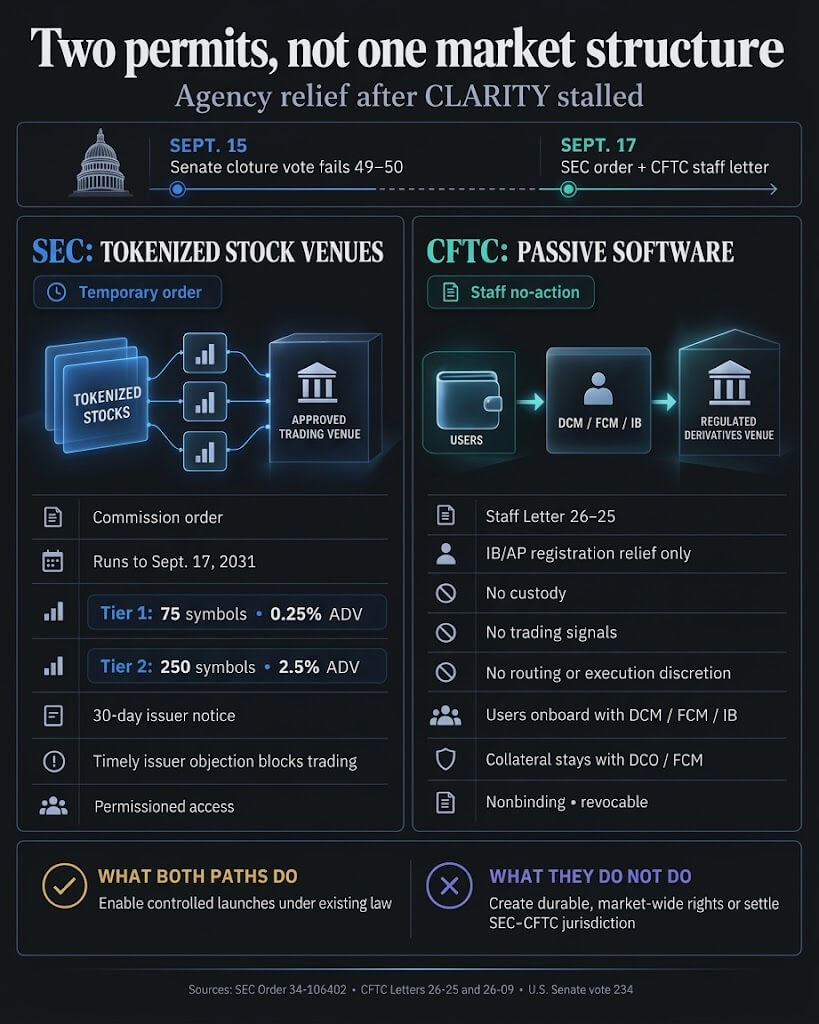
The Securities and Exchange Commission created a five-year path for permissioned venues to trade tokenized US stocks through automated market makers. The Commodity Futures Trading Commission broadened staff no-action relief so qualifying software providers can connect users to regulated derivatives markets without registering as introducing brokers for the covered activity.
The actions can support real products, but they do not recreate market-structure legislation. The SEC route is capped and conditional. The CFTC route still relies on registered derivatives firms for onboarding, trading and custody, and it rests on a staff position that can change.
The SEC turns existing authority into a five-year test
The timing was direct. On Sept. 15, senators voted 49-50 against cloture on the motion to proceed to H.R. 3633, according to the official roll call. That was a procedural failure to advance the CLARITY Act, not a final vote on the bill's merits.
On Sept. 17, SEC Chairman Paul Atkins connected the congressional setback to the Commission's next move. In a statement accompanying the Innovation Exemption, Atkins said the agency was acting within its existing statutory authority. He also characterized the exemption as a bridge that should be followed by durable rulemaking.
The SEC order creates a new category called a Tokenized Securities Venue, or TSV. A qualifying venue can bring buyers and sellers together through permissioned automated market maker liquidity pools without being treated as an exchange under the Exchange Act. Certain firms that supply tokenized stock from proprietary accounts can also receive conditional relief from the dealer definition for that activity.
The exemptions run through Sept. 17, 2031, unless the SEC modifies them. Their limits make the experiment deliberately small relative to the US equity market.
Across a TSV and its affiliates, Tier 1 stocks are limited to 75 symbols and no more than 0.25% of the prior month's average daily share volume in each relevant stock. Tier 2 stocks are limited to 250 symbols and 2.5% of average daily share volume.
Eligible tokenized stocks must preserve the economic and governance rights attached to equivalent traditional shares, including dividend and voting rights. Synthetic-exposure tokens, rights, warrants, primary issuances and initial offerings do not qualify.
Issuers also receive a direct control point. Before a TSV can trade stock tokenized by an unaffiliated third party, the venue must notify the issuer and wait at least 30 calendar days after receipt. An objection delivered within that window blocks the tokenized stock from trading on that TSV.
The blockchain may be public and permissionless, but the market is permissioned. TSVs must set access standards, verify participants or wallet addresses, and disclose when access can be denied or limited. Smart contracts must be public and auditable, while the venue remains responsible for delegated verification.
The order replaces full exchange oversight with tailored conditions rather than removing market safeguards. TSVs must publish transaction data, keep records, stop trading when the underlying stock is halted on its primary exchange, disclose operational risks and report significant systems events.
Other laws still apply. The order preserves Securities Act requirements, federal antifraud and antimanipulation rules and sanctions compliance. SEC, self-regulatory organization and anti-money laundering duties can still apply to participants based on their activities. The exemption covers the defined TSV model, not securities activity outside it.
The CFTC opens an interface while registered firms keep control
The Commodity Futures Trading Commission‘s Market Participants Division moved on the same day with Letter 26-25. The letter generalizes relief that the division granted to Phantom in Letter 26-09 in March. The earlier position applied only to Phantom; the new one is available to passive software providers on substantially the same terms and is not limited to crypto wallets.
A qualifying provider can display market and position data, market particular derivatives contracts and registered firms, solicit users, receive revenue sharing or transaction-based fees, and transmit user-directed orders. Those activities could otherwise trigger introducing-broker or associated-person registration.
The relief is narrow. The software provider cannot hold customer assets, generate express buy or sell signals, or exercise discretion over order routing or execution. Letter 26-25 addresses only whether the division will recommend enforcement for failure to register as an introducing broker or associated person for the covered activities. It does not provide a general exemption from other registration categories or laws.
Users must be onboarded directly with a designated contract market, futures commission merchant or introducing broker. They must be able to reach that registered firm independently of the software provider. Funds securing derivatives positions remain with a derivatives clearing organization and/or a clearing-member futures commission merchant.
The provider also assumes conditions covering conflict and risk disclosures, marketing controls modeled on National Futures Association rules, recordkeeping, regulatory notices and joint liability with each participating registrant for violations connected to the covered activity.
This creates a clearer role for wallets and other interfaces without moving the regulated market's core functions into the software layer. A provider can make derivatives easier to discover and access, but the designated market handles trading, registered firms onboard users, and a DCO or FCM holds collateral.
The legal foundation is also less durable than the SEC's time-limited Commission order. Letter 26-25 represents the views of one CFTC division, is not binding on the Commission and may be modified, suspended or terminated. Unless changed earlier, it runs only until relevant Commission rulemaking or guidance takes effect.
Useful permits still fall short of market structure
The SEC and CFTC actions solve different registration problems. Their shared feature is that both create conditional operating space without establishing general market-wide rights.
For tokenized stocks, access depends on a TSV's permissioning standards, symbol and volume caps, issuer objections and continuing compliance with the order. For regulated derivatives, the interface provider must remain passive while users, collateral and execution stay inside registered market infrastructure.
That distinction makes the new routes useful for controlled launches. A firm can build to specified conditions instead of waiting for Congress. Users may gain easier paths to tokenized stocks or regulated derivatives. Regulators can observe activity before writing permanent rules.
The same design creates uncertainty. Neither action settles the broader allocation of authority between the SEC and CFTC. Neither grants an unconditional right for a venue, wallet or user to enter these markets. Other applicable federal and state obligations remain outside the narrow relief, and future agency interpretations could change the economics of relying on it.
No company is named in the SEC order or CFTC Letter 26-25 as committed to launch under the Sept. 17 pathways. The CFTC letter says only that unnamed similarly situated providers and their counsel made inquiries after the Phantom relief.
The first practical test will be public commitments. For the SEC route, that means notices from operators willing to accept the caps, disclosure duties and issuer-objection process, followed by evidence that liquidity can develop within those limits. For the CFTC route, it means software providers signing agreements with registered derivatives firms, filing the required undertakings and offering an interface that remains passive in practice.
Market behavior will then reveal whether conditional access can scale. Issuer objections, participant onboarding, liquidity, transaction volumes and any regulatory modifications will show whether the pathways become durable market channels or remain experiments.
The agencies have demonstrated that US crypto access can grow without a new act of Congress. They have not shown that temporary exemptions and revocable staff relief can provide the certainty, uniformity or jurisdictional settlement that legislation could deliver.
Source: CryptoSlate