



FILTERED RESULTS
FILTERS
Fear & Greed 73/100Alts Index 57/100
BTC.D 58.8% +0.5%Stable.D 9.2% 0%ETH.D 11.6% +0.2%Others.D 20.4% -0.7%
GRASS$0.7472+29.22%•ZBCN$0.00244776+20.2%•SOON$0.4089+19.81%•NIGHT$0.0327+18.19%•PUMP$0.00581448+17.84%•ICP$3.449+15.25%•AAVE$166.54+14.38%•ETHFI$0.7761+11.31%•AVAX$11.483+11.03%•FARTCOIN$0.1821+11%•
HBAR$0.1035-15.4%•NMR$12.493-9.9%•AI$0.1982-9.26%•BR$0.8281-8.92%•MARSCOIN$0.1425-7.98%•ALGO$0.1253-6.9%•BTW$1.302-6.08%•Q$0.0235-5.94%•ORCA$1.612-5.46%•PROM$5.977-5.41%•
•
·
·
FILTERED RESULTS
873 $BTC (72,554,673 USD) transferred from unknown wallet to Coinbase Institutional...
Bitcoin bitcoin:native is testing a key long-term holder supply cluster around
BNB Chain Gains Nearly 1 Million Stablecoin Holders in a Week
2,057 $BTC (171,426,833 USD) transferred from unknown wallet to Coinbase...
Coinbase Faces $25M Loss Claim From Crypto Investor
Bitwise has launched Bitwise NEAR ETF
Bitcoin drops to $82,000 on US data, and inflation fear is blamed
749 $BTC (62,578,820 USD) transferred from unknown wallet to Coinbase Institutional...
Pakistan explores using landfill methane to generate energy as the...
Spark Finance Achieves 190% Loan Growth, Dominates DeFi Lending Market
NEW: Coinbase Ventures and CMCC Global closed a strategic funding round with trading firm Raven at a
Ethereum Gets Another Privacy Boost as Aztec Brings Back zk.money
Sequoia, Tiger Global Circle Kalshi in Fresh $1B Funding Talks: Report
2,000 $BTC (168,859,537 USD) transferred from unknown wallet to #Bitfinex...
Bitwise launches the first U.S. spot $NEAR ETF under ticker $NRR...
Trader "Dicedicedice", who suspiciously bet on the U.S. striking Iran by Feb. 28 and made $120K...
150,000,000 $USDT (150,043,500 USD) transferred from Tether Treasury to unknown...
Cboe and S&P Dow Jones Indices are exploring tokenized options as...
PRESIDENT TRUMP CONSIDER JAY CLAYTON FOR AI CZAR, PREVIOUS SEC CHAIRMAN WHO LAUNCHED SECURITIES...
Polymarket has named former Goldman Sachs Partner Lisa Mantil as Head of Institutional
Cboe's New S&P Deal Opens the Door to Tokenized Options
Sept 29 Update:#Bitcoin ETFs:1D NetFlow: +511 $BTC(+$42.99M)7D NetFlow: +15,196...
Bitcoin Could Reach $400,000 by 2030, Says Coinbase CEO Brian Armstrong
Bitget Reports 131% Reserve Ratio Following Security Incident
700 $BTC (59,031,992 USD) transferred from #Antpool to #Binance...
Morgan Stanley is moving deeper onchain, launching an internal lab to...
Ric Edelman Urges 10-40% Bitcoin Allocation, Sees $500K Price by 2030
Bitcoin market update /w Bitfinex, Moca Network goes live
Another whale (0x96de) withdrew 7,500 $ETH($20.5M) from #Binance in the past 30...
Bitcoin Kingpin Michael Saylor of Strategy Has Something New to Sell You
Volmex Finance Introduces Bitcoin Implied Volatility Perpetual Futures on Hyperliquid
Pakistan Pursues Bitcoin Mining and Methane Capture Initiatives Separately
XRP Surges 50% in a Month as Open Interest Soars to Highest Since August 2025
688 $BTC (58,075,022 USD) transferred from unknown wallet to #Antpool...
Belarus registers its first two crypto banks, allowing fiat deposits,...
Bitget Resumes Withdrawals After $388 Million Security Breach
Boeing Fell 7% After the FAA Held Back 737 MAX 10…
MoonPay has begun full-scale operations in South Korea, outlining new work with
Whale bc1qsz, linked to BIT.com (Matrixport), deposited 1,000 $BTC ($83.94M) into #Binance again an...
Kalshi Seeks $1 Billion at $40 Billion Valuation as Sequoia, Wellington, Tiger Global and Dragoneer...
Bitwise Launches First US Spot Near ETF After Token Nearly Triples Since August
447,824 $HYPE (39,563,029 USD) transferred from #HyperCore to #Kinetiq...
Ondo expands tokenized stocks with Korean equities for overseas...
BlackRock Predicts Stablecoins Will Facilitate AI Agent Payments
CRV Jumps Over 10% to $0.38 as Trading Activity Increases
Top Trending Coins (Today) 1. QNT 2. PENGU 3. NEAR 4. HBAR 5. GRASS 6. ZEC 7. TRUMP 8. AAVE 9....
Cboe and S&P Dow Jones Indices opened door to tokenized S&P-linked options
ZEC has dropped more than 18% from its recent high.Whale 0x362a opened a 5x long on 4,135...
Cboe Extends Exclusive S&P 500 Index Options License Through 2051, Explores Tokenized Options...
Rep. Comer Targets 3 Platforms in Expanded Prediction Market Probe
Coinbase Wallet Adds Polymarket to Its Crypto App Ecosystem
4,951 $BTC (415,696,748 USD) transferred from unknown wallet to unknown wallet...
SEC Files Lawsuits Against Cryptoaiml and TSAI for Alleged $15 Million Fraud
Bitget reopened BTC withdrawals, In the first hour, 3,326 BTC (~$276M) left the...
Aztec Labs Relaunches zk.money Privacy Wallet on New…
Anthropic Lost $42 Billion Last Year. It Wants to Go Public at $2 Trillion
Crypto regulation at SEC, CFTC to come down to 3 commissioners following key resignation
LaunchOnSF FLIPS ponsdotfamily IN 30-DAY REVENUE ...
US Stock Indices Mixed: Meta (META) Up 3.11%, Apple (AAPL) Down 2.74%
Chainlink Rally Brings Profit-Taking, While CCIP 2.0 Targets Institutional Money
Bitwise Launches First US Spot NEAR ETF With Staking Fees Taking 33% of Rewards
A newly created wallet, 0xc642, withdrew 18.84M $ENA($4.91M) from #FalconX 11 hours...
Fed guarantees 2-day stablecoin payouts, but $76B remains blocked
Spacecoin's Parent Company Signs $50M Binding Pre-Order Deal for Freeport Satellite Services in the...
The Race to List Tokenized Stocks in America: Why…
$PRL listed on Lighter futures・
Stablecoin Depeg Risk Ranked: USR Failed, USD0++ Hit $0.89,…
Aave expands lending collateral to Coinbase tokenized stocks, sparking a 16% AAVE rally toward...
HANetf Introduces First Euro-Hedged Bitcoin ETP in Europe
US hit on $24 billion crypto black market sends rival money launderers running for exits


US authorities have escalated their crackdown on Xinbi Guarantee, restraining more than $52 million in crypto and seizing key infrastructure.
A federal court authorized the seizure of Telegram channels tied to the Chinese-language marketplace on Sept. 7, while investigators seized two wallets holding about $12 million and sought restraint of 47 additional addresses linked to vendors and suspected money laundering.
The Treasury Department simultaneously designated Xinbi a significant transnational criminal organization and sanctioned SafeW Technology and Anwen Technology, companies tied to messaging and payment infrastructure used by the marketplace.
The measures extend beyond individual wallets. Xinbi had begun shifting merchant coordination and alleged laundering activity to the encrypted SafeW application around June 2025 and introduced XinbiPay, also known as NewPay, as scrutiny of its operations intensified.
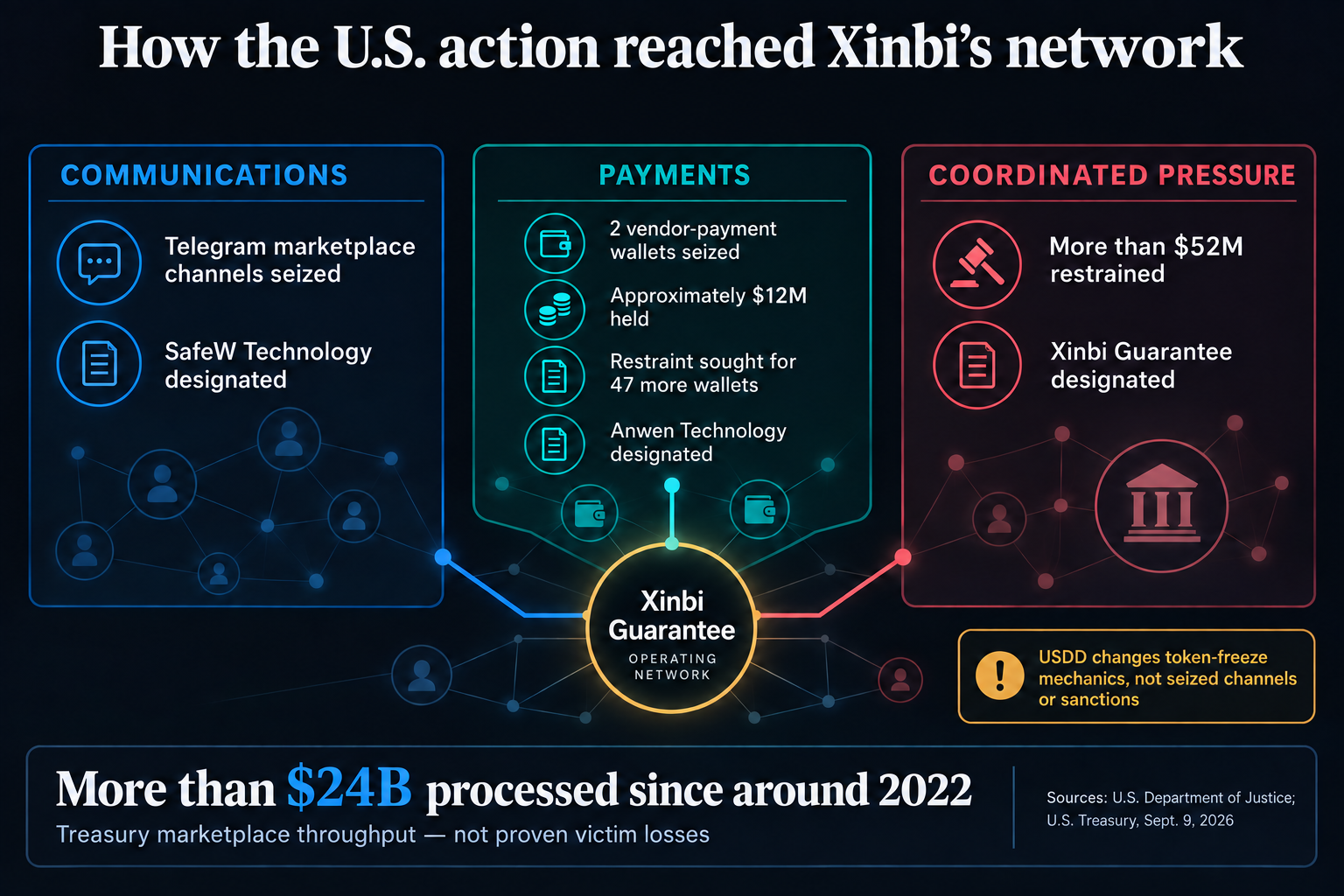
By sanctioning those service providers alongside wallet seizures, US authorities targeted both the movement of funds and the infrastructure used to organize transactions.
The action follows earlier pressure on Xinbi’s USDT network, including freezes affecting operational wallets used to receive, route and withdraw stablecoins. That had already pushed the marketplace to explore alternatives, including greater use of USDD.
Meanwhile, this US action follows sanctions imposed by the UK and comes as governments increasingly focus on the service providers that let stolen crypto and scam proceeds move between wallets, stablecoins, and cash-out networks.
North Korean hackers reveal Xinbi’s role in crypto laundering
Xinbi had become more than a marketplace for Southeast Asian scam operators, providing financial infrastructure that connects cyber theft, fraud proceeds, and underground cash-out networks.
Blockchain analysis firm Chainalysis said North Korea-linked threat actors moved tens of millions of dollars in stolen cryptocurrency through vendors operating on the platform.
Among the services available were specialist operators known as “Black U” launderers, which help criminals break the direct on-chain link between stolen assets and the money they ultimately withdraw.
The vendors accept cryptocurrency traceable to hacks and replace it with stablecoins sourced from separate illicit revenue streams, including pig-butchering and romance scams. That lets stolen tokens disappear into a much larger pool of criminal flows, while hackers receive different assets they can move through unlicensed over-the-counter desks and convert into fiat.
The model made Xinbi useful to actors trying to evade blockchain tracing without relying solely on conventional mixers or bridges.
Chainalysis said the platform hosted vendors offering cash delivery, bank-card fraud, personal data sales, know-your-customer bypasses, scam-platform development, surveillance equipment and malware services.
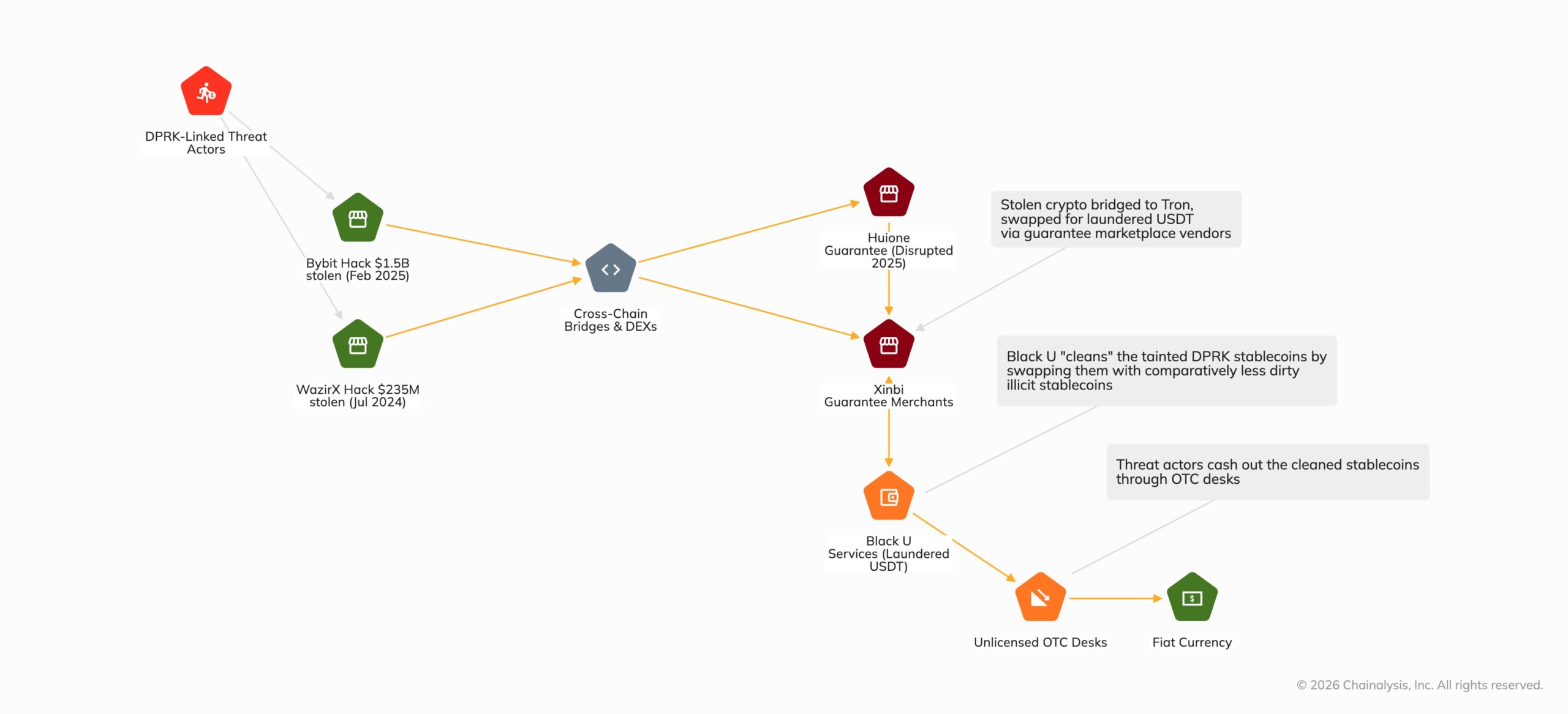
Its vendor channels also served as recruitment pipelines for some Southeast Asian scam compounds where trafficked workers have been subjected to forced labor and physical confinement.
Xinbi processed an estimated $24 billion in digital assets and fiat after emerging around 2022, making it one of the largest transaction-guarantee markets serving the region’s underground economy.
Its role in connecting different categories of illicit finance helps explain the breadth of the latest enforcement.
Rather than targeting a single token or laundering address, US authorities moved against the marketplace’s communications channels, payment wallets, and companies providing supporting infrastructure.
Sanctions trigger withdrawals and merchant exits
The impact of the US measures is already showing up onchain.
Bitrace said it detected abnormal outflows from a Xinbi sub-guarantee platform that had previously operated with little public visibility. Daily USDT withdrawals ranged from about $389,000 to $564,000 between Sept. 1 and Sept. 7, then jumped sharply as enforcement pressure intensified.
Outflows reached about $1.28 million on Sept. 8 and climbed to $1.81 million on Sept. 9. Another $708,125 had left by Sept. 10, Bitrace data showed.
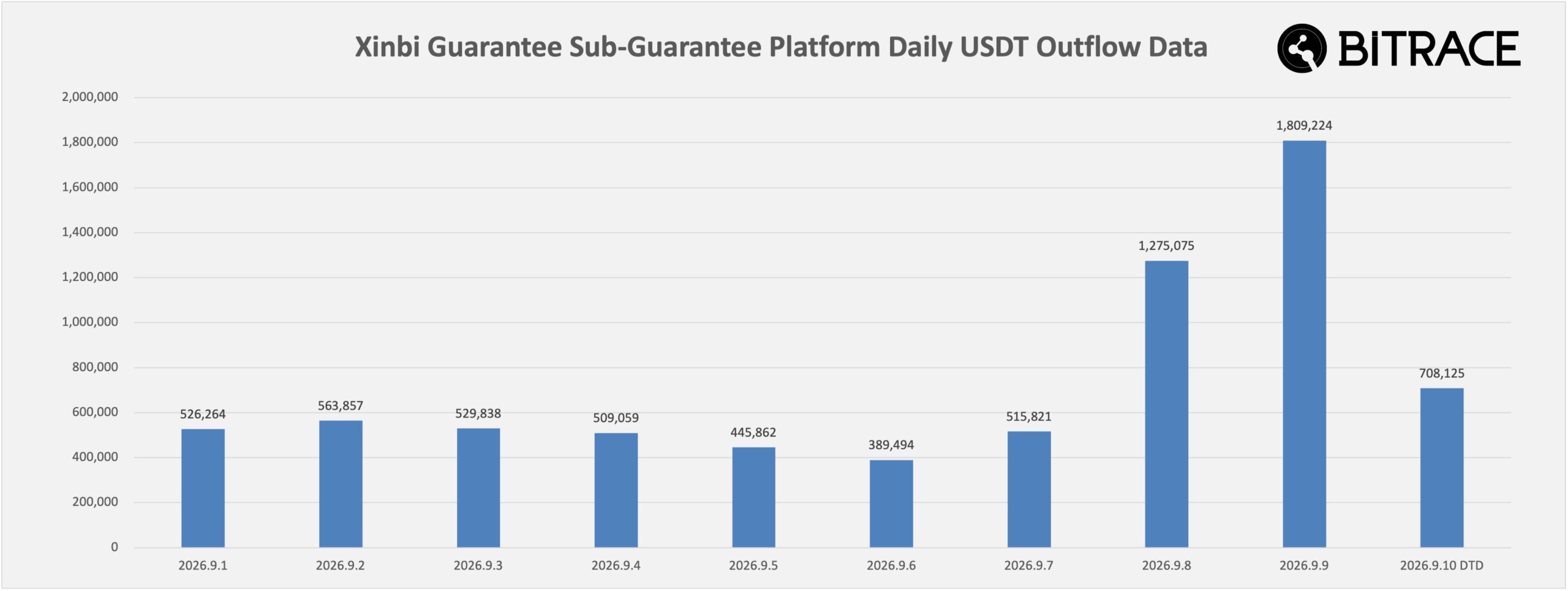
The firm said large numbers of guarantee merchants were moving funds rapidly to reduce the risk of having assets caught in subsequent freezes or sanctions measures.
That defensive behavior has spread to competing platforms.
Fulilai Guarantee, another major transaction-guarantee marketplace, began removing money-laundering merchants from public groups after the Xinbi sanctions, Bitrace said. The purge included operators offering services commonly described as “card-to-USDT” and “cash car,” both used to move or convert illicit funds.
Fulilai Wallet, operated by the platform, has recorded about $9.3 million in outflows since OFAC announced the Xinbi sanctions.
The reaction raises the cost of Xinbi’s adaptation efforts. The marketplace had already explored shifting activity away from USDT after issuer-level freezes demonstrated how centralized stablecoins could become an enforcement choke point.
Moving to another token may reduce exposure to a direct issuer freeze, but it does little to solve the broader problem created by sanctions on service providers, payment infrastructure and counterparties.
For rival platforms, the calculation is becoming more immediate. Continuing to host merchants linked to laundering operations could preserve transaction revenue, but it also increases the risk that wallets, channels and affiliated companies become the next targets.
Source: CryptoSlate