



FILTERED RESULTS
FILTERS
MCap $2.8T -1.3%24h Vol $98.4B +43%Fear & Greed 74/100Alts Index 57/100
BTC.D 58.8% -0.1%Stable.D 9.3% +0.1%ETH.D 11.4% 0%Others.D 20.5% 0%
QNT$254.76+48.18%•Q$0.0498+37.46%•BTW$1.148+23.58%•BP$1.510+20.63%•GRT$0.0321+17.61%•PUMP$0.00509638+16.08%•GRASS$0.6607+14.43%•SEI$0.0819+13.65%•SKY$0.0853+10.2%•SOON$0.3118+8.45%•
AI$0.2205-17.26%•PONS$0.5307-15.57%•BR$0.9088-11.77%•RUNE$0.7247-9.91%•CASHCAT$0.1627-9.83%•2Z$0.0626-9.6%•JTO$0.5739-9.28%•SENT$0.0214-9.25%•MARSCOIN$0.1164-9.16%•ZAMA$0.0815-8.62%•
•
·
·
FILTERED RESULTS
BTC, ETH and XRP Brace For Packed Week Of US Economic Data And Fed Clues
Gate's 7-day net inflow exceeds $118 million, ranking third among global centralized exchanges
$270 Million Liquidated from Crypto Market in 24 Hours Amid Price Swings
Hong Kong Expands Financial Oversight to Virtual Asset Service Providers
As $HYPE falls, $HYPE longs are getting liquidated!0x1add had 11,796 $HYPE ($1.06M) liquidated an...
Discover How 20 Million Russians Tap Into Over $43B in Cryptocurrency
Omnity Network to Cease Operations Amid Funding Shortages
999 $BTC (83,450,746 USD) transferred from unknown wallet to Coinbase Institutional...
Paid suspends X Money payment services, will launch web-based claim portal as interim solution
$XDP listed on OKX spot・
South Korea's Financial Services Commission considering introducing market maker system for virtual assets
‘A Billion Deaths’: Bill Gates Says AI Could Drive Deadly Events
Multiple whales dump HYPE, one address transfers $16.08 million in HYPE to exchanges
Whales are starting to dump $HYPE!0xc745 deposited 177,518 $HYPE ($16.08M) into #OKX and #Bybit an...
Newsom signs California ban on public officials issuing memecoins
HYPE spot ETF saw net inflows of $9.2547 million last week
SOL spot ETFs saw $188 million in net inflows last week
Bitcoin Spot ETFs See $2.386 Billion Net Inflow Last Week, a Near One-Year High
Key News Last Night and This Morning (September 27–28)
Crypto market mixed, RWA sector up 4.24%, BTC falls below $84,000
Waiting for a 30% Bitcoin Dip Backfired in 61% of Tested Cases
A $202 billion US Treasury settlement hits September 30, and it could trigger a surprise move in Bitcoin
China's Ministry of State Security Critiques Virtual Currency Anonymity
China's Ministry of State Security: The so-called "anonymity" of virtual currency is fundamentally a false proposition
China and the United States to Continue Artificial Intelligence Dialogue by November
4,499 $BTC (378,422,933 USD) transferred from unknown wallet to unknown new...
Zano rolls blockchain back a month after Gateway Address exploit
Another whale just transferred out 4,500 $BTC ($378.79M) after more than 4 years of...
TSMC to Boost 2-Nanometer Production Capacity Amid Rising Demand from Major Tech Firms
ALERT: ETH bears are going ALL IN on Bitfinex. ETH short positions have EXPLODED by roughly 13,000%...
Robert Kiyosaki Questions US Financial Future Amid Crash Predictions
Data: USDT added 845,900 holders in the past 7 days, more than double USDC
Deribit Sees Significant Net Outflow of $340 Million in Reserve Assets
China May Permit ByteDance and Alibaba to Acquire Nvidia Chips
183,500,000 $USDC (183,498,256 USD) transferred from Unknown Whale 1 to #Aave...
Tokenized Funds Surge to $11.39 for Every $100 in Stablecoins
KLEA Crypto Daily: Sunday, September 27, 2026
Crypto Fear and Greed Index Index Value : 74 Sentiment : Greed BTC Price : $84500 ...
Michael Saylor Wants Tokens to Fund 10 Million New Companies
Core Lightning patches flaw that could let revoked channel state escape penalty
THORChain under fire over Bitget, ETH evolves beyond blockchain: Hodler’s Digest
183,500,000 $USDC (183,497,339 USD) transferred from #Aave to Unknown Whale 1...
Blockchain Association CEO Summer Mersinger to Depart Amid Legislative Setback
Crypto Weekly: BCH and NEAR Surge 34% as Altcoins Outpace Bitcoin
Visa Survey Finds US Stablecoin Interest Jumps to 56% With Bank-Style Safeguards
Aave’s live stock-token loans expose USDC lenders to a weekend price gap
fomo FLIPS HyperliquidX IN 24H REVENUE ...
MicroStrategy Proposes Daily Dividends for Preferred Shares
We Asked 8 AI Chatbots to Predict Bitcoin’s Price, Here’s the Verdict
Onchain analyst Wazz linked $18.43 million in Robinhood Chain memecoin extractions to
An $84 million US asset seizure just sparked a massive question for Tether
Buterin Says Ethereum’s Last ‘Normal’ Fork Is Planned for 2027
Bitfinex Reports Significant Increase in Ethereum Short Positions Amid Price Recovery
XRP ETFs Attract $75M in a Week as SOL Funds Hit New 2026 High
Solana’s plan for fairer trades stalls as block producers still choose which orders get in
Zcash (ZEC) To Hit $5,000 By The End Of 2026: Co-founder
Same Name, Different Company: Blockstream Addresses $6.7M River Lawsuit
Top Trending Coins (Today) 1. QNT 2. NEAR 3. TRUMP 4. EDEL 5. SUI 6. PUMP 7. BP 8. RHEA 9. STONK...
Hunter Biden Says $LAPTOP Memecoin Still Has Significant Value Despite 99.5% Collapse
California Bans Public Officials from Issuing Meme Coins
Pump Fun is not authorized to solicit some Canadian investors, AMF warns
SEC official says widespread adoption could make tokenized trading...
Coinbase and Strategy: A Comparative Analysis of Two Crypto Investment Options
Ethereum Price Prediction: Top Analyst Sees Final Hurdle Before Bull Run
Bitcoin To Hit $300,000 By 2029, Says Fidelity Global Macro
Iran's Crypto Mining Operations Consume Significant Electricity Resources, Report Reveals
“The Crash Is Coming,” Prominent Analyst Warns XRP Holders of Trouble Ahead — But a $30 Moonshot Could Follow
Cosmos intercepts 1.23 million stolen ATOM but refunds now wait on governance vote
Ethereum’s Next Era: Vitalik Buterin Calls It a “Cryptographic World Computer”
Why Balancer’s $1.4M hack recovery won’t pay LPs anytime soon


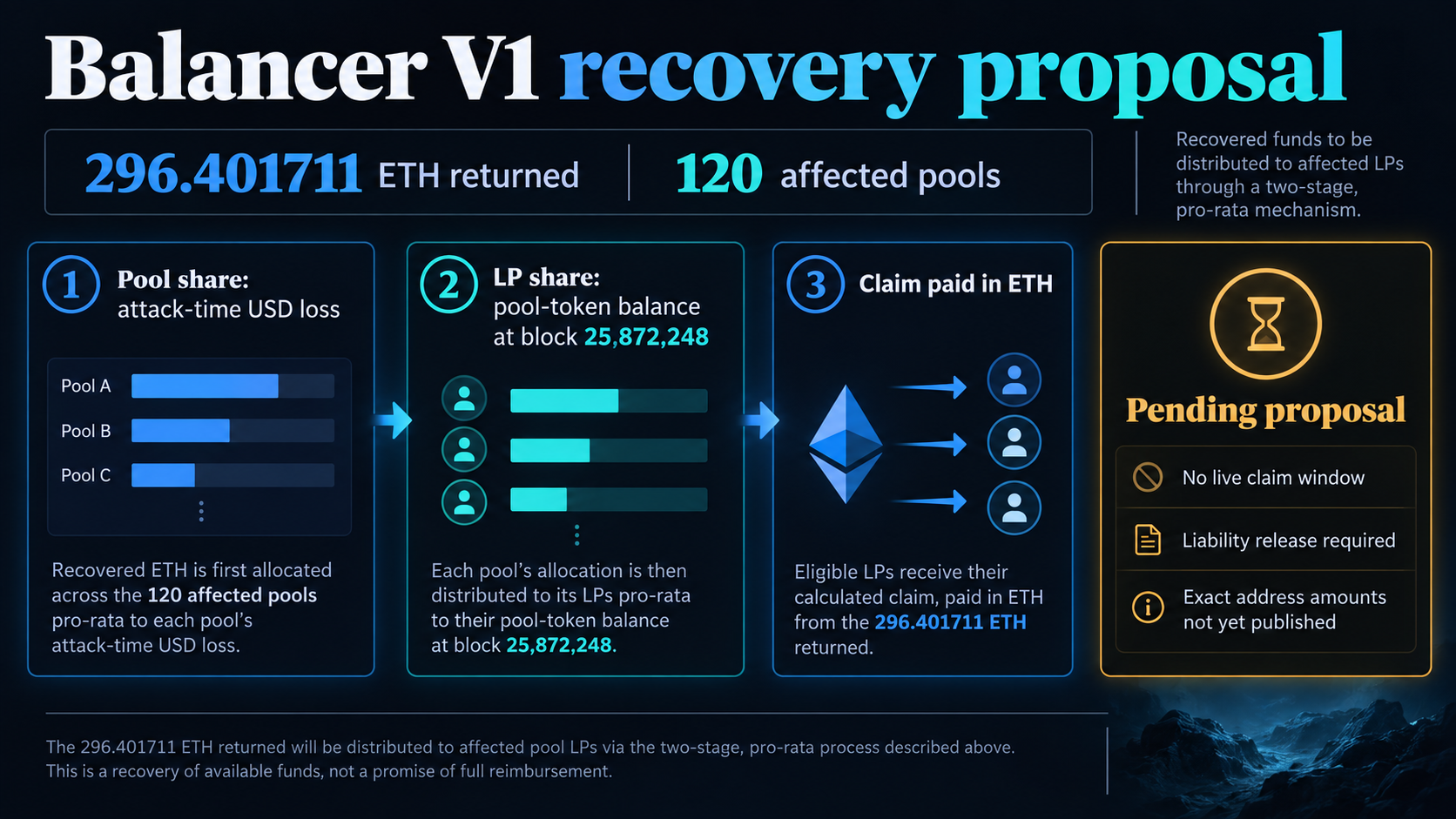
The Balancer V1 recovery proposal would divide 296.401711 ETH returned after an Aug. 31 exploit among liquidity providers in 120 legacy pools, but it does not yet show what any address could claim.
The proposal says tokens worth about $1.39 million at attack-time prices were drained from the pools. It lists five ETH returns to the Balancer DAO Multisig between Sept. 8 and Sept. 16 from the main greyhat, three anonymous whitehats and block builder Ultrasound.money.
The 296.401711 ETH is the amount the proposal records as returned, not a promise of full reimbursement. The attack loss is expressed in dollars at historical prices while the recovery pool is denominated in ETH, and the proposal does not state a recovery percentage.
How Balancer would allocate the recovered ETH
Under the plan, Balancer would first allocate recovered ETH to each pool according to that pool’s share of the total dollar loss at the time of the attack. It would then divide each pool’s allocation among liquidity providers based on their pool-token holdings at Ethereum block 25,872,248.
That block immediately preceded the first exploit transaction at block 25,872,249. Using one pre-attack snapshot would cover all 120 pools, including those later targeted by copycat activity.
The formula determines the relative weighting of claims, but the Sept. 18 post does not include the per-pool allocation table, holder lists or per-address amounts. Until those files are published, an individual LP cannot calculate an exact ETH payout.
Claims await a vote and address-level data
Receiving the proposed payment would also carry a legal condition. Claimants would have to provide digital consent releasing Balancer Labs, Balancer DAO, Balancer Foundation, affiliated parties and service providers from liabilities related to the incident. Payments would be made in ETH, while contract and multisig claims would be handled case by case.
As of Sept. 20, the Sept. 18 forum post remained labeled BIP-XXX and contained no Snapshot vote link. It says claim data would be published and a claim mechanism deployed only if the proposal passes, leaving the V1 claim window unopened and without announced start or end dates.
The recovery pool is separate from the assets covered by Balancer’s proposed shutdown. Its wind-down proposal says funds recovered from protocol attacks belong to affected LPs and sit outside the treasury distribution intended for BAL holders, a distinction also noted in CryptoSlate’s earlier coverage.
That separation preserves recovered exploit funds for LPs, but the pending vote and unpublished allocation data mean the Balancer V1 recovery proposal defines a recovery route, not a confirmed payout.
Source: CryptoSlate