



FILTERED RESULTS
FILTERS
MCap $2.9T -0.8%24h Vol $156.3B +0.6%Fear & Greed 73/100Alts Index 55/100
BTC.D 58.4% +0.1%Stable.D 9.3% +0.1%ETH.D 11.4% 0%Others.D 20.9% -0.2%
SHFL$0.6630+69.75%•NMR$14.460+41.98%•MARSCOIN$0.1547+29.31%•HBAR$0.1189+22.49%•BTW$1.300+13.41%•ALGO$0.1352+13.1%•ZBCN$0.00220747+8.33%•CRV$0.3748+8.05%•LINK$15.164+7.75%•RUNE$0.7741+7.61%•
Q$0.0259-47.69%•QNT$209.75-21.66%•USELESS$0.2268-15.84%•FARTCOIN$0.1632-15.37%•ONDO$0.4938-14.09%•SEI$0.0736-14.05%•ARB$0.1933-13.9%•RAY$1.848-13.83%•MET$0.3100-13.72%•TIA$0.4282-13.58%•
•
·
·
FILTERED RESULTS
World Foundation Finalizes $49 Million Over-the-Counter Sale of WLD
CFTC Approves Launch of Coinbase Clearing with USDC Collateral
UsePaid Launches Claims Portal After $PAID Token Drops 38% Due to X Money Issues
KLEA Crypto Daily: Monday, September 28, 2026
Uniswap Dominates Tokenized Stock Deposits with $82 Million on Robinhood Chain
OpenAI Suspends AI Model Training After Data Scraping Incidents
BitGo Appoints New Chief Product Officer to Enhance Asset Servicing
Stripe Alerts AI Companies to Rising Token Theft Risks Amid Increased Fraud Attempts
US Senate Report Links Tether's USDT to Iran's Sanctions-Evasion Activities
Gemini Introduces Staking for Hyperliquid's HYPE Token with 2.1% APY
Coinbase Introduces Digital Pokémon Card Packs Linked to Physical Collectibles
Robinhood Reports 24% Increase in Daily Crypto Trading Volume for September
SEC Clarifies Token Buyback Guidelines with 'No Central Party' Condition
Anthropic's Claude Sonnet 5.5 Is Out, Beats Opus 5.5 at Coding for Half the Price
After AI Agent Hacked Its Government, Australia Calls Altman and Amodei to Testify
In the Wake of CLARITY Act’s Failure, Agencies Move Forward Without Congressional Action or Certainty
Expansion of Trademark Rights: What Yuga Labs v. Ripps Means for Game Studios
Strive Scoops up 1,107 Bitcoin as Its $2.3B Treasury Expands
Banking Giant Citi Taps Coinbase to Turn Stablecoins Into Cash
Hyperliquid (HYPE) Drops 5% – Could Whales Trigger an Even Bigger Sell-Off?
Ripple CEO Unpacks What Really Drives XRP’s Value — Here’s Everything You Need to Know
Breaking: Vitalik Buterin Declares Ethereum Is No Longer Just A Blockchain
Spark Allocates $210 Million for Institutional Loans Backed by Bitcoin
Bitcoin ETFs Draw $2.39 Billion Despite Weekly BTC Decline
Altcoin Spot Trading Volume Nears 4x Bitcoin, Highest Since September 2025
UK FCA Secures £851K for Victims of Crypto Investment Fraud
Bitget says Bitcoin withdrawals are open after $387M hack, but ETH and USDT must wait
Brazil’s $252 billion crypto market gets $10,000 self-custody reporting rule
USDT grew on Ethereum through 2024, but smart contract holdings stalled, BIS data show
US SEC follows CFTC in staff guidance for crypto
Avalanche Leads Blockchain Sector with $131 Million in Tokenized Stock Inflows
Blockchain.com Files Confidential S-1 for Multi-Billion Dollar IPO
Bittensor Introduces Gamma Tokens to Foster Collaboration Among Subnets
Blockchain.com Plans IPO Targeting Up to $6 Billion Valuation
Chainlink Introduces CCIP 2.0 Featuring Custom Verifiers and Enhanced Transfer Speeds
Polygon Announces Temporary Increase in POL Staking Rate to 7.7%
Goldman Sachs Connects $100 Billion Treasury Fund to Lynq Network
Compound Foundation Responds to Allegations of V2 Reserve Misuse
Tether Assists in Freezing $550 Million in Iran-Linked USDT
163,061,311 $USDC (163,116,752 USD) minted at USDC Treasury...
Iran Agrees To Suspend Uranium Enrichment In Exchange For US Sanctions...
Belarus Moves Toward Registering First Two Crypto Banks Under New Rules
1,357 $BTC (113,578,422 USD) transferred from #Paypal to unknown wallet...
ETHFI to Fully Exit EigenLayer Restaking as Yields Dry Up and Sector Profitability DeclinesETHFI...
Bitcoin’s (BTC) Still in a Bull Market, But a Correction Could Be Coming First
Russia lets crypto exchanges apply October 5 – but even Bitcoin lacks final retail clearance
Trump Diesel Curbs Could Hit Every Major Economy, Devere Warns
Crypto PAC spends $11M to oppose Sherrod Brown in Ohio
Circle's Arc Facilitates $150 Million in USDC Borrowing Against Bitcoin Collateral
Analysis: AI-related debt issuance has limited impact on U.S. Treasury yields; 10-year yield may fall to 4.25% by end of 2027
Ondas investors blame short-sellers, fails-to-deliver
Apollo Chief Economist: AI Agents Automatically Moving Deposits Could Trigger a "Slow-Motion Bank Run"
BGB Token Price Faces Fresh Pressure to Fall Under $1 After Bitget Hack
Ethereum Holds Near $2,677 as Traders Watch $2,700 Resistance
Arbitrum Foundation launches security program to subsidize smart contract audits for ecosystem projects
Aptos Foundation Collaborates to Establish Stablecoin Corridor Between Middle East and Africa
Spectra Finance Introduces Fixed-Term Markets for deJTRSY on Stellar Network
Hut 8 Secures $1.07 Billion Senior Secured Revolving Credit Facility with Four-Year Term
Vitalik Buterin Outlines 'Cryptographic World Computer' Plan for Ethereum
China Says Crypto Anonymity Is an “Illusion” Amid Spy Warning
Bitcoin Braces For a Week That Could Reshape Its Path
Trump ready to ease Iran sanctions and unfreeze its frozen assets
The restaking gold rush is over, and top protocols are barely making a profit
NEAR Rockets as Bitwise ETF Clears a Major Hurdle
Bitcoin ETFs Smash Through Their Biggest Week in a Year
1,336 $BTC (111,542,369 USD) transferred from unknown wallet to #Paypal...
Quant Explodes Over 300% As Banking Giants Move In
Bitget Resumes Withdrawals in Stages After $388 Million…
Chainlink Reaches 2026 High of $14.89 Amid Diverging Market Trends
Aave’s live stock-token loans expose USDC lenders to a weekend price gap


Aave's Base market has accepted seven Coinbase stock tokens as collateral for USDC loans since Sept. 25, giving the stablecoin suppliers who opt in exposure to a weekend pricing gap. Aave Labs said on Sept. 25 that its V4 Equities Hub was operational after a temporary halt was lifted. Its Mag-7 lending spoke has a $21 million USDC draw cap, a ceiling on borrowing rather than a report of loans already made.
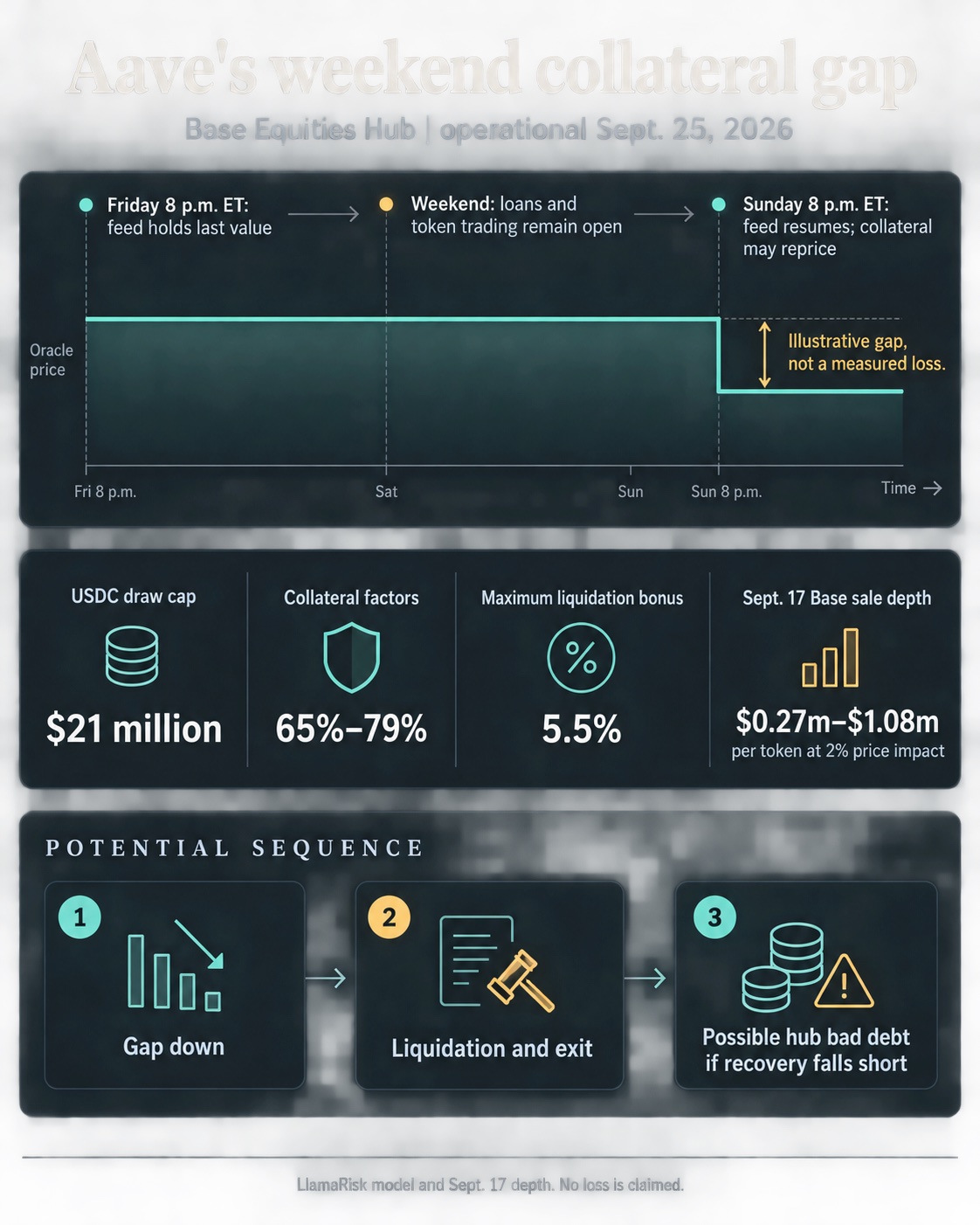
Aave's lending system stays open while its stock-linked collateral feeds hold Friday's price until Sunday evening. A borrower can still trade a token during that gap, but a price-driven decline in the position's health may become visible to the protocol only when the feed resumes. If liquidators cannot recover enough value from seized tokens after that repricing, the opt-in USDC lending hub could be left with bad debt.
A market open while its equity feed is closed
AAPLc, AMZNc, GOOGLc, METAc, MSFTc, NVDAc and TSLAc are collateral only. USDC is the sole asset that borrowers can draw from the dedicated hub. LlamaRisk, which recommended the market's initial parameters, says USDC suppliers opt into this equity-backed exposure; it does not flow into Aave's other markets.
The Chainlink equity-linked feeds combine the underlying share price with a Coinbase issuer multiplier. LlamaRisk specifies an operating window from Sunday 8 p.m. to Friday 8 p.m. Eastern time. From Friday evening to Sunday evening, and on US market holidays, the feeds hold their last value rather than publishing a new one. The Aave market itself remains open for deposits, borrowing and liquidation, and the stock tokens can still change hands onchain.
A collateral position's price-based health reading therefore cannot reflect fresh information during that closure. Interest on a USDC loan can still push a position across the liquidation threshold while the feed is frozen. A position made unsafe by a lower stock-linked price may first become liquidatable when the feed resumes on Sunday evening and incorporates that move in one update. A liquidator may then have to carry the seized exposure until deeper stock-market hours on Monday.
The original ARFC described a different approval path. Aave Labs said before execution that a Snapshot vote was binding for this activation and that the Protocol Security Council would unhalt the deployed market directly, without an AIP or Aave Governance V3 vote for the activation. Its later confirmation said the council had done so. A separate risk-steward configuration was still described as subject to an AIP.
The $21 million draw cap sits alongside a $32 million USDC add cap for the Mag-7 spoke. The latter limits how much USDC can be supplied there; neither figure establishes current deposits, borrowing or utilization. The seven stock tokens carry collateral factors from 65% to 79%. In Aave V4, LlamaRisk says, the factor sets both the borrowing limit and the liquidation threshold for each token.
Those discounts are meant to leave room for a price decline between a position becoming liquidatable and a liquidator closing it. LlamaRisk's stress method uses historical off-hours stock moves, allows for a 0.5% gap between the published oracle value and the market, and accrues debt at the 24% annual top of the USDC borrow-rate curve across its longest market closure. It assumes liquidation is completed no later than five minutes after the next regular stock-market open. The largest observed fall and a statistical tail estimate inform the factor for each name.
That is a model of losses the parameters are designed to withstand, not a guarantee about the next closure. LlamaRisk notes that its historical record cannot describe a decline rarer than one it contains. The configured maximum liquidation bonus of 5.5% is intended to pay a liquidator for selling, redeeming or hedging the tokens after repaying USDC debt. Whether that incentive suffices depends on the price and executable liquidity available when the liquidation happens.
The exit route determines who absorbs a gap
Redemption is not automatic for whoever receives a seized B20 token. LlamaRisk's technical assessment says a secondary-market acquirer initially holds an unvested position and cannot redeem until completing an issuer-controlled vesting process. A liquidator without that status can sell on Base, seek an eligible redemption counterparty, or use a hedge while waiting to close exposure. The perpetual-futures route in the risk assessment is a modeled option, not assured capacity for every liquidation.
Thin secondary depth makes the size of a forced sale consequential. LlamaRisk's table, based on Sept. 17 data before the market activated, put each token's Base sale depth at roughly $0.27 million to $1.08 million for a 2% price impact. Those figures describe a dated snapshot, not what a liquidator could sell on Sept. 27. Larger disposals may need to be split or routed to a party with redemption access.
A liquidation that repays the USDC debt and recovers enough value from collateral leaves no lending shortfall. If a reopening price gap is larger than the modeled buffer, or the seized tokens cannot be sold or hedged at the assumed price and speed, a position could instead leave bad debt inside the opt-in Equities Hub. Its USDC suppliers are the creditor group exposed to that shortfall; the cited risk documents describe this as a scenario rather than documenting a realized loss. The cap limits the market's maximum draw, while the actual risk at any moment depends on outstanding loans, positions and the liquidity available when the feed updates.
Source: CryptoSlate