



FILTERED RESULTS
FILTERS
•
·
·
FILTERED RESULTS
China Reports Increase in Exports to the U.S. Ahead of Upcoming Summit
Pimco Faces $35 Million Loss on Philadelphia Offices
FirstFT: The Xi-Trump finale
UK and Cambodia Sign Agreement to Combat Online Scams
Officer’s Choice Whisky Founders Are Said to Consider ABD Sale
Inpex to raise Ichthys LNG stake to 68.6% with JERA asset acquisition
Lawsuit claims fuel firms sold contaminated gas at NC stations
Bank of England’s Bailey sees AI as positive supply shock
Wall St futures gain as AI enthusiasm eases worries over higher oil prices, yields
Bluwhale Launches Trading Agents for Tokenized Stocks and Real-World Assets
US seizes bank accounts of payments group working for Tether’s and Bitfinex’s bank
U.S. stock futures edge higher as oil drop offers relief amid bond selloff
Raspberry Pi shares fall 9% after record H1 results trigger profit-taking
BoE’s Bailey says high energy prices make it harder to leave rates on hold
Moderna CEO’s Realistic Approach to Innovation
USD/JPY Declines as Japanese Officials Discuss Yen Weakness with US President Trump
This Is a World Many Bond Investors Have Never Seen Before
Iraq Offers Last-Minute Oil Cargoes as Record Freight Costs Bite
Yen Heads for Best Day in Two Weeks After Japanese Jawboning
Elon Musk Plans to Double Nvidia (NVDA) Chip Deployment at xAI’s Colossus 2 by Year-End
Why High Yields on US Treasury Bonds, Government Debt Look Like the New Normal
Why is Tandem stock surging today?
European stocks on track for weekly gain as oil eases; Mideast risks linger
SoftBank Stock Tumbles as Oracle Project Delay Sparks AI Investment Doubts
Angola to Press Ahead With Ending Fuel Subsidies as Costs Double
OpenAI Unveils GPT-6 Cyber: A Revolutionary Defense Against Digital Threats
Nanexa (NANEXA) Shares Skyrocket 120% Following Massive Novo Nordisk Partnership
Portland, Oregon’s rental market is so depressed that the nearly unthinkable is now common: High earners are paying some of the same rents as lower-income residents who qualify for subsidized housing
Airbus offers divestments to secure Brussels backing for space merger
Micron (MU) Stock: Wall Street’s Outlook for Sept. 30 Q4 Earnings Report
Reserves Benchmarks 2026 Charts
Tesla (TSLA) Semi Production Ramps Up With Massive 2,500-Truck Contract
Ethereum Faces Market Pressure Amid US-Iran Negotiations
Gold on track for weekly loss as Fed hike bets rise, dollar weighs
Banca Ifis tumbles 12% after Bank of Italy flags control issues
EssilorLuxottica valuation reset: Enough for a buy?
Treasury Yields Surge to Multidecade Peaks as Dow Continues Decline
Trump Administration Explores Diesel Export Restrictions as Prices Surge Beyond $6.50
PE firm Uplift adds Arkansas injury practice to law platform
CVC, NSSK weigh $3.2bn Kobayashi Pharmaceutical take-private
Meta Platforms (META) Stock Surges 27% on Muse AI Launch – What’s Next?
Oracle (ORCL) Stock Slides 3.6% Amid $18 Billion Debt Concerns and Data Center Delays
Costco (COST) Stock Falls Despite Earnings Win: What’s Behind the Muted Response?
Alphabet (GOOGL) Stock Rises as Google Cloud Partners With BNP Paribas on €750M AI Initiative
Bain-backed EcoCeres targets $1bn Hong Kong IPO
Aegon AM launches insurance-backed private credit fund for institutional investors
Gift Nifty 50 oversold at MFI 11.68 in bear flag: Live levels
Stock Market Today: Bond Selloff Abates as Oil Price Slips
The Robust U.S. Economy Powers Through Rate Hikes and Rising Bond Yields
Bond Traders Are Paying Too Much Attention to the Oil Price
NFL to maintain 10% PE ownership cap despite MLB and NBA changes
Czech Opposition Seeks No Confidence Vote in Cabinet Over Budget
Ares private credit fund sees redemptions ease as withdrawal pressure moderates
Turkey Fund Crisis Exposes Small Caps to Deeper Selloff
Why a U.S. Diesel Export Ban May Not Lower Prices
The Problem Is Where Interest Rates May Go, Not Where They Are Now
How Climate Change Is Disrupting Summer Travel
Jolt Capital appoints new HR Director
Senegal Hopes to Complete Debt Revamp Within Months, Faye Says
Europe gas heads for worst week since mid-June amid profit-taking
Costco beats Q4 estimates: Revenue hits $95.7B on massive e-commerce surge
UBS sees EURCHF opportunity above 0.94 through year-end
Morgan Stanley changes BoE rate call, sees hikes in Nov and Feb
Florida’s Private Railroad Brightline Files for Bankruptcy
Blackstone launches first multi-asset private markets fund for non-US investors
ArcelorMittal to shutter Ukraine operations after Russian strikes kill workers
Bond Selloff Fades as Oil Cools, Lifting Stocks: Markets Wrap
Dutch Seek End to Gas Storage Goals in EU Supply Security Revamp
Singapore Police Got Radiant Fraud Report Months Before Crisis
European Natural Gas Prices Plunge Over 8% as Strait of Hormuz Concerns Subside


Key Takeaways
- European and UK natural gas futures declined 3.2% on Friday amid profit-taking activity.
- The benchmarks are heading toward their largest weekly decline since mid-June, shedding over 8%.
- News of diplomatic discussions between the US and Iran regarding the Strait of Hormuz reduced supply concerns.
- European Union gas inventories stand at approximately 70% capacity, trailing last year by 12 percentage points.
- Scheduled maintenance on Norwegian pipelines continues to constrain European gas availability.
Wholesale natural gas prices across Europe experienced a significant retreat on Friday. Both the Dutch TTF benchmark and the British NBP contract registered declines of 3.2%.
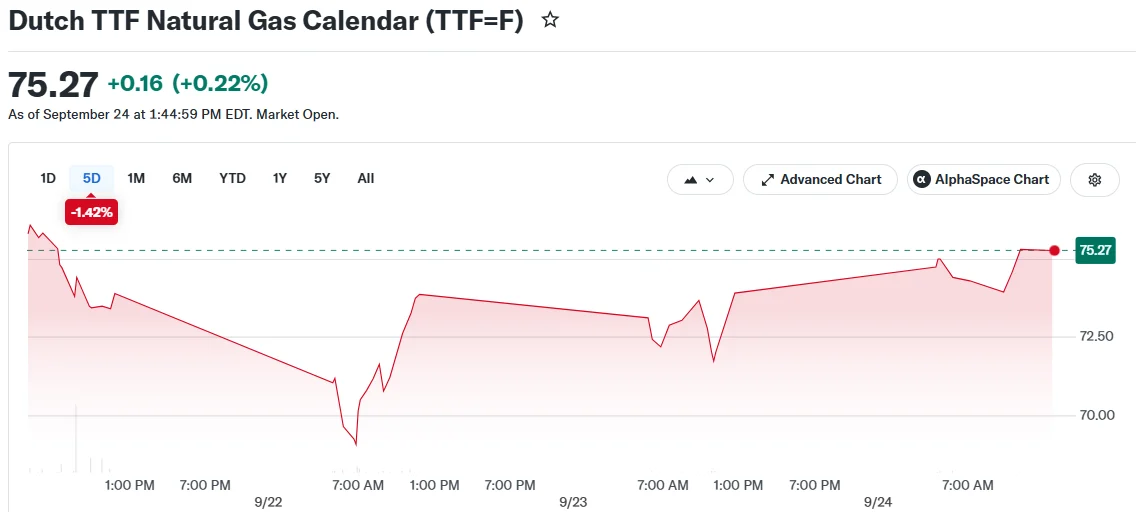
Market participants began locking in gains following several weeks of upward price momentum. This sell-off positioned both key benchmarks for their steepest weekly decline since the middle of June.
Throughout the week, prices have retreated more than 8%. This represents a notable shift from the elevated levels recorded in early September.
Factors Behind the Decline
The primary catalyst for the downturn is reduced anxiety surrounding the Strait of Hormuz. Multiple reports indicate ongoing dialogue between Washington and Tehran concerning a gradual agreement to restore passage through the strategic waterway.
BREAKING: Iran offers U.S. a 7-DAY plan to reopen the Strait of Hormuz and restart negotiations, per FT.
Iranian Foreign Minister Abbas Araghchi says Hormuz could be reopened by the end of the seventh day if certain conditions are met, with broader talks also set to resume.… pic.twitter.com/TcnmfVrcZY
— Coin Bureau (@coinbureau) September 25, 2026

 BREAKING: Iran offers U.S. a 7-DAY plan to reopen the Strait of Hormuz and restart negotiations, per FT.
The strait has been at the center of a conflict stretching nearly seven months. To date, neither party has been willing to relinquish control over the passage.
Despite the absence of a finalized agreement, financial markets are now factoring in reduced likelihood of additional military confrontation. This recalibration has diminished the risk premium associated with Persian Gulf energy resources.
Liquefied natural gas shipping companies have also adapted their operations. Tanker vessels are increasingly utilizing alternate routes that circumnavigate the Arabian Peninsula, alleviating concerns about complete disruption to physical LNG flows.
The temporary de-escalation prompted traders to liquidate positions before the weekend. This wave of profit-taking amplified the downward price movement.
Storage Capacity Falls Short of Historical Norms
Despite the price correction, European natural gas inventories continue to raise concerns. According to Gas Infrastructure Europe data, storage facilities throughout the European Union currently sit at approximately 70% of total capacity.
This figure represents a shortfall of about 12 percentage points compared to inventory levels recorded at this time last year. The deficit leaves energy providers with reduced flexibility as winter approaches.
Insufficient storage capacity means the continent remains vulnerable to price volatility should unseasonably cold temperatures arrive or fresh supply interruptions emerge. The European Central Bank has previously highlighted this vulnerability, noting that natural gas price fluctuations can cascade into broader consumer inflation.
Ongoing maintenance operations on Norwegian infrastructure compound the supply challenge. Diminished pipeline deliveries from Norway are constraining European supply precisely when storage levels remain below historical averages.
European buyers also face intensifying competition from Asian markets for available LNG shipments. This rivalry has escalated as both regions work to secure adequate supply in advance of peak winter heating demand.
Notwithstanding Friday’s price decline, natural gas remains considerably more expensive than earlier this year. The ongoing conflict’s impact on maritime routes and supply logistics has yet to be fully resolved.
Industry analysts suggest that a comprehensive settlement between the United States and Iran concerning the strait would likely deliver additional downward pressure on prices. In the absence of such an agreement, natural gas markets are expected to remain highly reactive to diplomatic developments.
By Friday’s close, TTF futures had declined below €73 per megawatt-hour, reversing the advances achieved during the previous trading session.
Source: Parameter