



FILTERED RESULTS
FILTERS
MCap $2.9T -0.7%24h Vol $105.6B -2.2%Fear & Greed 74/100Alts Index 53/100
BTC.D 59.0% +0.6%Stable.D 9.3% +0.1%ETH.D 11.5% +0.1%Others.D 20.2% -0.8%
NIGHT$0.0440+23.52%•STONK$0.2919+22.27%•STX$0.3853+21.03%•CAP$0.0737+18.55%•MON$0.0316+15.01%•JASMY$0.00593+14.38%•VELO$0.0057918+13.84%•PROS$0.7374+9.37%•TRAC$0.4622+7.55%•GOMINING$0.3916+7.18%•
AI$0.1811-13.33%•TIBBIR$0.2944-12.76%•BTW$1.158-11.27%•BR$0.7593-10.7%•2Z$0.0583-8.67%•BP$1.207-8.52%•LDO$0.4435-7.5%•MET$0.2991-7.41%•BONK$0.00000371-7.18%•ZRO$1.641-6.8%•
•
·
·
FILTERED RESULTS
EIP-8363 co-author announces withdrawal of the proposal from consideration for the Hegotá upgrade
Bitcoin kicks off new quarter in the old $82,000-$85,000 price range
Bitcoin trapped below $86K as PCE changes cloud inflation reading
Two Dallas Men Arrested for Attempted Home Invasion Targeting Cryptocurrency Holders in San Jose
Two Dallas men were arrested over an attempted home invasion in San Jose, with police
Bitcoin Is Up, DeFi Is Recovering, So Why Doesn’t This Look Like a Bull Market Yet?
XRP price prediction at $1.49: $2.46 bull, $0.90 bear
New Perpetual Contract Listing: CTUSDT#Bybit #NewFinancialPlatform...
Ostium $23.75M Hack Recovery: 3,321 Wallets Repaid, 345 LPs Face $1,000 Choice
Hawley–Murphy AI Bill Targets Agent Hacking Liability as Crypto Risks Emerge
Bitcoin holds above $83K as rally on lower US inflation data fades
The mysterious whale who previously sold 167,855 $ETH ($408M) bought 3.125M $UNI ($24.2M) at an...
According to SoSoValue, US Bitcoin spot ETFs recorded a total net outflow of $149 million on...
Yann LeCun: AI Runaway Incidents Can Be Prevented Through Engineering Improvements; AMI Labs to Launch Its First Product Soon
Tokenized Credit Dominates Real-World Asset Lending in DeFi, Report Finds
Binance’s EU services face scrutiny over licensing exemption: Report
The MNT Puzzle Hunt is live! Trade, convert, DCA, and collect puzzle pieces for a share of...
Historical Trap Ahead? This Early November Event Could Derail Bitcoin’s Rally
NIGHT Explodes 26% While BTC Cools After Wild PCE Swing: Market Watch
XRP Open Interest on Binance Declines 15% from Recent Highs
XDC Network Price Prediction 2026, 2027 – 2030: Is XDC Price a Good Investment?
Asia's Next-Generation Wealthy Want AI for Payments, Humans for Planning and Crypto From Their Private Bank
Citigroup raises 12-month bitcoin target to $113,000 as ETF inflows resume
Stacks jumps 20% after Muneeb Ali is named CEO as the network expands its institutional Bitcoin...
Citi raises 12-month Bitcoin and Ethereum price targets to $113,000 and $3,028
Ethereum Staking Reward Burn Process Adjusted by Authors in Hegotá
1,297 $BTC (108,747,111 USD) transferred from unknown wallet to unknown wallet...
Binance extends USD1 airdrop campaign, with a total prize pool including 150 million WLFI and up to 2.5 million USD1
Losses From Cryptocurrency Hacks Hit $766M in September — PeckShield
MetaMask Exits Lido Validators Amid Infrastructure ‘Security Incident’
Thorchain Co-Founder: Neutral Networks Can’t Pick Who Can Transact
$CT listed on Bybit futures・
U.S. Court Dismisses Most Claims in Celsius vs. Chainalysis Case
STX Price Prediction 2026: The Two Forces Behind Stacks’ Bitcoin-Native Finance Demand
Lloyds Bank and Visa Complete ~$750,000 Stablecoin Cross-Border Settlement Pilot
Florida's payment stablecoin regulatory rules take effect today
Ministry of Public Security: Mainland and Hong Kong police jointly dismantle cross-border underground bank gang, arresting over 170 people
A SWIFT-Ripple Alliance? Why A Single Rumor Just Sent The XRP Community Into A Frenzy
Bitget Hacker Moves Stolen Zcash Into Private Pool — About…
Zcash holders approved $8.39 million in retroactive grants, including $1.5 million tied
Uranium Finance attack trial opens, prosecutors allege defendant exploited contract vulnerability to steal over $53 million
Cardano Lands AI Payment Integration as ADA Challenges Multi-Year Resistance
Chainalysis beats most Celsius claims, but ‘audit’ lawsuit survives
Michael Saylor Says Strategy Has No Fixed Target for Its Bitcoin HoldingsOn September 28, 2026,...
Bitcoin Whales Returned After Over 10 Years of Silence: In September, They Moved More Than 2,184 BTC
Bitcoin Enters Its Most Bullish Month After Massive Q3: Uptober or Redtober Next?
Solana’s $100 Support Wall Could Be Setting the Stage for a 10X Move
Korea is Moving its Stocks Onchain, Here’s What it Means
UPDATE: SBI Holdings has completed its acquisition of Japanese crypto exchange Bitbank, making it a
Chainlink Fulcrum Sets Out to Unlock Idle Institutional Collateral
EU Presses Binance Over ‘Reverse Solicitation’ Exemption for Users: Report
Japan’s biggest payment network opens its doors for crypto via Binance Pay
Rethinking RWA: How Long Turned Stocks into Liquidity for the Robinhood Ecosystem
U.S. Judge Dismisses LIBRA and M3M3 Class Action Lawsuit
1,361 $BTC (113,321,786 USD) transferred from unknown wallet to unknown wallet...
Open USD Goes Live as Coinbase, Stripe, Visa, Mastercard Open Minting to Businesses
Analysis: MetaMask Exits 17,000 Validators After Staking Security IncidentMetaMask, one of the...
Institution Liquidates 172,500 ETH, Realizing $124 Million Profit
September Sees $766.4 Million in Exploit and Phishing Losses in Cryptocurrency Sector
Google Released Gemini 4 Argon with Million-Token Context Window and Unlimited Cybersecurity Protection
Bitget Hack Funds Hit Wasabi CoinJoin as DAI Flows to Tron, Freezes Catch Just $318K
Marinade Finance: DAO hit by malicious proposal attack, vulnerability fixed with no fund losses
After PCE, Goldman Sachs "tears up report": No longer predicts Fed rate hike in October, next one may be December
Open Standard Has Launched the OUSD Stablecoin
Base’s Cobalt upgrade adds another rule to affect token balances
Marinade Governance Committee Blocks DAO Takeover Attempts
Marinade Council Prevents DAO Takeover Attempt
LeveX Makes Trading Tournaments Monthly, Opening With a $5,000 Cash Competition
SBI completes full acquisition of crypto exchange Bitbank, bringing it under the SBI Group
A new XRPL upgrade could concentrate XRP ownership inside banks instead of retail wallets


A proposed XRP Ledger (XRPL) upgrade could let banks and fintechs absorb XRP costs so customers never need to hold the token.
The Sponsor amendment, based on the XLS-68 Sponsored Fees and Reserves proposal, would let a company pay account reserves and transaction fees for another XRPL user while that customer retains control of their account and private keys.
For financial institutions, the change would remove one of the frictions involved in deploying products on the network: requiring every customer to acquire and manage XRP before interacting with tokenized assets, payments or other applications.
Jazzi Cooper, Ripple’s head of product, said the feature is designed so a sponsor such as a bank, issuer or platform can cover those costs on behalf of users. That could allow consumer-facing applications and institutional platforms to keep the underlying XRP mechanics largely out of the customer experience.
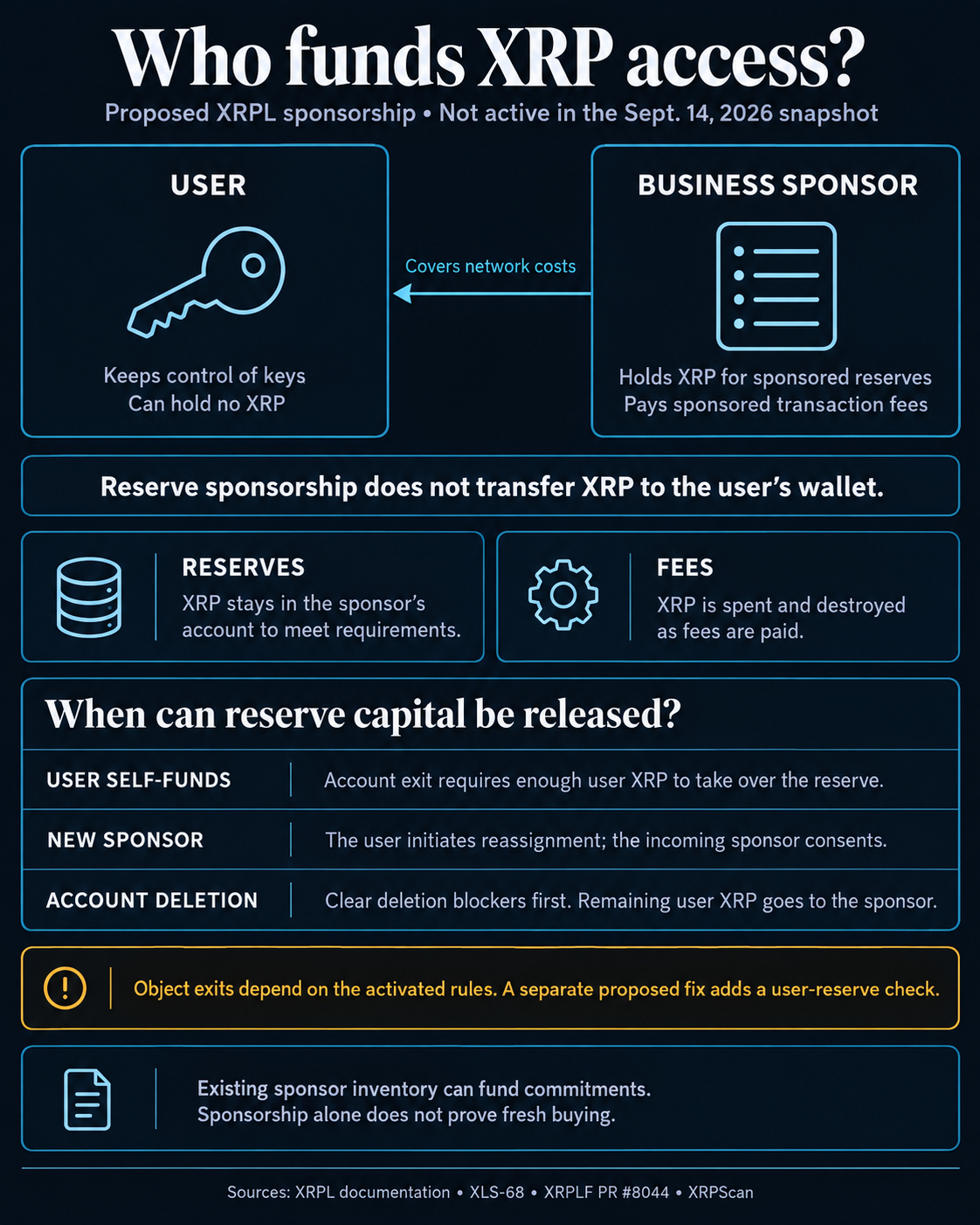
The trade-off moves to the sponsor’s balance sheet. Account reserves would still need to be covered in XRP, while transaction fees would continue to be paid in the token and destroyed when transactions settle. Businesses could therefore become the XRP holders supporting customers who themselves own none.
The proposal remains some distance from activation. As of press time, XRPScan data showed only six validators supporting the amendment, short of the 29-validator threshold, with no activation date scheduled.
Banks could become the XRP holders behind their customers
The structure would alter who carries the capital requirement without eliminating it.
XRPL currently requires a base reserve of 1 XRP per account and 0.2 XRP per standard owner-reserve unit, though validators can change those parameters. Under sponsorship, the XRP allocated to a user’s reserve would remain in the sponsor’s account while the ledger records which party is responsible for the obligation.
A business sponsoring 1,000 otherwise empty customer accounts would therefore carry roughly 1,000 XRP of additional base-reserve requirements alongside its own reserve, using current parameters. If those customers instead funded their accounts themselves, the same 1,000 XRP requirement would be distributed among them.
That distinction could become significant if banks, payment companies or tokenization platforms deploy XRPL products to millions of customers.
A firm serving 1 million users could theoretically carry about 1 million XRP of base-account reserve obligations under current requirements, before accounting for trust lines, token-related objects, optional sponsorship relationships, and transaction fees. The actual total would depend heavily on the service design.
Optional Sponsorship ledger entries can add another layer. Those entries allow businesses to establish prefunded sponsorship relationships rather than signing every subsidized transaction individually, but each also consumes reserve capacity.
The arrangement means wider XRPL adoption would not necessarily create an equivalent number of new retail XRP holders. A bank could onboard a large customer base while purchasing and managing XRP centrally, effectively concentrating the network’s reserve requirements among a smaller group of institutional sponsors.
That structure could make XRP easier to integrate into products where banks prefer customers to see only the asset or service they use, such as tokenized deposits, bonds, or money-market instruments.
Ctrl Alt, which has worked on the sponsorship proposal alongside Ripple and XRPL developers, has described the model as a way for institutions to manage XRP requirements internally while customers interact with tokenized assets without acquiring XRP themselves.
Easier onboarding creates a balance-sheet commitment
The same design introduces a capital-management problem for sponsors.
An XRP reserve remains committed while the sponsored account or ledger object still depends on it. A company cannot necessarily assume that the XRP becomes available immediately when a customer stops actively using its service.
Under the proposed SponsorshipTransfer mechanism, a sponsorship can be ended or reassigned, but account sponsorship carries conditions. A beneficiary taking over its own reserve needs enough XRP to satisfy the requirement.
That creates a complication for the very users the feature is intended to support. A customer who never acquired XRP may be unable to take over the reserve when a bank wants to stop sponsoring the account.
The sponsor could transfer enough XRP to the customer to cover the shortfall, but doing so would create a separate cost. The customer could also arrange for another sponsor to assume the obligation, with the incoming sponsor’s consent.
Account deletion offers another exit when applicable. Once relevant blockers are cleared, a sponsored account can be deleted and the reserve obligation released, with remaining account XRP directed as specified under the proposed rules.
Object sponsorship adds further uncertainty. A code change merged into XRPL’s development branch in August adds reserve checks when certain sponsorships end, but that behavior is gated behind the separate fixCleanup3_4_0 amendment. Its eventual mainnet status will determine how freely some reserve commitments can be unwound.
Those mechanics mean banks considering sponsorship would need to model more than the initial cost of acquiring XRP. They would also need to estimate customer churn, average reserve requirements, transaction-fee consumption and how much XRP could remain committed to inactive but still-open accounts.
The demand question comes after activation
The proposal could create a new institutional use for XRP without establishing how much fresh buying would follow.
An existing XRP holder could allocate tokens already on its balance sheet to sponsored customers without purchasing additional supply. New market demand would depend on the gap between that inventory and the reserve and fee commitments the institution chooses to assume.
That makes the eventual deployment data more important than the headline reserve formula. The number of sponsored accounts, sponsor balances, transaction volumes and reserve units tied to tokenized assets would reveal whether businesses are accumulating XRP to support the service or primarily recycling existing holdings.
The first hurdle remains validator approval.
If the Sponsor amendment gains sufficient support and clears the required activation period, banks and platforms would then have to decide whether removing XRP from their customer experience is worth carrying the token themselves.
For companies planning large-scale tokenized-asset products, that calculation could ultimately turn XRP from something every customer has to manage into an infrastructure cost concentrated on the institution’s own balance sheet.
Source: CryptoSlate