



FILTERED RESULTS
FILTERS
MCap $2.9T -0.5%24h Vol $70.7B -21%Fear & Greed 70/100Alts Index 59/100
BTC.D 59.3% -0.1%Stable.D 9.1% 0%ETH.D 11.4% 0%Others.D 20.2% +0.1%
PROS$0.8248+14.97%•FET$0.2618+13.99%•RAIN$0.0119+13.7%•ADA$0.2742+11.73%•VIRTUAL$0.8707+9.94%•DRV$0.4134+9.66%•STRK$0.0575+8.94%•ORCA$1.982+7.89%•FLOKI$0.00002953+7.89%•GEOD$0.3161+7.5%•
BR$0.4591-20.64%•BTW$1.179-18.64%•STONK$0.1996-14.92%•AI$0.1145-14.87%•BEAM$0.00261077-9.39%•SOON$0.3398-8.07%•GRASS$0.7236-7.13%•ATH$0.00742528-6.37%•ZAMA$0.0826-6.31%•CARDS$0.2464-5.95%•
•
·
·
FILTERED RESULTS
Metaplanet revises capital allocation policy, plans to allocate up to 90% of assets to BTC
Metaplanet plans to keep up to 90% of its assets in Bitcoin after...
BNB Surpasses $800 as Crypto Market Recovery Extends
Bity Exits Brazil: Bitybank Goes To Mercado Bitcoin,…
Metaplanet Acquires 1,000 BTC in Q3, Total Holdings Reach 44,000 BTC
Virtuals Protocol Price Prediction 2026, 2027 – 2030: Will VIRTUAL Price Hit $5?
Zcash NU7 Goes Live on Testnet With 25-Second Blocks, and…
Vivek Ramaswamy’s gubernatorial run lacks the crypto rhetoric of his presidential bid
Q4 2026 Digital Assets Market Outlook
Bitcoin (BTC) Rejected at $87K Again, Cardano (ADA) Soars 11%: Market Watch
Circle and Tether find common ground against MiCA’s bank reserve rules
Plume Launches Tokenized Bond Vault Backed by Fidelity Total Bond ETF Plume has launched nBND, a...
Bloomberg Terminal now supports round-the-clock monitoring of select perpetual contracts on Hyperliquid
Metaplanet: Net purchase of 1,000 BTC in Q3, total holdings reach 44,000
User turns $12,700 investment in ZCAT into about $422,000 profit, a 33x return
Technicals signal bitcoin shift, Ethereum gears up for Glamsterdam: Crypto Week Ahead
Remixpoint adds 7.45 BTC, total holdings rise to 1,508.72 BTC
Crypto.com and OKX Alumna Diana Pires Co-Found BYTEX…
5 Indicted in France Over Alleged $2M Crypto Aid to Hamas
Hood Inu Price Jumps 316% in 24 Hours, but There Is No Robinhood Listing Behind It
Hong Kong to Submit Virtual Asset Licensing Bill This Year
Zcash's NU7 upgrade activated on public testnet earlier than expected, cutting its
Gate Europe accelerates European market expansion, advancing MiCA compliance foundation and liquidity building in tandem
Bitcoin's Liquidity Fractures Along Geographic Lines as Leverage Builds
Kraken operator Payward and Singapore Gulf Bank platform for 24/7 institutional crypto settlement
USDC Reserve Yield Starts Funding HYPE Buybacks as…
Injective CEO Eric Chen said he expects U.S. ETFs tied to
Bloomberg Terminal Introduces Hyperliquid Perpetual Contract Monitoring Feature
Pudgy Penguins Price Prediction 2026, 2027–2030: How High Can PENGU Go?
Tom Lee Says Ethereum Could Hit $60,000 as New Investors Enter Crypto
BTC drops below $86,000, up 0.86% on the day
Kelsier Ventures-linked addresses' assets dropped from nearly $300 million in February 2025 to about $2 million now
Kelsier Ventures' Crypto Holdings Plummet from $300 Million to $2 Million
Injective CEO Eric Chen said he expects U.S. ETFs tied to $INJ to launch before 2027."I
BTC price fights to reclaim 2026 open: Three things to know in Bitcoin this week
Injective CEO: Expects US ETF tied to INJ to launch before 2027
The Clarity Act Stalled, but Crypto Dealmakers Are Not Slowing Down
U.S. Semiconductor, Storage, and Optical Communication Stocks Rise in Pre-Market Trading
Analyst Warns of Bitcoin Monday Dump After Sunday Gain
W Group Introduces hashbank’s Integrated Web2 and Web3 Banking Experience
Bubblemaps: Most claims in LIBRA case dismissed due to New York jurisdiction issues, Argentine investigation continues
Tokenisation Should Serve Companies, Not Just Traders
Ethereum OG "0xa2F6" sold another 13,330 $ ETH ($36.37M) after 6 months.This OG bought 170,000 $ ETH ...
Two US ETF Applications for Injective Token Progress with SEC Amendments
S&P Global Brings AAA-Style Risk Scores to DeFi’s $10B Lending Market
French Executives Propose Taxing Crypto-to-Stablecoin Conversions
Zcash Policy Group Registers to Lobby on 3 Crypto Bills With $750,000 Grant
600 $BTC (51,866,147 USD) transferred from #Coinbase to unknown new wallet...
Binance Tightens Cross-Border Crypto Transfers From Brazil…
Bitcoin ETFs Draw Up to $189.8M on October 2 as Ether Funds…
900 $BTC (77,768,131 USD) transferred from #Binance to unknown wallet...
Crypto Trader Loses $600,000 After Running Fake Cloudflare Command
Cardano Price Eyes $0.30 as ADA Breaks Higher—Can the Rally Hold While On-Chain Data Lags
ICP Price Rally Close to Key Resistance — Is the Next Move Up or Down?
Binance to Block Brazil Cross-Border Crypto Transfers
Hong Kong stocks close; semiconductor and AI application sectors shine
Crypto Users Lost $472,000 Due to Fake Addresses and Phishing Signatures
USDC Reserves Start Funding HYPE Buybacks as Hyperliquid Receives First $14.58M Payment Hyperliquid...
eToro Joins European Crypto Firms Pushing Traders Toward a Euro Stablecoin
US expands Hamas sanctions after tracing crypto transfers from France
Bitcoin ETFs notch third inflow week as Ether ETFs shed $138M
Trump names former SEC Chair Jay Clayton as AI czar to lead the new...
Hon Hai: September revenue NT$1.16 trillion, up 38.4% year-on-year
Only 6% of Asia Pacific Consumers Understand Stablecoins, Visa Survey Finds
Zcash NU7 Now Live on Testnet With 25-Second Blocks, Mainnet Height Still Unset
XRP Rich List Shows Lower Entry Point for Top 1% of Holders
17 Countries Including the U.S. Back the "Kyoto Vision," Aiming to Expand Research AI and Computing Access and Reform Research Funding
Malicious USDG permit approvals used to drain Revenue users’ wallets in a coordinated attackRead ...
CZ reveals he owns only three cars: a Nissan SUV and two minivans
Avalanche’s Helicon upgrade cuts validator lockups from 14 days to 48 hours


Avalanche’s Helicon upgrade is scheduled to give validators shorter, auto-renewing commitments while raising the uptime cutoff for rewards and reducing returns at the shortest durations.
The network upgrade is set to activate on Avalanche Mainnet on Sept. 22 at 15:00 UTC. Validators must install AvalancheGo v1.15.0 beforehand to remain compatible with the upgraded chain.
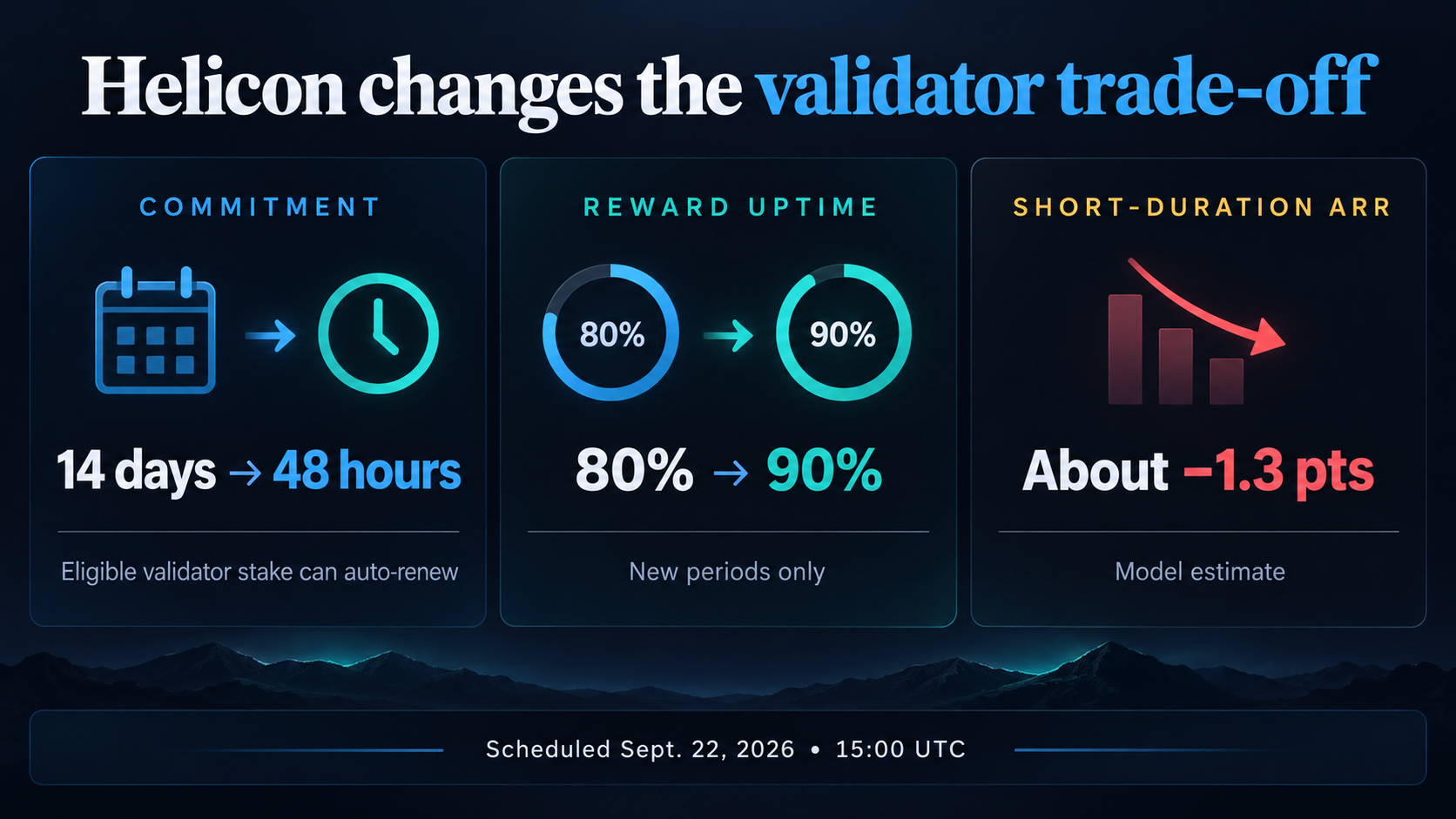
What changes for validators
Helicon will cut the minimum Primary Network validation period from 336 hours to 48 hours. It will also let eligible validators automatically begin another cycle when the current one ends, reducing manual signing work and potential reward gaps from repeatedly leaving and rejoining the validator set.
Operators can choose how much of each cycle’s reward to compound into the next one and can update the configuration for a future cycle. That creates a way to combine brief capital commitments with continuous validation, instead of choosing between a long lockup and repeated manual restaking.
The feature applies only to the validator’s own stake. Delegations will not auto-renew, and each delegation must fit inside one validator cycle because the validator is not guaranteed to continue beyond that boundary.
Validation periods that start on or after Helicon activation must achieve at least 90% uptime to earn rewards, up from 80%. The rule is not retroactive: periods that began before activation remain subject to the existing 80% requirement even if they extend beyond Sept. 22.
Avalanche's uptime measurement will not change, and rewards will remain all or nothing. Falling below the applicable threshold forfeits the full reward for that period, though the validator’s principal is not slashed.
For a validator using auto-renewal, missing the threshold has an additional consequence. The position will not roll into another cycle, and the validator will exit. Its principal and rewards accrued in earlier cycles are returned, but the failed cycle’s reward is lost.
Short cycles reduce how long capital is committed, while the higher threshold raises the operational reliability required to collect each cycle’s reward and continue automatically. For operators, that links continuity to cycle-by-cycle performance without changing how Avalanche measures peer responsiveness or adding a partial-reward buffer.
How short-duration Avalanche rewards change
Helicon will also begin a 90-day adjustment to Avalanche’s reward curve. The protocol’s minimum consumption rate, an input that helps determine staking rewards, is scheduled to decline linearly from 10% to 7.5%. The maximum rate at the one-year duration will remain unchanged.
Avalanche’s modeling estimates that this adjustment will reduce the annualized reward rate at the shortest duration by about 1.3% after the phase-in. The exact realized yield will remain variable because it depends on factors including AVAX supply, duration, and compounding choices.
The same modeling projects annual AVAX inflation falling by roughly 0.5% to 1% and the stake-weighted average duration increasing by about two months. Those outcomes are estimates depending on how validators and delegators respond.
The mechanical trade-off is more certain: Helicon makes short, renewable validator commitments easier to use, but sets a lower reward at the short end while preserving the one-year rate and demands more reliable uptime for new validation periods.
Source: CryptoSlate