



FILTERED RESULTS
FILTERS
MCap $2.9T -0.1%24h Vol $113.1B -27%Fear & Greed 71/100Alts Index 57/100
BTC.D 58.4% +0.1%Stable.D 9.3% +0.1%ETH.D 11.4% 0%Others.D 20.9% -0.2%
QNT$293.98+40.97%•SOON$0.4010+35.88%•GRASS$0.7412+29.09%•PUMP$0.00586976+24.18%•NIGHT$0.0325+16.81%•ZBCN$0.00256529+16.72%•ZRO$1.738+16.47%•ETHFI$0.7730+14.43%•COMP$26.296+13.4%•PENGU$0.0101+11.94%•
HBAR$0.1028-12.65%•LIT$3.831-11.52%•AI$0.1982-9.26%•BR$0.8281-8.92%•MARSCOIN$0.1462-7.15%•ALGO$0.1249-6.38%•BTW$1.302-6.08%•Q$0.0235-5.94%•ZAMA$0.0733-5.41%•PROM$5.955-4.95%•
•
·
·
FILTERED RESULTS
Bitdeer reports H1 revenue of $417.7 million and net loss of $251.8 million
Trader Killa: Market's expected deep pullback may not materialize, still bullish on Bitcoin toward the $90,000 range
Maelstrom CIO Arthur Hayes said at Korea Blockchain Week 2026 that no digital currency —
Abracadabra Proposes Liquidation Agreement for MIM Stablecoin Holders
DeepSeek Open-Sources Infrastructure for Huawei Ascend Computing Platform
Binance Pay Brings PayPay QR Payments to Tourists in Japan with Limited-Time 10% Discount!Binance is...
750 $BTC (62,660,077 USD) transferred from unknown wallet to Coinbase Institutional...
Abracadabra Proposes Winding Down Magic Internet Money at Four Cents on the Dollar
Brazil's CSD BR Collaborates with Ripple to Integrate Securities Records on XRP Ledger
Bitget Releases 47th Proof of Reserves, Composite Reserve Ratio Across 19 Asset Classes Reaches 131%
Abracadabra Proposes Liquidation of MIM at Four Cents on the Dollar
250,000,000 $USDC (250,033,000 USD) minted at USDC Treasury...
Ripple Brings XRP Ledger to Brazil’s BRL 22 Trillion Asset System
Binance Will Support the Ronin (RONIN) Network Upgrade & Hard Fork - 2026-10-07Starting at appro...
Velocity (formerly Drift Protocol) co-founder Cindy resigns; exchange restarts after rebuilding following hack
171,900,000 $USDC (171,922,604 USD) transferred from Unknown Whale 1 to #Aave...
171,900,000 $USDC (171,921,917 USD) transferred from #Aave to Unknown Whale 1...
Whale 0x9a80, who bought 30M $ENA($8.3M) 3 days ago, bought another 7.96M $ENA($1.99M)...
Whale that bought 30 million ENA three days ago buys another 7.96 million
100,000,000 $USDC (100,015,350 USD) transferred from #Ethena to unknown wallet...
Arrington Capital transfers $3.44 million worth of HYPE to FalconX
Multicoin Capital announces investment in DePIN project Grass, which generated $17 million in revenue in the first half of 2025 and 2026 respectively
XRP Seoul Brings Tokenization, Yield, and Privacy Firms Together
986 $BTC (82,446,607 USD) transferred from unknown wallet to Coinbase Institutional...
Kalshi is ending its volume incentive program, effective no earlier than Oct. 13,
Kalshi Ends Volume Incentive Program Effective October 13, 2026
1,827 $BTC (152,513,055 USD) transferred from #Paypal to unknown wallet...
Quant Network founder moves about 25,800 QNT worth $6.97 million after 7 years of dormancy
Quant Network founder wallet 0x48E9 moved 25,776 $QNT($6.97M) to new wallets after 7 years of...
1,826 $BTC (152,396,197 USD) transferred from unknown wallet to #Paypal...
Sentora split 50% Aave revenue, but suppliers absorb all losses
Robinhood is launching in-app perpetual futures trading in coming months, allowing
LIT briefly falls below $3.7, with $6.86 million liquidated in 4 hours
Robinhood Introduces 10x Leveraged Crypto Trading for US Users
Machi closes PUMP long for $827,000 profit, then opens $5.26 million 10x leveraged long
1,333 $BTC (111,291,916 USD) transferred from unknown wallet to unknown wallet...
Anthropic Research Highlights Zhipu GLM-5.3's Network Utilization Capabilities
VelocityDEX Launches After Audit Completion Amid Co-Founder Departure
Michael Saylor Sees $100T Digital Asset Industry With Rule Changes
Machi (@machibigbrother) closed his $PUMP long 9 hours ago, realizing a $827K profit.Right after...
1,332 $BTC (111,225,164 USD) transferred from unknown wallet to unknown wallet...
Grayscale's ETF adds $2.36 million worth of LINK
Project Eleven Acquires Riva Labs to Strengthen Post-Quantum Security Research and Engineering Capabilities
SEC sues Cryptoaiml and TSAI over alleged $15 million AI trading scam...
Binance Co-CEO Highlights Early Signs of Recovery Amid Economic Challenges
CZ: Industry Pioneers Don’t Always Remain the Biggest Winners On September 25, 2026, Binance...
177,614,496 $USDC (177,636,521 USD) transferred from unknown wallet to #Coinbase...
Robinhood to launch AI agents, 10x leverage crypto perpetual contracts, and weekend US stock trading
Fake Coinbase Texts Led to $900K Bitcoin Theft, US Seeks Seized Crypto
KLEA Crypto Daily: Tuesday, September 29, 2026
Crypto Fear and Greed Index Index Value : 71 Sentiment : Greed BTC Price : $83660 ...
153,139,246 $USDC (153,192,845 USD) transferred from Coinbase Institutional to...
Project Eleven Acquires Riva Labs to Enhance Post-Quantum Security Capabilities
Stride Proposes Orderly Shutdown of Its Liquid Staking Chain
Zano Network Stabilizes After 30-Day Blockchain Rewind to Fix Inflation Bug...
RobinhoodApp ANNOUNCES PERPS ARE ROLLING OUT FOR U.S. TRADERS ...
618 $BTC (51,432,007 USD) transferred from Coinbase Institutional to unknown wallet...
Robinhood Launches Cryptocurrency Perpetual Contracts in the US
749 $BTC (62,330,840 USD) transferred from unknown wallet to Coinbase Institutional...
Robinhood To Offer Perps In-App Using Bitstamp: Press Release ...
Robinhood Introduces AI Trading Agents and New Trading Features
SEC charged Cryptoaiml Ltd., Cryptoaiml Capital Foundation, as well as TSAI Pro Ltd.
Bitcoin Was the Asset. Now Institutions Are Building Around It
5,035 $BTC (418,671,285 USD) transferred from Coinbase Institutional to unknown...
CryptoQuant says a bitcoin correction could be near after traders' unrealized profit
Robinhood adds AI agents, perps and weekend trading in push to win active traders
Hut 8 locks in $1B credit line, but faces 40% liquidity rules
1,551 $BTC (129,069,580 USD) transferred from unknown wallet to Coinbase...
Aztec relaunches privacy wallet on its Ethereum Layer 2
Binance Research: the RWA Market Is Entering the Capital Activation Era


- According to Binance Research, total RWA market AUM reached $34.18 billion, up 85.2% year to date.
- The report introduces two metrics — the Programmable Asset Ratio and the Capital Activation Rate — which measure not only the scale of tokenization, but also how assets are used in onchain finance.
- Binance Research notes that only about 0.01% of underlying markets are currently tokenized, while the overall capital activation rate is around 12%.
Binance Research, the research arm of the Binance exchange, has released a report titled The RWA Activation Era, focused on a new stage in the development of the tokenized real-world assets (RWA) market. This was stated in a press release for Incrypted.
The study notes that RWA growth is no longer limited to the question of how much traditional assets are being moved onchain. The next phase is about how these assets are used after tokenization — in trading, liquidity pools, lending, and as collateral.
According to Binance Research, total assets under management in the RWA market reached $34.18 billion, up 85.2% year to date as of September 15, 2026.
Bonds and money market funds remain the largest category at $18.29 billion. Equities, meanwhile, became one of the fastest-growing categories, rising 390.4% year to date. Together, these two segments accounted for more than three quarters of the market’s growth.
Growth is also extending to gold and commodities, private credit, and real estate. Binance Research believes this shows that tokenization is no longer just a story about crypto-native collateral and is expanding to a broader set of traditional markets.

The Market Remains at an Early Stage
Despite the growth, Binance Research estimates the share of tokenized assets at roughly 0.01% of the corresponding underlying markets.
The clearest example is equities. The onchain volume of tokenized stocks has reached $4.43 billion, but that is only 0.0029% of the $151.9 trillion public equities market.
Binance Research believes this points to significant upside potential. At the same time, the key question is not only whether the supply of tokenized assets will grow, but whether they can become fully fledged financial instruments in an onchain environment.

According to the report, bond funds and money market funds have $18.29 billion in onchain assets and an estimated PAR of 0.0171%. Their larger existing asset base creates a sizable pool of yield-bearing instruments for onchain applications, while equities are scaling faster thanks to broader distribution and access.

New Metrics for Assessing RWAs
The Binance Research report introduces two metrics to assess the market’s shift from simply issuing assets to putting them to financial use.
Programmable Asset Ratio (PAR) measures what share of the relevant underlying market is already represented as programmable onchain assets.
Capital Activation Rate (CAR) shows what share of the tokenized base is actually deployed in onchain financial applications. This includes liquidity pools, lending protocols, and collateral markets.
According to Binance Research, overall PAR is about 0.01%, and overall CAR is about 12%. This means that roughly $12 out of every $100 of tracked tokenized asset value is already being used in onchain financial applications.

Binance Research notes that the aggregate metric masks significant differences across asset classes. Private credit has the highest CAR at 49.67%, while equities posted one of the largest increases — from 1.95% to 7.54% since the start of the year.

The use of tokenized equities in DeFi is concentrated in financial infrastructure. Liquidity pools account for 65.4% of tokenized equities TVL in DeFi, with another 28.1% in lending. Together, these areas make up 93.5% of the deployed value.
Binance Research notes that the next phase of the RWA market will be tied not only to the question of “how many assets are tokenized,” but also to what users can do with those assets after issuance.
This shift is described in the report as the RWA activation era. Tokenized assets are starting to serve not only a representative function, but are also becoming programmable financial instruments.
Equities Show a Shift From Adoption to Usage
Tokenized equities are one of the clearest examples of this shift. According to the report, their volume has grown by 390.4% since the start of the year, and the onchain balance reached $4.43 billion.
At the same time, the share of tokenized equities remains extremely small compared with the underlying market. As Binance Research notes, $4.43 billion onchain corresponds to just 0.0029% of the $151.9 trillion public equities market.
However, the use of tokenized equities in DeFi is already growing. Equity CAR increased from 1.95% to 7.54% since the start of the year.
According to Binance Research, the combination of low penetration and rising usage makes equities one of the key segments to watch. The assets are not only being issued onchain, but are also starting to be used in liquidity, lending, and collateral mechanisms.
Scenarios for Tokenized Equities
In its 2030 scenarios, Binance Research draws on equity forecasts from its earlier report, Tokenization’s Trillion-Dollar Runway. They project roughly $61 billion, $349 billion, and $987 billion in tokenized equities under the conservative, base, and bull scenarios, respectively.
Given the current market size of $4.43 billion, these figures correspond to roughly 0.04%, 0.23%, and 0.65% PAR by 2030.
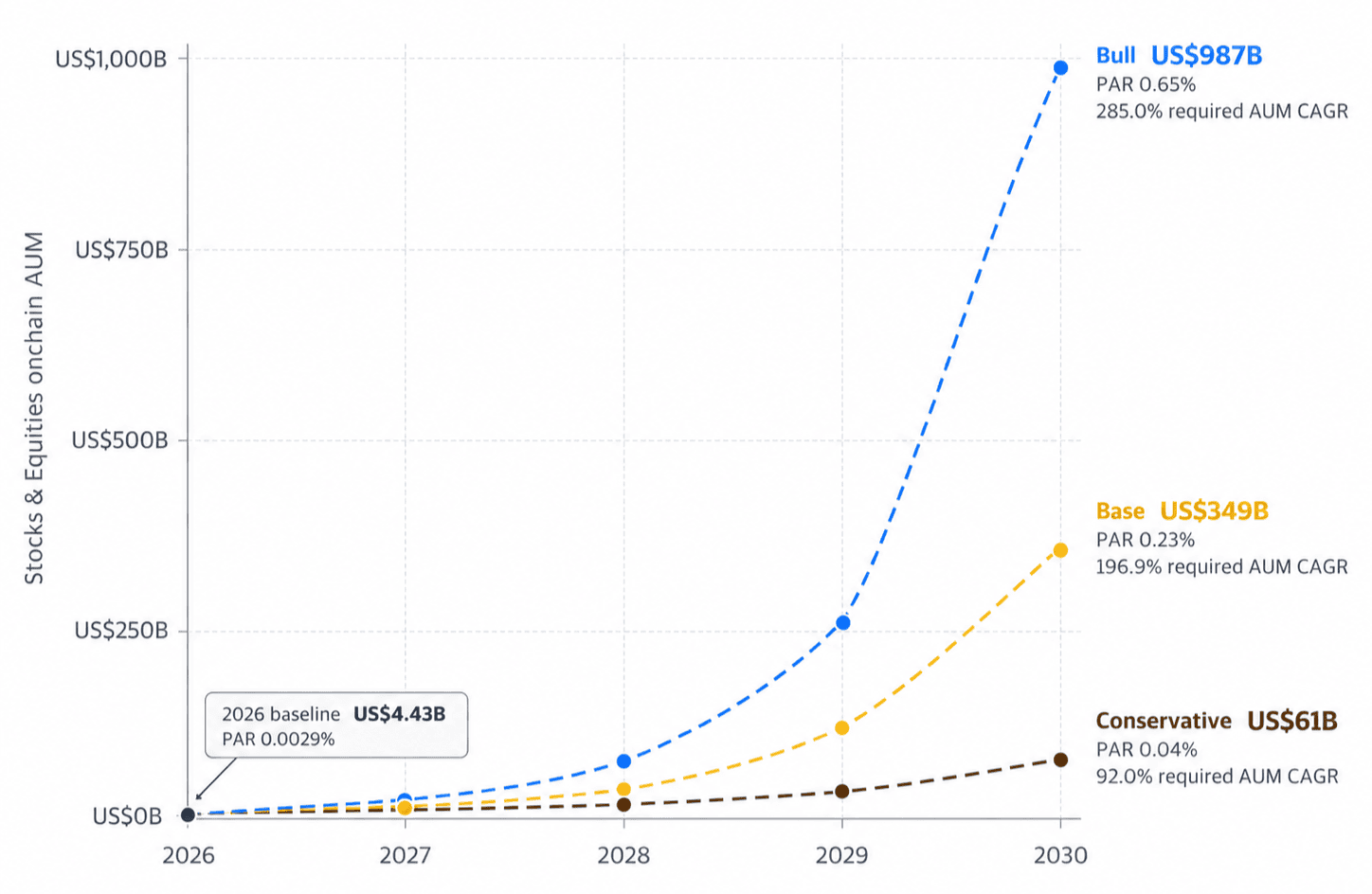
All else being equal, higher AUM should generally translate into higher PAR. However, CAR can evolve independently — depending on whether liquidity, lending, and collateral applications scale alongside asset issuance.

One takeaway from the report is that AUM growth and higher utilization can reinforce each other.
In Binance Research’s base-case scenario for 2030, around $349 billion in equities could become programmable. If CAR is 10%, activated capital would reach $34.94 billion. If CAR rises to 20%, that figure would increase to $69.87 billion without any additional issuance of tokenized assets.

This means the next phase of RWA growth may be driven not only by bringing more assets onchain. A meaningful role could be played by increasing the utility of capital that has already been tokenized.
What’s Next
Binance Research notes that broader RWA adoption can raise PAR by bringing new assets and users into the onchain environment. At the same time, integrations with liquidity, lending, and collateral markets can increase CAR by giving holders more ways to use assets after purchase.
In the authors’ view, a stronger signal for the industry would be not only AUM growth, but also a simultaneous increase in PAR and CAR. This would indicate that tokenization is moving from asset issuance to repeatable financial use.
As a result, the RWA market is entering a phase where not only the scale of tokenization matters, but also the real-world usability of the assets. After the stage of bringing traditional instruments onchain, the next question becomes their financial role within onchain infrastructure.
Сообщение Binance Research: the RWA Market Is Entering the Capital Activation Era появились сначала на INCRYPTED.
Source: Incrypted