



FILTERED RESULTS
FILTERS
MCap $2.9T -0.1%24h Vol $44B -4.5%Fear & Greed 65/100Alts Index 57/100
BTC.D 59.3% +0.6%Stable.D 9.2% 0%ETH.D 11.4% +0.1%Others.D 20.1% -0.7%
BEAM$0.00256787+20.7%•PROS$0.8248+14.97%•AKT$0.7835+14.97%•AXS$1.376+14.71%•HNT$0.5731+14.5%•RAIN$0.0119+13.7%•FET$0.2565+13.56%•DRV$0.4134+9.66%•BAT$0.1041+9.64%•IOTA$0.0594+9.28%•
BR$0.4591-20.64%•BTW$1.179-18.64%•STONK$0.1996-14.92%•AI$0.1145-14.87%•SUPER$0.2431-8.13%•CAP$0.0648-6.44%•NIGHT$0.0451-6.29%•CARDS$0.2464-5.95%•KITE$0.1469-5.75%•SOON$0.3606-3.83%•
•
·
·
FILTERED RESULTS
*S&P 500 CLOSES UP 0.1%, NASDAQ UP 0.2% ...
ETH falls below $2,700, up 0.04% on the day
Bitcoin Liquidation Map Shows $90,000 Short Squeeze Zone
Cardano Founder Tells UN Crypto Is Entering A New Era Of Exponential Growth
XRP News Today: Chart Points To $11 Long Term, But $1.66 Must Break First
Zcash Price Slides 23% as Grayscale ETF Hits Reverse
Bitcoin and Ethereum ETF Weekly Flows: The Good, the Bad, and the Concerning
New Treasury rules could change how stablecoin issuers get your dollars back
India’s local crypto exchanges get just 0.7% of inflows, Chainalysis reports
Cathie Wood Projects Bitcoin Price Could Reach Up to $2.4 Million by 2030
Polymarket CEO shayne_coplan TEASES TOKEN2049 ANNOUNCEMENT ...
There's an election next month: State of Crypto
Ripple and XRPL Foundation Launch XRP Asia in Seoul as…
4,500 $BTC (383,961,630 USD) transferred from unknown wallet to unknown new...
Ripple President Reveals Plan To Let Payment Customers Borrow Against XRP
SEC Approves Listing of Bitcoin ETF Targeting 3x Daily Futures Moves
Drift hack recovery opened near one cent per dollar lost
Security firm: Revenue Family involved in malicious authorization to steal users' USDG
Trump Taps Jay Clayton, the SEC Chair Who Sued Ripple, to Lead AI Push
What Could Decide Bitcoin’s Q4? The Fed, Bond Yields, and One Crucial Price Level
Vitalik-inspired AI payment system can send expired deposits to its treasury
Tokenized Stocks on Solana Reach $12.4 Billion in Trading Volume in 2026
NEAR Intents Recovers Full $3.8M Stolen in Omni Contract Exploit
Japan Sanctions Garantex as Russia Crypto Crackdown Expands…
Drift Hack Victims Get Their Money Back, 1 Cent at a Time
sunrise ENABLES ACCESS TO $SHIB (Shibtoken) MEMECOIN ON solana LaunchOnSF AND Pumpfun NOW...
Banking Group Sues to Block Crypto's 'Side Door' Into the Banking System
Lido’s proposed staking route needs over 13 times the default entry bond
3x Bitcoin and Ether futures funds clear SEC listing hurdle
Russia Uses Digital Ruble for Salaries After $192,000…
$6 million in wstETH drained from a Base vault controlled by an anonymous 3-of-7 SafeRead...
$6M Vanishes From Crypto Vault Controlled by 7 Mystery Signers
Binance Founder Comments on SAFU Fund's Bitcoin Profit
Base Vault Hack: $6M in wstETH Drained After Attacker Gains Whitelist Access
Billionaire Grant Cardone: Tech giants issued US$66 billion in high-yield debt to seize the AI market; yields will fall if expectations miss
Binance's SAFU Fund Surpasses $1.27 Billion in Bitcoin Holdings
Bybit's weekly platform updates General• ByPicks is live: free picks across crypto, sports and...
'Uptober' Starts Green as Bitcoin ETFs Draw $134 Million
America’s Middle Class Is Getting Crushed: Where Does Bitcoin Fit?
Ethereum's zkAPI Breaks the Link Between AI Prompts and Payers
IMF Releases $138 Million to El Salvador Despite Missed…
Greenfield Files Regulatory Complaint Against Safe Ecosystem Foundation with Swiss Authorities Over Governance Issues
Hyperliquid broker HyperLink completes $2.5 million funding round with participation from Alliance and others
RWA Foundation Reports $6.2 Billion Tokenized Credit Market Amid Holder Growth
‘More Orange Than Ever’: Saylor Stirs Strategy Bitcoin Buy Speculation
CoinW Lists SI Perpetual Contract with Up to 50x Leverage
Strive CEO Indicates Potential Increase in Bitcoin Holdings
Crypto poured years into new products. The next challenge is keeping users
Is Bitcoin’s $85K Consolidation the Calm Before the Storm Amid Rising Middle East Tensions?
The same Fed rate hike can help stablecoins and hurt Bitcoin borrowers
Trump taps intel chief Jay Clayton to lead new Super Intelligence Force
Open Standard's OUSD Stablecoin Sees Rapid Growth of $626.3 Million in First Week
Best Altcoins To Buy And Hold Till 2030: Standard Chartered’s Geoffrey Kendrick Names Top 4
Anchorage Digital Cuts 17% of Staff Months After $4.2B…
*US MARCH NONFARM PAYROLLS RISE 178K M/M; EST. +60K*US MARCH UNEMPLOYMENT RATE 4.3%; EST. 4.4%*US
Open Standard's OUSD Stablecoin Achieves $666.3 Million Market Cap Shortly After Launch
Binance Founder Zhao Changpeng Claims Net Worth Significantly Lower Than Forbes Estimate
Ostium Rebuilds Its Trading Stack After a Faked Price Drained $23.75M
Michael Saylor Reveals Bitcoin Tracker Data, Suggesting Increased Holdings
The Clarity Act stalled. Bankers aren’t hitting the brakes yet on crypto dealmaking
'We Have Identified You, Sir': Near Intents Recovers $3.8 Million After 48-Hour Ultimatum
Up and Onwards – Week In Review
Binance will hold some Brazil crypto deposits until users explain where the money came from
Binance Co-Founder Zhao Changpeng Addresses Controversy Over Merchandise Gift to Reporter
Asia's weekly TOP10 crypto news: Japan Launches New Tax System to Boost Detection of Undeclared...
Top 10 Cryptocurrencies by Weekly Growth — Who Became Market Leader?
Japan adds Garantex to list of Russia sanctions over Ukraine war
Two Bitcoin OGs who bought 1,346 $BTC($115M now) 13 years ago have moved 0.0005 $BTC ($43) after...
In a new feature, The New York Times dispatched a reporter to Abu Dhabi to shadow @cz_binance...
Bitcoin Core’s new fix closes gap that could redirect funds without stealing keys


Bitcoin Core has added a safeguard against signing transactions that may not bind funds to the payment destination a user approved.
The change, merged into Bitcoin Core’s master development branch on Sept. 25, targets a narrow flaw in partially signed Bitcoin transactions, or PSBTs, that could produce a valid signature without protecting the intended output.
Bitcoin Optech highlighted the update on Oct. 2. The issue does not expose a user’s private key, but creates a different risk: a signature can remain valid even when the transaction’s recipient is changed under specific conditions.
The weakness involves SIGHASH_SINGLEwhich is a signing mode designed to commit an input to the output in the corresponding position. If the transaction contains no output at that position, the protection breaks down differently depending on the type of Bitcoin being spent.
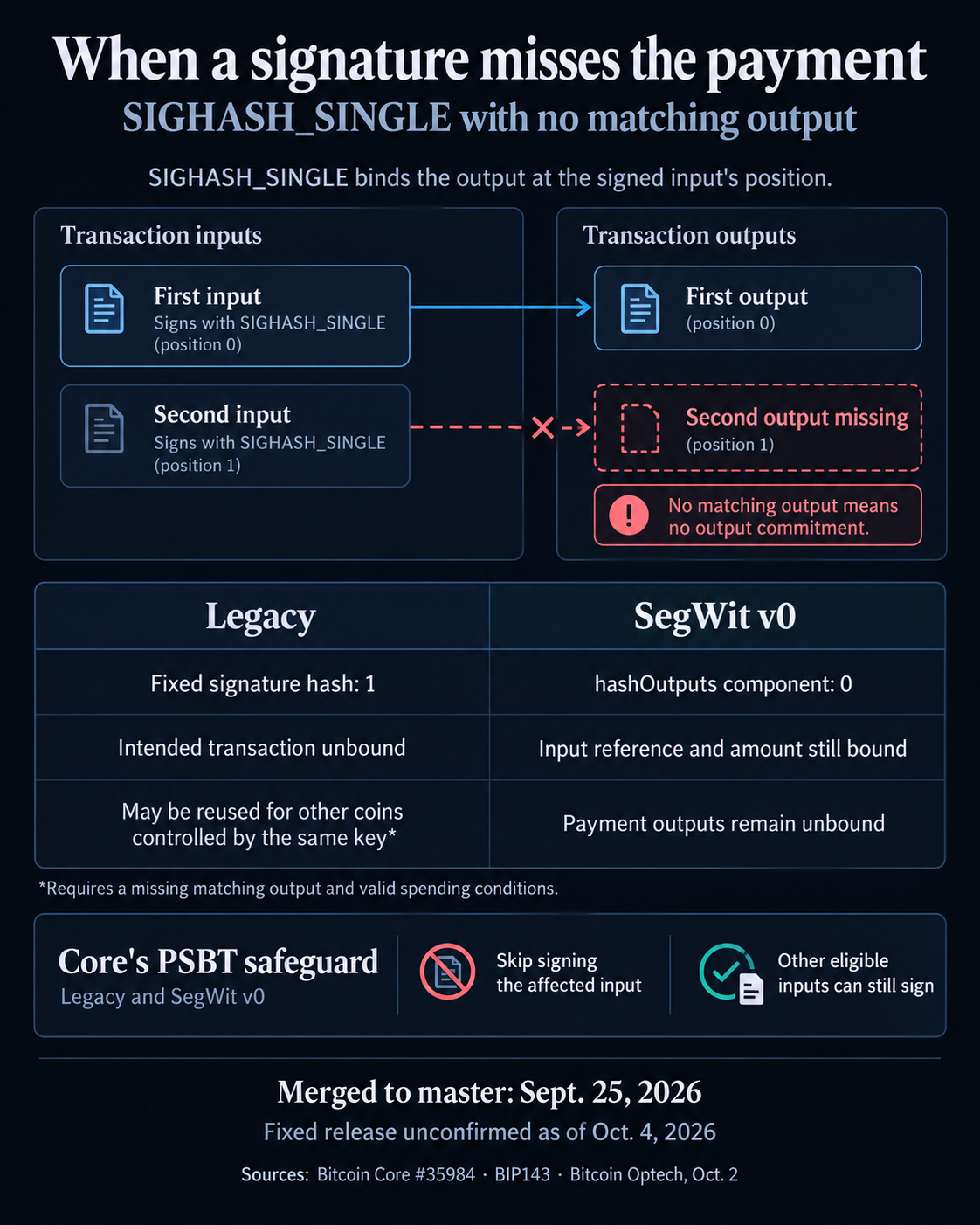
For legacy inputs, the missing-output case can produce a signature over a fixed hash value. Bitcoin Core developers said that signature may then be reusable against other unspent outputs controlled by the same key when the same structural conditions are present.
SegWit v0 transactions retain stronger protections because the signature still commits to the specific coin being spent and its amount. The destination output, however, can remain unbound.
That creates an authorization problem for wallets and signing devices: software could present one payment to the user while producing a signature that does not cryptographically guarantee that the approved recipient remains unchanged.
Bitcoin Core blocks the risky signing request
Bitcoin Core already rejected the edge case through its raw-transaction signing interface. Its PSBT path, including walletprocesspsbtcould still sign it.
The new code moves the check into Bitcoin Core’s shared signature-creation logic, preventing affected legacy and SegWit v0 inputs from being signed while allowing other valid inputs in the same PSBT to proceed.
PSBTs are commonly used to coordinate transactions between software wallets, hardware devices and offline signers. They allow transaction builders to pass information to a separate signer without giving that system control of the private keys.
The fix therefore reinforces a boundary that wallet developers must enforce independently of key security: a valid cryptographic signature must commit to the transaction details the user actually authorized.
Bitcoin Improvement Proposal 174, which defines PSBTs, already tells signers to reject unacceptable signing modes and recommends SIGHASH_ALL when no alternative is specified. The Bitcoin Core change explicitly prevents this missing-output configuration from reaching the signing stage.
Users do not yet have a confirmed production release containing the safeguard. The Sept. 25 change was merged into Bitcoin Core’s development branch, while the project’s published release listings had not identified a fixed version or confirmed backport as of Oct. 4.
That leaves wallet providers and hardware-signing integrations with the more immediate decision: review their own handling of SIGHASH_SINGLE requests rather than waiting for a Bitcoin Core release to enforce the same protection downstream.
Source: CryptoSlate