



FILTERED RESULTS
FILTERS
MCap $2.8T -1.8%24h Vol $117.9B +71%Fear & Greed 74/100Alts Index 59/100
BTC.D 58.8% -0.1%Stable.D 9.4% +0.2%ETH.D 11.4% 0%Others.D 20.4% -0.1%
Q$0.0498+37.46%•QNT$221.93+28.63%•BTW$1.148+23.58%•HBAR$0.1154+21.75%•BP$1.510+20.63%•GRT$0.0321+14.69%•XDC$0.0347+10.61%•ALGO$0.1293+9.82%•CASHCAT$0.1955+8.78%•MARSCOIN$0.1451+8.48%•
AI$0.2205-17.26%•USELESS$0.2488-14.61%•PONS$0.5353-13.36%•FARTCOIN$0.1701-13.36%•MET$0.3156-13.07%•JTO$0.5605-12.59%•RAY$2.012-12.51%•BR$0.9088-11.77%•SENT$0.0208-11.27%•ZEN$7.101-10.8%•
•
·
·
FILTERED RESULTS
Bitcoin falls to $83,000 while altcoins unwind Friday's rally
Bitcoin Price Logs Its Best Weekly Close Since January but Then Stumbles
U.S. 10-Year Treasury Yield Reaches Highest Level Since 2007
Hong Kong Expands Financial Reporting Oversight to Crypto Firms
Ark Invest: AI Makes Vulnerabilities Easier to Discover and Exploit, Bitcoin and Hardware Wallets May Be First in Line
California Bans Public Officials From Issuing Meme Coins Under New Newsom Law
Bitget Resumes BTC Withdrawals Four Days Following $387.5M Hack
$KII listed on Bybit futures・
Hong Kong regulators expand financial reporting oversight to licensed crypto firms
Apple Ordered to Pay $5.7 Billion in Landmark Patent Case
A whale's ETH long position has an unrealized profit of $14.06 million, and it opened a new short position of 650 BTC
Live updates: Bitcoin sinks below $83,000 as Iran talks stall and oil climbs
Binance Adds 5 Stocks on Binance Stock Trading - 2026-09-28Starting from 2026-09-28 13:30 (UTC), Bin...
How Settlemint and Utila Are Securing Institutional Tokenized Assets
QNT and HBAR Defy Altcoin Crash, BTC Drops Below $83K: Market Watch
$18.4M Allegedly Extracted Across 53 Robinhood Chain Token Launches
Bitget CEO Details How Attackers Stole Approximately $380MIn a September 28 livestream, Bitget CEO...
GoPlus: Another Meme RUG Factory Exposed on Robinhood Chain, with Over $9 Million in Volume
Crypto scammers built an entire fake blockchain to steal over $2 million
Bitcoin rally takes a breather ahead of key U.S. employment data: Crypto Week Ahead
Capital B Buys 13 BTC, Bitcoin Treasury Hits 3,538 BTC
Analysis: Bitcoin shorts pay to bet on further declines, futures positions near yearly lows
Bitcoin bears pay to bet on further declines as futures positions near yearly lows
Circle co-founder Sean Neville has stepped down from stablecoin issuer's board,
617 $BTC (51,109,319 USD) transferred from Coinbase Institutional to unknown wallet...
Capital B acquired 13 bitcoin:native for $1.1 million, bringing its total holdings to
Scammers steal $2M in ETH as fake GIWA network fools DYORSWAP
Strategy Inc. Surpasses First Abu Dhabi Bank in Market Capitalization Amid Bitcoin Investments
What Crypto Is Actually Building While Prices Rise
106,335,859 $USDT (106,394,450 USD) transferred from #OKEX to unknown wallet...
$84,000 Fulcrum: Why Bitcoin is Refusing to Break
Bitcoin Braces for a Volatile Week as Key U.S. Economic Data Looms
Bitcoin Rally Wobbles as Macro Risks Overshadow ETF Demand
Bitcoin drops under $83K as liquidity hunting keeps bulls from targeting yearly open
799 $BTC (66,381,984 USD) transferred from unknown wallet to Coinbase Institutional...
Gate.io's Traditional Finance Desk Achieves $17 Billion in September Trading Volume
Bitget has resumed phased withdrawals after its $387.5 million exploit, with 6,878
XRP ETFs Hoard 1.18 Billion XRP as Ripple Readies a 1 Billion Unlock
736 $BTC (61,072,188 USD) transferred from unknown wallet to Coinbase Institutional...
'It's Really Not Just a Blockchain Anymore': Buterin's 2030 Ethereum Vision
XRP Breaches the $1.50 Wall: Is $2 in the Bag?
Circle’s CFO and a Co-Founder Depart, With $1.05M Exit Package for the CFO
Stablecoin payments firm RedotPay says it received a "clean" audit opinion from a Big
bitget ANNOUNCES IT “HAS BEGUN THE PHASED RESUMPTION OF WITHDRAWALS FOLLOWING THE SECURITY...
MEXC responds to user's ~$340,000 asset theft, has set up a special task force to provide solutions
Separately, @ai_9684xtpa reported that 2,042.28 BTC, worth about $169 million, has been transferred...
Bitget Reopens BTC Withdrawals After September 24 Security IncidentBitget said it has begun a...
Bitcoin ETFs Experience $2.4 Billion Inflow in Record Week
Bitwise Advances Spot NEAR ETF Toward NYSE Arca Listing, Sending NEAR to a One-Year HighRead...
Money supply across the US, eurozone, China and Japan hit a record...
Bitget starts phased withdrawal resumption following $388 million exploit
Xie Jiayin Responds to Bitget's First Security Incident in 8 Years: Hackers Exploited a Vulnerability in a Third-Party Security Product, Independent Review Launched with Security Firms
Bitcoin ETFs draw $2.4B in biggest inflow week since October 2025
Crypto ETF Flows: Bitcoin, Ether and Solana Funds Add $308M…
Donald Trump Oval Office Speech Today at 2 PM: What to Expect
Bitget has opened BTC withdrawal services as scheduled
The CLARITY Act failed because Democrats opposed President Trump more than they...
Upbit crypto exchange reported a weekly volume of $11.7 billion in week ended Sept.
California Governor Gavin Newsom Signs Law Banning Public…
Quant rises after The Clearing House selects it for On Chain Money Initiative and UK banks...
Bitcoin Price Crashes to $82,780 as Gold and Silver Lose $550B in Hours
4 Major Events to Watch for Bitcoin and Crypto Markets This Week
RedotPay Delays US IPO to 2027 Following Financial Audit and Legal Challenges
XRP Ledger’s Batch Upgrade Slips From September 29 to…
Crypto Sentiment Flipped“F&G has moved from around 30 to 74 in a relatively short period, while...
RedotPay completes financial audit as it presses ahead with U.S. IPO plans
BitMine's MAVAN Emerges as Key Revenue Driver with $357 Million Projection
A newly created wallet "0x80Fa" just withdrew 10,390 $QNT($2.87M) from...
THORChain Rejects Bitget’s Call to Block Attacker Funds After $387.5M HackTHORChain responded to...
Cardano fees covered just 0.7% of staking rewards as transactions fall 72%


Cardano collected 3.3 million ADA in transaction fees while recording 493.7 million ADA in staking rewards across the 73 epochs ending Sept. 1, 2026, according to Bitquery's full-chain count. Fees covered about 0.668% of rewards, leaving the reward total roughly 149.6 times larger than fee revenue.
The figures turn Cardano's fee-replacement question into a measured economic gap. Planned upgrades may give the network enough throughput to process far more activity, while sustainable staking rewards still depend on applications and users generating substantially more fee revenue.
Cardano's fee-reward gap spans two measurement windows
The Bitquery analysis counted Cardano transactions from the network's first block and grouped the latest reward comparison into 73 five-day epochs from Sept. 1, 2025, through Sept. 1, 2026.
Its 3.3 million ADA fee total amounted to about one ADA for every 150 ADA in staking rewards. Reserve emissions supplied the dominant share of the reward economy during the period.
Cardano's epoch 655 supply page offers a shorter official snapshot. It attributed 108,500 transactions and 33,855 ADA in fees to completed epoch 654. Spread across five days, that was about 21,700 transactions per day, or 0.251 transactions per second. Fees equaled about 0.339% of roughly 9.998 million ADA in distributed rewards for the epoch.
The one-epoch snapshot uses a different reward denominator from Bitquery's 12-month staker total, so the percentages are not directly interchangeable. Each window nevertheless places transaction fees at well below 1% of its respective reward measure.
| Measure | Observed value | Economic signal |
|---|---|---|
| Fees, 73 epochs | 3.3 million ADA | Network fee revenue |
| Staking rewards, 73 epochs | 493.7 million ADA | About 149.6 times fees |
| Average daily transactions | 90,294 in 2022; 24,869 in 2026 | A 72.46% decline |
| Bot share of transactions | 11.5% in 2022; 32.8% in 2026 | Automated activity became a larger part of the smaller total |
| Reserve, epoch 655 | 6.127 billion ADA | 13.62% of the 45 billion ADA maximum supply |
| Share of circulating ADA staked | 75.6% at end-2022; 58.3% in 2026 | Participation declined alongside activity |
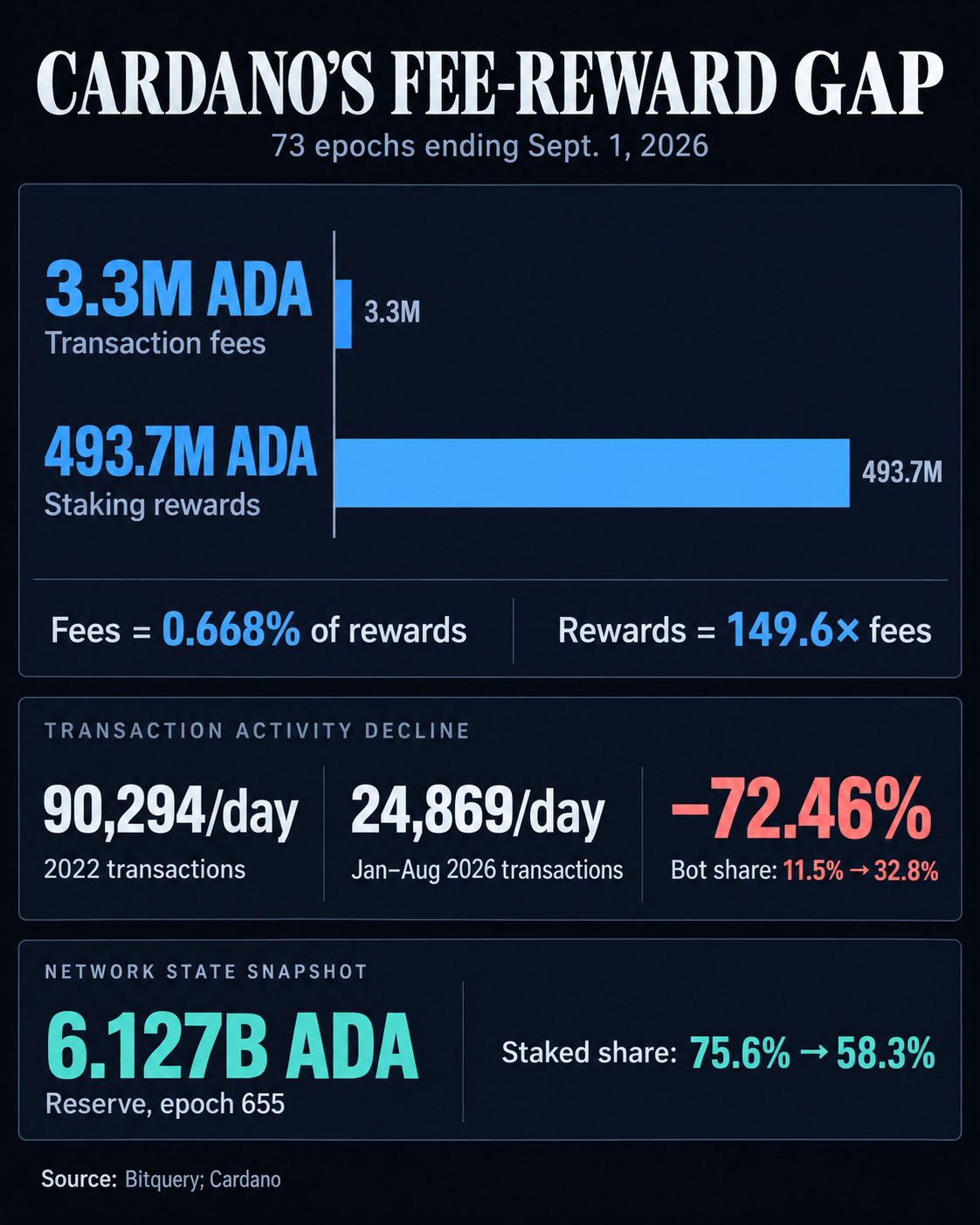
The long-window transaction count also points to weaker demand. Cardano averaged 90,294 transactions per day in 2022. From January through August 2026, the average was 24,869, a decline of 72.46%.
Activity composition changed at the same time. Bitquery classified wallets sending at least 3,000 transactions in a month as bots unless their behavior resembled an exchange. Under that method, bots' share of transactions rose from 11.5% in 2022 to 32.8% in 2026, with batchers forming the largest identified bot subgroup.
Those counts describe on-chain actions rather than unique people. One bot can submit thousands of transactions, while a decentralized exchange batcher can process orders for many customers. A modern Cardano wallet can use multiple addresses tied to one stake key, and a holder who stakes ADA without moving it remains absent from a count of sending wallets.
The transaction decline still matters for fee revenue because every action creates an opportunity to pay a fee. It cannot reveal how many people left, remained active or delegated their coins.
Bitquery also measured a decline in the share of circulating ADA staked, from 75.6% at the end of 2022 to 58.3% in the last epoch of its study period. That is a participation measure. The cited evidence contains no direct security-outcome metric, so it cannot support a claim that network security has already deteriorated.
The reserve creates runway as its contribution declines
Cardano's epoch 655 data showed 6,126,859,027 ADA left in reserves, equal to 13.62% of the network's 45 billion ADA maximum supply.
The reserve is designed to shrink. Under Cardano's monetary policy, transaction fees and 0.3% of the remaining reserve enter a virtual pot each epoch. The treasury receives 20% of that pot, and the balance is available for stake rewards, subject to pool performance. Unclaimed rewards remain in the reserve.
Applying a fixed percentage to the remaining balance produces exponential decay. Cardano's documentation describes a reserve half-life of roughly four to five years, without setting a definitive exhaustion date.
That declining reserve contribution changes the reward side of the equation. Nominal reward outlays can fall as emissions decline, which would reduce the fee revenue needed to match them. A lower target would still leave the network dependent on real economic activity if fees are to replace a larger share of rewards.
Cardano's fee structure provides another variable. Current minimum fees combine a fixed component with a charge based on transaction size, and protocol governance can change those parameters. Higher revenue per transaction would narrow the gap with less traffic, although the price of block space can also influence demand.
Holding average fees constant shifts the calculation toward activity. Scaling the 2026 average of 24,869 daily transactions by the current 149.6 reward-to-fee ratio produces about 3.72 million transactions per day, or roughly 43.1 transactions per second.
That is a simplified gross scenario calculated before the 20% treasury allocation. It is a translation of the measured gap, rather than a forecast or a precise break-even point.
The 43.1 TPS illustration broadly aligns with CryptoSlate's Sept. 8 model, which estimated that replacing reserve-funded rewards could require roughly 36 to 50 sustained transactions per second. That model placed a central estimate near 45 TPS after the treasury cut.
Linear Leios is designed for throughput above that range. The proposed CIP-164 specification models sustained capacity above the simplified 43 TPS scenario, giving Cardano a plausible technical path to process the necessary volume.
Leios test results leave the demand question open
Test results address only the capacity side. Cardano reported roughly sixfold Leios performance in an August public testnet update, using synthetic traffic. The result showed that the design could process more load under test conditions. It supplied no evidence that mainnet users would generate enough activity to multiply fee revenue by roughly 150.
Deployment also remains ahead. Intersect's Dijkstra planning document targets code completion in the fourth quarter of 2026, excluding Preview and pre-production testing and governance time from that schedule. The mainnet hard-fork date remains undetermined.
The economic equation has several moving parts. More transactions and higher average fees increase the revenue side. Declining reserve emissions and lower reward outlays reduce the amount that fees would need to replace. Leios enlarges Cardano's processing capacity, but adoption decides how much of that capacity generates revenue.
For now, the measured distance is stark: 3.3 million ADA in fees against 493.7 million ADA in rewards. Leios may remove a technical ceiling, while Cardano's larger test is attracting enough paid activity to turn capacity into durable network income.
Source: CryptoSlate