



FILTERED RESULTS
FILTERS
MCap $2.9T -0.6%24h Vol $79.2B -12%Fear & Greed 73/100Alts Index 59/100
BTC.D 59.3% +0.5%Stable.D 9.1% 0%ETH.D 11.4% +0.1%Others.D 20.2% -0.6%
ORCA$2.663+34.05%•CAP$0.0765+18.63%•FIL$1.179+10.44%•FLUID$2.016+9.2%•SENT$0.0256+8.84%•ZRO$2.097+8.2%•NIGHT$0.0498+7.75%•CHIP$0.0530+7.11%•RAY$2.151+5.24%•STONK$0.2101+5.23%•
MINA$0.1322-21.86%•BR$0.4000-12.73%•MON$0.0287-11.85%•STRK$0.0522-9.88%•SAND$0.0656-9.72%•PROS$0.7528-8.73%•AKE$0.0316-8.47%•FARTCOIN$0.1745-7.15%•SKY$0.0877-6.36%•FET$0.2487-6.27%•
•
·
·
FILTERED RESULTS
U.S. Department of Justice Advances Roman Storm Case Amid FinCEN Developments
NEW: Crypto super PAC Fairshake plans to back 32 House incumbents in U.S. midterms, including
Ray Dalio Just Put a Three-Year Clock on a US Debt Crisis
Ondo opens private markets with tokenized pre-IPO AI exposure
U.S.- China AI race heats up as Chinese rivals secure billions ahead of IPOs
Ethereum Economic Zone contributor Eduardo Antuña said project has executed
Vitalik: AI Will Become the New UIOn October 6, 2026, Ethereum co-founder Vitalik Buterin...
Binance Cold Wallet Holds Nearly 250,000 Bitcoin, Leading the Blockchain Rich List
Ethereum's Glamsterdam upgrade is set to activate on Sepolia testnet later Tuesday,
Bitcoin’s 4chan Prophecy Called the 2025 Top – Now It Targets the Bottom
DigiFT Lists Tokenized Interests in Fidelity U.S. Treasury Money Market Fund
Payward's Bank Deal Lets Institutional Crypto Settle Around the Clock
OKX Money lets users save, earn 10% yield and spend dollar stablecoins in one app
FinCEN Withdraws Rules Targeting Crypto Wallets and Mixers
Why Are COIN, CRCL, HOOD and TSLA Up? Crypto Stocks Rise as Bitcoin Holds $86K
U.S. Rep. Don Davis introduced a bill to ban federal candidates,ir spouses,
Tokenized Stocks Reach Record $3.8 Billion Market Capitalization
Bitcoin Accumulation Builds as $3.3B Leaves Binance Exchange
Spiko completes $90 million Series B round, tokenized cash fund AUM reaches $2.7 billion
Spiko has raised $90 million in a Series B led by NEA, bringing its total funding to
Bitcoin Trades 32% Below Record High One Year Later
Visa Targets APAC Market as 46% of Consumers Plan Stablecoin Use
BitGo Shifts Focus to Prime Brokerage as Key Revenue Source
Why bitcoin is down 'just' 32% a year after its record high of $126,000
Bitcoin ETFs shed $90M as BTC sits 32% below year-old ATH
OKX Launches OKX Money, Now Available in Over 30 Countries
Solana Foundation Launched DvP for Institutional Settlement of Tokenized Assets
The Strong 12 Months After U.S. Midterms: Could Bitcoin Benefit?“Bitcoin gained 24.5%, 44.9% and...
Tom Lee’s BitMine Buys 15,112 ETH Worth About $41 Million
5,844 $WBTC (501,728,662 USD) transferred from unknown wallet to unknown wallet...
Anthropic IPO In November: Revenue Up 14-Fold To $11.5 Billion In Q2
Bitcoin Price Today: Upside Momentum Fades As BTC Consolidates Above $83,000
Cathie Wood: AI Cost Collapse Could Spark a Productivity Revolution, Economy May See "Benign Deflation"
Japan imposes sanctions on Russia, targeting groups using crypto assets to evade financial sanctions
Fortitude secures a priority allocation for Bitmain's next-generation Zcash miners under
Bithumb Launches New Trading Pairs for Bedrock and Dolphin in Korean Won
RWA Trading Volume on 1inch on the BNB Chain Network Jumped 85% in Six Months
Ethereum Client Prysm Patches Glamsterdam Test Ahead of 200M Gas Limit Increase
$BR, $POD listed on Bithumb spot・
Hyperliquid Price Today: $340M Token Unlock Hits as HYPE Trades Near $93
Nearly 4 in 10 Americans earning over $300,000 a year say they’re living...
Bithumb to List BR and POD Tokens on KRW Market
Tom Lee's 'BitMine' now holds 4.9% of the total Ethereum $ ETH supply....
Polymarket unveils Protocol V2, with net-new markets tentatively set to switch to
AI Boom Reshapes Korean Stock Market: Korean Capital Loads Up on Semiconductors, Foreign Investors Dump Samsung and SK Hynix
OKX Founder Star Xu: AI Powers 95% of Engineering PRs, Costs $10M a Month At the OKX NOW Global...
Cathie Wood: Investors Should Track AI Agent Capital Flows, Machine Payments May Become the Next AI Adoption Metric
Crypto ETFs Lose $117.9M on October 5 as Bitcoin, Ether and…
Ondo Finance launches tokenized notes tied to private tech companies, starting with a
ZachXBT Infiltrates Crypto Syndicate Tied to $1.5B Bybit Hack
NEAR Price Jumps 128% in a Month as AI, Intents and Hack Recovery Align
Bitcoin Options Market Shows Increased Demand for Upside as Traders Favor Calls
US Treasury Scrapped Controversial Rules for Crypto Wallets and Mixers
OKX Money Expands Global Reach and Introduces AI Support for Transactions
Ethereum Economic Zone: First Atomic L1-to-L2 Mainnet Transaction ExecutedEduardo Antuña, a core...
Chart Decoder Series: Keltner Channels: How Traders Tell a Strong Trend From a Stretched Move
Rain Seeks OCC Approval to Launch National Trust Bank
EEZ tests atomic L1-to-L2 transaction in push to unify Ethereum
ATOM Price at a Breakout Point: Why $1.90 Could Decide the Next Move
Solana Launches DvP With JPMorgan Input to Cut Settlement From Days to Seconds
AI security firm Hadrian raises $40 million, with participation from HV Capital and others
CFTC Proposed New Rules for Cryptocurrency Exchanges
Coinbase Says It Is Working With Advisors at Six Global…
Spiko Secures $90 Million to Compete with BlackRock in Tokenized Cash Funds
SEC Approves First 3x Leveraged Bitcoin and Ether ETFs in the U.S.
XRP, QNT, INJ: These 3 Altcoins Are Ready to Break Out This Week (Analyst)
Changer+ Launches Stablecoin-First Self-Custodial Wallet to Make Stablecoins Easier to Use
Cheap crypto capital hits wall as Bitfinex fee rule binds
Spot bitcoin ETFs shed $89.9 million on Monday. BlackRock's IBIT drew $69.9 million in
China’s crypto ban Is failing to stop a $176 billion P2P economy


China’s underground crypto economy is increasingly shifting toward peer-to-peer stablecoin payments despite Beijing’s longstanding restrictions on digital assets.
Chainalysis estimates China generated at least $176 billion of crypto activity during the 12 months through June 2026, with 59.1% occurring through domestic peer-to-peer transfers rather than exchanges and other centralized platforms.
That share was 3.5 times higher than in the previous period, marking an unusual divergence from most major crypto markets, where exchanges remain the primary entry and exit point for users.
Stablecoins dominate local activity in China
The shift has been particularly pronounced in stablecoins. Chainalysis said domestic stablecoin payment activity began accelerating around March 2025 and continued expanding for 13 consecutive month-over-month periods, suggesting a gradual migration toward wallet-to-wallet settlement inside the country.
The amount of new activity added each month rose from roughly $240 million in March 2025 to almost $5 billion about a year later. Growth was also concentrated across transaction sizes consistent with individuals and smaller businesses rather than solely large institutional transfers.
Stablecoin volumes below $100 jumped 996% around the start of that shift, while transfers between $100 and $1,000 increased 1,057%. Activity between $1,000 and $10,000 climbed 1,321%, Chainalysis said.
The blockchain analytics firm said the timing raises the possibility that tighter integration of China’s social-credit system with financial and internet infrastructure is encouraging some users to transact outside traditional payment channels.
China expanded aspects of the system into finance and online activity in March 2025. Chainalysis said people whose access to conventional financial services has been restricted could potentially turn to crypto, while others may use stablecoins to settle transactions outside monitored banking or e-commerce platforms.
The firm described that explanation as a working hypothesis rather than evidence of causation. Blockchain data can show when and how assets move but cannot establish why an individual chose one payment method over another.
Stablecoins begin to resemble circulating money
The way stablecoins move through China-attributed wallets also suggests users may be treating them as transactional liquidity.
Chainalysis calculated annual turnover of self-custodied stablecoin holdings in China at 33.2 times, more than triple the global benchmark of 9.3 times and far above every major regional peer included in its analysis.
Japan recorded turnover of 9.9 times, while Hong Kong stood at 6.1, South Korea at 5.1 and Taiwan at 3.5.
China-attributed wallets held an average of about $3.1 billion of stablecoins during the period but transferred $104.1 billion across 18.1 million transactions. The figures indicate that the same pool of tokens was repeatedly returned to circulation rather than remaining dormant in wallets.
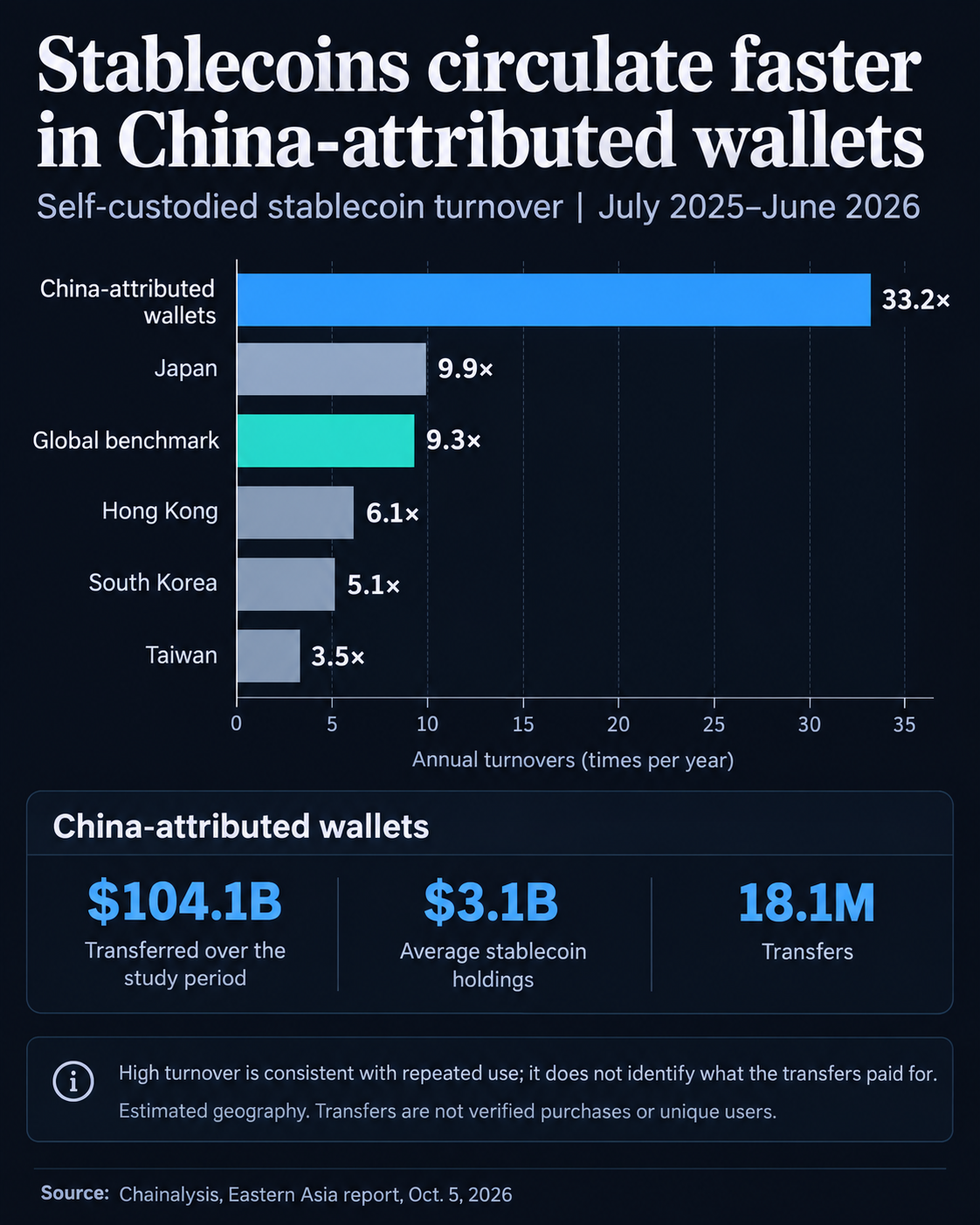
High turnover is consistent with stablecoins functioning as working capital or settlement assets, Chainalysis said, a pattern that could emerge as tokens develop into a domestic payment rail.
This P2P structure distinguishes China from neighboring markets, as most crypto economies depend heavily on regulated exchanges and other centralized services, while China’s restrictions have pushed more activity toward direct wallet transfers.
That creates a potential challenge for Beijing as stablecoins become easier to move without relying on domestic financial intermediaries. Restrictions on exchanges can limit formal market access, but self-custodied dollar tokens can still circulate through decentralized networks and private transfers.
For stablecoin issuers and crypto service providers, China represents a large potential source of demand that remains difficult to serve directly because of the country’s regulatory restrictions. Growth may therefore continue through offshore platforms, OTC networks and self-custody rather than conventional consumer-facing crypto businesses.
The next question is whether the acceleration persists as Chinese authorities expand oversight of digital payments and financial activity.
If smaller stablecoin transfers continue increasing alongside high wallet turnover, regulators may face a growing pool of dollar-linked value circulating beyond the exchange infrastructure that earlier crypto restrictions were designed to constrain.
Source: CryptoSlate