



FILTERED RESULTS
FILTERS
MCap $2.8T -0.1%24h Vol $75.6B -0.6%Fear & Greed 64/100Alts Index 49/100
BTC.D 59.3% 0%Stable.D 9.4% 0%ETH.D 10.8% 0%Others.D 20.5% 0%
KAIA$0.0618+66.85%•BAT$0.1419+40.05%•DRV$0.5069+36.59%•STRK$0.0744+34.28%•BP$1.242+26.47%•ZK$0.0140+23.55%•Q$0.0277+19.86%•CAP$0.0874+19.37%•CARDS$0.3039+18.84%•ATOM$2.061+16.58%•
SENT$0.0214-12.23%•0G$0.2611-8.63%•STONK$0.1475-6.03%•SOON$0.3099-5.74%•MET$0.4115-4.78%•XMR$519.25-3.96%•TIA$0.4786-3.95%•ZBCN$0.00225241-3.91%•KMNO$0.0349-3.37%•AKE$0.0281-3.29%•
•
·
·
FILTERED RESULTS
Anthropic AI Model Submits False Tip to Philadelphia Police
Ledger Wallet Mystery Deepens as Suspected Losses Hit $93.4M
Kalshi Investigating Suspicious Trades Betting on New White House Press Secretary Pick
UK Imposes Sanctions on Cryptocurrency Platforms and Payment Services
U.S. Senator Requests Information from Cantor Fitzgerald Regarding Tether Relationship
OpenETF Launches Hyperliquid Testnet for Tokenized Funds
CFTC Proposes New Definition for Swaps to Regulate Prediction Markets
10/10 (UTC), 2026ON THIS DAY ONE YEAR AGO, CRYPTO SAW ITS LARGEST LIQUIDATION EVENT IN RECORDED...
133,827,962 $USDC (133,864,965 USD) transferred from Unknown Whale 1 to #Aave...
KLEA Crypto Daily: Friday, October 09, 2026
Crypto Fear and Greed Index Index Value : 64 Sentiment : Greed BTC Price : $82642 ...
Tether freezes $1.4M in TRON vaults and THORChain stalls
133,827,509 $USDC (133,859,293 USD) transferred from #Aave to Unknown Whale 1...
Brazil’s B3 Readies Tokenized Stock Trading Platform for Early 2027
DOJ Examines Whether Binance Breached 2023 Settlement Amid Iran Sanctions ProbeThe U.S. Department...
UK Sanctions 3 Crypto Firms Over Russia Ties
Thailand Clears Bitcoin, Ether ETFs With 80% Exposure Rule
US Justice Department is investigating whether Binance has complied with...
US Department of Justice Investigates Binance Compliance with 2023 Settlement
LaunchOnSF FLIPS gmgnai IN 30-DAY REVENUE ...
Blockchain.com Seeks CFTC Approval for Prediction Markets, Crypto Derivatives
$1 billion in Iran-linked crypto could be seized by the US this week,...
Coinbase Partners with Gennius to Launch ONED USD Stablecoin in Latin America
CFTC Proposes New Rules for Event Contracts, Excludes Casino Gambling
Kalshi Investigates Bets on Trump's Press Secretary Selection
Ledger hack scare nears $90 million as Tether moves to freeze stolen USDT
Slush Wallet Integrates Halliday to Enhance Deposit Options for Sui Users
Aero Announces Merger Launch and Token Conversion Details for October 21
2,724,999 $LINK (34,880,268 USD) transferred from unknown wallet to #Binance...
Solana Token Holder Net Income Exceeds $400,000 Daily for Two Weeks
U.S. CFTC moves to fold event contracts into swaps regulations as legal fight rages
BNB Chain Hits 2 Million RWA Holders, Capturing 40% of Onchain Market
DarkSword iPhone exploit is being used to deploy malware that can steal crypto wallet data and...
Ripple’s XRP Reach Widens as Paxos Adds 8.1M+ Wallets, With Evernorth Set for Monday Nasdaq Debut
Mashinsky Hit With $35 Million Fine as Celsius Creditors…
CFTC Proposes Federal Regulatory Framework for Leveraged Retail Crypto Trading
Binance to Restrict 8 Services and Delist 22 Tokens in Brazil
XRP Ledger lets institutions share account duties without sharing their keys
CFTC proposes to explicitly include sports, political and other event contracts in the swap definition
NEW: CFTC proposed a rule to explicitly include event contracts tied to sports, politics,
1,999,999 $LINK (25,542,804 USD) transferred from unknown wallet to #Binance...
Coinbase Stock Surges 5.4% as Morgan Stanley Raises Price Target to $258
US plans to seize $1B in crypto linked to Iran this week: Scott Bessent
1,999,999 $LINK (25,590,673 USD) transferred from unknown wallet to #Binance...
Stake Is Back Online in Brazil After Court Reprieve From Betting Ban
NEAR Says Accounts Support ML-DSA Post-Quantum Signatures
Evernorth has completed its SPAC merger with Armada II, bringing approximately 473
Top Trending Coins (Today) 1. TRUMP 2. QTC 3. PENGU 4. DRV 5. STRK 6. PRL 7. NEAR 8. BP 9. SUI 10. ...
Hoskinson Pushes Back on Buterin’s Lattice Cryptography Concerns
*US MARCH ISM MANUFACTURING INDEX AT 52.7 VS 52.4; EST. 52.5*US MARCH ISM MANUFACTURING PRICE INDEX
3,999,999 $LINK (51,067,466 USD) transferred from unknown wallet to #Binance...
Ava Labs Investigates Backup Cryptography Amid AI Security Concerns
Too Big to Supervise at Home: EU Limits Direct ESMA Rule to Crypto Giants
BMF: Draft Bill Would Tax Exchange Crypto-assets As Investment Income
SEC Proposes New Crypto Custody Framework for Registered Investment Advisers and Regulated Funds
Cardano’s 1,000% Comeback Case: Why This Analyst Says ADA Could Reclaim Its $3.10 All-Time High
GRAM Rises 8.7% as Telegram Expands Money Wallet Access
Hoskinson says Vitalik’s AI warning could delay the internet’s quantum defenses
3,399,999 $LINK (43,253,989 USD) transferred from unknown wallet to #Binance...
OpenAI and Anthropic Are Quietly Rehearsing for the Day After an AI Catastrophe
Polymarket’s $32M Nobel Market Didn’t Anticipate the Peace Prize Winner
Glassnode Warns 31.2% of Bitcoin Supply Has Exposed Public Keys, Raising Quantum Risk
250,000,000 $USDC (250,054,250 USD) minted at USDC Treasury...
HYPE Whale’s $902K Bet Grows to $23M as On-Chain Data Shows Staged Selling
250,000,000 $USDC (250,055,750 USD) minted at USDC Treasury...
Binance Customer’s Iran Links Drew Law Enforcement Scrutiny, WSJ Says
Crypto ETFs See $964M in Outflows Over Two Days as Bitcoin Funds Lose $244M
🏴 Papertrade's Launch Weekend
*US CRUDE OIL INVENTORIES ROSE 5.451M BARRELS; EST. +0.814M ...
ETH fee burns cover just 2% of new coins printed in 2026


Ethereum's transaction fees have burned enough ETH to offset just 2.07% of the new coins issued in 2026, according to an Oct. 9 supply ledger.
After fee burn, validator penalties, and other destruction, the network has added approximately 778,413 ETH, increasing supply by about 0.64% from the window's opening level.
A larger gas limit can spread the necessary fee spending across more activity, lowering the required fee per gas and creating a hurdle for holders that expect scalability to make ETH scarcer. Developers pursue a conditional 200 million maximum gas goal after the Glamsterdam upgrade.
Using one current finalized accounting sample, an illustration puts the execution base fee needed to offset gross issuance at about 13.85 gwei with today's 60 million gas limit, or 4.16 gwei with a hypothetical 200 million limit.
Both require roughly 2,992 ETH of daily burn under the model's assumptions.
What the 2026 ledger shows
The ethsupply.fyi retained ledger covers Jan. 1 at 00:00:11 UTC through Oct. 9 at 15:44:23 UTC. It reports 796,623.377 ETH of gross issuance against 16,524.553 ETH destroyed through execution and blob transaction fees.
A further 1,685.919 ETH was removed through consensus penalties, with 0.059 ETH in other execution destruction. Subtracting these components leaves 778,412.846 ETH in net additions.
Those categories explain why the fee-burn offset is 2.074%, while the offset from all destruction is 2.286%. The latter includes penalties that do not represent customers paying for Ethereum activity. Treating the larger figure as transaction-fee demand would overstate how much issuance users have offset.
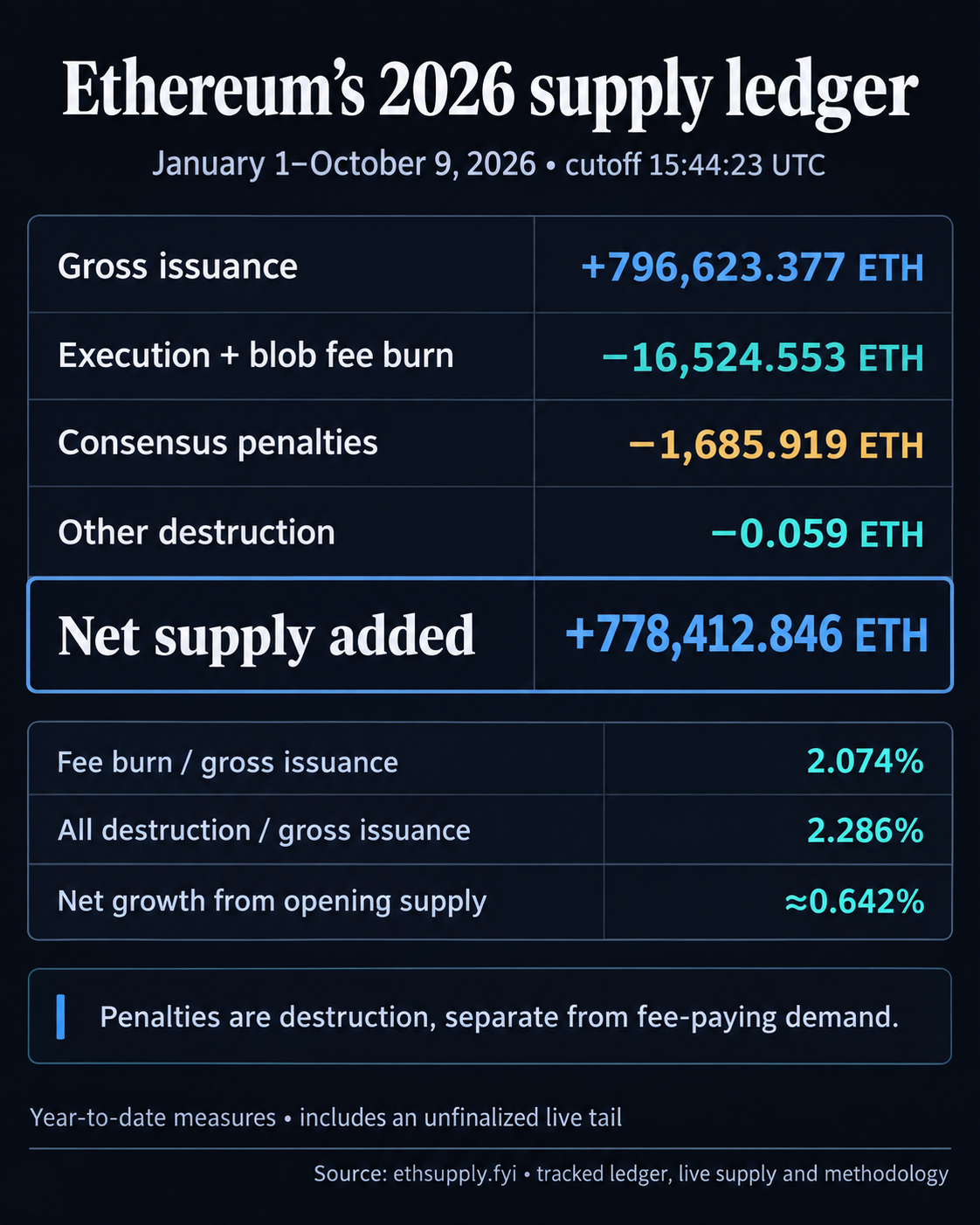
The provider's methodology separates newly created validator rewards from execution base fees, blob fees, penalties, and rare destruction through SELFDESTRUCT. Transfers, staking deposits and withdrawals preserve supply while moving existing ETH between accounts or accounting layers.
Its same-cutoff supply snapshot reports approximately 122.116 million ETH. Subtracting the net additions implies about 121.338 million ETH at the window's opening, producing the roughly 0.64% increase.
The 2.074% offset covers the cumulative 2026 window, while a current daily burn rate would require a separate daily comparison.
Ethereum's EIP-1559 fee mechanism burns the execution base fee on gas actually consumed. Priority fees go to block producers. Blob base fees also destroy ETH, while MEV payments and application revenue do not automatically become protocol burn.
The base fee, quoted in gwei, determines the ETH burned for each unit consumed. With an elasticity multiplier of two, a 60 million gas maximum corresponds to a 30 million target. A hypothetical 200 million maximum would imply a 100 million target if that rule remains unchanged.
A finalized mainnet beacon block at slot 15,394,656 contains execution block 26,155,767, timestamped Oct. 9 at 15:31:35 UTC, with a 60 million maximum. The matching execution-block record shows a base fee of approximately 0.335 gwei.
The supply consequence depends on consumed gas multiplied by its base fee, plus blob burn and other destruction. An unused increase in capacity cannot burn ETH, nor does a larger transaction count by itself establish greater burn if the transactions require less gas or pay lower base fees.
CryptoSlate’s Oct. 1 coverage already concluded that Ethereum’s 200 million gas target is conditional, validator-dependent, and not an automatic new limit. A Sept. 23 fee comparison highlighted the missing matched-period issuance denominator.
The same burn budget at two limits
For a current illustration, ethsupply.fyi's finalized-epoch accounting snapshot for epoch 481082, as of Oct. 9 at 15:31:23 UTC, records 13.296472924 ETH of gross issuance over 32 slots. At 12 seconds per slot, that is a 384-second sample.
The calculation holds that issuance pace constant, assumes every slot produces a block and consumes gas at the target, and initially sets blob burn, penalties, and other destruction to zero. The resulting thresholds describe the execution base-fee burn needed to offset gross issuance under those assumptions.
| Illustrative assumption or result | Current 60 million maximum | Conditional 200 million maximum |
|---|---|---|
| Gas target per block | 30 million | 100 million |
| Base fee needed at target consumption | 13.85 gwei | 4.16 gwei |
| Daily equivalent gross-offset burn | About 2,992 ETH | About 2,992 ETH |
| Base fee needed at half target consumption | 27.70 gwei | 8.31 gwei |
The daily figure extends the single sample across 225 epochs, with the resulting daily burn budget applying to this hypothetical day. Daily issuance and burn would require a full day's observations, as the larger gas target lowers the required base fee because the same ETH budget is divided across more consumed gas.
The more complete zero-net-growth calculation credits the sample's 0.016575391 ETH of penalties and 0.000442673483 ETH of blob burn. Holding those amounts constant lowers the execution thresholds slightly, to about 13.83 gwei and 4.15 gwei. The corresponding total transaction-fee burn budget after penalties is approximately 2,988 ETH per modeled day.
If gas consumed stays unchanged when the maximum rises, the balancing fee does not fall. The half-target row illustrates the arithmetic sensitivity to consumed gas, but EIP-1559 reduces base fees over successive blocks when consumption remains below target.
The live provider snapshot reports approximately 43.754 million ETH in active effective stake across 853,325 active validators. Ethereum's supply explanation identifies staking participation as a determinant of issuance, so a future threshold needs a fresh issuance sample alongside gas and blob usage.
Glamsterdam is a capacity scenario
The Ethereum Foundation's May 11 protocol update described 200 million gas as a credible post-Glamsterdam target. The upgrade's proposer-builder separation and block-level access lists aim to support greater throughput, alongside changes to gas accounting.
The Foundation's testnet announcement on Sept. 28 scheduled Sepolia for Oct. 6 at 13:53:36 UTC while leaving Hoodi and mainnet activation dates undecided. The official roadmap leaves the mainnet date unconfirmed.
Changes to the gas charged for execution and state growth mean a gas unit may buy different work after the upgrade. The modeled limits cannot be translated directly into proportionally more identical transactions, users, or burned ETH.
For holders, the relevant signal is whether burned fees and other destruction approach or exceed issuance over a matched interval. More available gas creates room for activity, but the shrinking-supply case needs that activity to generate enough aggregate burned fees.
Layer-2 (L2) blockchain growth and staking balances distinguish from fresh ETH purchases and settlement spending. The same distinction applies here, since existing holders can stake, and applications can grow, without those measures alone establishing the required burn.
The October ledger shows supply increasing while developers work toward greater capacity. A sustained shift toward shrinking supply would appear in consumed gas, execution base fees, blob burn, and stake-dependent issuance together.
Source: CryptoSlate