



FILTERED RESULTS
FILTERS
MCap $2.9T +0.1%24h Vol $87.8B -2.2%Fear & Greed 73/100Alts Index 59/100
BTC.D 58.9% +0.1%Stable.D 9.1% 0%ETH.D 11.3% 0%Others.D 20.7% -0.1%
ORCA$2.385+16.24%•FLUID$2.055+15.63%•CAP$0.0735+13.38%•NIGHT$0.0504+11.74%•FIL$1.159+9.38%•OKB$133.05+9.2%•LIT$4.012+8.51%•KAIA$0.0409+8.15%•NEAR$5.287+8.05%•VELO$0.00597577+7.12%•
BR$0.4000-12.73%•STRK$0.0525-10.29%•SAND$0.0674-9.3%•PROS$0.7528-8.73%•AKE$0.0316-8.47%•MINA$0.1440-8.09%•MON$0.0307-7.59%•SKY$0.0893-7.17%•SOON$0.3381-6.02%•TRAC$0.4192-5.37%•
•
·
·
FILTERED RESULTS
Tom Lee: Crypto market has entered a bull cycle, BMNR outperformed ETH in the first 9 months of this year
Analyst: BTC spot trading volume shows modest recovery, but demand is not yet enough to support new highs
US Congressman Proposes Ban on Candidates Trading Their Own Election Contracts on Prediction Markets
GLM-5.3 Launches on Amazon, Zhipu Opens Overseas Revenue-Sharing Channel
Whale 0xf7AD, who bought 654,288 $UNI ($5.96M) at an average price of $7.17 over the past month,...
Hunter Biden responds again to LAPTOP token controversy: wallet records can prove it was not a scam
Andre Cronje: NFTs Should Be More Than JPEG Wrappers, Flying Tulip Brings Perpetual Options to NFT Form
The Next Big Risk for U.S. Treasuries: A Futures "Technical Switch" Could Amplify the Next Selloff
Google Nears $1 Billion Nuclear Power Deal with Constellation
Canary Capital said today that its proposed Staked INJ ETF, under ticker INJC, is
Ripple Targets Turkey’s $200 Billion Crypto Market Amid Lira Pressure
Crypto PAC Fairshake Endorses 32 Congressional Candidates for 2026 Midterm Elections
The Cost of Missing Out: Why Bitcoin Market Timing Fails
Hong Kong Financial Secretary: Will submit amendment bill within this year to establish licensing regime for virtual asset trading and custody
"AI Stock God" Leopold's Four Options Expire In-the-Money, Earning About $45.6 Million in Two Weeks
CZ on "Every dip is an opportunity": Accurate prediction was pure coincidence, but he remains bullish
CFTC issued no-action relief allowing DCMs to turn certain existing contracts that
Kraken parent joins Singapore Gulf Bank, opening 24/7 institutional dollar rails
Crypto PAC Fairshake announces support for 32 House representatives, plans to spend over $100 million
Analysis: Bitcoin fails to break September-end high in two attempts, retreats after nearing $87,000
Grayscale Research Highlights Concentrated Gains in Bitcoin's Price Performance
Morgan Stanley Adds About 28 BTC This Morning, Total Holdings Value Tops $900 Million
Grayscale Research Head: BTC's Best Trading Days Are Hard to Predict, Timing the Market May Carry High Opportunity Cost
Smart money that bet on UNI in September appears to take profit, depositing all 654,288 UNI into Coinbase two hours ago
Peter Brandt Hints at Bullish XRP Pattern With a Coffee Cup Chart
SEC proposes reforming accredited investor rules; DCG founder Barry Silbert's suggestion from 15 years ago may finally come to fruition
Polymarket Releases Protocol V2: Rebuilding Prediction Market Smart Contract Infrastructure, Plans to Switch New Markets Starting November 2
Ansem: The market cap gap between BTC and gold will keep narrowing; this cycle resembles the 2020-2021 DeFi expansion
129,300,000 $USDC (129,300,000 USD) transferred from Unknown Whale 1 to #Aave...
KLEA Crypto Daily: Monday, October 05, 2026
CZ: Growing Up Poor Was One of My Sources of Motivation On September 25, 2026, Binance founder CZ...
Solana Treasury Company DFDV Added About 26,200 SOL Last Week, Total Holdings Exceed 2.56 Million
Musk's Net Worth Tops $1 Trillion Again After Three Months
BlackRock and multiple UAE funds in talks to join OpenAI's latest $30 billion funding round
Probability of Fed keeping rates unchanged in October at 77.3%
Crypto Fear and Greed Index Index Value : 73 Sentiment : Greed BTC Price : $85818 ...
Ripple’s Schwartz Slams Fee Metric as 100x XRP Fee Hike Is Floated
TOKEN2049 Singapore Set to Attract 25,000 Attendees Amid Bitcoin Rally
Inside the CFTC’s New Rules for Crypto Asset Markets
129,300,000 $USDC (129,279,958 USD) transferred from #Aave to Unknown Whale 1...
Plume Opens Onchain Door to Fidelity’s $28B Bond Giant
Crypto Elite Gather in Singapore as Bitcoin’s Rally Buoys Bulls
Strive CEO Says ASST Can Outrun Strategy in the Next Bitcoin Bull Market
CFTC makes its biggest move yet to bring offshore crypto trading back to the US
Brazil Moves Its Crypto Banking Cut-Off to 6 November as…
Strive Adds $169M Bitcoin in Its Biggest Buy in Four Months
Brazil Calls Its Own Betting Laws Unconstitutional as Shutdown Begins
Polymarket Launches Protocol V2 with Enhanced Features and Upcoming Market Transition
BTC breaks above $86,000, up 0.87% on the day
ESMA 2027 Annual Work Programme
Strategy Estimates a $20.91 Billion Q3 Bitcoin Gain –…
Crypto PAC announces support for 32 House candidates in US midterms
THORChain Co-founder Defends Protocol's Decentralization Amid Criticism
DeFi Development Corp Adds $3 Million in Solana as SOL Buys Slow
Novig Says Trading Jumped 94% After Sydney Sweeney’s Viral Ad
$MON added to Robinhood assets・
A Florida Woman Used Claude as a Diary. An Anthropic Employee Read It and Reported It to Police
Binance Introduces 1:1 Conversion Between US Stocks and Tokenized bStocks
XRP Ledger’s Permission Delegation Did Not Go Live on…
Binance Launches Retail AI Assistant, Repackages Existing Trading Tools
OKX and ICE File to Trade 63 Tokenized NYSE Stocks
ZachXBT infiltrates $1B crypto syndicate to expose Lazarus Group
US credit spreads eased on October 2 after widening beyond the weakest borrowers
Brazilian Markets Spike After Bolsonaro’s First-Round Election Win
FinCEN withdraws proposed crypto mixing rule over ‘legitimate activity’ concerns
CFTC Approves Fast Track for Stock-Index Perpetual Conversions
Why a 4chan Bitcoin Prophecy Says Today Is the End of Crypto Winter
CFTC Opens Door to More Perpetual Futures in U.S. Crypto Markets
250,000,000 $USDC (249,960,000 USD) minted at USDC Treasury...
Ethereum’s past outflow charts can change when more exchange wallets are identified


Coin Metrics has rebuilt Ethereum's historical Standard Flow Metrics, raising a timing problem for tests that treat exchange outflows as a trading signal.
The crypto data provider's Oct. 1 notice says it recomputed Ethereum Standard Flow Metrics from the network's first block using its most up-to-date information as part of its Ethereum Point-in-Time release. The affected scope is all ETH Flow Metrics at daily and hourly frequencies, with corrected history available for backfilling.
That creates a practical distinction for investment research. A chart downloaded today can describe past flows using knowledge acquired later. A backtest, which replays a trading rule through historical data, needs the information available when each decision would have occurred. Those are different information sets, even when their observations carry the same dates.
The notice supplies no revision amounts or ETH strategy comparison. The immediate consequence is a need to identify data vintage, meaning the version of the data used in the test; any effect on returns still requires measurement.
Why the same historical date can tell a different story
Coin Metrics' flow methodology makes the distinction concrete. Standard metrics use all addresses currently known to belong to an exchange or other tracked entity, with each address's history starting at its first nonzero balance. Past values can be restated when additional entity addresses are identified.
Its Point-in-Time, or PIT, series instead uses addresses known to belong to the entity during the historical interval. An address contributes from its discovery date, and later discoveries do not rewrite earlier PIT intervals. The provider documents daily and hourly PIT counterparts to Standard exchange-flow metrics.
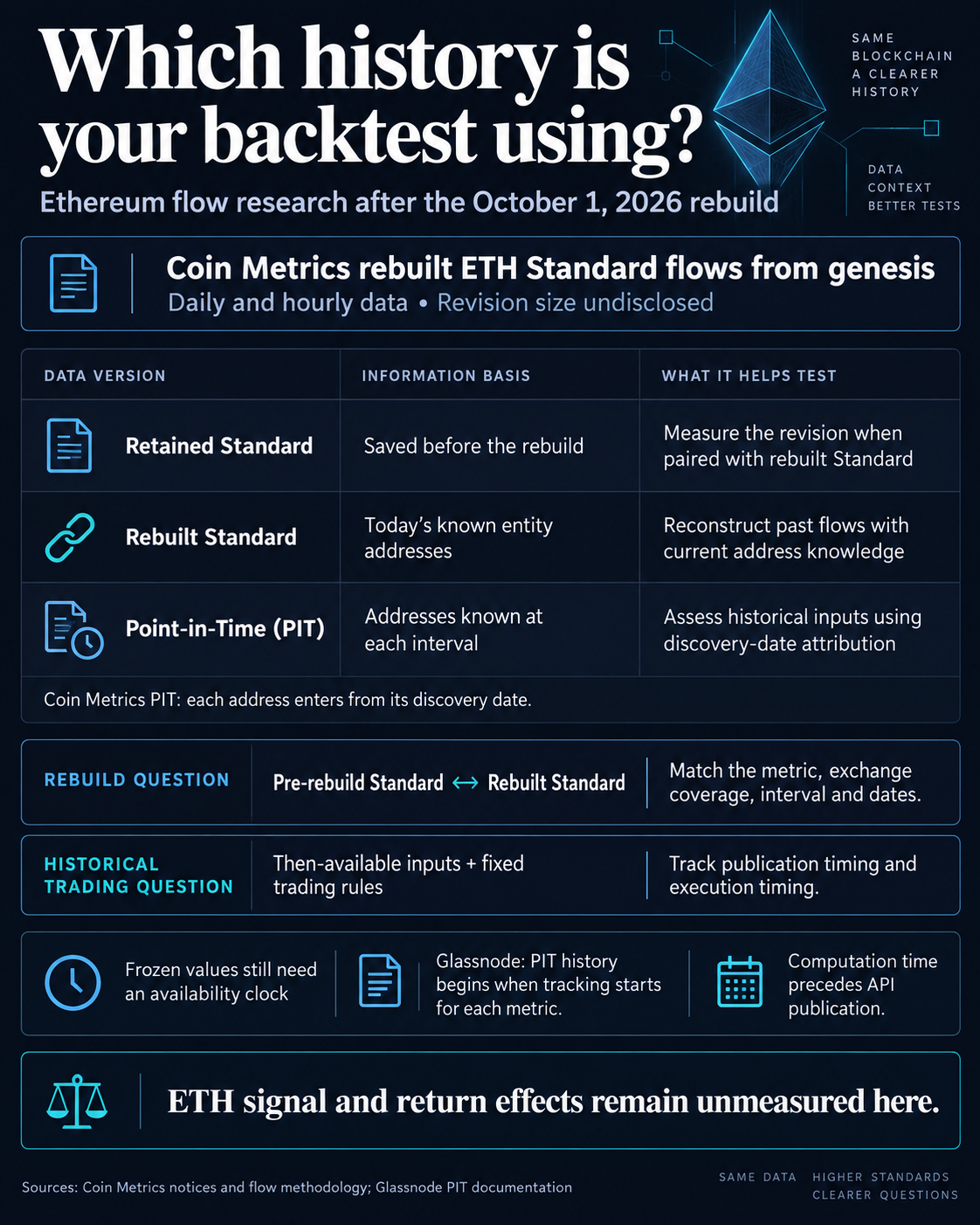
The underlying issue is attribution. A transfer can be assigned to an exchange retrospectively once the provider identifies the wallet. That fuller reconstruction may be useful for analyzing past supply movements with today's address coverage. Establishing what a trader could have recognized requires the address information and values available at that earlier moment.
Coin Metrics had outlined the recomputation on Sept. 28 to maintain that distinction, expecting ETH completion on Sept. 30. Its completion notice was posted Oct. 1 at 17:04 UTC; notice timing alone does not date every affected value's availability.
Two comparisons must also stay separate. Standard versus PIT tests different address-knowledge rules. Retained Standard history from before and after the rebuild is the comparison needed to measure this particular revision. PIT is a distinct attribution method. A copy of pre-rebuild Standard values preserves a particular version of the Standard product.
CryptoQuant's ETH Exchange Flows documentation explicitly warns that the endpoint does not support PIT accuracy. It says historical values may change as exchange wallets are discovered, added and validated through periodic clustering updates.
CryptoQuant schedules automatic updates for Tuesday at 00:00 UTC each week and says values can change slightly, especially recent observations. Each provider's revisions require their own measurements and update records.
For an analyst, retaining an old query date is therefore insufficient if the historical values are fetched again from a mutable endpoint. The dates of the observations may remain the same while the information used to construct them changes.
The interpretation of an outflow also needs restraint. A withdrawal measures movement relative to attributed exchange wallets. A claim about buying or profitable trading requires additional evidence.
Glassnode's BTC illustration isolates data-vintage risk
Glassnode supplied an illustration of the problem in a March 13, 2026, hypothetical backtest. It used Binance's BTC exchange balance to enter the market when a five-day moving average fell below a 14-day average and exit when the shorter average rose above the longer one.
The test covered Jan. 1, 2024, through March 9, 2026, starting with $1,000 and charging 0.1% per trade. Glassnode said it repeated the test using PIT balances while keeping the signal logic, parameters, dates and fees unchanged. The provider reported worse performance with PIT data than with revised balances.
The useful comparison is that the rule stayed fixed while the data variant changed. A historical balance pattern reconstructed with later knowledge can trigger different decisions from a pattern built from contemporaneous knowledge.
Glassnode supplied this BTC balance result, and the test remains unreplicated in this analysis. Its relevance to ETH is the measurement approach: hold the rule fixed and compare the data vintages. ETH signal and return effects require their own experiment.
The availability clock adds a further constraint. Glassnode's PIT documentation adds two limits to the shorthand promise of replaying the past.
First, PIT history exists only from the date tracking began for each metric. Before July 2025, coverage was limited to BTC, ETH and selected tokens and metrics; tracking expanded across all platform metrics from July 2025. A metric added then does not acquire earlier PIT observations merely because regular historical data exists.
Second, the timestamp attached to an observation is not necessarily when a trader could retrieve it. Glassnode says it has recorded relevant computed_at timestamps since September 2024, omitting the field when unavailable, and that API publication follows computation with a delay.
An unchanged historical value addresses later revision. Replaying a trading decision also requires placing the input after its actual publication. A test that acts before the input could be accessed still uses information from the future.
For Coin Metrics' ETH series, that means documenting each metric's first tracking date and historical customer availability. Glassnode's coverage dates and publication disclosures apply to its own products.
The evidence needed to measure an ETH trading effect
Measuring this rebuild requires paired observations from the same provider and metric, with matching exchange coverage, intervals and dates. For the revision question, that means retained pre-rebuild Standard values alongside the post-rebuild Standard history. For the trading question, it also means an information set demonstrably available at each decision time.
The rule must remain fixed across the comparison: the same entry and exit conditions, parameters and evaluation window. Availability cutoffs and execution timing belong in the test, alongside trading costs. Otherwise, changing the strategy while changing the data would leave the source of any performance difference unclear.
The comparison should then distinguish changed input values from changed signals, changed trades and changed returns. A revision can matter to the dataset without changing a particular rule's decisions.
The decisive follow-up is a paired ETH dataset and a fixed-rule replay that separates data changes from trading changes. Revised history can describe supply with today's address knowledge. A claim that outflows offered a usable trading edge requires reproducible inputs, publication timing and trading decisions.
Source: CryptoSlate