



FILTERED RESULTS
FILTERS
MCap $2.9T -0.6%24h Vol $122B +25%Fear & Greed 72/100Alts Index 45/100
BTC.D 58.9% +0.2%Stable.D 9.2% +0.1%ETH.D 11.3% -0.1%Others.D 20.6% -0.2%
SAND$0.0678+51.38%•NIGHT$0.0492+26.89%•CARDS$0.2493+22.4%•GALA$0.00262984+16.44%•ATH$0.0066348+13.76%•MANA$0.1009+13.75%•STONK$0.2589+11.93%•APE$0.1660+11.69%•WLD$0.5498+8.91%•AXS$1.231+7.62%•
2Z$0.0458-18.9%•MARSCOIN$0.1080-15.22%•SOON$0.3683-12.21%•PONS$0.4463-12.1%•BR$0.6682-11.58%•BP$1.360-8.56%•CASHCAT$0.1547-8.36%•PUMP$0.00538518-7.72%•LIT$3.568-6.38%•KNTQ$0.3160-5.93%•
•
·
·
FILTERED RESULTS
150,800,000 $USDC (150,813,572 USD) transferred from #Aave to Unknown Whale 1...
‘Casino Secrets’ Leak Ties UK Bookmakers to Offshore Mystake Operator
U.S. SEC Proposes Custody Framework for Cryptocurrency Assets
Federal Judge Rules in Favor of Kalshi and Coinbase in Illinois Sports Contracts Case
Kalshi and Coinbase Secure Partial Legal Victory in Illinois Over Sports Contracts
Off the Grid Crypto Explained: A Guide for Beginners
Masked Robbers Threaten Pregnant Wife in UK Crypto Home Attack
US Community Bank Group Sues OCC, Challenging Trust Bank Charters for Crypto Firms
South Korea proposes rules to bring stocks, bonds and funds onchain from February...
Shiba Inu (SHIB) Explained: Burn Mechanisms, Tokenomics,…
North Dakota’s Roughrider Coin Goes Live on Fiserv and Solana
Stablecoin issuers have replaced 40% of China’s lost US Treasury demand
Arbitrum Suspends New Stylus Activations Amid Security Concerns
Microsoft’s X Account Hijacked to Promote Clippy Meme Coin
🏴 CryptoPunks Rally Again
Chainlink SWIFT Deal Could Put LINK Closer to Thousands of Banks
Independent Community Bankers of America Sues OCC Over Trust Licenses for Cryptocurrency Firms
Bank group sues U.S. regulator over granting crypto trust charters
California Subpoenas OpenAI Over AI Models That Hacked Their Way Out of a Test
Strategy Moves $297M in Bitcoin After Latest Purchase; Should Traders Be Concerned?
Uniswap Dominates Tokenized Stock Trading with $17.1 Billion in Volume
Dormant Bitcoin Wallet Holding 600 BTC Awakens After 14 Years as Price Hits $87,000
250,000,000 $USDC (250,009,749 USD) minted at USDC Treasury...
Crypto Price Predictions: Bull Market Targets for BTC, ETH, SOL, and XRP
Ethereum Foundation and OA Launch zkAPI for Private AI Payment
Ethereum’s $2,800 Test Will Set the Tone for Altcoins This October
Bitcoin’s $85,000 sell wall is gone and traders are now betting on $100,000
Backpack SECURITIES-ISSUED $BLK, TOKENIZED BLACKROCK, GOES LIVE ON solana VIA sunriseNOW ON...
Backpack Securities Launches Tokenized BlackRock Shares on Solana
CryptoPunks Are Heating Back Up
Aave Founder Warns EU MiCA Review Could Restrict DeFi Access
September and October Usher in the Most Bullish Bitcoin Price Predictions — Details
Community Bankers Sue OCC Over Crypto Firms’ Bank Charter Path
European crypto users have ‘more faith’ in regulated firms under MiCA: Bitpanda co-CEO
Tesla Delivered 486,532 Cars in Q3 – 24,558 Above the…
BlackRock’s $195.6 million Inflow Push Bitcoin ETFs Back Into Green
Dehradun Trader Allegedly Duped of Rs 1.5 Crore in Crypto Scam
Powerus Goes Public on Nasdaq and Launches Tokenized Shares on Solana
Ethereum Now Lets You Pay for AI Without Revealing Who You Are
Drift opens claims for stolen funds compensation, initial payout rate around 1% of losses
NY Man Pleads Guilty in $5 Million Senior Fraud Scheme Involving Crypto
Lummis Says Democrats Opposed CLARITY Act Over Customer Protections
Crypto hackers exploit third-party Aave tool to steal 114 ETH
Circle Pushes Back on MiCA's Bank-Deposit Mandate for Stablecoins
US Midterms: Stand With Crypto Backs Bipartisan Slate After Senate Bill Fails
278,000,000 $ENA (65,549,627 USD) transferred from unknown wallet to unknown wallet...
Anchorage Digital Lays Off 17% of Workforce Amid Cryptocurrency Market Downturn
Large Stake of $1 Million in SOL Boosts New Solana Validator
SEC Proposes New Custody Standards for Crypto Assets
966,000 $SOL (114,103,817 USD) staked at unknown wallet...
NEAR Intents Ends Exploit Probe After $3.8 Million Is Returned
NEW: Institutional crypto bank Anchorage Digital has reportedly laid off roughly 17% of its staff,
This AI Is Already Fooling People on Video Calls Into Thinking Its Human, Company Says
Ethereum Long Positions Cluster at $2,538 Amid Market Activity
Client Alert: $320 Million Crypto Heist—What It Means for Asset Recovery and Who Pays
Bitcoin Crashes Below $84K as Crypto Liquidations Near $600M
SEC Proposes Rules That Could Change How Funds Custody Crypto
Iran has just struck an oil tanker conducting an outbound transit of the Strait of...
SEC Proposes Last-Resort Crypto Self-Custody for Advisers and Funds
Meet the New Bitcoin Treasury Firm That Already Plans to Sell BTC
U.S. Sanctions Hamas Network Over $2M Crypto Funding
Drift Hack Victims Can Redeem DFX at About 1 Cent Per…
Hester Peirce Leaves SEC After Advocating for Digital Assets
Ethereum Foundation Launches zkAPI for Enhanced Privacy in API Payments
Porsche scraps NFT project with floor price down 96%
BTC falls below $84,000, down 1.61% intraday
Bitcoin on Pace for Third Straight Weekly Gain on ETF Demand
Absa Bank Becomes First African Bank to Offer Bitcoin Custody Services
Aave Proposes Legal Entity to Hold Protocol IP for the DAO
Gen Z are investing like Boomers – with some surprising portfolio decisions


Like fashion, investing eventually finds something embarrassing in the back of the wardrobe and puts it on again. Millennial-era crypto gave us yield-bearing dog coins and all kinds of food-themed financial contraptions. Now Gen Z has entered the market in JNCO jeans, carrying an ironic digicam and, in at least one corner of the market, displaying a positively parental interest in conventional investments.
The jeans are super low again, and apparently their tolerance for portfolio risk is, too.
Binance Research's Aug. 12 report looked at how different generations use the exchange's direct equities, tokenized bStocks, and TradFi perpetuals. The youngest users weren't the ones constantly reaching for leverage or flipping positions. Across all three products, Gen Z was the lowest-turnover working-age cohort. The findings cover Binance users over a short period; its direct-equity product only reached scale in June 2026.
The most traditional-est, conservativ-est, unimaginativest portfolios in crypto, believe it or not, may belong to zoomers.
A rebellion with an expense ratio
The easiest place to see the difference is in ETFs.
ETFs accounted for 25% of Gen Z's direct-equity trading volume in the first days of August, up from 14.6% in June. Millennials were at just 9.5% in early August, which means the younger group was directing more than twice as much of its equity trading toward funds.
The money moving into those funds looks even more interesting than the trading volume. Unleveraged ETFs accounted for 18.5% of Gen Z's net equity inflow in June and 21.9% in July, while the share going into individual stocks fell from 77% to 74.2%.
July was a weaker month for Gen Z equity deployment overall, with net investment falling 17.4%, but unleveraged ETF inflows barely moved, declining just 2%. Single-stock inflows fell 20.4%, while leveraged products dropped 28.5%.
Gen Z was also the only cohort in the Binance data whose ETF holder base actually grew during July, rising 2.9% while the number of millennial ETF holders fell 4.5% and Gen X fell 5.9%.
So this isn't simply a case of young traders occasionally buying SPY between more exciting trades. When Gen Z pulled back, ETFs were the part of the portfolio they kept funding.
The individual investments don't exactly resemble something assembled by a regional pension fund, but they're also far from the lottery-ticket stereotype.
Among Gen Z accounts that had only bought and never sold, the largest average direct-equity purchase was SCHD, Schwab's US Dividend Equity ETF, at $16,567 per trade. Broadcom followed at $12,370. The overall holdings had a noticeable semiconductor and AI tilt, but the smaller average purchases among the top names went to some of the companies most associated with retail speculation, including Tesla at $633 and Nvidia at $514 in bStocks.
In other words, Gen Z still likes technology and AI, but the bigger tickets aren't necessarily going into the names with the loudest cult following.
The holding behavior points in the same direction. Some 22% of Gen Z direct-equity accounts in the report had never placed a sell order, compared with 19% of Gen X and 9% of Baby Boomers. Millennials actually led that category at 30%, so they can claim at least one victory in the case against their alleged financial recklessness.
Once the definition is widened from “never sold” to simply buying more than selling, Gen Z moves to the front.
About 76% of Gen Z bStocks accounts were net accumulators, the highest share of any generation and nine percentage points above millennials. In direct equities, 77% were accumulating, compared with 74% of Gen X and 68% of Baby Boomers.
They're not just trading less. In the parts of Binance designed to resemble ownership rather than a short-term derivative trade, they're mostly adding.
Perps are for trading and ETFs are for keeping
That behavior becomes stranger when you look at perpetuals, because a generation that came of age alongside crypto should theoretically be perfectly comfortable with them. They're comfortable enough to use them, but they're not using them as aggressively as older users.
The average Gen Z account made 13 TradFi-perpetual trades per month, compared with 17 for millennials, 16.5 for Gen X, and 19 for Baby Boomers. Only 14% of Gen Z perpetual accounts qualified as high-frequency, below millennials and Gen X at 18% and even below boomers at 16%.
That gives us the slightly ridiculous situation in which the 22-year-old trading stocks through a crypto exchange is making fewer perpetual trades than someone's boomer dad.
We saw a similar pattern in leveraged and inverse ETF usage, too. Some 88.2% of Gen Z TradFi-perpetual accounts recorded no activity in leveraged or inverse ETFs, compared with 84.5% of millennials and 85.9% of Gen X. In bStocks, 98.9% of Gen Z accounts avoided those products, again more than either of the other working-age cohorts.
Boomers remain harder to beat. They had the highest share of accounts avoiding leveraged and inverse products overall, including 98.9% in direct equities versus 96.5% for Gen Z.
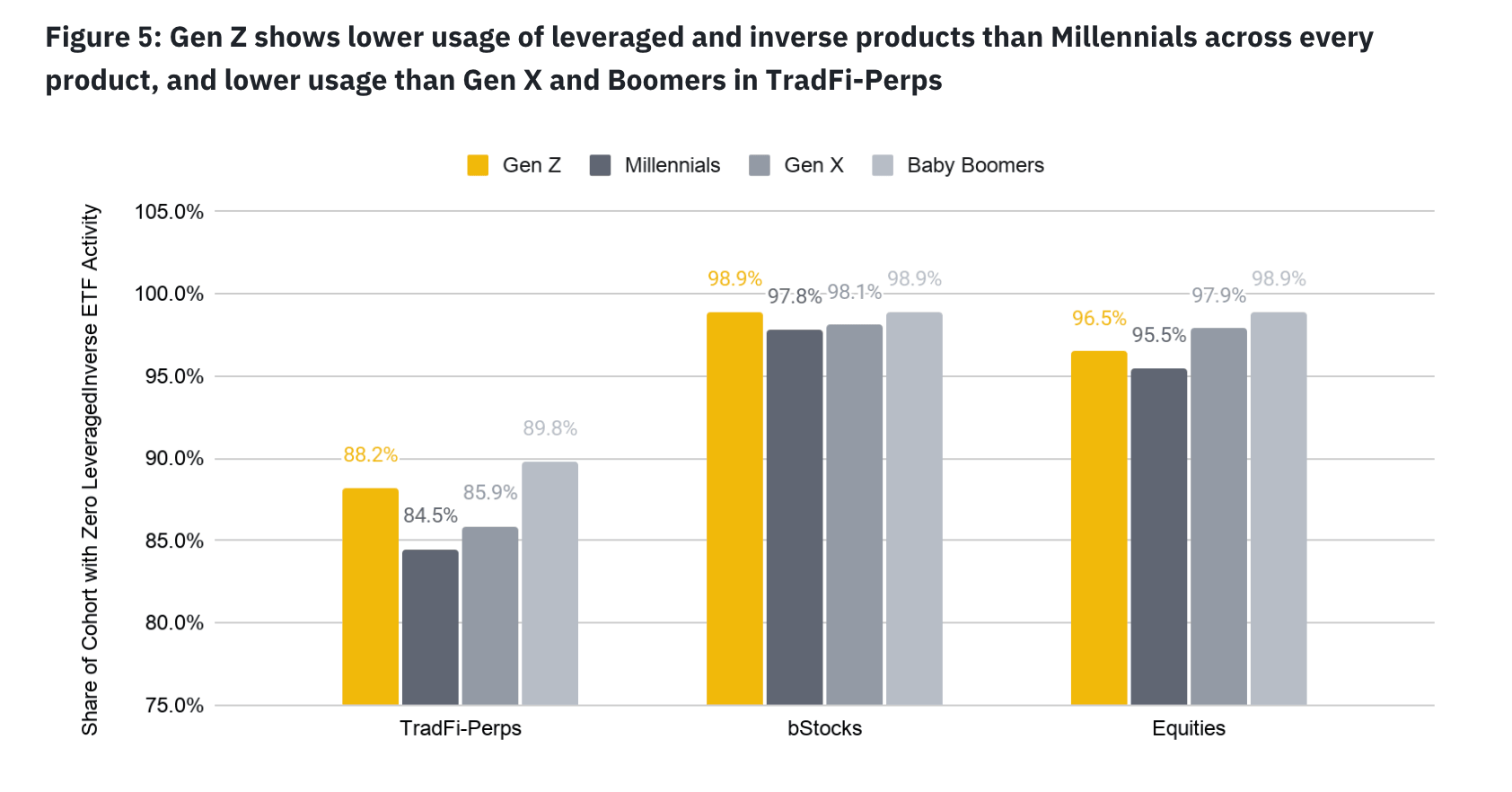
So zoomers haven't become boomers. However, among people who haven't reached retirement age, their behavior is surprisingly close.
The more interesting distinction is between what Gen Z trades and where it actually leaves money.
Leveraged and inverse ETFs represented 9.25% of Gen Z direct-equity turnover in July, but only 3.93% of net inflows. By the first days of August, their share of net inflows had fallen again to 2.65%.
That suggests leverage is being treated the way leverage is supposed to be treated: as a short-term position rather than somewhere to park capital.
TradFi perpetuals show something similar. About 60% of Gen Z accounts were net buyers, the highest proportion of any age group, but the actual net flow represented less than 1% of gross volume. Traders were opening and closing positions, leaving very little capital behind.
Equities look completely different. Gen Z's direct-equity net flow ratio was 26.5%, with average net inflows of $1,898 per account.
The distinction explains why simply asking whether young investors use perps misses what's happening. They do use them, but their persistent capital is going somewhere else.
Binance's earlier research on the next generation of investors gives a plausible reason for this. Gen Z already accounts for around 44% of Binance's direct-stock and bStocks users and 45% of TradFi-perp users, making it the largest cohort in direct stocks and bStocks and roughly level with millennials in TradFi perpetuals. More than 90% of TradFi users across generations were based in emerging markets, where getting access to US securities through a conventional domestic broker can be considerably harder.
For some of those users, the crypto exchange may effectively be the easiest brokerage they've ever had.
They already know the interface, the account is funded, fractional exposure is available, and the market can be accessed outside normal US trading hours. Binance reported that 13% of all Direct Stocks users were Gen Z customers in emerging markets with less than $2,000 in equity assets.
That makes the behavior easier to understand. The exchange doesn't have to turn every young customer into a perpetuals trader because it can also become the place where that customer buys ordinary investments.
We used to put the money in a pickle
The contrast is funny because some of the financial products that came out of crypto during earlier crypto cycles were completely insane by conventional standards.
Pickle Finance had Jars and Farms, including arrangements that compound returns from other protocols and reward users for depositing the resulting tokens. The concepts have financial explanations, although the vocabulary makes them sound like a pension designed during a prolonged supermarket incident.
ShibaSwap likewise uses “Bury” for staking tokens, with SHIB, LEASH, and BONE among the names in the interface. Crypto took activities already capable of confusing newcomers and gave them instructions suitable for a very ambitious dog.
A decade of that created a reasonable assumption that people who don't remember a world before Dogecoin would be even more comfortable with financial chaos.
Instead, the Binance data shows younger users putting a growing share of their equity money into unleveraged ETFs, trading less frequently than millennials and Gen X, and leaving leveraged exposure with a relatively small share of their net investment.
That doesn't mean they've abandoned crypto. A 2023 FINRA Foundation and CFA Institute survey found that 55% of US Gen Z investors owned cryptocurrency, while CryptoSlate has previously covered the broader appetite among young Americans investing in crypto.
The more interesting possibility is that using crypto and wanting maximum financial risk were never the same preference.
For someone who first encountered finance through an exchange app, Binance doesn't necessarily feel like the rebellious alternative to a brokerage account. It's simply the financial interface they already know, and once stocks and ETFs appear inside it, there's no reason their investment taste has to resemble the branding that surrounded crypto's earlier years.
That's where Gen Z looks different from both the millennials immediately above them and the boomers at the other end.
They're not building classic retirement portfolios. Semiconductor exposure, AI stocks, tokenized equities, and 24-hour markets are hardly an attempt to recreate 1990s wealth management. But they're using those products with a surprisingly old-fashioned instinct: buy something, keep more than you sell, and don't make every position dependent on leverage.
Crypto spent years making finance stranger so younger people would want to use it. The youngest customers may have taken the interface and left some of the weirdness behind.
Fashion can bring back the jeans while finance brings back the ordinary ambition to own something, leave it alone for a while, and hope it does reasonably well. The pockets are certainly big enough for both.
Source: CryptoSlate