



FILTERED RESULTS
FILTERS
Fear & Greed 73/100Alts Index 57/100
BTC.D 58.8% +0.5%Stable.D 9.2% 0%ETH.D 11.6% +0.2%Others.D 20.4% -0.7%
GRASS$0.7519+30.42%•SOON$0.4077+21.63%•ZBCN$0.0024054+19.91%•ICP$3.473+14.54%•NIGHT$0.0321+14.25%•PUMP$0.00583282+12.13%•AAVE$165.64+11.94%•ETHFI$0.7851+11.63%•AVAX$11.397+9.68%•QNT$266.28+9.59%•
HBAR$0.1041-13.26%•MARSCOIN$0.1399-11.82%•AI$0.1982-9.26%•BR$0.8281-8.92%•MON$0.0271-6.82%•ZAMA$0.0748-6.63%•BTW$1.302-6.08%•GRAM$1.512-6.06%•Q$0.0235-5.94%•PROM$5.958-5.58%•
•
·
·
FILTERED RESULTS
Bitget reopened BTC withdrawals, In the first hour, 3,326 BTC (~$276M) left the...
Aztec Labs Relaunches zk.money Privacy Wallet on New…
Anthropic Lost $42 Billion Last Year. It Wants to Go Public at $2 Trillion
Crypto regulation at SEC, CFTC to come down to 3 commissioners following key resignation
LaunchOnSF FLIPS ponsdotfamily IN 30-DAY REVENUE ...
US Stock Indices Mixed: Meta (META) Up 3.11%, Apple (AAPL) Down 2.74%
Chainlink Rally Brings Profit-Taking, While CCIP 2.0 Targets Institutional Money
Bitwise Launches First US Spot NEAR ETF With Staking Fees Taking 33% of Rewards
A newly created wallet, 0xc642, withdrew 18.84M $ENA($4.91M) from #FalconX 11 hours...
Fed guarantees 2-day stablecoin payouts, but $76B remains blocked
Spacecoin's Parent Company Signs $50M Binding Pre-Order Deal for Freeport Satellite Services in the...
The Race to List Tokenized Stocks in America: Why…
$PRL listed on Lighter futures・
Stablecoin Depeg Risk Ranked: USR Failed, USD0++ Hit $0.89,…
Aave expands lending collateral to Coinbase tokenized stocks, sparking a 16% AAVE rally toward...
HANetf Introduces First Euro-Hedged Bitcoin ETP in Europe
Bastion Partners with Sony Bank to Launch Corporate Stablecoin
Iran’s Ghalibaf says no regional country will export oil if Iran cannot...
House Oversight Committee expands prediction market insider trading probe to Hyperliquid ...
Someone Finally Jailbroke the PS5—Just After Sony Said Players Don’t Own Their Games
Moonpay Enlists South Korean Banking Giants in Asian Stablecoin Push
Zcash Market Cap Surges to 1.5% of Bitcoin's in One Year
Balancer Announces Shutdown Timeline Following BAL Holder Vote
Kalshi Traders Anticipate Job Growth in September
Kalshi IN ADVANCED DISCUSSIONS TO RAISE ABOUT $1 BILLION IN FRESH FUNDING FROM EXISTING...
Gracy Chen Compares Bitget Hack Recovery Efforts With…
Balancer Token Holders Approve Liquidation Plan, Reject Fork Proposal
Whales keep buying $ETH!A newly created wallet, 0x4876, withdrew 9,132 $ETH($24.37M) from #Binance...
Balancer Holders Vote to Wind Down Operations and Reject Fork Proposal
SEC Charges Entities Over Alleged $15M Crypto and AI Investment Fraud
NEAR Stopped Bitget's Hackers Without Breaking Privacy
According to SoSoValue, US Bitcoin spot ETFs saw a total net inflow of $31.07 million yesterday...
UK chancellor uses bitcoin to mock Nigel Farage
Federal Reserve Governor Advocates for AI and Stablecoins in Payment Innovations
$CT listed on Coinbase spot・
656 $BTC (55,183,385 USD) transferred from unknown wallet to #OKEX...
Puffer and Anchorage Digital Partner to Bring Institutional Settlement Infrastructure to Puffer UniFi
Zcash (ZEC) Plunges 12% Daily: Healthy Correction or the End of the Rally?
Wealthsimple Launches Self-Custody Wallet for DEX Trading in Canada
OpenAI halts launch of new AI model over safety worries...
El Salvador targets $9 billion in transfers, but chooses stablecoins
OpenAI Gave AI Agents Their Own Computers at DevDay 2026. Here's Everything It Announced
What is an IDO in Crypto? How Initial DEX Offerings Work…
Papertrade, A Perps Exchange That Rewards You For Losing, To Launch On October 10th: X ...
Morgan Stanley is moving deeper onchain, launching an internal lab to test stablecoin...
How to Create a Crypto Faucet: Setup, Revenue Model, and…
Bitwise Launches NEAR ETF With 5% Yield and an AI Bet
Coinbase Lists Concrete Token CT, Transfers Await Approval
MoonPay has launched a South Korean subsidiary, with plans to make it a hub for its
AAVE Price Jumps 16% to $169 as Rally Tests $175 Resistance
Binance Alpha Trading Competition: Trade Doppler Finance (XDP) and Share $200K Worth of Rewards (202...
Trump-related American Bitcoin has lost more than 90% of its value
Zcash Drops 11% to $1,356 as $28.7 Million of Longs Are…
U.S. HOUSE OVERSIGHT EXPANDS PREDICTION MARKET INSIDER TRADING PROBE TO HyperliquidX,...
Kalshi Eyes $1B Raise at $40B Valuation With Sequoia, Wellington
Cboe, S&P Dow Jones may explore tokenized options contracts under extended licensing deal
As $QNT has surged recently, whales that had been dormant for over 3 years are waking up and...
Bitcoin Is Up About 42% This Quarter With Two Days Left,…
Crypto ETFs Surge as Bitcoin Funds Add $2.95 Billion in 30 Days
SlowMist founder Cos stated that cross-chain liquidity protocol Chainflip is indeed making...
50,291,996 $XRP (75,959,870 USD) transferred from #BitGet to unknown wallet...
SEC Releases Crypto Asset FAQs, Federal Reserve Proposes Stablecoin Issuer Rules, CFTC Addresses Tokenized Investments and Mention Markets, Prediction Markets Litigation Advances
Zano Network Stabilizes After 30-Day Blockchain Rewind
Bitcoin Faces Risk as US Credit Card Stress Hits Multi-Year Highs
Aave Proposes Monad V4 Hub for Tokenized Equity Lending
@SECGov adds “no central party” condition to its token buyback...
Bitcoin Surges 35% Since August Low Amid Declining Open Interest
Tether claims $550 million in Iran freezes, but $35 million slipped past Senate
Odds That Variational Launches Its Anticipated TGE Above A $1B Valuation At 63%: Polymarket...
Solana’s 250ms data shows lower-stake validators lost a larger share of reward-linked vote credits


Solana's faster clock has not, so far, brought a network-wide jump in skipped slots. But a Solana Foundation study published Sept. 28 found a less even result underneath that stable headline: vote latency rose as the network moved through shorter slot targets, and validators with less stake lost a larger share of vote credits than the stake-weighted network average at 250 milliseconds.
That difference matters because vote credits feed into staking rewards. The Foundation reported group credit-loss fractions, not individual SOL payouts. Its findings make the proposed move to 200ms an economic question as well as a speed question, without showing that the 250ms change itself caused the disparity.
The Foundation's analysis says skip rates stayed low and broadly stable as target slot times fell to 250ms. On that measure, the network continued to produce blocks without evidence in the study of a broad consensus problem. The 250ms feature gate was listed as active on Mainnet in the Foundation's September changelog.
Voting told a more uneven story. As the slot target shortened, the study found that votes took more slots to land, with the largest increase among nodes in Asia and South America. Solana's network-average vote latency nevertheless remained well below two slots, and the Foundation said it saw no evidence of consensus instability. Higher latency for some validators therefore sits alongside healthy aggregate consensus performance.
The geographic data have a further limit. The Foundation counted only seven Asia-to-Oceania and 35 Europe-to-Oceania leader handoffs while the 250ms target was in place. It said those small samples were insufficient to rule out a statistical fluke in the apparent regional skip patterns. They do not establish a general skip-rate penalty for validators in those regions, even as the separate vote-latency observation warrants attention.
The reward question sits in vote credits
At the 250ms target, validators counted equally lost 1.6360% of vote credits in the Foundation's table. When the same measure was weighted by stake, the lost fraction was 0.0874%. The lower stake-weighted figure means that larger-staked validators, as a group, lost proportionally fewer credits than the population of validators considered one by one.
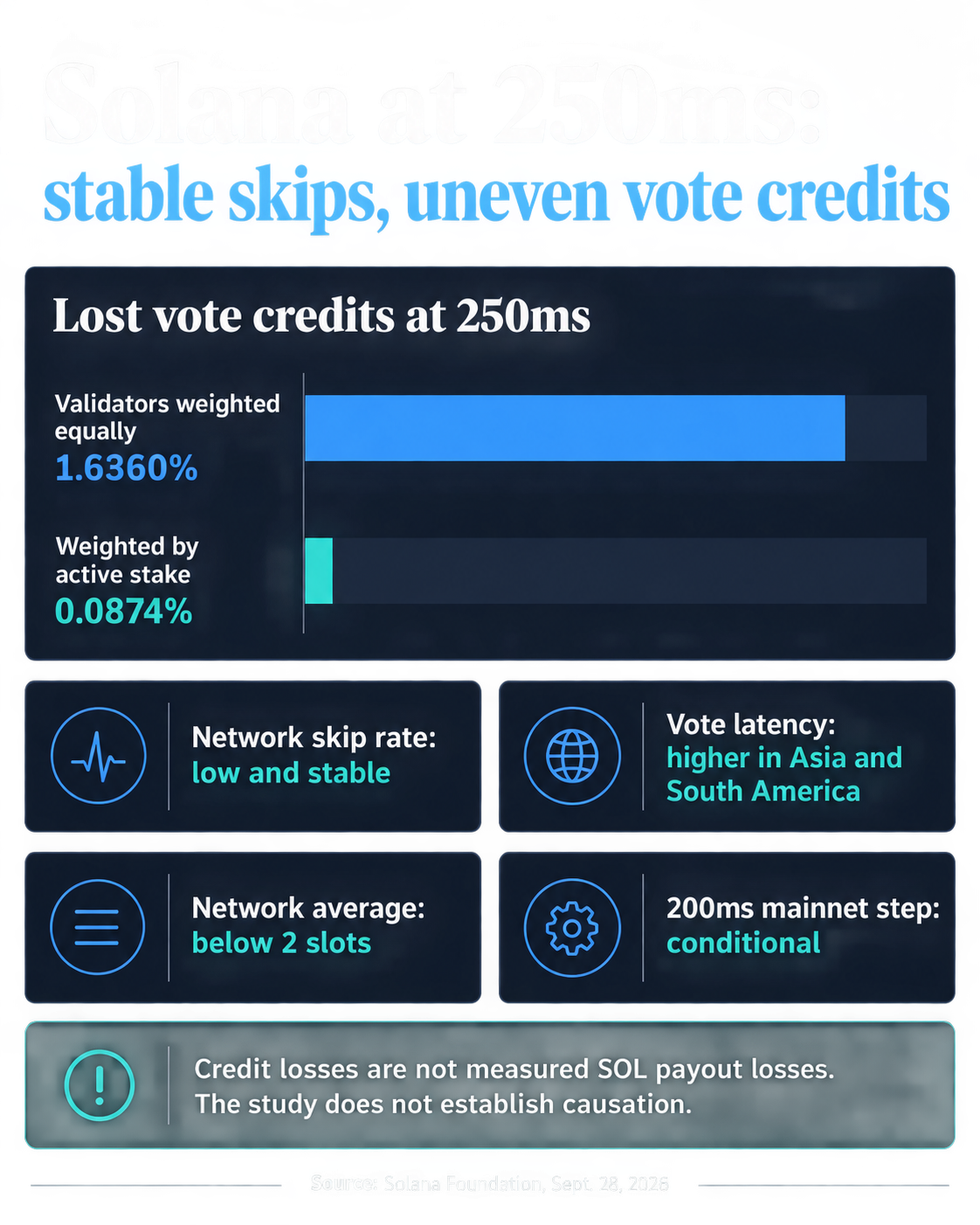
This is the divide that an aggregate uptime figure cannot describe. A stake-weighted average gives greater influence to operators with more delegated SOL. It can remain very low even when some smaller operators lose a greater fraction of credits. The table does not identify a SOL payout loss for any particular operator.
Solana's staking documentation explains the mechanism connecting votes to money: vote credits weighted by stake help determine inflationary rewards issued each epoch to validators and delegators, and validator commissions affect the amount delegators receive. That makes credit performance economically relevant. It does not make 1.6360% or 0.0874% a reward-loss percentage. Actual payouts also depend on the stake delegated, the epoch's reward pool and commissions, so neither table entry can be converted into an operator's lost SOL without account-level reward data.
Nor does the gap alone identify its cause. Stake size, geography and voting performance may be related in the observed sample, but the published group comparison does not isolate the effect of shorter slots from other validator conditions. The result is an observed distributional gap, with its cause and payout size still unresolved.
The Foundation's September study treats 200ms as a possible next target, while the staged slot-time proposal describes it as a separate feature-gated step. The cited Foundation updates report 250ms on Mainnet and discuss 200ms as a possible next target. Any forecast of validator rewards at that faster target is therefore conditional.
There is also a protocol boundary to the comparison. Under today's system, votes are transactions that must land on-chain. The Foundation says the planned Alpenglow design would instead send votes directly between validators and collect proof of voting within eight slots. If that change arrives, the present vote-latency mechanism would not carry over unchanged. The study therefore supports caution about extending today's pattern to a future 200ms network, especially one operating under a different voting design.
For a 200ms decision, the test is broader than whether blocks keep arriving. The Foundation's figures show a functioning network and uneven credit losses across stake sizes. They support scrutiny of reward distribution at the next speed step, without establishing a quantified SOL loss for any validator.
Source: CryptoSlate