



FILTERED RESULTS
FILTERS
•
·
·
FILTERED RESULTS
Boehringer, Zealand Obesity Drug’s Weight Loss Disappoints
US Job Cuts Decline in September Amid Weak Hiring Trends
FirstFT: A ‘vicious loop’ of selling grips government bond market
EU Engages Member States Regarding Emergency Diesel Stocks
US Soccer Fans Surge After World Cup, Surpassing NHL
Why is Constellation Energy stock rallying 4% today?
Resilient Economy Keeps Pushing Bond Yields Higher
Why Are Bond Yields Higher Globally? Investors React to Inflation, Fiscal Risks
Submit a question: What does the bond sell off mean for the global economy?
Broadcom to Provide Up to $42 Billion Loan to Anthropic for Infrastructure Leasing
Why is Liquidia stock down 5% today?
UK manufacturing growth edges up as input and selling prices rise
Analysis-Volatility control funds near record equity exposure, raising selloff risk
Major development banks launch new guidelines to capture, and boost, cash mobilisation
Well-Off Buyers Prop Up Auto Sales as Monthly Payments Hit $821
European Stocks Drop as Bond Yields Spook Investors; Banks Lag
Fintech Unicorn MNT Halan Plans Egypt Listing as Market Rallies
U.S. Administration Leverages China's Dependence on Aviation Suppliers in Trade Talks
Europe stocks extend sell-off into Q4 as French budget unveil and inflation weigh
Leading Democrat asks AI firms for data on any Chinese access to sensitive code
NIO (NIO) Stock Climbs Following Impressive September Delivery Figures
AWS to Increase GPU Prices Amid Sustained AI Demand
Filtronic (FLTCF) Stock Surges 14% on $68M SpaceX Contract – Should You Invest?
Citi sees frontier AI models widening lead over open-weight rivals
Jefferies cuts AI sector view as price war intensifies, US-China gap widens
Nike (NKE) Stock Faces Critical Test as Fiscal Q1 Earnings Loom
Oracle (ORCL) Stock Tumbles After New Mexico Flooding Threatens $18B AI Data Center
Slowest UK Population Growth Since 1998 After Immigration Plunges
Trump Calls for Powell to Resign From Fed Board
We have forgotten what budgets are for
Flydubai scare revives Israel’s hijacking trauma
Wachtell hires former Manhattan US attorney to strengthen litigation ranks
Netflix (NFLX) Stock Declines Following Co-CEO’s Growth Admission
Goldman Sachs Updates Top U.S. Stock Picks
Crude Oil Prices Rise Amid US-Iran Negotiation Stalemate
Syrian Officials and Hezbollah Hold First Meeting in Turkey
Saudi economy forecast to shrink and deficit to widen
Is Alberta Leaving Canada? Carney Confronts Breakup Push as Concerns Deepen
Strong nominal growth carries a message for Treasury yields. Read more in today’s WSJ Economics newsletter:
Why Domino’s New CEO Says an Insider Is a Better Innovator
Greece Forecasts Its Economy to Grow Faster Than 2% Next Year
Gold Holds Steady as Traders Weigh Higher Bond Yields, Oil
Starbucks opens first cafés in China’s Xinjiang
EU Considers Emergency Diesel Stock Release Amid U.S. Request
KB Securities sees solar demand outlook improving
European equity outperformance fades as higher oil prices cap gains: Barclays
Four US Energy Firms Poised to Profit From South Korea’s Massive $200B Investment
U.S. Layoff Announcements Decrease Significantly in September
Lam Research (LRCX) Stock Rises Following Strong Earnings Beat and Dividend Hike
Accenture (ACN) Stock: Analyst Expectations for Today’s Q4 Earnings Release
Russia Clarifies Nuclear Warning to NATO as Non-Confrontational
UK Is First Big Economy to Pay 6% on Long Debt Since Euro Crisis
Eurozone Labor Market Continues to Defy Mounting Economic Headwinds
SEC proposes widening retail access to private markets
Europe faces $800bn annual infrastructure funding need, says KKR
TPG raises $10bn for second climate private equity fund
Dow futures hit three-month low as yields surge, Micron earnings offer support
Analysis-Investors wary of slowdown in US corporate profit boom
Rocket Lab (RKLB) Secures Record-Breaking 20-Launch Contract with Synspective
Cerebras (CBRS) Stock Plummets 9% on Nvidia Partnership Concerns
Bianco Turns Bullish on Treasuries as Yields Climb
US Companies Announce Fewest Job Cuts for a September Since 2022
Zealand Pharma (ZEAL) Stock Plunges 12% Despite Promising Obesity Drug Weight Loss Results
Nu Holdings (NU) Stock Climbs After Dismissing Monzo Acquisition Reports
Bank of Japan’s summary of opinions points to accelerated pace of rate rises
US tells France and Germany to release diesel stocks or face US export ban, sources say
HSBC says investors are shifting funds from France to UK
Instant View: Bond markets take a drubbing again, 10-year Treasury yields highest since 2002
European stocks slip to three-month lows as global yields surge
10-Year Treasury Yield Reaches Highest Point Since 2002: What Investors Need to Know


Quick Summary
- The 10-year US Treasury yield surged to 5.342% on Thursday, marking its highest point since the beginning of 2002.
- This represents a breakthrough past the previous 2007 peak as the third quarter bond selloff intensifies.
- The 30-year Treasury yield similarly advanced, hovering around 5.64%.
- While August’s PCE inflation report showed figures below analyst predictions, core inflation continues to exceed the Federal Reserve’s 2% objective.
- Market expectations for an October Federal Reserve rate increase have declined to approximately 37-38% from above 45% prior to the inflation release.
On Thursday, the US 10-year Treasury yield climbed to 5.342%, marking a significant milestone. This represents the highest level recorded since the early months of 2002.
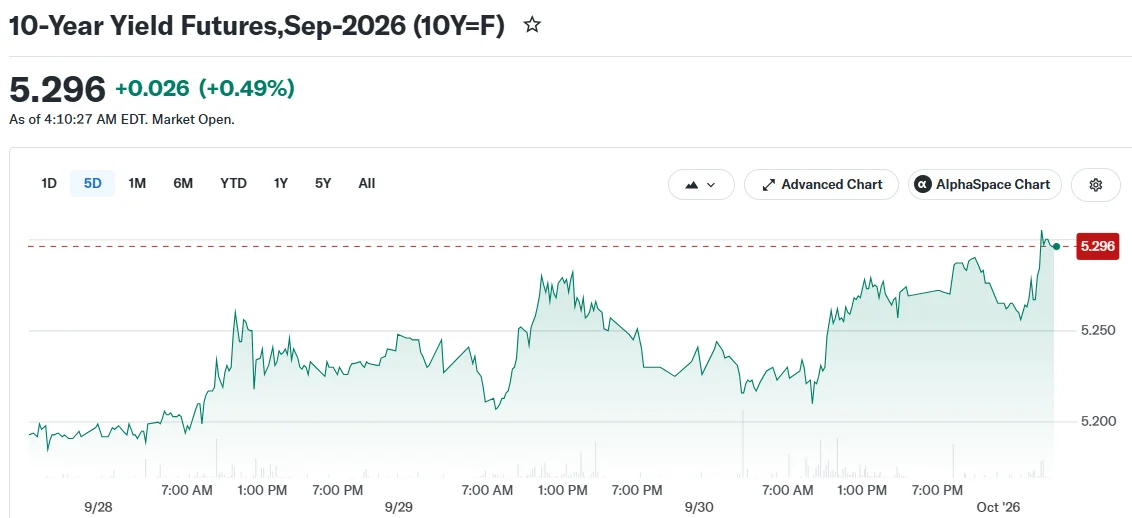
The surge occurred as the bond market selloff gained momentum. The yield broke through its former 2007 record high. Market participants are closely monitoring whether this upward trajectory will continue.
During the third quarter, the global benchmark yield experienced its largest quarterly increase this century. This milestone represents a significant achievement across an extensive historical timeline.
The 30-year Treasury yield followed suit with its own advance. On Thursday, it hovered near 5.64%, reaching levels not observed since 2002.
Forces Behind the Bond Market Decline
Multiple elements are contributing to the upward pressure on yields. Persistent elevated energy costs are fueling concerns that inflation may remain stubbornly high.
WARNING: US Treasuries just posted their WORST month in four years, per FT.
The 10-year yield surged more than half a percentage point in September to 5.3%, the sharpest rise since September 2022.
The 30-year yield is trading at its highest level since June 2002.
Investors… pic.twitter.com/FycpiaSeqb
— Coin Bureau (@coinbureau) October 1, 2026
 WARNING: US Treasuries just posted their WORST month in four years, per FT.
Despite signs of recovering oil supply from the Middle East, diplomatic discussions between the US and Iran have yielded minimal results. Consequently, oil prices continue trading near levels typically associated with geopolitical conflicts.
Expanding government borrowing requirements are another contributing factor. Recent bond buyback programs have fallen short of expectations, intensifying stress on the Treasury market.
According to Patrick Munnelly, a market strategist at Tickmill Group, escalating government budget shortfalls combined with substantial Treasury issuance are expected to maintain upward momentum on yields. He also highlighted corporate borrowing linked to artificial intelligence infrastructure investments as an additional contributing element.
Latest Inflation Numbers Present Complicated Picture
Fresh inflation statistics were published this week. The PCE price index increased 0.3% during August, falling short of the anticipated 0.4% gain.
Core PCE inflation advanced 0.2% on a monthly basis, likewise coming in under analyst estimates.
On an annual basis, core PCE inflation registered a 3% increase for the twelve months concluding in August. This marks a decline from the prior month’s 3.3% reading.
Despite these positive developments, inflation continues significantly exceeding the Federal Reserve’s 2% objective. Bill Adams, chief US economist at Fifth Third Commercial Bank, noted that while the inflation trajectory points downward, substantial distance remains before reaching the Fed’s target.
Adams emphasized that the Federal Reserve’s upcoming policy decision will hinge on September’s inflation statistics, which remain unreleased.
Additional economic indicators demonstrated strength. Revised output calculations revealed second quarter economic expansion exceeded initial estimates.
September’s private sector employment growth also surpassed projections, based on ADP’s report.
Market Expectations for Federal Reserve Action Evolve
Financial markets currently assign approximately 37% to 38% probability to a Federal Reserve interest rate increase in October. This represents a decline from the over 45% probability assessed before the inflation data emerged.
Yields experienced a temporary decline immediately following the inflation announcement. However, the selloff regained momentum as market participants analyzed the contradictory signals emerging from broader economic data.
The two-year Treasury yield, which serves as a barometer for interest rate projections, reached 4.893% during afternoon trading.
International bond markets exhibited contrasting behavior. Germany’s 10-year bund yield decreased 5 basis points to 3.563%. The UK’s 10-year gilt yield experienced a modest decline to 5.392%.
Market attention now shifts to upcoming US economic releases. Thursday brings weekly unemployment claims data, while Friday features the comprehensive September employment report. These releases carry significant potential to influence expectations regarding the Federal Reserve’s next policy action.
Source: Parameter