



FILTERED RESULTS
FILTERS
•
·
·
FILTERED RESULTS
Cipher Digital stock jumps after extending Barber Lake lease
European AI-linked stocks rally After Anthropic’s $11.6 bln computing deal
Intel (INTC) Stock Surges Nearly 4% on AI Developments and Packaging Breakthrough
International Criminal Court Deputy Prosecutor Claims Insulation from US Sanctions
Swap lines with PBoC outnumber those with ECB by factor of three
South America Is Now Big Oil’s Top Hunting Ground
Markets Pushing Limits on Pricing in Fed Hikes, Says SocGen’s Rajappa
Advanced Micro Devices (AMD) Stock: Can It Reach $750 After Breaking $1 Trillion?
Saudi, Turkish, Pakistani representatives to meet amid Yemen fighting - Al Jazeera
Greenland Energy (GLND) Stock Surges 60% After Farm-Out Agreement Amendment
European Stocks Set for First Weekly Gain in Four as Oil Eases
Premarket movers: Akamai surges on Anthropic deal , Comcast and Twilio slip
Alphabet (GOOG) Stock Climbs as Google Prepares First AI Satellite Launch
BASF Made Merger Proposal to German Rival Evonik, FT Reports
Trump, Xi and the Tech Moguls
US equity funds post first inflow in five weeks on renewed AI optimism
Why is Nike stock sliding today?
Global equity funds snap two-week outflow as AI optimism returns
Semiconductor Stocks Surge: AMD, Intel, and Marvell (MRVL) Rally on Friday
MGM Resorts (MGM) Stock Drops 11% Amid Surprise Bid for Barry Diller’s People Inc
Johnson & Johnson Reports Five-Year Survival Rate of 69.2%
Trump and Xi Discuss AI Safety Concerns in Recent Talks
Interest Rate Expectations Shift Following Recent Events
Oil is King for Gilts in Volatile Week
Dell (DELL) Stock Dips 2% Following $32M Executive Stock Sale Wave
Kenyan Appeals Court Upholds President’s Unpopular Housing Levy
BASF makes takeover approach for chemicals rival Evonik
Russia targets Ukraine’s data centres
The world’s 80mn-kilometre power grid problem
Italy regulator closes P&G hair removal device probe after ad commitments
Why is Comcast stock sliding today?
Iraq Offers Last-Minute Oil Cargoes as Freight Costs Bite
Panda Diplomacy Shows Thawing US-China Ties as Xi and Trump Meet
Trump Trying to Buy Time With Xi; Amundi's Rosenberg
Qualcomm (QCOM) Stock Slides Following Ambiguous Apple Patent Agreement
Meta’s AI Game Tools Trigger Selloff in Unity (U), Roblox (RBLX), and Take-Two (TTWO) Stock
Xi Jinping Didn’t Bring a CEO Entourage. What That Says About China-US Relations.
Bernstein cuts Deutsche Telekom on T-Mobile U.S. risks; names BT top pick
First Solar stock analysis: Buy the dip?
European Markets Gain Ground As Energy Costs Retreat And Yields Stabilize
Alabama TikTok Trial Begins: First Test of Teen Mental Health Claims in Court
Why stocks held up despite rising yields and $100 oil? These 2 words explain it
Why is Twilio stock sliding today?
Rescue Operation Successfully Retrieves U.S.-Sanctioned Oil Tanker Hijacked by Somali Pirates
Max Kettner Would Be Long Anything If Oil Falls to $80
Bank of America Reports Currency Trends Ahead of Month-End Fixing
How China is conquering high-tech markets once controlled by the West
New York Fed President Warns of Persistent Supply Shocks Impacting Inflation Goals
UBS upgrades Glencore as commodity gains boost earnings outlook
Bank of England may struggle to hold rates amid high energy costs
FTSE 100 Live: Stocks Set for Rebound, Pounds Sits Close to $1.32
Crude Oil Prices Decline Amid US-Iran Negotiations for Strait of Hormuz Reopening
Federal Reserve to Raise Asset Thresholds for Bank Regulation
Ukraine Strikes Two Refineries in Russia, Claims President Zelenskyy
BOE’s Bailey Warns It’s Getting Harder to Avoid Rate Hikes
US Labor Market Not Contributing to Inflation, Says Federal Reserve Official
Analysis-Talk of US export ban on diesel deepens US crude futures’ discount to global benchmark
Rush of money, campaign stops show Republicans feel vulnerable in Iowa, Kansas
First US trial against TikTok to test claims platform fueled teen mental health crisis
Americans navigate ’wild West’ of health insurance options after dropping Obamacare plans
Kremlin says US, Russia, Ukraine meeting may happen soon
Jobs report, inflation data to test US rate path, economic strength
China Reports Increase in Exports to the U.S. Ahead of Upcoming Summit
Dollar’s Best Rally Since March Has Legs as Fortunes Shift
Pimco Faces $35 Million Loss on Philadelphia Offices
FirstFT: The Xi-Trump finale
UK and Cambodia Sign Agreement to Combat Online Scams
Officer’s Choice Whisky Founders Are Said to Consider ABD Sale
Inpex to raise Ichthys LNG stake to 68.6% with JERA asset acquisition
Treasury Yields Surge to Two-Decade Peak: What Investors Need to Know


Quick Summary
- The benchmark 10-year Treasury yield surpassed 5.2%, marking its highest reading in approximately twenty years.
- Long-dated bonds saw even sharper moves, with the 30-year yield reaching levels last seen in 2004.
- Mortgage borrowers are feeling the squeeze as the average 30-year fixed rate crossed 7% for the first time since the beginning of 2025.
- Financial advisors are recommending alternative fixed-income strategies, including short-duration bonds, mortgage-backed securities, and investment-grade corporates.
- The yield surge is a worldwide phenomenon, with Germany, Japan, and other nations experiencing similar upward pressure on rates.
Treasury yields have experienced a dramatic spike throughout this week, climbing to heights unseen for approximately two decades. The 10-year note pushed past 5.2%, while its 30-year counterpart touched the highest level recorded since 2004.
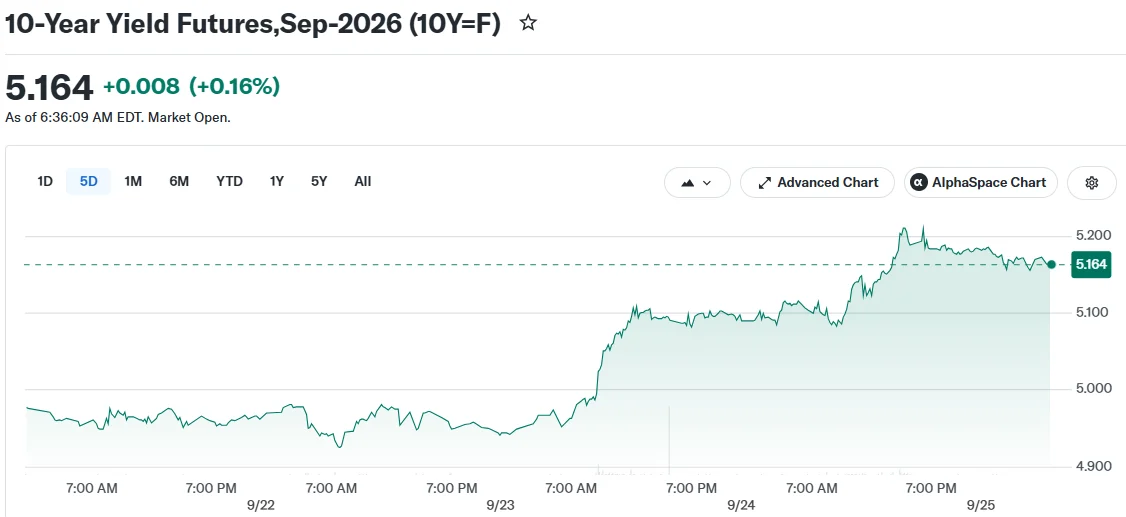
There’s an inverse relationship between bond prices and yields. As bond values decline, yields increase proportionally, offering new purchasers enhanced returns relative to their investment.
Forces Behind the Yield Surge
Multiple dynamics are contributing to this dramatic shift. Market participants are increasingly concerned about inflationary pressures, fueled in part by elevated energy prices connected to geopolitical tensions involving Iran.
Federal borrowing requirements have expanded significantly. When additional bonds flood the market, prices naturally decline while yields move higher.
Technology companies constructing massive AI infrastructure are simultaneously releasing substantial quantities of corporate debt. This wave of issuance further increases bond market supply.
Recent economic indicators point to surprising resilience. Data released this week revealed that business activity expanded at the quickest rate in more than five years, potentially strengthening arguments for additional Federal Reserve tightening.
Just last week, the Federal Reserve implemented its first short-term rate increase since 2023. Market participants are now pricing in the likelihood of at least one additional hike before year-end.
Consequences for Consumers and Businesses
The yield acceleration extends well beyond professional bond traders. Homebuyers are confronting a 30-year mortgage rate that has reached 7% for the first time since the start of 2025.
These elevated yields complicate housing affordability significantly. Corporate financing expenses are climbing too, while government interest payments continue expanding.
There’s a silver lining for depositors, however. Higher yields translate to improved returns on cash holdings and shorter-maturity bonds. The 1-year Treasury bill currently offers just below 4.5%.
Equity markets haven’t escaped unscathed. The S&P 500, which approached record territory earlier this week, has lost upward momentum as the bond rout unfolded.
Broad bond market funds like the iShares Core U.S. Aggregate Bond ETF have declined nearly 5% year-to-date. By comparison, the S&P 500 maintains gains close to 13% for the same period.
Strategic Shifts Among Portfolio Managers
Financial professionals suggest that shorter-maturity bonds may present a more favorable risk-reward profile currently. These instruments exhibit reduced sensitivity to rate fluctuations compared to longer-dated Treasuries.
Mortgage-backed and asset-backed securities are gaining attention as viable alternatives. Exchange-traded funds focusing on these sectors are presently delivering approximately 4.5% yields.
Investment-grade corporate debt represents another segment drawing analyst recommendations. Numerous blue-chip enterprises maintain solid balance sheets despite the challenging rate backdrop.
Municipal bonds are experiencing renewed interest as well. Their tax-advantaged structure becomes particularly attractive when paired with elevated yield levels.
Developing nation sovereign debt is attracting capital flows too. One fund concentrating on shorter-term obligations from nations including Saudi Arabia and Mexico currently provides 5.6% returns.
An International Phenomenon
This yield expansion isn’t confined to American shores. Germany’s 10-year bund yield stands near 3.60%, representing the highest reading since 2008.
Japan’s equivalent maturity rests at 3.08%. This represents a substantial transformation from the negative territory the nation experienced as recently as 2020.
Market observers attribute this worldwide pattern to escalating sovereign debt burdens and persistent inflation worries affecting developed and emerging economies alike.
Source: Parameter