



FILTERED RESULTS
FILTERS
MCap $2.8T -1.8%24h Vol $14280.4T +12887722%Fear & Greed 64/100Alts Index 53/100
BTC.D 59.4% +0.6%Stable.D 9.5% +0.2%ETH.D 11.1% 0%Others.D 20.0% -0.8%
MET$0.4824+53.15%•JUP$0.3768+17.04%•W$0.0161+15.65%•ALGO$0.1338+13.69%•RAY$2.465+10.97%•STRK$0.0553+10.46%•JTO$0.5677+9.77%•CRV$0.3844+9.64%•CVX$2.276+7.69%•TIA$0.4832+7.36%•
NMR$13.965-17.91%•CAP$0.0721-16.58%•BP$1.053-16.35%•MINA$0.0847-14.01%•DRV$0.3630-11.6%•BR$0.5392-10.74%•PUMP$0.00580788-10.23%•ORCA$2.642-7.67%•USELESS$0.1967-7.5%•ZEC$1,204.01-7.46%•
•
·
·
FILTERED RESULTS
Base Announces Plans to Tokenize Around 500 Stocks by Year-End
Bitcoin ETF investors head for the exit, and it's the biggest rush in months
Crypto ETFs Lose $650.6 Million on October 7 as BlackRock…
TOKEN2049 Singapore Day 2: Wall Street, Coinbase Global Exchange, Cardano’s Midnight, AI, 2027 Expansion
Moscow Exchange Plans to Open Cryptocurrency Trading from December 1
Google Launches a Platform for Creating Games Using Prompts
622 $BTC (51,428,576 USD) transferred from Coinbase Institutional to unknown wallet...
“We aim to launch our custody offering to hold selected crypto, stablecoins and tokenized real
Former Senator Blanche Lincoln Advocates for Kalshi Amid Regulatory Debate
Binance Wallet Launches Zest Protocol (ZEST) Trading Competition, Distributing $200,000 in Rewards Across Two Rounds
Ripple Custody Platform Adds Support for Canton Network Assets
Binance Alpha Trading Competition: Trade Zest Protocol (ZEST) and Share $200K Worth of Rewards (2026...
Ethereum Is About to Lose Its Steadiest Buyer as BitMine Nears a 5% Cap
Why Is Jupiter Price Up Today? JUP Jumps 13% as Solana Slips
BitMine’s Ethereum buying spree could end in six weeks
Bitcoin’s failed breakout reveals a dangerous mix of thin volume and easy profits
Bitcoin and tech stocks under pressure as rising Treasury yields, higher oil prices and a...
SoFi Launches Stablecoin Card Settlement on Mastercard, Projecting $25 Billion in Annual Transactions
Sui's Bitcoin financial infrastructure Hashi to launch mainnet this month, with over $500 million in capital commitments
Hong Kong announces 4.00% interest rate for Silver Bond Series due 2027
China Denies Allegations of AI-Driven Cyber Attacks on South Korean Financial Institutions
Live news: Risk assets under pressure as bond selloff and oil rally intensify
Former PlayStation Exec Slams Sony's Move to Kill Discs: 'What Are You Buying?'
Hyperliquid (HYPE) Price Holds Near $87 After Pullback From $98 Peak
622 $BTC (51,461,639 USD) transferred from Coinbase Institutional to unknown wallet...
XRP Price News: Two Charts Point To $50 If XRP Holds Its Retest Zone
Anthropic IPO: Research Firm Values AI Company At $150 Billion, Calls Offering ‘Most Ridiculous Of 2026’
Starknet Considers Becoming An L1 To Build A Quantum-Resistant Network By 2027
UK 20-year government bond yield hits 6% for first time since March 1998
Ripple Expands into Prime Brokerage with $1.25 Billion Acquisition of Hidden Road
Spot silver falls over 2% intraday, now at $58.56/oz
Greece Plans 10% Crypto Capital Gains Tax, Down From 15% Floated in June
$DRV listed on Lighter perps・
ESMA orders EU crypto firms to phase out non-MiCA compliant stablecoin services within three...
Data Breaches at South Korean Banks Linked to AI Attacks
Vietnam to explore independent digital asset regulatory framework to modernize financial system
Bitcoin slips below $83,000 as Ethereum researcher's 'bunker mode' call divides crypto
$783K Crypto Bust Ends Site Selling Stolen Images of 17,000 Women
Ethereum Price Today: Ethereum Price Holds Near $2,570 as ETF Outflows Hit $161M
ESMA requires crypto service providers to stop offering non-MiCA-compliant stablecoin services, with a 3-month wind-down
IREN Stock Falls 6.3% as Debt-Funded Data Centers Sell Off…
Bitcoin ETFs Bleed $485M as BTC Falls Toward $82K — Bearish Move Ahead?
Starknet is considering becoming an independent Layer 1 blockchain to control its own
PeckShield: 79th Vault attacked, losing about $12.51 million
Market Analyst Calls Cardano Data “Insane,” Insists ADA Is Far From Dead — Here’s Why
Hyperliquid Founder Considers Options Trading for Future Ventures
ESMA Orders EU Crypto Firms to Cease Non-Compliant Stablecoin Services by January 2027
Bitcoin Sees $4.9 Billion in Monthly Inflows Amidst Existing Holder Activity
$110B Gone From Crypto Markets in 36 Hours as Bitcoin Dives Below $83K: Market Watch
India vs Elon Musk: Starlink’s Global Wall of Bans, and the Crypto Thread Running Through It
Bitcoin monthly ‘new money’ inflows near $5B as BTC price rally stalls
ESMA gives crypto firms 3 months to exit non-compliant stablecoins
doublezero CO-FOUNDER Austin_Federa ACCUSES solana OF MOGGING solanamobile EVANGELIST...
OpenAI and Ironclad Collaborate to Enhance AI in Complex Contracting Workflows
Circle has partnered with SAP-backed Tereina to bring USDC and EURC stablecoin payments
Starknet Explores Transition to Layer 1 for Enhanced Security Against Quantum Threats
Binance Will Judge Its Marketing on User Retention, Interim CMO Eowyn Chen Says
Standard Chartered to expand institutional crypto and RWA custody to Singapore
OpenAI Shares Advances in Mathematics Through AI Models
Hackers Attack Another Bitcoin Project as Ark’s Second Exploited
XRP Falls 4.2% Below $1.44 After Failing to Break $1.50
Santiment: Bitcoin Whales Accumulated 86,702 BTC Over Three Weeks
Jump Trading integrates ChatGPT to enhance quantitative research
Foundry's founding CEO Mike Colyer is stepping down after seven years, Bitcoin
Manus parent company Butterfly Effect completes new funding round of over $500 million
ByteDance Dominates China's Data Center Market with Significant Capacity
SuiNetwork CO-FOUNDER EmanAbio ANNOUNCES THAT datafdn IS MIGRATING TO SUI AND...
Raydium Price Prediction: Can RAY Turn the Current Breakout into a Move Toward $3.5?
Greece prepares to levy 10% capital gains tax on cryptocurrency
Bitcoin holds near $78,500 as a surging Japanese yen threatens global risk assets


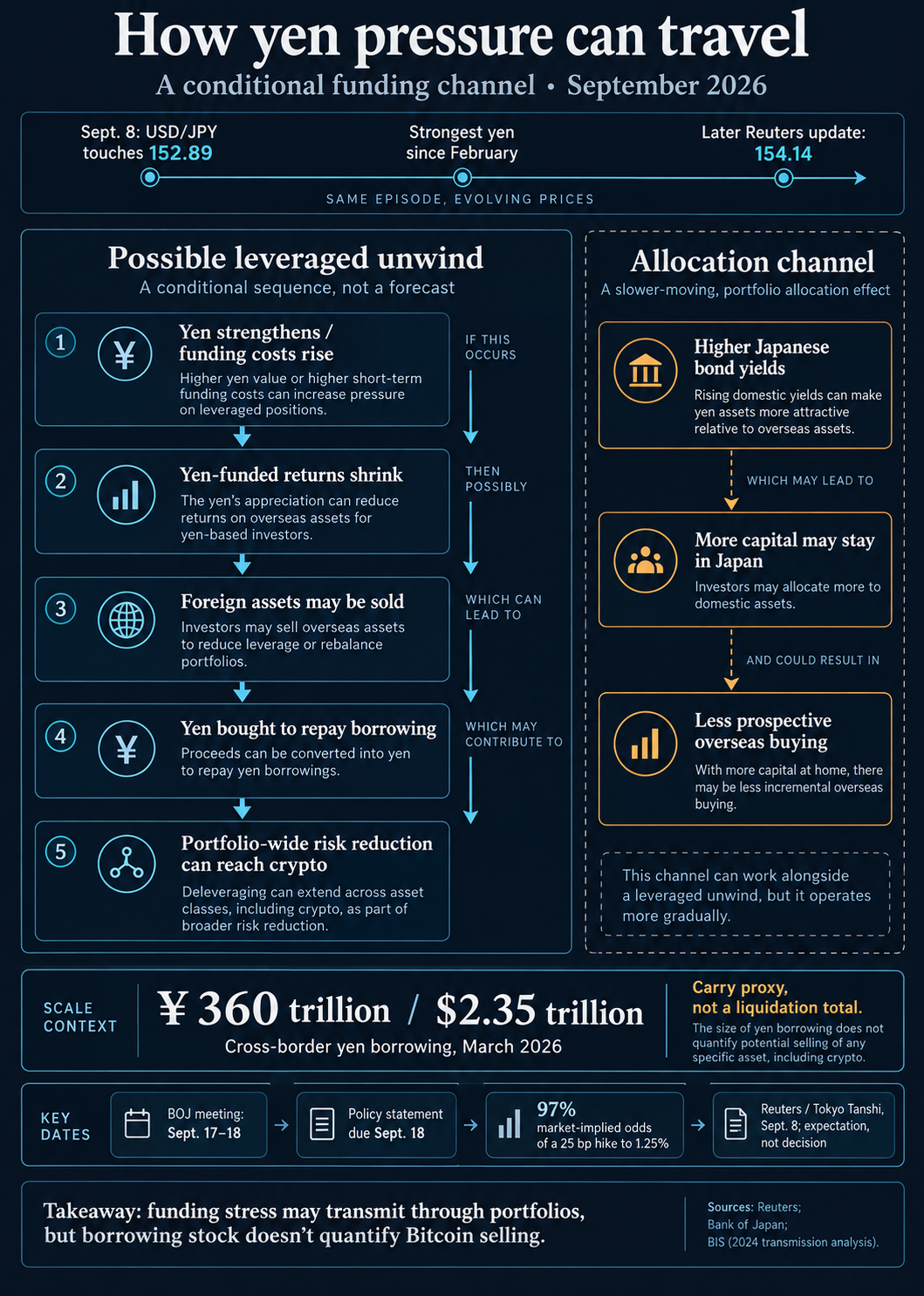
Bitcoin held near $78,500 on Sept. 8 as the Japanese yen touched its strongest level since February, leaving BTC inside its recent trading range while investors cut bets against Japan’s currency.
The yen reached 152.89 per dollar during Asian trading before retreating to 154.14, easing part of the currency pressure ahead of the Bank of Japan’s Sept. 17-18 meeting. A stronger yen can squeeze investors who borrowed it to buy foreign assets, potentially prompting sales across their portfolios.
The question is whether Bitcoin’s buyers can keep absorbing supply if Japanese funding becomes more expensive and investors reduce risk across their portfolios.
ETF inflows and a lower acquisition cost for recent holders offer some support. Futures-led rallies, elevated exchange inventory and large paper profits leave that support open to a harder test.
What the yen move can transmit
Cross-border yen borrowing reached ¥360 trillion ($2.35 trillion) in March, according to a Jefferies analysis of BIS data.
A carry trade borrows in a low-cost currency to buy assets offering higher returns, and a stronger yen raises the cost of repaying yen liabilities when measured against foreign assets. Higher Japanese interest rates can also narrow the strategy's return.
The risk extends beyond investors who explicitly borrowed yen to buy crypto: losses or margin demands in one part of a portfolio can prompt sales elsewhere. The BIS analysis of the August 2024 turmoil describes how deleveraging and margin pressure spread across markets, including crypto.
September’s outcome would depend on remaining leverage, margin demands and which assets investors choose to sell.
Higher domestic bond yields can give Japanese investors more reason to keep future capital at home. Reports described early hints of repatriation alongside reductions in short-yen positions by leveraged funds and real-money investors.
Reduced overseas buying and liquidation of existing trades can both affect foreign markets, but they are different processes.
For Bitcoin, renewed yen appreciation would become more consequential if it coincided with broader risk reduction and weaker buying.
Bitcoin’s price near $78,500 on Sept. 8 remained within the recent $77,200-$82,100 range described in Bitfinex’s Sept. 7 analysis. Bitcoin was consolidating through the initial currency pressure.
Farside Investors recorded $730.8 million of net inflows into US spot Bitcoin ETFs on Sept. 3 and another $174.6 million on Sept. 4. Those completed sessions show demand through a major investment channel, with the pace of subsequent buying still to be established.
Bitfinex also pointed to expanding stablecoin supply and viewed the market as consolidating with an upside bias, while warning that higher yields constrained follow-through.
In its Sept. 2 report, Glassnode placed the short-term-holder cost basis near $71,000. With Bitcoin trading above that average acquisition price, the cohort still had a cushion before moving underwater.
ETF inflows show actual demand, while the lower cost basis gives recent holders a larger price cushion before their average position falls into a loss.
Together, they provide a plausible explanation for the market’s ability to absorb pressure.
| Market signal | Recent reading in article | Bullish interpretation | Fragility risk |
|---|---|---|---|
| BTC spot range | $77,200–$82,100 | Price is consolidating instead of breaking down | Failure below range could trigger faster derisking |
| Spot BTC ETF flows | +$730.8M Sept. 3; +$174.6M Sept. 4 | Real demand is present through regulated products | Demand may be uneven if inflows slow after the spike |
| Stablecoin supply | Expanding in Bitfinex’s Sept. 7 view | Crypto liquidity base is still growing | Higher yields may cap follow-through |
| Short-term-holder cost basis | About $71,000 | Recent holders have a cushion before average losses | Break below cost basis could change holder behavior |
| Futures open interest | $25.2B to $27.5B on Sept. 3 | Momentum capital returned quickly | Leverage can unwind faster than spot buyers absorb supply |
The marginal rally still relies heavily on futures
CryptoQuant contributor Carmelo Alemán reported aggregate open interest rising from $25.2 billion to $27.5 billion during the Sept. 3 session. He said derivatives were the main initial driver, while acknowledging later spot and on-chain participation.
Dollar-denominated open interest measures outstanding positioning, and its dollar value reflects the total value of outstanding contracts. Traders’ vulnerability to forced closure also depends on their collateral and leverage.
Still, a derivatives-led move can be vulnerable if prices reverse and participants reduce leverage before spot buyers absorb the resulting supply.
CryptoQuant contributor CW8900 described negative spot-demand readings alongside continued buying by large investors. XWIN Japan’s Sept. 8 note similarly reported negative apparent demand despite ETF accumulation.
Those indicators suggest that identifiable buying has not translated into uniformly strong demand across the market.
At the same time, CryptoQuant’s CQ Research reported spot trading volume roughly three to four times its early-August lows during the recovery, with increased whale activity on exchanges.
That turnover captures both sides of trading and confirms increased spot participation, while leaving the balance of buying and selling unresolved.
If ETF buying slows while derivatives positions contract, other buyers would have to absorb more supply to keep the range intact. Stronger yen pressure could expose that imbalance if it prompted investors to reduce risk.
CryptoQuant contributor IT Tech reported short-term-holder whale unrealized profits of over $9 billion on Sept. 4, a record in that metric’s history going back to 2016. The figure fell to $7.5 billion on Sept. 5, showing how quickly a paper cushion can shrink as valuations change
CryptoQuant contributor XWIN Japan’s Sept. 8 note placed Binance reserves around 685,000-687,000 BTC. The contributor’s Aug. 30 report had identified approximately 687,000 BTC as a 2026 high at that time.
Custody movements, wallet changes, market making, and derivatives collateral can also affect reserves, leaving holders’ selling intentions uncertain.
Two on-chain measures can help distinguish potential pressure from changes in holder behavior.
The latest Glassnode short-term-holder SOPR reading available on Sept. 8 was approximately 1.003. Under Glassnode’s definition, the measure compares the value of spent outputs younger than 155 days with their value when acquired.
Persistent readings below 1 would indicate that those spent young coins were, in aggregate, moving at a loss. That could reveal stress among active recent holders even while the broader cohort remained above its average acquisition cost.
Glassnode’s Sept. 2 report puts the cost basis at about $71,000, answering where the average short-term holder acquired Bitcoin. A decline below the updated measure would put that cohort average underwater.
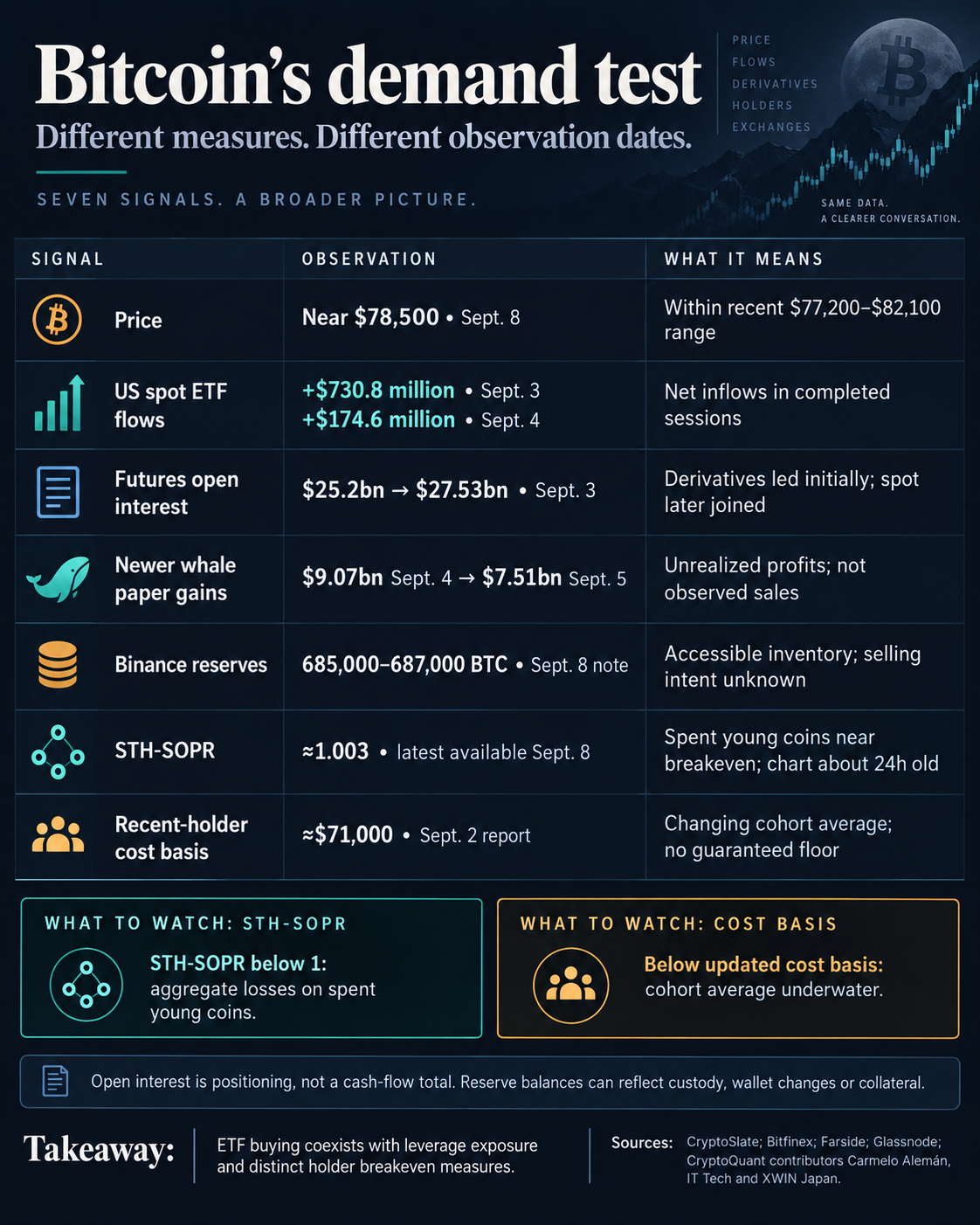
The spending measure and the holding-cost measure can deteriorate at different times. Watching both avoids treating every dip below an arbitrary price as evidence of capitulation.
The BOJ test is about expectations
The Bank of Japan’s calendar schedules its meeting for Sept. 17-18, with the policy statement due Sept. 18. A Sept. 8 Tokyo Tanshi report priced a 97% probability of a 25-basis-point increase to 1.25%.
With a hike so heavily priced, guidance on subsequent tightening could matter as much as the immediate rate change.
A hike accompanied by a slow outlook could disappoint yen bulls, while guidance pointing to faster tightening could reinforce the currency’s strength and increase pressure on carry positions.
A surprise hold could reverse part of the yen rally, although any benefit to Bitcoin would depend on the broader market response.
| Scenario | BOJ outcome / guidance | Yen reaction risk | Bitcoin impact | Confirmation signal |
|---|---|---|---|---|
| Base case | 25 bp hike to 1.25%, cautious guidance | Yen rally pauses or consolidates | BTC remains range-bound if ETF demand continues | BTC holds $77,200–$82,100 range |
| Bull case | Hike is priced in, guidance sounds gradual | Yen strength fades | BTC benefits if leverage unwinds orderly and inflows persist | Positive ETF flows plus stable/declining open interest |
| Bear case | Hike plus hawkish forward guidance | Yen strengthens further | Carry pressure tests BTC demand and recent-holder conviction | Falling ETF flows, contracting OI, STH SOPR below 1 |
| Black swan | Policy surprise or disorderly carry unwind | Sharp yen spike and cross-asset deleveraging | BTC sells off as part of portfolio-wide risk reduction | Exchange inflows, forced liquidations, STH cost basis breach |
Bitcoin’s next test would become more concerning if renewed yen strength arrived alongside weaker ETF demand, contracting leveraged positions and causing sustained losses for coins held by recent buyers.
Conversely, continued buying and orderly positioning adjustments would strengthen the case that the market can absorb more expensive Japanese funding. The decisive evidence will come from buyers continuing to absorb supply and recent holders choosing whether to protect gains or realize losses.
Source: CryptoSlate