



FILTERED RESULTS
FILTERS
MCap $2.8T -0.1%24h Vol $676.6T 0%Fear & Greed 59/100Alts Index 45/100
BTC.D 59.1% 0%Stable.D 9.5% 0%ETH.D 10.9% 0%Others.D 20.5% 0%
APEPE$0.00000151+20.23%•BTW$1.386+14.29%•STRK$0.0557+13.19%•PYTH$0.0814+10.48%•Q$0.0231+8.18%•币安人生$0.5135+6.96%•TIA$0.4999+6.07%•AERO$0.8280+4%•IMX$0.1829+3.98%•AKE$0.0291+3.3%•
ORCA$2.346-19.13%•STONK$0.1551-17.16%•MINA$0.0765-16.98%•NEAR$4.503-15.58%•SAND$0.0665-14.62%•CRV$0.3380-13.04%•B$0.1474-12.26%•CVX$2.024-11.61%•LDO$0.4070-11.37%•ZRO$1.964-10.74%•
•
·
·
FILTERED RESULTS
BTC involved in address reuse rose from 3.79 million to 4.33 million over the past year, now 21.5% of circulating supply
Bitcoin Life Insurance Company Secures $37.5 Million in Funding
Trump Declares 'Superintelligence' as Official Terminology, Labels AI Detractors as Enemies
Arthur Hayes: Bull markets must overcome many fears at the start, and the "money-printing wave" will drive asset prices to surge
133,813,000 $USDC (133,830,261 USD) transferred from Unknown Whale 1 to #Aave...
Jump Crypto Stakes $49.81 Million Worth of SOL
Nasdaq CEO Advocates for Tokenization to Unlock Trapped Capital
Securitize Launches Tokenized Apple, Nvidia and Tesla…
Satoshi’s Abandoned Poker Experiment Returns With a Bitcoin Twist
Bitcoin Core’s privacy fix reaches v32 code while the v31 patch remains open
133,813,470 $USDC (133,830,263 USD) transferred from #Aave to Unknown Whale 1...
262,459 $HYPE (22,128,779 USD) transferred from #HyperCore to #Kinetiq...
US Senator Investigates Cantor-Tether Relationship, Demands Explanation of Sanctions Compliance Measures
Securitize Brings Apple, Nvidia and Tesla Stocks Onchain on Solana
Aptos Foundation commits to permanently lock and stake 210 million APT
82 Million Samsung Galaxy Devices Could Soon Get Native Solana Stablecoin Transfers
Bitcoin crashes through $81,000 buy wall as $1 billion crypto liquidation bloodbath unfolds
Citrini Research Highlights Agentic Finance as a Transformative Force in Crypto Investing
Securitize CEO carlosdomingo JOINS CNBC TO DISCUSS BRINGING STOCKS TO SOLANA IN THE U.S....
IMF Report Details Why Tokenized Finance Is Struggling to Scale
Bitdeer Plans 67MW Capacity Delivery by Q2 2027
Ethereum Researcher Tells BTC and ETH Holders to Prepare…
NFL Joins 39 States, Global Regulators in Pushing Supreme Court on Kalshi Case
Bitcoin Address Reuse Exposes 4.33 Million BTC Public Keys
Polkadot Introduces USDT-Backed Stablecoin dotUSD
Abstract to Cease ETH Withdrawals After December 15
AI Startup Manus Raises $500 Million After China Nixed Meta’s $2 Billion Acquisition
Kyrgyzstan to Retire Gold-Backed USDKG Following UK Sanctions
Starknet Considers Transition to Layer 1 for Enhanced Quantum Security by 2027
Securitize stock jumps 10% after launching tokenized US equities on Solana....
Top Democrat among Senate investigators probes ties between Cantor Fitzgerald, Tether
2,099 $BTC (171,467,450 USD) transferred from unknown wallet to unknown wallet...
Senator Blumenthal Investigates Tether's Links to Sanctioned Entities and Cantor Fitzgerald
RobinhoodCrypto IS EXPLORING A STOCK TOKEN TIED TO AN ACTIVELY MANAGED ETF ON ROBINHOOD CHAIN...
Anthropic launches cybersecurity program, offering free vulnerability scanning for open-source projects
Google Wants Gemini to Be Your Next Coworker—Complete With Its Own Email Address
Bitcoin Surges Above $81,000 Following Trump's No-Strike Assurance on Iran
Luxembourg VC Nextblock’s $3M Bet Targets a Missing Piece of Crypto Finance
1,040.19 #BTC ($84,990,497) aggregated inflows to #Binance ...
Hunter Biden Blames Market Maker for LAPTOP Meme Coin Collapse
818 $BTC (66,908,590 USD) transferred from Coinbase Institutional to unknown wallet...
Less Cat Ears and Spandex as Crypto Bros in Suits Take Over
SAP Pay adds USDC payments, with Circle Mint access required
Three Fired OpenAI Safety Researchers Publish Open Letter, Say They Were Dismissed for Putting Safety First
629 $BTC (51,466,123 USD) transferred from Coinbase Institutional to unknown wallet...
CoreWeave Sees Institutional Ownership Surge to 75.8% with Total Stake Approaching $40 Billion
815 $BTC (66,596,005 USD) transferred from Coinbase Institutional to unknown new...
Coinbase Users in Michigan Will Lose Sports Markets This Weekend
Polkadot Launches Native dotUSD Stablecoin Through OpenGov
STRK Price Rises 19% as Starknet Targets Quantum-Resistant L1 by 2027
Ethereum Test Network Raises Block Limit to Over 3x Its Current Capacity
818 $BTC (66,819,620 USD) transferred from Coinbase Institutional to unknown new...
Top Trending Coins (Today) 1. SIMD 2. TRUMP 3. TIA 4. PENGU 5. NEAR 6. PYTH 7. DRV 8. QTC 9. ZEC...
818 $BTC (66,655,020 USD) transferred from Coinbase Institutional to unknown new...
CFTC Issues Advance Notice of Proposed Rulemaking on Regulation Crypto Asset Transactions and Regulation Crypto Asset Markets
Client Alert: “Power” to the New York City People?: A UDAAP Legislation with Teeth
NFL Urges Supreme Court to Review Kalshi Sports Contracts
Zcash (ZEC) Price Falls 13% as Open Interest Drops and ETF Outflows Rise
Why XRP’s 63 billion circulating tokens don’t tell buyers what’s for sale
760 $BTC (62,001,176 USD) transferred from unknown wallet to Coinbase Institutional...
TD Cowen: Raises year-end Bitcoin forecast to about $109,000
CNBC Host Expects Bitcoin to Take Off in October; Here’s Why
BNB Chain Dominates Tokenized Equities Market with 41% Share
Wall Street's tokenization boom could have bigger winners than bitcoin and ether, Citrini says
🏴 The NFL Audibles on Prediction Markets
818 $BTC (66,654,826 USD) transferred from Coinbase Institutional to unknown new...
33M Americans Are Eyeing Crypto, but the Next Wave Looks Different: Survey
Bitcoin Falls 3.3%, Ethereum Drops 5.7% as Crypto Selloff Deepens
2,080 $BTC (169,521,849 USD) transferred from unknown wallet to Coinbase...
PumpFun is making millions from a market where 81% of memecoins crashed 90%


Pump.fun, a leading Solana token launchpad, keeps generating millions of dollars from memecoin trading even as most established tokens struggle to recover from steep losses.
The platform produced about $18.6 million in protocol revenue over the seven days through Oct. 7, according to DefiLlama data. Separately, a Talos study found that 81% of a selected group of memecoins had fallen at least 90% from their all-time highs, and recoveries from deep collapses were rare.
The contrast exposes a central fault line in the memecoin economy: trading across Pump.fun can enrich the platform, support PUMP buybacks, or reward selected users without necessarily helping someone holding a token whose demand has already disappeared.
Talos examined 150 memecoins for its survival analysis and 151 for return comparisons, requiring each asset to have pricing available on at least one centralized exchange. That threshold already selects for relatively successful tokens, meaning the results may understate the failure rate across the much larger universe of launchpad coins that never secure such listings.
Even among that stronger cohort, losses were severe.
The median token peaked about 17 days after exchange trading began. Talos defined collapse as a 95% decline from the eventual peak and estimated a median of about 370 days between the high and that threshold.
Only a small fraction of collapsed tokens later revisited their previous highs, while just five of the 151 coins in its return sample remained above their first-day price. In Talos’ analysis of major Solana memecoins, active addresses with balances of at least $1 had also fallen to no more than 7% of their respective peaks.
The pattern suggests attention frequently moves on rather than returning to repair older positions. Talos found roughly two-thirds of the Solana-era memecoins it examined never staged a meaningful second rally after their initial run.
For a trader, that creates a very different economic exposure from the one Pump.fun itself carries.
Memecoin churn keeps Pump earning
Pump’s revenue depends on transactions occurring somewhere across its ecosystem and does not require an older token to recover.
A trader who sells one fading coin and moves into another generates another fee-producing transaction. New launches, rotations between tokens and speculative bursts can therefore support platform income even while earlier buyers remain heavily underwater.
DefiLlama showed traders paying about $52.5 million in fees over the seven days through Oct. 7, with roughly $18.64 million accruing to the protocol. Over 30 days, fees totaled about $184.5 million, and protocol revenue reached about $60.7 million.
Who ultimately benefits from that activity depends on where the money flows.
Pump’s fee structure distributes portions of trading income among the protocol, creators and liquidity-related recipients. Its native PUMP token also has a route through buybacks and burns, giving the asset exposure to activity across the broader platform.
DefiLlama recorded about $8.45 million of PUMP burns over seven days and $27.29 million over 30 days. Pump has committed part of designated revenue to buy and burn PUMP for a year starting in April.
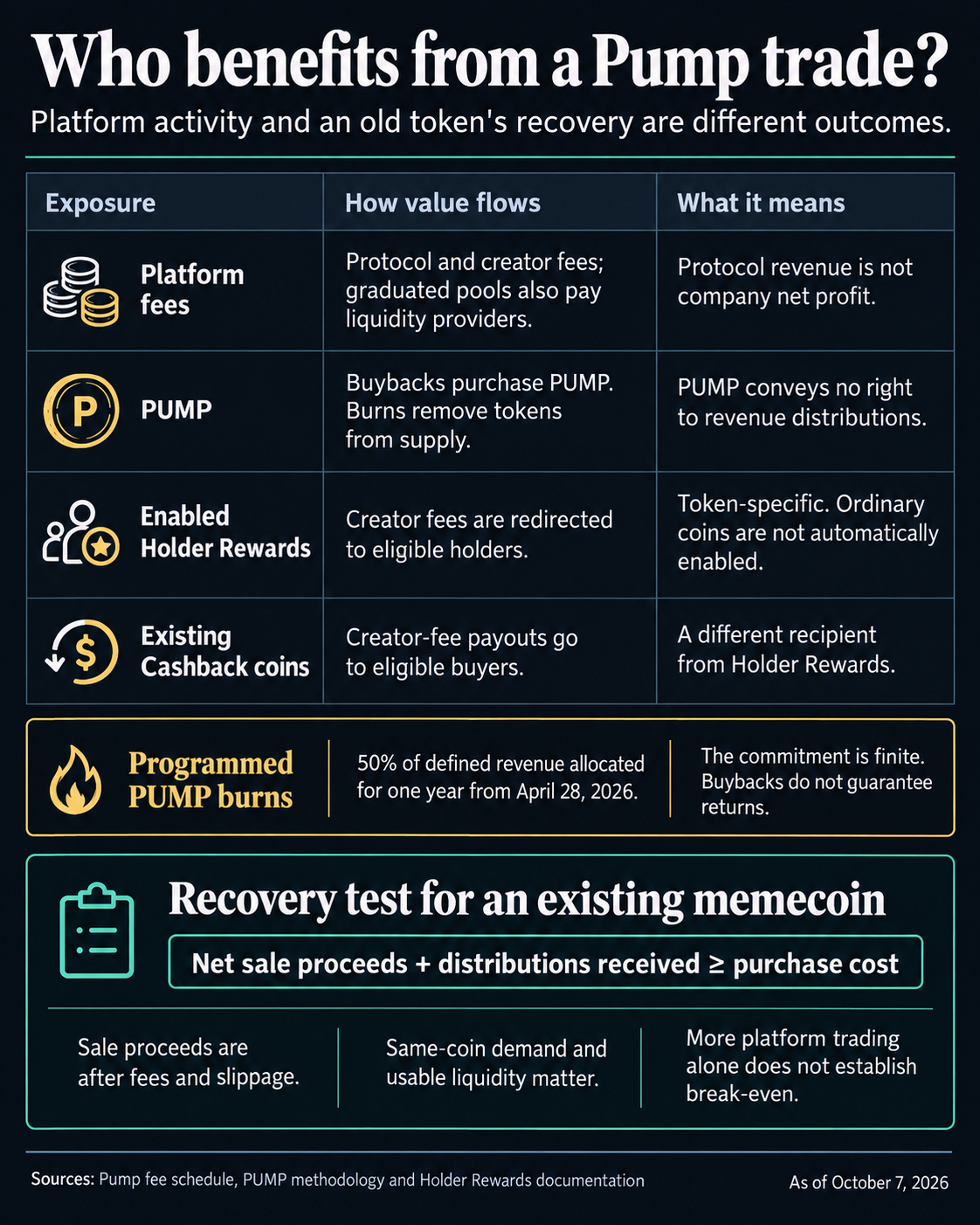
However, that mechanism does little directly for somebody holding a separate memecoin.
For those investors, recovery still depends on demand returning to the asset they own, enough liquidity to sell it, and distributions large enough to offset losses in the token itself.
Still, Pump.fun says it is widening the share of platform economics reaching users.
Alon Cohen, the memecoin launchpad co-founder, said more than 140,000 users collectively received about $4.46 million over a recent 24-hour period, including $730,000 in Holder Rewards, $330,000 in Callout Rewards and $3.4 million in creator fees.
“In time, Pumpfun will vastly outperform the social media industry in user payouts & rewards,” he said.
The payouts support Pump’s argument that the platform is increasingly distributing trading economics rather than retaining them entirely at the protocol level. But the three categories reward different participants.
Creator fees benefit people behind tokens. Callout Rewards compensate eligible promoters or contributors. Holder Rewards apply to participating coins and do not automatically reach every person holding a Pump-launched asset.
That distinction matters most when token losses are measured against the rewards.
A holder can receive distributions and still lose money if the underlying coin's value falls faster. Likewise, a creator can generate substantial trading fees even as buyers who entered near the peak suffer deep drawdowns.
PUMP holders face another equation. Buybacks create demand and burns reduce supply, but the token carries its own market risk and does not grant a contractual claim on Pump.fun revenue. Scheduled unlocks can also add supply even as burns remove tokens from circulation.
The economics therefore separate as speculation moves through the platform. Pump can earn from aggregate trading, PUMP can capture part of that activity through buybacks, and selected creators or holders can receive fee distributions. None guarantees recovery for the investor waiting for buyers to return to an older memecoin.
That gap will become more important as Pump expands its rewards programs.
If distributions grow enough to materially compensate holders for declining token values, they could alter the economics of staying invested after the initial speculative rush fades. If trading continues migrating toward new launches faster than rewards accumulate in older ones, Pump may keep converting churn into revenue while many of the traders supplying that activity remain unable to exit their original positions at break-even.
Source: CryptoSlate