



FILTERED RESULTS
FILTERS
MCap $2.8T +0.7%24h Vol $94.1B +80%Fear & Greed 57/100Alts Index 47/100
BTC.D 59.5% -0.3%Stable.D 9.4% 0%ETH.D 10.9% -0.1%Others.D 20.2% +0.4%
Q$0.0390+23.62%•BAT$0.1793+18.6%•S$0.0673+17.15%•ZK$0.0165+10.26%•STX$0.4149+8.67%•SAFE$0.1349+7.59%•BTW$1.896+6.75%•OP$0.1433+6.19%•WAL$0.0386+6.02%•XTZ$0.3401+5.63%•
W$0.0181-24.57%•RSR$0.00205497-16.61%•ZRO$2.023-14.24%•币安人生$0.5311-10.9%•GRASS$0.7044-10.68%•QNT$206.72-9.21%•NEAR$5.082-8.69%•ORCA$2.024-7.93%•DRV$0.4200-7.5%•USELESS$0.1701-7.34%•
•
·
·
FILTERED RESULTS
Apple Stock Price Today: 22nd All-Time High Of 2026 Pushes Market Cap Near $5 Trillion
AI Powered PlayStation Crack Could Let You Play GTA 6 on PC at Launch
French Companies Deploy NVIDIA Agentic Computing From Satellites to Retail
Crypto payments firm MoonPay has appointed Anne Giviskos as chief financial officer for
Anthropic Warns AI Worms Could Hijack Smart Home Devices Within Months
Goldman Sachs CEO denies departure rumors, says no leadership transition plan or timeline currently
A UK Court Has Issued a Ruling in the Case Involving the Confiscated 61,000 BTC
StarkWare Introduces Shadow Accounts on Starknet
Celo Core Co. Launches buy Marketplace for Autonomous Agent Payments
Binance Pulls the Plug on Bitcoin Mining After 6-Year Run
Peach Introduces Native USDC Bridging for Arc Users
SEC Commissioner Defends Quorum Rule Changes Amid Staffing Challenges
NEW: Blockchain .com confirmed Tuesday that it has filed for CFTC licenses to offer crypto
XRP News Today: Monthly RSI Hits Lowest Level In 13-Year History
Anthropic Reports 90–99% Reduction in Distillation Attacks on Claude Models
Wintermute Reports Weekly Declines for BTC and ETH Amid Spot ETF Outflows
Trezor Overhauls Reseller Network After Hidden Ledger Wallet Implants Surface
U.S. Federal Trade Commission Initiates Review of Online Sports Betting Industry
Strive $ASST acquired 3,311 bitcoin:native for approximately $280 million last week,
Interactive Brokers Introduces Ethereum Staking for US Clients
Wells Fargo CEO Highlights Uncertainty in US Stablecoin Use Cases
Interactive Brokers launches cryptocurrency staking services for its...
JPMorgan Leads Bank Earnings Blitz After Fed’s Rate…
Binance Announces AI Personal Assistant and Multi-Asset Trading Expansion
Interactive Brokers Launches Ethereum Staking For Clients, Provided By ZeroHash: Press Release...
Trader loses $637,000 in PaperTrade, partially recovers losses through staking rewards
NVIDIA Announces Software Ecosystem Updates Ahead of RTX Spark Laptop Launch
A UK High Court judge has ruled that Chinese law governs fraud victims' claims over
Trader 0x26b6 lost $637K on @papertrade_xyz.He lost $1.71M from trading and earned 136M $PAPER...
Sui Devnet Adds Post-Quantum Signature Support, Targets Mainnet Rollout in Q1 2027Mysten Labs...
Microsoft to Scale Azure Maia to Multi-Gigawatt Deployments Starting 2027
CME Group and CF Benchmarks Introduce New Crypto Indices
22,624 $ETH (56,639,421 USD) transferred from Coinbase Institutional to unknown new...
BlackRock downgrades its outlook on US stocks over AI volatility...
Wells Fargo Posts Q3 Numbers as Kraken Question Looms
Aptos Deploys Encrypted Mempool to Shield Users From Bots
Weekly Blockchain Blog - October 2026 #2
STRC Nearly Hits $100 After Bitcoin Giant Strategy Breaks Buyback Promise
Bitcoin Price Analysis: More Danger Ahead as BTC Remains Below Broken Trendline?
XRP’s 100 Billion Supply Cap Is Safe After RippleX Fixes a Critical XRPL Flaw
Trezor Reduces Reseller Network Following Supply-Chain Issues
NEW: Bitcoin bitcoin:native miner Bitdeer $BTDR has secured another 60 MW of AI data center
CME Group CEO says CFTC's regulation of prediction markets is "a bit of a stretch," expects the issue to ultimately be decided by the Supreme Court
Scientists Called for the Creation of an International Body to Oversee Advanced AI
SBI and KB Kookmin Card Plot Crypto Payments for Tourists
NVIDIA and Princeton Unveil ReplaySSM to Accelerate Hybrid-Model Inference
MediaMarktSaturn Removes Ledger Products Across Stores and…
NVIDIA and Princeton Introduce ReplaySSM to Accelerate Hybrid AI Model Decoding
Bitcoin Developer Critiques Lightning Network's Custodial Dominance
Lynq and The Better Money Company Successfully Test Asset Conversion to RLUSD
Fomo Reports 59% Decline in Weekly Revenue Amidst Crypto Market Slowdown
NEW: Bank of England Deputy Governor Sarah Breeden saysre's no rush to launch "Britcoin,"
Analysis: Bitcoin's short-term trend shows strong "hunting" characteristics, key support at $75,500
SpaceX Lock-Up Schedule Puts the Largest Unlock on an…
S&P Dow Jones Indices, Kaiko Enable First On-Chain OTC Swap Tied to Tokenized Benchmark
Coinbase Co-Founder Fred Ehrsam Invests in Venezuelan Oil Industry
UK Could Sell $5 Billion in Seized Bitcoin After Court Ruling
Binance shuts down Bitcoin mining, pivots to renewable energy and offers sustainable passive income
Trezor Tightens Channel Management After Supply Chain Incident, Says No Evidence Devices Were Compromised
GitHub Publishes Guide on Customizing Copilot for Repository-Specific Workflows
XRP’s $1 Lifeline Could Unlock $10 and $20 Targets as XRPL Patches Decade-Old Flaw That Risked Billions in Fake XRP
Apple's total market cap hits $5.06 trillion, setting a new all-time high
“Paper” Trading: How to Prepare for Cryptocurrency Trading in 2026
Is Bitcoin kidding itself about the Lightning Network?
MoonPay Appoints Anne Giviskos as Chief Financial Officer
Binance will discontinue its mining pool and related services on Nov. 10, ending support
German Ledger reseller pauses sales following $86M draining incident
Goldman Sachs, Citadel and Google Alumni Launch RWA…
Oct 13 Update:#Bitcoin ETFs:1D NetFlow: -788 $BTC(-$65.55M)7D NetFlow: -8,267...
Sky’s $4.4 billion liquidity disclosure shows why USDS cash-outs need a separate bank route


Sky.money reported more than $4.4 billion of stablecoin liquidity in its Peg Stability Module in an Oct. 9 explanation of the conversion mechanism. The PSM gives holders a direct route between USDS, Sky Protocol’s dollar-linked token, and USDC at a one-for-one rate.
Those measures answer different questions. Token circulation describes the stock of holdings. Conversion inventory describes what a holder can receive on a particular exit route. Fresh external dollar demand concerns money entering from outside the token system. Borrowing against collateral and upgrading an existing token can change individual token counts without establishing a matching inflow of bank dollars. A swap through existing inventory moves liquidity between holders or token forms; it does not by itself establish new issuance.
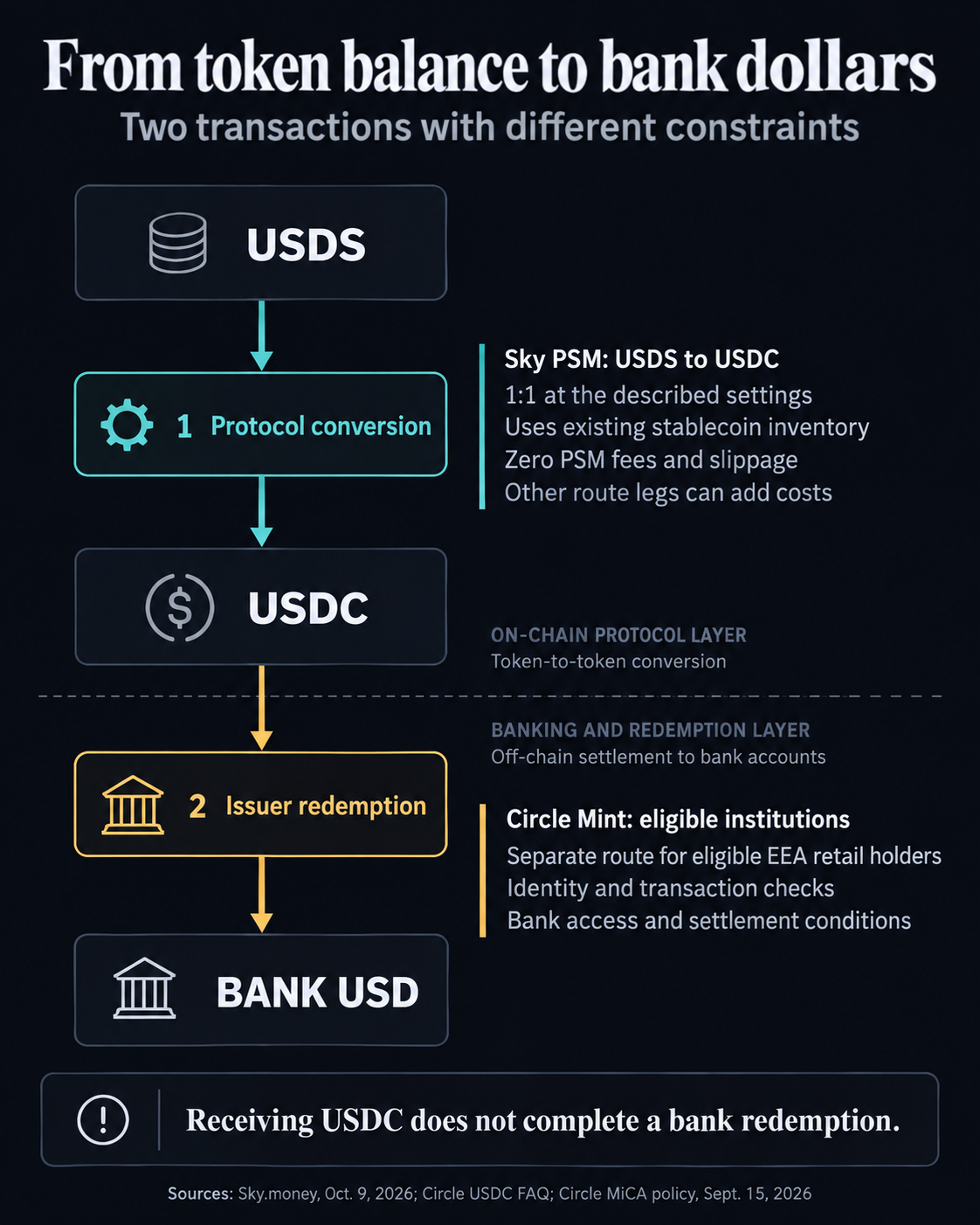
Sky describes direct USDS–USDC conversion in both directions through liquidity already held inside the protocol. The mechanism supplies the conversion itself, so it does not need to find another trader willing to take the opposite position.
At the settings described in the October explanation, the direct PSM leg has no protocol swap fee or slippage. A routed trade can still incur costs elsewhere: if it passes through another token pool before reaching USDC or USDS, that leg follows the pool’s own pricing, liquidity and fees.
The $4.4 billion figure describes aggregate stablecoin liquidity disclosed on Oct. 9. A USDS exit depends on the USDC inventory available on that route at the time of the transaction.
Sky also reported about $1.6 billion in cumulative USDC–USDS volume processed through Uniswap routing by Oct. 6, following its July 8 integration. Cumulative turnover can include movement in both directions and repeated conversions; it does not measure net USDS issuance or new dollars deposited into crypto.
Borrowing and migration change what a supply increase means
A separate Ethereum converter connects DAI and USDS. Sky’s developer documentation says the two tokens share an issuance source and that holders can convert between them in either direction without liquidity restrictions. That statement applies to the DAI–USDS converter, rather than to the availability of USDC in the PSM.
The accounting implication is straightforward: a holder can change an existing position’s denomination. An increase in USDS considered alone therefore need not represent additional money entering the wider system. Understanding the economic change requires following the DAI side of the conversion as well.
USDD is a separate collateral-backed stablecoin whose borrowing and migration routes add two more ways a token count can change. Its vault documentation describes depositing collateral, minting USDD debt and repaying the tokens plus stability fees to release collateral. Users can also withdraw collateral while maintaining sufficient coverage. This creates spendable liquidity for someone who wants to retain a collateral position, alongside an obligation to repay.
The borrower’s new ability to transact is economically useful. It can be created against assets already held, however, so each newly issued token does not require a corresponding new bank-dollar deposit. The pledged assets support the debt; their valuation is a different measure from the stablecoin inventory available to satisfy an immediate conversion request.
USDD also offers a migration route from USDDOLD into an equivalent amount of new USDD, with gas costs and no deadline. Here, a higher count in the new token can reflect an upgrade of an existing holding. Comparing old and new contracts separately can obscure whether the underlying economic position has increased.
A supply comparison needs consistent observation times and stated token coverage, including how it treats legacy tokens and holdings that back other tokens.
| Route | What the holder provides | What the transaction establishes |
|---|---|---|
| Circle Mint issuance | Bank USD through an eligible account | A direct fiat-funded issuance route |
| USDC–USDS PSM conversion | An existing stablecoin | A conversion through protocol liquidity |
| DAI–USDS conversion | An existing DAI or USDS holding | A change between linked token denominations |
| USDD vault issuance | Collateral supporting a debt position | Borrowing-created spending liquidity |
| USDDOLD migration | An existing legacy-token holding | An equivalent holding in the new token |
USDD’s PSM instructions make the immediate constraint explicit. The mechanism offers one-for-one conversion between USDD and supported stablecoins, with no service fee but network gas costs. Users must check the displayed quantity of the target token and keep their swap within that available amount.
A holder seeking USDT needs the inventory that can deliver USDT. An aggregate collateral valuation cannot substitute for that balance, just as a debt position’s backing cannot automatically be treated as an uncommitted pool of redemption cash.
Receiving USDC is a separate step from receiving bank dollars
USDC issuer Circle describes a more direct fiat connection in its USDC issuance and redemption process. Eligible businesses deposit dollars into Circle accounts to obtain newly minted USDC. Returning USDC for dollars removes the redeemed tokens from circulation. Circle says the backing consists of highly liquid cash and cash equivalents, with most reserves invested in the Circle Reserve Fund, whose portfolio can contain short-dated Treasuries, overnight Treasury repurchase agreements and cash.
A purchase on an exchange can instead draw on USDC already held by the exchange. Circle says an exchange may mint additional tokens when it needs more inventory. A buyer’s demand for USDC therefore need not trigger a new issuance transaction each time.
Access also differs between a protocol conversion and bank redemption. Circle Mint is an institutional product that is unavailable to individuals and small businesses through that service. Eligible retail holders in the European Economic Area have a separate direct route with Circle France.
Circle’s MiCA redemption policy, last updated Sept. 15, requires eligibility, identity and transaction checks, along with an EEA bank account that can accept USD for a USDC redemption. For eligible EEA retail holders, the policy gives a five-business-day timeframe unless discrepancies arise. It also permits deferrals during a stress event that prevents reserve rebalancing between Circle France and Circle LLC.
For a USDS holder seeking bank dollars, obtaining USDC through the PSM completes the token-conversion leg. The issuer and banking route still has to complete the cash leg. A stablecoin conversion balance and a bank payment are separate stages of access to dollars.
Source: CryptoSlate