



FILTERED RESULTS
FILTERS
MCap $2.9T +0.3%24h Vol $90.4B -42%Fear & Greed 71/100Alts Index 59/100
BTC.D 58.5% +0.2%Stable.D 9.2% 0%ETH.D 11.4% 0%Others.D 20.9% -0.2%
SOON$0.4608+32.5%•NIGHT$0.0362+21.82%•TRAC$0.4397+15.85%•QNT$295.14+15.03%•PUMP$0.00573841+13.27%•ZRO$1.759+12.94%•BONK$0.000004+11.31%•KSM$5.132+10.52%•CAP$0.0631+10.43%•NEAR$5.205+9.67%•
LIT$3.913-11.34%•HBAR$0.1064-9.31%•AI$0.1982-9.26%•BR$0.8281-8.92%•MINA$0.1430-8.04%•ZAMA$0.0736-7.51%•BTW$1.302-6.08%•Q$0.0235-5.94%•LINK$14.412-5.86%•XDC$0.0344-5.83%•
•
·
·
FILTERED RESULTS
Apple to release smart home hub on October 13, with HomePod mini and new Apple TV updated simultaneously
HTX to List CT (Concrete) on September 30 at 20:00
Anthropic’s IPO doubles the price of its own books
Bitget Suffers Major Breach, Funds Laundered Through Zcash
120,000,000 $USDC (120,015,119 USD) transferred from #Aave to Unknown Whale 1...
XRP Price Prediction Q4 2026: Can XRP Reach $2.20?
Brazil's CSD BR Mirrors BTG Pactual Fund Share Records onto XRP Ledger
Metaplanet executive equity incentives questioned, independent director issues statement in response
Zcash Developers Merge Udon Into Zakura Common in Broader Scaling Efforts
Suspected North Korean Hackers Move Stolen Funds from Bitget to Zcash
OpenAI seeks $30 billion funding at $1.4 trillion valuation, IPO pushed back to after 2027
CoinW Has Launched a Promotion for New Users With Bonuses of up to 200 USDT
zachxbt SAYS "THE ALLEGED DPRK ATTACKERS HAVE JUST BEGUN SHIELDING ~2.7K ZEC ($3.8M) TOTAL...
OpenAI, Google and Meta pledge outside AI audits under voluntary White House deal
Gate.io Sees 92 Liquidations in BENUSDT Market Following Dividend Adjustment
Sky Ecosystem's USDS Supply Surpasses $10 Billion Following $237 Million Increase
Bitcoin Walks Into a Data Gauntlet With Yields At 2007 Highs
US Senator Blumenthal Calls Tether's USDT a 'Superhighway' for Iranian Sanctions Evasion
Standard Chartered Initiates Ethena Coverage, Sets $2 ENA Price Target for End-2028
Gate BEN Market Reports 92 Liquidations Following Dividend Adjustment
Metaplanet directors push back against shareholder fury over a controversial executive payout plan
Coinbase Launches Auction for Concrete Token Trading
Live updates: Bitcoin below $84,000 ahead of PCE inflation data, Micron earnings
Stable Integrates Visa Direct for Enhanced Payout Options
HSBC Unveils 'RedCoin' Stablecoin for Hong Kong Market
Binance Pay is now accepted at 10M+ PayPay merchants across Japan,...
Coinbase's CT-USD trading pair enters auction mode, no matching for at least 10 minutes
The ECB Is Looking for Partners to Test the Digital Euro With AI Agents
Bitget said it recorded $231 million in deposits over past 24 hours, compared with
Crypto hardware wallets compared for 2026
Bitcoin ETFs stretch $3.1B inflow streak as Ether funds turn red
Trader 0x4287 opened a 5x long on 1.38M $ASTER($1.05M) on @Aster_DEX and is currently sitting on an...
Trader goes 5x long on 1.38 million ASTER, with unrealized profit exceeding $137,000
Aztec Has Relaunched the Private Wallet zk.money
SlowMist traces Bitget hack activity to Aug. 31 zero-day exploit
Pendle Finance Launches Fixed-Yield Market for USDG Stablecoin on Robinhood Chain
Canadian ‘Crypto King’ Aiden Pleterski to Represent Himself in Fraud Trial
BetFury Offers Futures With an x1000 Multiplier and Slippage-Free Crypto Trading
Standard Chartered Begins Coverage of Ethena with $2 Price Target
Anthropic tokenized pre-IPO volume hits $643M, but liquidity test looms
Binance Pay is now accepted at PayPay merchants across Japan, letting users spend crypto...
UK Financial Conduct Authority has opened its authorization gateway for crypto
Binance Account Blocked? Here’s What to do and How to Regain Access
Kimi K3 joins OpenAI Codex enterprise channel, marking first entry of a Chinese large model into OpenAI's enterprise billing system
Uphold Adds Crypto Inheritance, But Its “Industry-First”…
Illinois Publishes Draft Rules for 0.2% Digital Asset Tax
Standard Chartered initiated coverage of Ethena, forecasting
Bank of England Financial Policy Committee: Government bonds face new threat if AI growth fails to boost as expected
Abracadabra ethereum:0x090185f2135308bad17527004364ebcc2d37e5f6 governance is
OpenAI Seeks at Least $30 Billion at $1.4 Trillion Valuation as Bridge to Delayed IPO
Bitcoin Price at $83,000 Turns a Silk Road-Era Whale’s $70 Into $1.7M
Illinois publishes draft rules for 0.2% digital asset transaction tax, clarifying scope for stablecoins and DeFi
Tokenized Market Hit $331.8 Billion: Growth Moved Beyond Stablecoins — Pantera Capital
U.S. spot Bitcoin bitcoin:native ETFs recorded $66.2 million in net inflows on Tuesday,
SBI, Mesh, Money Forward to Form Japan Digital Asset Joint Venture
Elliptic: North Korea-linked crypto thefts exceed $1.2 billion this year
Meta avoided billions in federal taxes by classifying its data centers as experimental facilities
492,721 $QNT (139,624,813 USD) transferred from unknown wallet to unknown wallet...
UK FCA opens authorization applications for crypto firms, new regulatory regime to take effect in October 2027
Coinbase Receives CFTC Approval to Operate a Derivatives Clearing Organization
Blockchain.com Targets $6 Billion IPO, Less Than Half Its 2022 Value
Evernorth’s Shareholders Vote Today on Bringing 473…
Tom Lee says investors may not own enough crypto as BitMine builds a $16.2B Ethereum stakeRead...
SEC Chair Paul Atkins Vows Onchain Rules Despite Failed CLAIRTY Act
Bitcoin $215K Scenario Emerges as BTC Reclaims Key Market Levels
Major Ripple (XRP) Partnership Targeting Brazil’s $22 Trillion Financial Market Infrastructure
Bitget Protection Fund replenished to $300 million, balance now 3,705 BTC
OpenAI seeks $30 in funding at whopping $1.4 trillion valuation after delaying IPO
Trader Point Farm Capital has cashed out $91,600 in STONK, still holds $9.97 million in tokens
Solana beats Bitcoin on one key metric, but a single software bug could still take down the network


ARK Invest and Glassnode have put a new number on blockchain capture risk: the smallest group of block-production entities needed to cross a protocol-relevant control threshold.
Their joint scorecard, published Sept. 1, put the threshold at three entities for Bitcoin and Ethereum and 19 for Solana. The same framework placed Bitcoin first in its composite decentralization ranking. The apparent tension reflects different forms of network exposure. The coalition needed to disrupt consensus is one risk measure; ownership, infrastructure, software, auditability and exit speed describe other routes to pressure a network.
Institutions considering a blockchain as settlement infrastructure must define the failure they need to survive before selecting a metric.
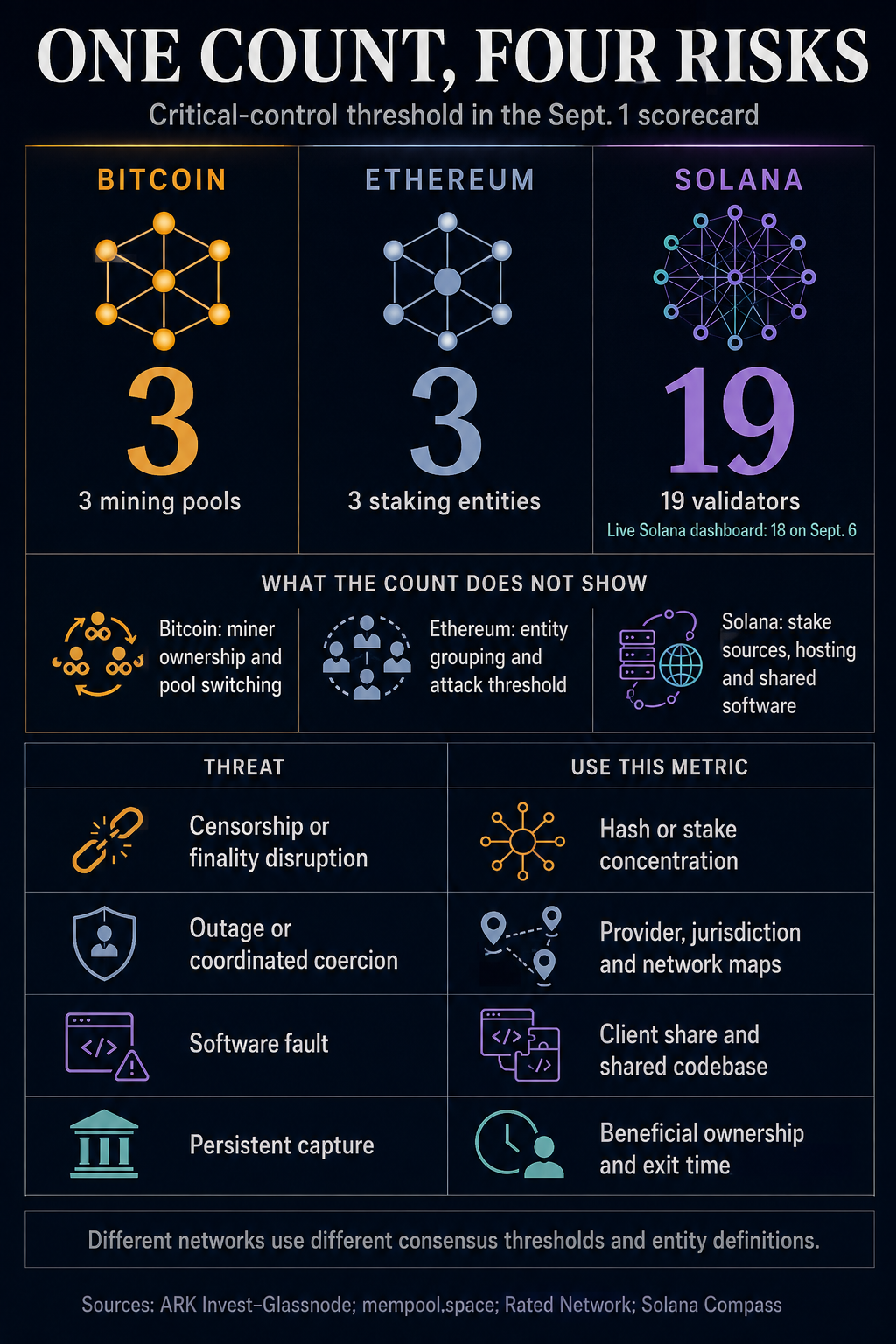
What the 3/3/19 result measures
The report calls the measure a critical resilience threshold. It asks how many of the largest entities must coordinate to pass a concentration point governing block production or voting power.
The inputs change by network. Bitcoin weights hash rate attributed to mining pools. Ethereum and Solana weight stake, while their dashboards may classify a liquid-staking protocol, exchange, distributed validator network, underlying operator or individual validator as the relevant entity. Protocol rules then determine what a given percentage can accomplish.
| Network | Reported count | Coordination unit | Risk captured | Outside the measure |
|---|---|---|---|---|
| Bitcoin | 3 | Mining-pool labels by hash rate | Concentrated block-template coordination at the report's threshold | Hardware ownership, pool switching and node distribution |
| Ethereum | 3 | Staking entities under the report's taxonomy | Stake concentration at the selected threshold | Underlying operators, attack level, clients, hosting and exit queues |
| Solana | 19 | Validators by delegated stake | A coalition crossing the measured one-third voting-power threshold | Common owners, delegation sources, software and data centers |
A seven-day Bitcoin mining snapshot on Sept. 6 attributed 26.88% of blocks to Foundry USA, 16.91% to AntPool and 15.25% to F2Pool. The three pools coordinated block templates for 59.04% of observed production, consistent with the report's three-pool result.
Pool share remains distinct from miner ownership. Individual miners supply work to a coordinator and can redirect that hash rate. The report estimates that a miner could leave a 1% Bitcoin position in roughly 30 seconds by switching off hardware. This mobility makes pool concentration important for short-term censorship and template selection while leaving ultimate control of the machines more dispersed.
Ethereum highlights the classification problem from the other direction. Rated Network, an Ethereum validator analytics provider, listed Lido at 21.17%, SSV at 16.56% and Binance at 7.77% in its Sept. 6 pool view. The same table described Lido as 544 entities. One label can therefore represent a protocol, hundreds of operators or both, depending on the grouping.
Ethereum's own threat model adds another distinction. Official protocol documentation says at least 33% of stake can delay finality. More than 50% can censor transactions and control short-range fork choice. At least 66% can finalize a preferred chain and alter finalized history. Each attack maps to a different threshold.
Solana's coefficient also changes with stake distribution. Solana Compass, an independent network dashboard, showed a Nakamoto coefficient of 18 on Sept. 6. ARK and Glassnode reported 19, while the Solana Foundation's June 2025 health report, using April 2025 data, recorded 20.
Solana Compass defines the coefficient as the fewest validators whose combined stake reaches 33.4% of voting power. The Foundation links that coalition to censoring blocks or stopping consensus. A value of 18 means that this specific disruption requires coordination across more top validators than a count of three would suggest. Shared ownership, stake sources, hosting, jurisdiction and software create separate exposures.
The dependencies that reshape capture risk
Infrastructure can give nominally separate entities a correlated failure mode. A data-center operator, cloud platform, government or network carrier can affect many nodes or validators together, even when the consensus coefficient looks widely distributed.
Bitcoin's node footprint illustrates how measurements can shift with the crawler. The joint report cited 63% of Bitcoin nodes operating behind Tor. A Clark Moody network dashboard showed 12,959 Tor nodes among 26,837 reachable nodes on Sept. 6, or 48.3%. Different node populations and collection methods can produce materially different shares. In either case, Tor usage speaks to node visibility and geographic resilience, while mining pools remain the direct block-production measure.
Ethereum hosting data varies for the same reason. The report cited roughly 20% of nodes on AWS. Rated Network's host view showed AWS at 14.4% of measured validator hosts. Ethernodes, an execution-layer node crawler, tracks another slice of the network and separates Amazon infrastructure across several ISP labels. A single AWS percentage loses meaning unless the node population and provider taxonomy travel with it.
Solana exposes the performance side of the tradeoff. High-throughput validators generally operate in commercial data centers. The Solana Foundation's dated 2025 report counted more than 100 providers, with TeraSwitch and Latitude hosting 45.70% of stake between them. Solana Compass's current broader view counted 437 data centers. The large facility count coexists with a sizable stake concentration among the leading providers.
Client software creates a second common dependency. Ethereum's client-diversity guidance explains that independent implementations reduce the blast radius of a shared bug. Rated showed Geth at 50.17% of measured execution clients. On Solana, the Foundation reported about 92% of stake using Agave/Jito and about 7% using Firedancer or the hybrid Frankendancer in April 2025. These figures measure exposure to a shared codebase, a failure mode separate from deliberate collusion.
Exit speed determines how long concentrated influence can persist. Bitcoin miners can redirect work without waiting for a protocol queue. Ethereum validators follow a rate-limited exit process. ARK and Glassnode's estimate of weeks applies to stressed conditions. On Sept. 6, beaconcha.in's live queue showed an empty validator exit queue and a withdrawal estimate near one day. Ethereum's withdrawal documentation explains that the delay moves with demand.
During coercion, the separation becomes practical. Hash power can leave a pool quickly when miners defect. Stake can remain tied to a validator during a congested exit queue, even when a liquid-staking token trades freely. Market liquidity and protocol exit provide different escape routes.
How institutions should read the scorecard
An institutional decentralization review can pair each threat with the corresponding measure:
- Transaction censorship or finality disruption calls for stake or hash-rate concentration at the relevant protocol threshold, with transparent entity grouping.
- Coordinated legal pressure and infrastructure outages call for validator and node maps by provider, jurisdiction and network operator.
- Software faults call for client-share and shared-codebase analysis.
- Persistent capture calls for beneficial ownership, delegation sources and the time required to withdraw or redirect resources.
- Independent verification and recovery call for the cost of running a verifier and reconstructing network state.
The joint report's composite ranking favors Bitcoin because the framework combines auditability, ownership dispersion, geographic resilience, exit fluidity and other dimensions. Solana's 19-entity result, now 18 on one live dashboard, describes one form of coordination risk.
The figure describes the largest-validator coalition needed to cross Solana's measured voting threshold. An institutional decision also requires the rest of the map, including who supplies the stake, where the machines run, which software they share, how quickly participants can leave and how independently users can verify the ledger.
Source: CryptoSlate