



FILTERED RESULTS
FILTERS
MCap $2.9T +0.3%24h Vol $90.4B -42%Fear & Greed 71/100Alts Index 59/100
BTC.D 58.5% +0.2%Stable.D 9.2% 0%ETH.D 11.4% 0%Others.D 20.9% -0.2%
SOON$0.4608+32.5%•NIGHT$0.0362+21.82%•TRAC$0.4397+15.85%•QNT$295.14+15.03%•PUMP$0.00573841+13.27%•ZRO$1.759+12.94%•BONK$0.000004+11.31%•KSM$5.132+10.52%•CAP$0.0631+10.43%•NEAR$5.205+9.67%•
LIT$3.913-11.34%•HBAR$0.1064-9.31%•AI$0.1982-9.26%•BR$0.8281-8.92%•MINA$0.1430-8.04%•ZAMA$0.0736-7.51%•BTW$1.302-6.08%•Q$0.0235-5.94%•LINK$14.412-5.86%•XDC$0.0344-5.83%•
•
·
·
FILTERED RESULTS
Apple to release smart home hub on October 13, with HomePod mini and new Apple TV updated simultaneously
HTX to List CT (Concrete) on September 30 at 20:00
Anthropic’s IPO doubles the price of its own books
Bitget Suffers Major Breach, Funds Laundered Through Zcash
120,000,000 $USDC (120,015,119 USD) transferred from #Aave to Unknown Whale 1...
XRP Price Prediction Q4 2026: Can XRP Reach $2.20?
Brazil's CSD BR Mirrors BTG Pactual Fund Share Records onto XRP Ledger
Metaplanet executive equity incentives questioned, independent director issues statement in response
Zcash Developers Merge Udon Into Zakura Common in Broader Scaling Efforts
Suspected North Korean Hackers Move Stolen Funds from Bitget to Zcash
OpenAI seeks $30 billion funding at $1.4 trillion valuation, IPO pushed back to after 2027
CoinW Has Launched a Promotion for New Users With Bonuses of up to 200 USDT
zachxbt SAYS "THE ALLEGED DPRK ATTACKERS HAVE JUST BEGUN SHIELDING ~2.7K ZEC ($3.8M) TOTAL...
OpenAI, Google and Meta pledge outside AI audits under voluntary White House deal
Gate.io Sees 92 Liquidations in BENUSDT Market Following Dividend Adjustment
Sky Ecosystem's USDS Supply Surpasses $10 Billion Following $237 Million Increase
Bitcoin Walks Into a Data Gauntlet With Yields At 2007 Highs
US Senator Blumenthal Calls Tether's USDT a 'Superhighway' for Iranian Sanctions Evasion
Standard Chartered Initiates Ethena Coverage, Sets $2 ENA Price Target for End-2028
Gate BEN Market Reports 92 Liquidations Following Dividend Adjustment
Metaplanet directors push back against shareholder fury over a controversial executive payout plan
Coinbase Launches Auction for Concrete Token Trading
Live updates: Bitcoin below $84,000 ahead of PCE inflation data, Micron earnings
Stable Integrates Visa Direct for Enhanced Payout Options
HSBC Unveils 'RedCoin' Stablecoin for Hong Kong Market
Binance Pay is now accepted at 10M+ PayPay merchants across Japan,...
Coinbase's CT-USD trading pair enters auction mode, no matching for at least 10 minutes
The ECB Is Looking for Partners to Test the Digital Euro With AI Agents
Bitget said it recorded $231 million in deposits over past 24 hours, compared with
Crypto hardware wallets compared for 2026
Bitcoin ETFs stretch $3.1B inflow streak as Ether funds turn red
Trader 0x4287 opened a 5x long on 1.38M $ASTER($1.05M) on @Aster_DEX and is currently sitting on an...
Trader goes 5x long on 1.38 million ASTER, with unrealized profit exceeding $137,000
Aztec Has Relaunched the Private Wallet zk.money
SlowMist traces Bitget hack activity to Aug. 31 zero-day exploit
Pendle Finance Launches Fixed-Yield Market for USDG Stablecoin on Robinhood Chain
Canadian ‘Crypto King’ Aiden Pleterski to Represent Himself in Fraud Trial
BetFury Offers Futures With an x1000 Multiplier and Slippage-Free Crypto Trading
Standard Chartered Begins Coverage of Ethena with $2 Price Target
Anthropic tokenized pre-IPO volume hits $643M, but liquidity test looms
Binance Pay is now accepted at PayPay merchants across Japan, letting users spend crypto...
UK Financial Conduct Authority has opened its authorization gateway for crypto
Binance Account Blocked? Here’s What to do and How to Regain Access
Kimi K3 joins OpenAI Codex enterprise channel, marking first entry of a Chinese large model into OpenAI's enterprise billing system
Uphold Adds Crypto Inheritance, But Its “Industry-First”…
Illinois Publishes Draft Rules for 0.2% Digital Asset Tax
Standard Chartered initiated coverage of Ethena, forecasting
Bank of England Financial Policy Committee: Government bonds face new threat if AI growth fails to boost as expected
Abracadabra ethereum:0x090185f2135308bad17527004364ebcc2d37e5f6 governance is
OpenAI Seeks at Least $30 Billion at $1.4 Trillion Valuation as Bridge to Delayed IPO
Bitcoin Price at $83,000 Turns a Silk Road-Era Whale’s $70 Into $1.7M
Illinois publishes draft rules for 0.2% digital asset transaction tax, clarifying scope for stablecoins and DeFi
Tokenized Market Hit $331.8 Billion: Growth Moved Beyond Stablecoins — Pantera Capital
U.S. spot Bitcoin bitcoin:native ETFs recorded $66.2 million in net inflows on Tuesday,
SBI, Mesh, Money Forward to Form Japan Digital Asset Joint Venture
Elliptic: North Korea-linked crypto thefts exceed $1.2 billion this year
Meta avoided billions in federal taxes by classifying its data centers as experimental facilities
492,721 $QNT (139,624,813 USD) transferred from unknown wallet to unknown wallet...
UK FCA opens authorization applications for crypto firms, new regulatory regime to take effect in October 2027
Coinbase Receives CFTC Approval to Operate a Derivatives Clearing Organization
Blockchain.com Targets $6 Billion IPO, Less Than Half Its 2022 Value
Evernorth’s Shareholders Vote Today on Bringing 473…
Tom Lee says investors may not own enough crypto as BitMine builds a $16.2B Ethereum stakeRead...
SEC Chair Paul Atkins Vows Onchain Rules Despite Failed CLAIRTY Act
Bitcoin $215K Scenario Emerges as BTC Reclaims Key Market Levels
Major Ripple (XRP) Partnership Targeting Brazil’s $22 Trillion Financial Market Infrastructure
Bitget Protection Fund replenished to $300 million, balance now 3,705 BTC
OpenAI seeks $30 in funding at whopping $1.4 trillion valuation after delaying IPO
Trader Point Farm Capital has cashed out $91,600 in STONK, still holds $9.97 million in tokens
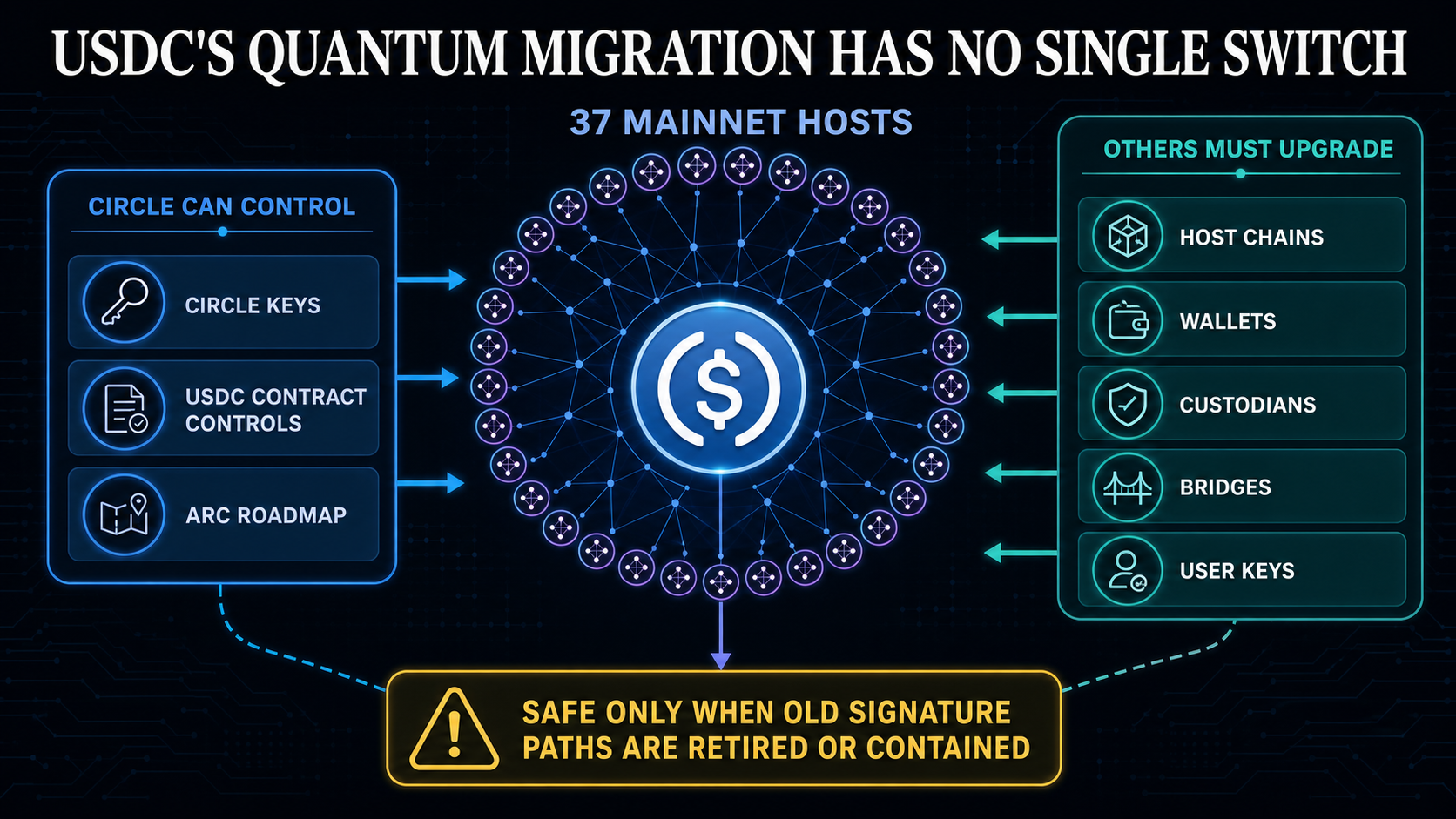
USDC may be only as quantum-safe as its slowest wallet, bridge or blockchain


Circle issued a warning that the quantum circuits needed to attack widely used blockchain signatures are becoming leaner, citing a low-width record of 813 logical qubits.
For the USDC quantum migration, the immediate consequence is a dependency problem across every host chain, wallet, custodian, bridge and user account that must eventually accept a safer way to authorize transactions.
Circle's current contract documentation contains 37 mainnet USDC rows. The company can protect infrastructure it controls and exercise token-contract powers on supported networks, but it cannot rotate a customer's private key, rewrite a custodian's signing stack or unilaterally change the signature rules of Ethereum, Solana, XRPL or any other host.
In its Aug. 31 disclosure, Circle told developers to inventory their cryptography, identify vendor dependencies and prepare key rotation. USDC was worth about $73.6 billion on Sept. 2, giving that coordination problem financial scale. A migration that secures Circle's own keys while leaving an old wallet, bridge or base-layer path exposed would not secure the whole footprint.
The 813-qubit figure is one coordinate, not a countdown
Circle describes 813 logical qubits as the August 2026 low-width record on ECDSA.fail. That is evidence that quantum circuit designs are becoming more resource-efficient, but the number is easy to misread.
The public challenge specification optimizes a reversible point-addition circuit for secp256k1, the curve used by Bitcoin and Ethereum. It scores submissions by multiplying peak logical-qubit width by average Toffoli-gate count. A design can reduce width by spending more gates, or reduce gates by using more width. The 813 figure therefore does not describe, by itself, a complete Shor attack, its circuit depth, its error-correction overhead or how long it would run on physical hardware.
A March 2026 paper makes the tradeoff explicit. The researchers estimated that a 256-bit elliptic-curve discrete-log attack could use fewer than 1,200 logical qubits and fewer than 90 million Toffoli gates, or fewer than 1,450 logical qubits and fewer than 70 million Toffoli gates. Their minutes-scale scenario also assumed a fast-clock superconducting architecture, physical error rates of 10^-3, planar connectivity and fewer than 500,000 physical qubits.
Those estimates are a stronger resource model than a width figure alone, but they still do not provide a delivery date for such a machine.
Circle's hardware comparison also needs correction. Its post says Google achieved 105 logical qubits with Willow. Google describes Willow as a 105-qubit processor, while the associated Nature paper describes 105 physical qubits used in a distance-7 surface-code logical-memory experiment involving 101 qubits. That is not the same as 105 attack-ready logical qubits.
The migration case does not need an invented deadline. NIST standardized SLH-DSA in FIPS 205 and says organizations should begin replacing quantum-vulnerable cryptography now. Its 2035 horizon concerns deprecation and removal from standards, not a prediction of Q-day.
The practical trigger is readiness. Networks need enough time to add verification rules, wallets and custodians need tested key-rotation paths, and users need a period in which classical and post-quantum authorization can coexist without splitting liquidity or trapping balances.
Arc is one controllable layer inside a 37-network system
Arc gives Circle a place to design post-quantum support more directly, but its present documentation separates several layers that Circle's disclosure compresses into the phrase “supports SLH-DSA.”
Arc's execution-layer documentation describes a precompile that can verify SLH-DSA-SHA2-128s signatures. A verification precompile lets contracts check that signature type. It does not automatically replace the signature that authorizes an ordinary network transaction.
Arc's custody guide still specifies standard secp256k1 ECDSA transaction signing. Its post-quantum roadmap places opt-in beta post-quantum wallet signatures at mainnet launch and post-quantum validator signatures later. Circle also says Arc has not chosen its final post-quantum transaction-signature scheme and expects hybrid ECDSA support during migration.
Arc can become a proving ground for a hybrid design. It cannot make USDC quantum-safe on Ethereum, Solana or 35 other mainnet rows simply by adopting that design.
USDC quantum migration spans 37 different network paths
Circle's public count is itself moving. Its USDC page says 35 networks as of June 29, 2026 while enumerating 37 names. The current contract-address table is the mainnet anchor used here and contains 37 rows. A separate Circle Mint table reaches 38 only when Arc testnet is included, so Arc testnet is not counted in the inventory below.
The table distinguishes verified signing classes from hosts that need their own cryptographic audit. “EVM path” means an Ethereum-style externally owned account normally uses secp256k1 ECDSA, with its public key recoverable after signing, while a smart-contract account may use contract-defined verification. “Chain-specific” avoids assigning an exact scheme where the cited primary chain documentation does not establish one. The status column records whether the cited material establishes a host-wide post-quantum switch; it does not rule out exploratory work elsewhere.
| Host network | Signing and exposed-key path | Protocol upgrader | Circle-controlled layer | Host-wide migration status |
|---|---|---|---|---|
| Algorand | Chain-specific | On-chain supermajority | Native asset controls vary | No host-wide plan established |
| Aptos | Chain-specific or multi-scheme | Host governance, wallets, custodians | Native asset controls vary | No host-wide plan established |
| Arbitrum | EVM path | Chain governance plus wallet stack | EVM token admin roles | No host-wide plan established |
| Avalanche C-Chain | EVM path | Chain governance plus wallet stack | EVM token admin roles | No host-wide plan established |
| Base | EVM path | Chain governance plus wallet stack | EVM token admin roles | No host-wide plan established |
| Celo | EVM path | Chain governance plus wallet stack | EVM token admin roles | No host-wide plan established |
| Codex | EVM path | Chain governance plus wallet stack | EVM token admin roles | No host-wide plan established |
| Cronos | EVM path | Chain governance plus wallet stack | EVM token admin roles | No host-wide plan established |
| EDGE | EVM path | Chain governance plus wallet stack | EVM token admin roles | No host-wide plan established |
| Ethereum | secp256k1 EOA or smart-account path | Ethereum protocol and wallet ecosystem | EVM token admin roles | Migration research, no completed host-wide switch |
| Hedera | Chain-specific or multi-scheme | Host governance, wallets, custodians | Native asset controls vary | No host-wide plan established |
| HyperEVM | EVM path | Chain governance plus wallet stack | EVM token admin roles | No host-wide plan established |
| Injective EVM | EVM path | Chain governance plus wallet stack | EVM token admin roles | No host-wide plan established |
| Ink | EVM path | Chain governance plus wallet stack | EVM token admin roles | No host-wide plan established |
| Linea | EVM path | Chain governance plus wallet stack | EVM token admin roles | No host-wide plan established |
| Monad | EVM path | Chain governance plus wallet stack | EVM token admin roles | No host-wide plan established |
| Morph | EVM path | Chain governance plus wallet stack | EVM token admin roles | No host-wide plan established |
| NEAR | Chain-specific or multi-scheme | Host governance, wallets, custodians | Native asset controls vary | No host-wide plan established |
| Noble | Chain-specific | Host governance, wallets, custodians | Native issuance module | No host-wide plan established |
| OP Mainnet | EVM path | Chain governance plus wallet stack | EVM token admin roles | No host-wide plan established |
| Pharos | EVM path | Chain governance plus wallet stack | EVM token admin roles | No host-wide plan established |
| Plasma | EVM path | Chain governance plus wallet stack | EVM token admin roles | No host-wide plan established |
| Plume | EVM path | Chain governance plus wallet stack | EVM token admin roles | No host-wide plan established |
| Polkadot Asset Hub | sr25519, Ed25519 or ECDSA accounts | Polkadot governance plus wallets | Asset Hub controls vary | No host-wide plan established |
| Polygon PoS | EVM path | Chain governance plus wallet stack | EVM token admin roles | No host-wide plan established |
| Sei | EVM contract path | Chain governance plus wallet stack | EVM token admin roles | No host-wide plan established |
| Solana | Ed25519 transaction signatures | Solana feature and validator process plus wallets | Token-program authority varies | No host-wide plan established |
| Sonic | EVM path | Chain governance plus wallet stack | EVM token admin roles | No host-wide plan established |
| Starknet | Chain-specific account-contract path | Host governance plus wallet contracts | Native asset controls vary | No host-wide plan established |
| Stellar | Chain-specific | Validator consensus plus wallets | Native asset controls vary | No host-wide plan established |
| Sui | Chain-specific or multi-scheme | Host governance, wallets, custodians | Native asset controls vary | No host-wide plan established |
| Unichain | EVM path | Chain governance plus wallet stack | EVM token admin roles | No host-wide plan established |
| World Chain | EVM path | Chain governance plus wallet stack | EVM token admin roles | No host-wide plan established |
| X Layer | EVM path | Chain governance plus wallet stack | EVM token admin roles | No host-wide plan established |
| XDC | EVM path | Chain governance plus wallet stack | EVM token admin roles | No host-wide plan established |
| XRP Ledger | Chain-specific or multi-scheme | Sustained trusted-validator amendment support | Issuer controls vary | No host-wide plan established |
| ZKsync Era | EVM path | Chain governance plus wallet stack | EVM token admin roles | No host-wide plan established |
The documented examples show why one deadline cannot describe the whole footprint. Solana transactions use Ed25519 signatures. Polkadot supports sr25519, Ed25519 and ECDSA accounts. Ethereum-style externally owned accounts and smart-contract wallets have different migration options even before comparing them with a non-EVM host.
Upgrade authority also differs. An XRPL amendment needs more than 80% trusted-validator support for two weeks. Algorand protocol changes require an on-chain supermajority. Stellar network upgrades depend on validator consensus. None of those decisions belongs to Circle.
Freeze and reissue powers do not rotate a user's key
Circle has important controls at the token layer. Its EVM FiatToken design includes roles that can mint, burn, pause, blacklist and upgrade the contract. Its USDC terms also reserve blocking and service-suspension powers in defined circumstances.
Those controls could help contain an identified incident on a supported contract. Circle might freeze an address where the implementation permits it, stop minting or transfers, and arrange redemption or reissuance under its legal and operational rules. But a freeze does not make a stolen private key safe. It also cannot change the host chain's signature verifier.
The responsible actor changes with the vulnerable key:
- Circle must rotate issuer and contract-administration credentials it controls.
- A user or custodian must move funds from an exposed account using a wallet and host chain that accept the destination signature.
- A bridge operator must protect its own signing and contract controls while coordinating liquidity across both sides.
- A base-layer community must approve and deploy protocol changes.
- Wallet makers, hardware vendors and exchanges must support both old and new signatures during a transition.
The weakest link is therefore not necessarily the chain with the slowest technical proposal. The custodian that cannot rotate thousands of accounts quickly, the bridge whose emergency controls still rely on an exposed key, or the user cohort that never moves before an old signature path is retired are all targets.
A workable rollout would need more than an activation height. Each operator would need an inventory of exposed and unexposed keys, a tested destination account type, hardware and software support for the new signature, and a recovery policy for balances that do not move. Hybrid acceptance would need a defined end state so that classical authorization does not remain an indefinite bypass. Circle could coordinate those milestones for its contracts and services, but each host ecosystem would still decide how and when its own classical path closes.
Migration urgency can be real without a Q-day date
Circle's disclosure is useful because it moves post-quantum preparation into present-tense operational planning. The 813 record shows that attack circuits can improve while hardware teams work on error correction. NIST's standards give implementers concrete alternatives to test.
The disclosure overreaches when it compares 813 logical attack qubits with Willow's 105 physical device qubits as if the two values occupied one scale. It also understates the practical gap between verifying an SLH-DSA signature inside Arc and authorizing, settling and recovering USDC across dozens of independent production networks.
Circle can make its slice of the system more adaptable. It cannot declare USDC quantum-safe across its footprint until host chains, wallets, custodians, bridges and users can all move, and until every remaining classical route is either retired or deliberately contained. That is a migration program with many veto points, not a cryptographic switch.
Source: CryptoSlate