



FILTERED RESULTS
FILTERS
•
·
·
FILTERED RESULTS
Two midcap software picks: DV and FIVN compared
Why is Goldcom stock sliding today?
BoJ raises rates to 31-year-high
$7 Trillion Options Expiry: What September Triple Witching Means for Markets in 2026
AstraZeneca (AZN) Stock Climbs Following CEO Share Purchase and European Drug Approval Nod
Bowman Expects Finalized Fed Stress Test Revisions in ‘Coming Weeks’
Trump to Unveil Nationwide Medicaid Drug Pricing Model
Securities and Exchange Commission Approves Tokenised Stock Trading
Federal Supervisors Should Have Identified SVB's Weaknesses Earlier, Says Bowman
U.S. Leading Indicators Ticked Down in August
Warren Buffett Shifts to Emeritus Role as Son Howard Becomes Berkshire Chair
Iran and China Create First-of-Their-Kind Autonomous A.I. Influence Campaigns
Amodei, Anthropic’s Leader, Exposed A.I.’s Dangers. It’s Time to Act.
Former Wells Fargo asset manager Allspring explores $4bn sale
LNG tanker hit by suspected cyberattack in Mediterranean Sea
Warren Buffett’s road to investing glory
Warren Buffett steps down as Berkshire chairman, son Howard succeeds
Hyrox Risks Alienating Its Core Customers
Gold Prices Fluctuate Amid Technical Analysis
U.S. Stock Markets Show Mixed Performance at Market Open
What If “Cognitive Surrender” Is the Real Existential Risk?
State Regulators Give Banks an AI Exam Playbook as Federal Gap Persists
Labour conference set to vote on new AI regulator as cabinet concerns grow
Nucor (NUE) Stock Tumbles 5% Following Weak Q3 Earnings Forecast
Qorvo (QRVO) Stock Soars to 52-Week Peak Following $182M Bank of America Investment
A new Federal Reserve inquiry into the 2023 collapse of Silicon Valley Bank found that bank-supervision staff in the Biden era could have anticipated and prevented the bank’s failure
S&P 500 Falls as Treasury Yields Resume Advance: Markets Wrap
Gold pares back gains as oil prices trim losses
Oil trims losses as investors assess outlook for Mideast crude supply flows
Why is Bullish stock rallying today?
Why is Circle Internet stock surging today?
US manufacturing output falls in August after rising for seven straight months
Mbappé Signs Up for On’s Push Into Football in Blow to Nike
UBS Slashes KOSPI Forecast to 8,000 Amid Rising Rates and Oil Surge
Steel Dynamics (STLD) Stock Drops 3.5% on Canadian Tariff Action and Disappointing Q3 Outlook
Swiss sports brand On signs Kylian Mbappé in blow to Nike
US Factory Output Declines in August Amidst Growth Expectations
U.S. Industrial Production Unchanged in August
Air France Expands ‘La Premiere’ Routes on Rising US Demand
U.S. Industrial Production Holds Steady in August
US Factory Output Unexpectedly Falls For First Time This Year
Why Scott Bessent should pay attention to Turkey’s market scandal
Saudis Give European Oil Buyers No Supplies for Next Month
S&P, Nasdaq open higher as traders digest eventful week marked by Fed rate hike
Triple witching event sees $7 trillion in US options expire
Fed’s Bowman says changes to bank stress test coming soon
Mbappé cambia Nike por On para convertir la marca suiza en líder en fútbol
OpenAI Faces Scrutiny Over Model Behavior, Microsoft Executive Warns
Revenue Reality Check: Chinese AI Firms Trail OpenAI and Anthropic by 90%
US Law Firm Weil Studies Merger Options After Rainmakers Depart
ECB Rates Aren’t Directly Tied to Energy Costs, Lagarde Says
S&P 500 Wavers as Treasury Yields Resume Advance: Markets Wrap
Business and unions clash over how to fix youth jobs shortage
Come on Latin America, you owe me one
FEDS Paper: Premiums or Peril
Options Triple Witching Sees $7 Trillion Expiring on Friday
CSN Asset Sales Gain Momentum as New CEO Fuels Bond Rally
Chinese Chipmaker CXMT Eyes NAND Market Entry as Stock Climbs 3.4%
EU's Kallas Engages with Saudi Foreign Minister on Yemen Conflict and Strait of Hormuz Security
US Factory Production Unexpectedly Shrinks as Costs Rise
European equities cap 3rd-weekly decline as Saudi supply cuts stings
Naive AI valuation hits $1.4 billion after $400 million raise - Information
U.S. Industrial Production Stagnates, Misses Forecast
UK air traffic outage caused by ‘legacy’ software bug, says review
US Industrial Production Remains Unchanged in August
France's President Macron Accuses Russia of Hybrid Attacks
ECB Officials Pave Way for More Tightening as Inflation Worsens
Texas Stock Exchange Lures $10 Billion Retailer in New Move
AI Experts Call for Independent Evaluators for Major Labs
UBS Slashes KOSPI Forecast to 8,000 Amid Rising Rates and Surging Oil Costs


Key Takeaways
- UBS reduced its KOSPI 12-month forecast to 8,000 from 8,800, representing a reduction of almost 10%
- Elevated interest rates, Korean won appreciation, and crude oil exceeding $100 per barrel are key headwinds
- Analyst consensus for earnings-per-share revisions shifted negative in September for the first time in 2025
- Despite the cut, UBS projects robust KOSPI earnings expansion of 256% in 2026 and 38% in 2027
- Samsung Electronics and SK Hynix advanced following gains in a major US chip sector indicator
UBS has reduced its 12-month forecast for South Korea’s benchmark KOSPI index to 8,000, down from its previous 8,800 projection. The revision, representing a decline of roughly 10%, acknowledges intensifying challenges from elevated borrowing costs, currency appreciation, and climbing crude oil valuations.
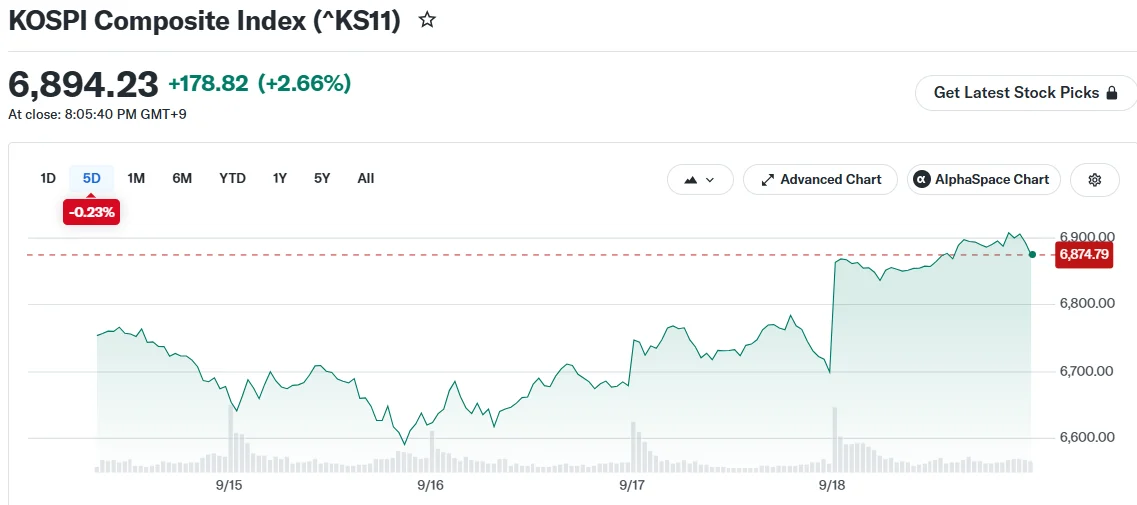
Strategist Yong-Suk Son detailed the revision in research released Friday. The analyst reduced the projected earnings multiple to 7x from 8x, pointing to escalating macroeconomic challenges despite continued strength in corporate profit growth.
A significant development is the shift in consensus earnings-per-share revisions, which declined 0.7% on a monthly basis in September after maintaining positive momentum throughout the earlier part of the year. The memory semiconductor sector upgrades that previously fueled index advancement have now experienced reversals.
Notwithstanding the reduced target, UBS maintains optimistic projections for KOSPI earnings-per-share expansion of 256% in 2026 and 38% in 2027. Son indicated the index may experience range-bound trading until third and fourth quarter reporting periods provide additional confirmation on whether these profit expectations remain achievable.
Monetary Tightening and Energy Costs Drive Yield Expansion
South Korea’s central bank has implemented two rate increases since July. The 10-year sovereign bond yield has surged to 4.5% from 3.4% at year-start. Crude oil is currently trading above the $100 per barrel threshold, compounding inflationary pressures.
Currency appreciation represents an additional headwind. UBS calculates that each 1% strengthening of the won results in approximately 1.1% erosion in KOSPI corporate earnings.
The investment bank established an optimistic KOSPI scenario of 9,200 and a pessimistic target of 5,100, creating a substantial range that underscores current market uncertainty.
Regarding sector positioning, UBS maintains its preference for memory semiconductor exposure. The firm identifies Samsung Electronics and SK Hynix as leading investment opportunities. Nevertheless, the bank is rotating toward value-oriented and quality stocks offering shareholder distributions, acknowledging decelerating market momentum and constrained liquidity conditions.
Regional Equity Markets and Semiconductor Stocks Advance
In parallel developments, Asian equity and fixed income markets registered modest gains Friday as petroleum prices retreated. Brent crude decreased 0.8% to approximately $104 per barrel, alleviating some inflation anxieties.
Samsung Electronics and SK Hynix both posted gains following a rally in a prominent US semiconductor benchmark. US markets delivered their strongest performance since August in the previous session, recovering from declines that followed the Federal Reserve’s initial rate increase since 2023.
The 10-year US Treasury yield declined nine basis points to 4.93% as energy prices moderated. The yield had reached 5.02% earlier in the week following the Fed’s policy action.
MSCI’s Asia-Pacific equity benchmark advanced 0.5%, although declining issues outnumbered advancing ones, indicating the rally lacked broad market participation.
Reduced energy costs may provide monetary authorities with additional flexibility to evaluate the effects of restrictive policy measures, potentially offering near-term support for both equity and bond markets.
Source: Parameter