



FILTERED RESULTS
FILTERS
MCap $2.9T -0.3%24h Vol $74.9B -17%Fear & Greed 70/100Alts Index 59/100
BTC.D 59.3% -0.1%Stable.D 9.1% 0%ETH.D 11.4% 0%Others.D 20.2% +0.1%
FLUID$2.123+22.12%•ADA$0.2754+12.37%•ORCA$2.001+9.56%•SKY$0.1001+8.73%•VIRTUAL$0.8609+8.42%•FET$0.2577+8.07%•LIT$3.879+7.47%•FLOKI$0.00002918+7.12%•KAIA$0.0400+6.71%•ENA$0.2529+6.67%•
BR$0.4000-12.73%•PROS$0.7528-8.73%•SOON$0.3382-8.49%•AKE$0.0316-8.47%•SAND$0.0718-7.82%•BEAM$0.00251379-6.63%•MON$0.0315-5.76%•AXS$1.303-4.92%•KITE$0.1430-4.34%•BP$1.212-4.31%•
•
·
·
FILTERED RESULTS
Binance Brings ‘Vibe Coding’ to Crypto Trading Strategies
250,000,000 $USDC (249,970,666 USD) minted at USDC Treasury...
Solana Financial Company DFDV Increases Holdings to Over 2.56 Million SOL
U.S. Treasury withdraws proposed crypto reporting rules targeting...
US stocks open, Dow falls 0.12%
Bitmine Nears ‘Alchemy of 5%’ With Latest 15,112 ETH Purchase, Leading its Treasury to 6.02 Million
TREASURY WITHDRAWS PROPOSED CRYPTO SURVEILLANCE RULES TARGETING UNHOSTED WALLETS AND CVC CRYPTO...
HIVE Digital Transforms Bitcoin Mining Sites into AI Infrastructure in Canada
Live Nation doubles CEO pay target despite monopoly ruling
[BITGET INS GALA] We are entering a new chapter…Where artificial intelligence, cloud computing, and
The Market Is Bracing for Volatility: A Trader Assessed Scenarios for Bitcoin and Ethereum Price Moves
Bank of America’s Crypto Patents Explained: What the…
25,000 $ETH (67,897,319 USD) transferred from #Revolut to unknown wallet...
XRP Price Jumps as Korea Volume Overtakes Bitcoin – Is $2 Next?
XRP News : Evernorth-Linked XRP Stock XRPN Surges 273% Ahead of Merger
Can SpaceX Price Rally Extends: Morgan Stanley’s Sees $300 Target
Could Polymarket reveal a crypto token at Token2049?
ZachXBT said he infiltrated a Chinese organized crime network that laundered over $1
Wintermute Launches Armitage Vault Curation Business on Morpho
China P2P stablecoin wallets grew 43x despite crypto restrictions: Chainalysis
BTC Market Pulse: Week 41
Strive Completes Its Third-Largest Bitcoin Purchase, Adding 2,000 BTC
3 in a Row: Strategy Ramps Up Bitcoin Purchases as Holdings Hit 848,000 BTC
Binance Introduces AI Product Stack Binance Intelligence
Tom Lee's Bitmine $BMNR bought 15,112 ethereum:native over past week, taking its
Robinhood's Stock-Token Volume Already Tests the SEC's New Caps
Bitcoin Price Grinds at $86K as Resistance Refuses to Give Way
*S&P 500 OPENS DOWN 1.3%, NASDAQ DECLINES 1.7% ...
Strategy's BTC holdings show $9.059 billion unrealized profit, while Bitmine's ETH holdings show $3.73 billion unrealized loss
OKX Files With SEC to Launch Tokenized Stock Trading
Strategy Posts $21B Q3 Gain, Buys $29M in BTC, Repurchases $176M in STRC
Strategy opts for bigger spending on STRC buybacks over BTC purchases
BitMine Buys Another 15,112 ETH, Holdings Rise to 6.02M ETH....
Binance launches AI product stack Binance Intelligence, including AI Pro and Agent OS
Strive $ASST acquired another 2,000 bitcoin:native for roughly $169 million at an
Metaplanet Announces Revised Capital Allocation Strategy Amid Shareholder Concerns
Bitmine Increases Ethereum Holdings to Over 6 Million ETH
Meme Coins Reach Record Low Share of Altcoin Market, Analyst Reports
Bitmine Acquires Additional Ethereum, Approaches 5% Network Ownership
BitMNR NOW OWNS 4.9% OF THE TOTAL $ETH SUPPLY - $ETH HOLDINGS SURPASS 6 MILLION...
COIN Stock: Bank of America Raises Coinbase Price Target to $203
Metaplanet Raises Bitcoin Holdings to 44,000 BTC After Q3 Purchase
Strategy’s Bitcoin Holdings Reach 848,000 BTC After $28.7M Purchase
BitMine Buys Another 15,112 ETH, Holdings Rise to 6.02M ETH BitMine said it acquired 15,112 ETH...
XRP Sentiment Turns Bearish: Analysts See a Potential Contrarian Setup As “Uptober” Starts
Cardano Price Today: ADA Jumps 11% to 3-Month High as Golden Cross Fuels Rally
*US JOBLESS CLAIMS 202K IN MARCH 28 WEEK; EST. 212K*US CONTINUING CLAIMS 1.841M IN MARCH 21 WEEK;
Safe Investor Calls on Swiss Watchdog Over Board Dispute
Bitcoin’s Most Important Indicator Just Flashed Green: Can BTC Hold Above $85,000?
Strive bought 2,000 $BTC for $169 million at an average price of...
Strategy bought 334.3 BTC, increasing its holdings to 848,000.3 BTC....
VanEck Forecasts $3 Million per Bitcoin by 2050 and Calls It a Hedge Against Dollar Devaluation
Google Gemini Cited in a $69K Crypto Scam Investigation
Metaplanet reveals net income strategy to fuel Bitcoin accumulation
Investigator Exposes Money Laundering Ties to North Korean Hackers
Strive bought another 2,000 $BTC ($168.84M) at $84,422 last week.Since Aug 24, #Strive has bought a...
An XRP treasury SPAC surges nearly 300% ahead of Evernorth merger
Bitcoin ETFs Bag $241 Million Inflow, Ethereum Funds Bleed $138 Million Amid Pressure
Plume Launches Fidelity-Backed nBND Vault but Live Directory Shows No Holdings
Strive said it acquired 2,000 BTC for approximately $169 million at an average price of $84,422 per...
Derive Dominates Onchain Options Market as Volume Reaches $5 Billion
Strategy $MSTR acquired 334 bitcoin:native for $28.7 million at an average price of
Strategy Reaches 848,000 BTC While Spending $176M on STRC Buybacks Strategy said it acquired 334 BTC...
Ethena (ENA) Price Prediction 2026, 2027 – 2030: Is a Multi-Year Expansion Toward $1 Possible?
Ethereum Glamsterdam vs Solana Alpenglow: October 2026 Protocol Comparison
Michael Saylor: Strategy repurchased about $176 million in STRC preferred stock last week
The US is Lending Vistra $4.2 Billion to Squeeze More Power…
Strategy’s Bitcoin Treasury Reaches 848,000 After 334 BTC Buy
Michael Saylor’s Strategy (MSTR) Extends Bitcoin Buying Streak With 334 BTC Addition
Circle can delay European USDC redemptions if reserves cannot cross borders


European USDC holders seeking dollars from Circle could have to wait if reserves cannot move between its French and U.S. issuers, even while retaining their claim to a dollar. Circle’s current European redemption policy allows temporary delays during failed reserve rebalancing, exposing a cash-access boundary inside a token that is interchangeable worldwide.
That boundary matters as Circle presses Europe to preserve cross-border co-issuance. Its Oct. 1 response to the European Commission’s MiCA review argues that the structure keeps global stablecoin liquidity within Europe’s regulatory perimeter. The existing terms show what can happen when the reserve transfers supporting that structure cannot be completed.
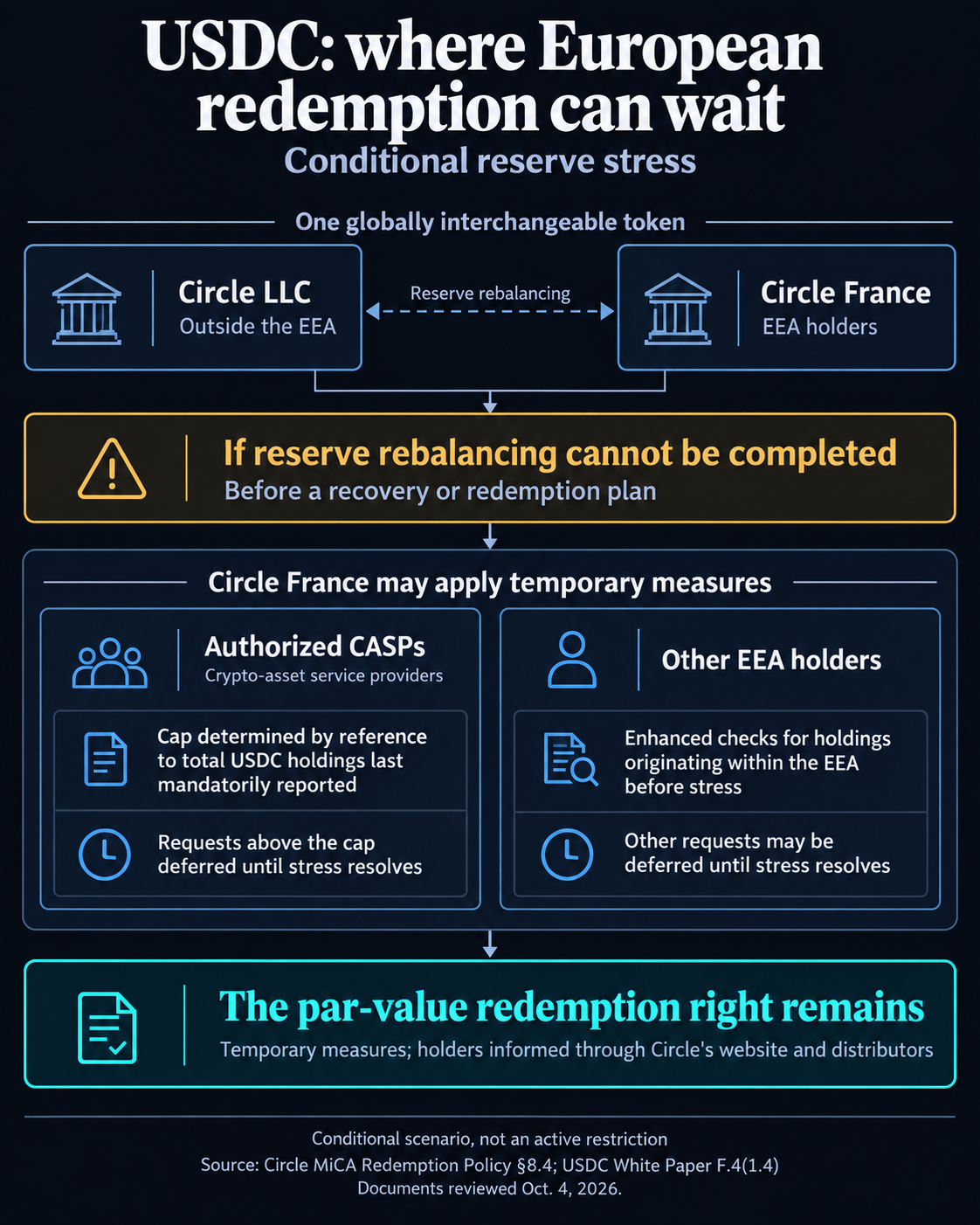
The controls distinguish authorized crypto service providers from other European Economic Area holders. Providers may face a redemption cap based on previously reported holdings; other holders may face checks establishing that their holdings originated within the EEA before the stress began.
These are contingency provisions. The public documents reviewed do not establish an active reserve-transfer failure or an imposed reserve-stress redemption restriction as of Oct. 4. They nevertheless qualify what European users can assume about access to issuer cash during stress.
Under Circle’s MiCA redemption policy, Circle France, formally Circle Internet Financial Europe SAS, handles redemption for USDC holders established in the EEA. Holders established outside the EEA exercise their redemption rights with Circle Internet Financial, LLC under its own agreement.
The policy says that allocation preserves the right to redemption at par under Article 49 of MiCA. For a holder, however, the amount of the claim and the timing of the payment are separate questions.
Circle’s current EEA Mint terms make the timing distinction explicit. A customer may submit a redemption request at any time, but execution remains subject to legal, regulatory, compliance, prudential, liquidity and operational conditions.
The redemption policy is marked Sept. 15, 2026, and the USDC white paper lists an amendment on that date.
Two ways redemption can be deferred
Section 8.4 of the redemption policy defines a Stress Event as a period when USDC reserves cannot be rebalanced between Circle France and Circle LLC, before a Recovery Plan or Redemption Plan is activated. During that period, Circle can adjust the processing and order of redemption requests, including deferring execution beyond ordinary policy timing.
The USDC white paper, in Section F.4(1.4), sets out the holder-specific measures:
- Authorized crypto-asset service providers: Circle France may impose a temporary maximum redemption limit referenced to the provider’s total USDC holdings as last reported under its mandatory reporting obligation. Requests above it would be deferred until the stress is resolved.
- Other EEA holders: Circle France may temporarily restrict redemption to holdings that enhanced checks clearly identify as originating from USDC holdings within the EEA before stress. Other requests could be deferred until resolution.
Circle describes the adjustments as temporary and non-discriminatory, preserving redemption at par. Its policy provides for informing holders through its website and distributing providers. If rebalancing is not restored, redemption is managed under the recovery or redemption arrangements.
The controls can therefore affect both an intermediary seeking issuer cash and an EEA holder seeking to redeem directly. Being able to receive USDC during stress would not, by itself, establish that a non-provider’s new holdings satisfy the pre-stress EEA condition.
A secondary-market sale could still provide an immediate exit while issuer redemption waits, if a buyer or intermediary is willing to pay. The conditional cash-flow implication is that another party must supply the cash before Circle settles. A buyer could purchase the tokens outright using its own liquidity; no loan would necessarily be involved.
An exchange promising to pay before Circle would depend on its own cash arrangements and available liquidity. The token’s continuing par-value claim does not automatically fund that payment. An intermediary choosing to advance cash would take on the timing gap until it could redeem or otherwise dispose of the tokens.
The reviewed documents identify no named intermediary commitment to provide unrestricted immediate cash-outs under this reserve-stress scenario, nor an available stress-market bid or financing cost. A sale would depend on a willing buyer and the terms offered.
Global backing disclosures answer a different question. Circle’s transparency page describes reserve disclosures and monthly third-party assurance of backing.
The white paper describes a French minimum reserve requirement equal to EEA USDC holdings and an inter-issuer rebalancing procedure. That requirement has to accommodate changes in where tokens are held. The paper expressly identifies the risk that Circle LLC cannot rebalance reserves when holdings and redemption requests shift toward the EEA.
The reserve-transfer test behind Circle’s policy case
Circle’s Oct. 1 response recommends preserving multi-issuance and formalizing safeguards, including dynamic rebalancing between global and EU-specific reserves. It argues that restricting the structure would push stablecoin use toward offshore providers and outside MiCA’s protections.
Europe’s systemic-risk watchdog has advanced a different position. In its 2025 recommendation on third-country multi-issuer stablecoins, the European Systemic Risk Board asked the Commission to interpret the existing MiCA framework as not permitting such schemes. If the Commission considered otherwise, it recommended a dedicated framework with safeguards.
Adopted Sept. 25, 2025, the recommendation also called for assessing barriers to reserve mobility and obtaining evidence that supporting institutions can promptly sell assets, transfer funds across borders and retain access to payment systems.
Circle’s terms show why those operational questions matter to holders. Rebalancing is a safeguard when cash can move to the issuer facing redemption requests. When it cannot, temporary restrictions can shift the wait onto service providers and other EEA holders, even while the par-value right continues.
The practical tests are therefore reserve-transfer readiness, the treatment of holders’ requests and any intermediary’s actual cash-out undertaking. Circle’s policy case depends on keeping global liquidity accessible in Europe; its current redemption terms acknowledge the conditions under which European access to that liquidity could slow.
Source: CryptoSlate