



FILTERED RESULTS
FILTERS
MCap $2.9T -0.2%24h Vol $87.7B -2.4%Fear & Greed 73/100Alts Index 57/100
BTC.D 58.9% +0.1%Stable.D 9.1% 0%ETH.D 11.3% 0%Others.D 20.7% -0.1%
FLUID$2.182+22.99%•ORCA$2.390+16.71%•CAP$0.0735+12.77%•NIGHT$0.0496+11.3%•LIT$4.022+9.54%•ZRO$2.101+9.38%•FIL$1.154+9.35%•NEAR$5.315+9.22%•KAIA$0.0412+8.87%•OKB$132.38+8.73%•
BR$0.4000-12.73%•STRK$0.0524-10.21%•SAND$0.0669-9.16%•PROS$0.7528-8.73%•SKY$0.0879-8.52%•AKE$0.0316-8.47%•MINA$0.1427-8.43%•MON$0.0305-7.91%•SOON$0.3386-5.11%•BONK$0.00000378-4.62%•
•
·
·
FILTERED RESULTS
US Regulators Push National Crypto Rules as America Chases Global Lead
CertiK Introduces AI Agents for Tracking Stolen Cryptocurrency
Solana Introduces Open-Source DvP Program for Institutional Trade Settlement
Solana Debuts Institutional Settlement Standard With J.P. Morgan Input
A newly created wallet, t1Sj6J, withdrew 7,166 $ZEC ($9.67M) from #Coinbase over the past 12...
Michael Saylor on the Bitcoin Investment Matrix: BTC, MSTR, and STRC Correspond to Ownership, Leverage, and Yield
Tom Lee: Crypto market has entered a bull cycle, BMNR outperformed ETH in the first 9 months of this year
Analyst: BTC spot trading volume shows modest recovery, but demand is not yet enough to support new highs
US Congressman Proposes Ban on Candidates Trading Their Own Election Contracts on Prediction Markets
GLM-5.3 Launches on Amazon, Zhipu Opens Overseas Revenue-Sharing Channel
Whale 0xf7AD, who bought 654,288 $UNI ($5.96M) at an average price of $7.17 over the past month,...
Hunter Biden responds again to LAPTOP token controversy: wallet records can prove it was not a scam
Andre Cronje: NFTs Should Be More Than JPEG Wrappers, Flying Tulip Brings Perpetual Options to NFT Form
The Next Big Risk for U.S. Treasuries: A Futures "Technical Switch" Could Amplify the Next Selloff
Google Nears $1 Billion Nuclear Power Deal with Constellation
Canary Capital said today that its proposed Staked INJ ETF, under ticker INJC, is
Ripple Targets Turkey’s $200 Billion Crypto Market Amid Lira Pressure
Crypto PAC Fairshake Endorses 32 Congressional Candidates for 2026 Midterm Elections
The Cost of Missing Out: Why Bitcoin Market Timing Fails
Hong Kong Financial Secretary: Will submit amendment bill within this year to establish licensing regime for virtual asset trading and custody
"AI Stock God" Leopold's Four Options Expire In-the-Money, Earning About $45.6 Million in Two Weeks
CZ on "Every dip is an opportunity": Accurate prediction was pure coincidence, but he remains bullish
CFTC issued no-action relief allowing DCMs to turn certain existing contracts that
Kraken parent joins Singapore Gulf Bank, opening 24/7 institutional dollar rails
Crypto PAC Fairshake announces support for 32 House representatives, plans to spend over $100 million
Analysis: Bitcoin fails to break September-end high in two attempts, retreats after nearing $87,000
Grayscale Research Highlights Concentrated Gains in Bitcoin's Price Performance
Morgan Stanley Adds About 28 BTC This Morning, Total Holdings Value Tops $900 Million
Grayscale Research Head: BTC's Best Trading Days Are Hard to Predict, Timing the Market May Carry High Opportunity Cost
Smart money that bet on UNI in September appears to take profit, depositing all 654,288 UNI into Coinbase two hours ago
Peter Brandt Hints at Bullish XRP Pattern With a Coffee Cup Chart
SEC proposes reforming accredited investor rules; DCG founder Barry Silbert's suggestion from 15 years ago may finally come to fruition
Polymarket Releases Protocol V2: Rebuilding Prediction Market Smart Contract Infrastructure, Plans to Switch New Markets Starting November 2
Ansem: The market cap gap between BTC and gold will keep narrowing; this cycle resembles the 2020-2021 DeFi expansion
129,300,000 $USDC (129,300,000 USD) transferred from Unknown Whale 1 to #Aave...
KLEA Crypto Daily: Monday, October 05, 2026
CZ: Growing Up Poor Was One of My Sources of Motivation On September 25, 2026, Binance founder CZ...
Solana Treasury Company DFDV Added About 26,200 SOL Last Week, Total Holdings Exceed 2.56 Million
Musk's Net Worth Tops $1 Trillion Again After Three Months
BlackRock and multiple UAE funds in talks to join OpenAI's latest $30 billion funding round
Probability of Fed keeping rates unchanged in October at 77.3%
Crypto Fear and Greed Index Index Value : 73 Sentiment : Greed BTC Price : $85818 ...
Ripple’s Schwartz Slams Fee Metric as 100x XRP Fee Hike Is Floated
Inside the CFTC’s New Rules for Crypto Asset Markets
TOKEN2049 Singapore Set to Attract 25,000 Attendees Amid Bitcoin Rally
129,300,000 $USDC (129,279,958 USD) transferred from #Aave to Unknown Whale 1...
Plume Opens Onchain Door to Fidelity’s $28B Bond Giant
Crypto Elite Gather in Singapore as Bitcoin’s Rally Buoys Bulls
Strive CEO Says ASST Can Outrun Strategy in the Next Bitcoin Bull Market
CFTC makes its biggest move yet to bring offshore crypto trading back to the US
Brazil Moves Its Crypto Banking Cut-Off to 6 November as…
Strive Adds $169M Bitcoin in Its Biggest Buy in Four Months
Brazil Calls Its Own Betting Laws Unconstitutional as Shutdown Begins
Polymarket Launches Protocol V2 with Enhanced Features and Upcoming Market Transition
BTC breaks above $86,000, up 0.87% on the day
ESMA 2027 Annual Work Programme
Strategy Estimates a $20.91 Billion Q3 Bitcoin Gain –…
Crypto PAC announces support for 32 House candidates in US midterms
THORChain Co-founder Defends Protocol's Decentralization Amid Criticism
DeFi Development Corp Adds $3 Million in Solana as SOL Buys Slow
Novig Says Trading Jumped 94% After Sydney Sweeney’s Viral Ad
$MON added to Robinhood assets・
A Florida Woman Used Claude as a Diary. An Anthropic Employee Read It and Reported It to Police
Binance Introduces 1:1 Conversion Between US Stocks and Tokenized bStocks
XRP Ledger’s Permission Delegation Did Not Go Live on…
Binance Launches Retail AI Assistant, Repackages Existing Trading Tools
OKX and ICE File to Trade 63 Tokenized NYSE Stocks
ZachXBT infiltrates $1B crypto syndicate to expose Lazarus Group
US credit spreads eased on October 2 after widening beyond the weakest borrowers
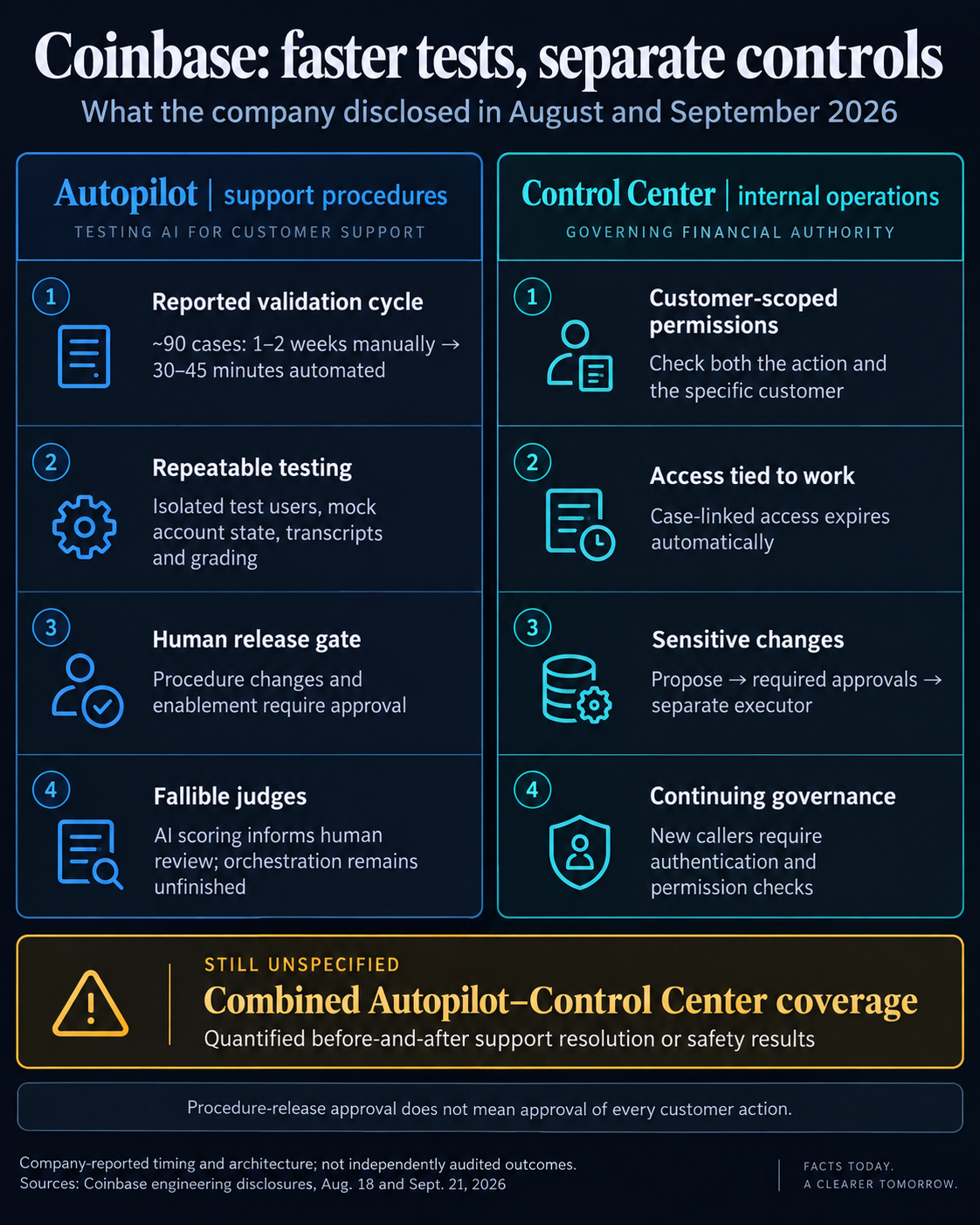
Coinbase says it cut a 90-case AI support test from 1–2 weeks to 30–45 minutes


Coinbase says it can now complete a support-testing cycle of roughly 90 cases in 30–45 minutes, work that previously took one to two weeks of manual setup and execution. The figure, disclosed by its engineers on Sept. 21, gives Coinbase CEO Brian Armstrong’s push for an AI-native company a concrete example of automation reducing repetitive work.
The system, called Autopilot, tests the procedures that support bots follow when handling customer problems. It also retains human approval before procedure changes reach production. The next test for Armstrong’s operating model is whether faster procedure development produces reliable support and accountable actions on customer accounts.
Customers need their account problems resolved correctly and their data accessed only with proper authority. Coinbase’s disclosures describe work to address both needs, while leaving the effect on customers unmeasured. Approving changes, restricting permissions and measuring real results remain operating responsibilities as the company automates more work.
Where the time saving comes from
Armstrong announced an approximately 14% workforce reduction in his May 5 memo, citing both a weak crypto market and AI changing how employees work. He proposed fewer management layers, leaders who also contribute directly, smaller AI-native teams and experiments with one-person teams.
The September engineering account moves that operating argument into a specific support process. Coinbase says its bots look up account state, take bounded actions and escalate problems requiring greater judgment to a person. Autopilot helps maintain the procedures those bots follow.
Its testing service creates isolated test users and mock account states, simulates conversations, records transcripts and tool results, and grades what happened against expected behavior. Agents can help generate tests; a repeatable runner executes them. Coinbase says it shipped a hybrid system combining the service, GitHub Actions release gates and a user interface that engineering and non-engineering teams can use.
That division explains why the time comparison is useful. Repeatedly setting up test accounts, driving conversations and collecting results is work a shared service can perform consistently. Faster validation could make it practical to check procedure changes more often, provided the cases and expected outcomes remain appropriate.
The reported comparison measures the validation cycle, leaving customer response times and staffing savings outside its scope. Connecting that cycle to the workforce reduction would require evidence of which tasks were displaced and the resulting costs.
A shorter testing cycle gives Coinbase more capacity to evaluate changes. Whether that capacity produces better support depends on what the tests cover, what reviewers do with their findings and how the resulting procedures perform after deployment.
Autopilot uses adversarial conversations as well as tests of expected behavior. Coinbase says an AI model scores those conversations, but acknowledges that the judge can be wrong. Scores feed human review and release gates rather than independently deciding that a procedure is ready.
The release boundary separates a proposed procedure from one that a support bot can use with customers. Agents can suggest changes, while a person must approve production writes and enablement.
That is a safeguard against an automated quality loop promoting its own work without review. It also means review remains an operating responsibility as the system accelerates.
The approval scope should be read precisely. Coinbase’s statement concerns changes to the support procedures and their enablement. It does not say a human approves every action a deployed bot takes on an individual customer’s account.
Further automation remains unfinished. Coinbase says discovery, authoring, testing and analysis exist, while orchestration from an identified performance gap to a promoted procedure is still being developed. A fully shared contract for conversation summaries also remains unfinished.
That leaves integration work alongside the automation gain. A system that identifies a weak flow, generates a revision and tests it still needs reliable information passed between those steps and an accountable decision about release.
Permission to act is a separate control
Coinbase’s Aug. 18 internal-operations disclosure addresses another part of customer protection: who can access customer data and who can change it.
The company describes Control Center as a separate shared platform for support, compliance, legal, risk and engineering. Coinbase has not specified its coverage of Autopilot. Within the platform, authorization, audit records, approvals and rate limits sit in front of the underlying services.
Its permission checks consider both the requested action and the particular customer. Missing customer context on a customer-scoped operation means denial. Access is tied to assigned cases, limited to the customers involved and set to expire.
For designated sensitive changes, including refunds, account-state changes and limit overrides, the platform separates proposing a change from executing it. The proposal enters review, the required approvals must arrive, and a separate executor then performs the change. Failures are reserved for human handling.
Those controls answer questions that conversational testing cannot answer on its own. A procedure can describe the expected response, while an authorization system determines whether the caller may reach the relevant customer data. Approval rules determine whether a sensitive change can proceed.
Control Center also makes the continuing work explicit. Coinbase says new client types, including automated agents, must be brought under the authorization, audit and rate-limiting rules, with authentication boundaries revalidated as callers change.
Establishing how these controls apply to support automation would require a clearer account of which bots and actions pass through the permission and approval checks. The relevant coverage measure is the set of customer operations governed by those rules.
For the AI-native operating model, the consequence is straightforward: adding automated callers still requires someone to maintain the rules governing their authority. The architecture can make that work more consistent. Its effectiveness still depends on keeping each new caller within the rules.
Case-linked access provides a concrete example: permissions must continue to match the assigned work as cases and callers change. The account boundary needs to hold alongside faster procedure development.
More testing needs an outcome measure
The same need to connect activity to outcomes extends to Coinbase’s separate Continuous Adversarial Testing (CAT) security platform. On Sept. 15, Coinbase reported more than 150,000 scans of its production estate since mid-2026, including over 128,000 pull-request reviews, and more penetration-test findings being fixed. Those reported activities and fixes provide security context.
The distinction between testing and deployed performance is also central to the National Institute of Standards and Technology’s (NIST) July 2024 generative-AI risk profile. The voluntary framework recommends evaluating systems in real-world scenarios because controlled testing may miss problems and discusses measurement gaps between laboratory and deployment conditions. The framework offers a general standard for evaluating these claims.
Autopilot already points toward customer measures. Coinbase says customer-intent labels, resolution and customer-satisfaction signals help identify weak high-volume support flows. That suggests the company recognizes that completing tests and solving customer problems are different measures.
Yet the September disclosure does not publish quantified before-and-after customer-resolution or safety results. The useful next evidence would connect the deployed procedures to those outcomes, alongside the share of relevant support activity covered by the testing and permission systems.
Resolution quality would help show whether automation solves the customer’s problem. Escalation performance would help show whether cases requiring human judgment reach it. Evidence about unauthorized actions and errors would address protection more directly than the time required to run a test suite.
The reported 30–45-minute validation cycle is a concrete example of work being automated. The disclosed approval gates and access restrictions make accountability part of the operating model. Demonstrating the value to customers requires connecting both to results in live support, while carrying the review and governance work that the disclosed systems still require.
Source: CryptoSlate