



FILTERED RESULTS
FILTERS
MCap $2.9T +0.4%24h Vol $63.8B -48%Fear & Greed 67/100Alts Index 53/100
BTC.D 58.8% 0%Stable.D 9.2% 0%ETH.D 11.3% 0%Others.D 20.7% 0%
STRK$0.0521+19.12%•SUPER$0.2613+14.38%•SAND$0.0735+13.86%•ZAMA$0.0867+13.42%•RAY$2.105+8.88%•JTO$0.5831+8.17%•STX$0.3885+7.27%•ZRO$2.067+7.24%•JST$0.1383+6.84%•SYRUP$0.2541+6.34%•
PONS$0.4107-19.27%•AI$0.1345-13.49%•MARSCOIN$0.1107-10.44%•RAIN$0.0105-9.96%•CAP$0.0697-9.95%•STONK$0.2347-9.36%•DRV$0.3770-6.64%•STABLE$0.0267-5.85%•CASHCAT$0.1602-5.41%•RUNE$0.7328-5.34%•
•
·
·
FILTERED RESULTS
Bitget Faces Fallout After $387.5 Million Hack, Criticizes DeFi Protocols
Bitcoin Miners Bank Strong September as Difficulty Barely Budges
Bitcoin Crash Warning Goes Viral as X Post Flags Benner Cycle
Community Bankers Sue to Close Crypto's 'Side Door' Into US Banking
Chainalysis Used AI to Trace the $387M Bitget Hack Back to North Korea
BTC Price Analysis: Is Bitcoin Gearing Up for $96K or a Retest of $82K?
Stacks Labs Prepares for PoX-6 Upgrade to Enhance Decentralization
BNY and Kraken Parent Explore Deal Linking Digital Assets…
Bitcoin Time Capsules Resurface as 5,419 Dormant BTC Moved in September
Greek Police Arrest 17 in Alleged $8M Crypto Investment Scheme
Crypto Job Postings Surge to 1,241 in September Amid Declining Applications
Payments firm OpenPayd targets year-end Nasdaq listing to fund U.S. expansion and acquisitions
Crypto job postings triple to over 1,200 in September, but applications fall
OpenAI Banned PewDiePie Twice While He Built Ajax, an Uncensored AI That Will Run on Your PC
Lummis Says CLARITY Act Included Democrats’ $150M FinCEN Demand
Trump Proposes $5,000 Dividends for American Citizens Amid Midterm Election Campaign
Is TRUMP Team Cashing Out $249M? Funds Moved to Crypto Exchange
Ethereum Price Holds $2,600 as Futures Activity Dominates
Total crypto liquidations hit $291 million in past 24 hours, mostly longs
Glassnode: Bitcoin Gains 1% as Fed October Hike Odds Fall to 22%
Cathie Wood: US Treasury yields at historical median, AI inference costs plunge sharply
Flare, Doppler Bringing Direct FXRP Vault Access to XRP Holders
DeFiLlama: Most Tracked Public Chains Generate Near-Zero Fees
NEAR Intents Recovers Full $3.8 Million Stolen in Security…
Coinbase Collaborates with Major Banks to Enhance Bitcoin Access
Singapore F1 Event Week Flight Bookings Drop by Nearly 23%
Once Worth $2 Billion, Blast Winds Down Its Ethereum Layer-2 Network
Cathie Wood says smart investors need to start watching where AI agents spend money
Pricing Out the Hike
Trump Is Hosting Yet Another Meme Coin Dinner: Here Are the Details
Citi Turns More Bullish on Bitcoin and Strategy: Here Are the New Targets
Luxembourg Allows Investment Funds to Issue Shares on Distributed Ledgers
Central Bank of Iran to Block Rial Accounts Linked to Crypto Exchanges
Aave Labs Proposes Establishment of Aave Foundation in the Cayman Islands
20,000 $ETH (53,573,068 USD) transferred from #Bitfinex to #Aave...
NVIDIA CEO Jensen Huang's Wealth Surges with Stock Holdings
Circle Urges EU to Scrap Strict Bank Deposit Rules for Stablecoins
71% of Tracked Blockchains Generated Zero Fees in the Past 24 Hours According to DefiLlama, 514 of...
Majority of Blockchains Report Zero Fees in 24 Hours, DefiLlama Data Reveals
NEAR Intents Hits Year-High Fee Revenue in September
Six US banks have failed in 2026 but the numbers look nothing like 2023
Kalshi Faces Legal Challenges Amid Surge in US Sports Betting
Hyperliquid Strategies Buys Another 1.9 Million HYPE, Worth $167.2 Million
Donald Trump (TRUMP) Token Team Moves $249M to CEXs as Price Falls by 6%
Weekly Project UpdatesEthereum Launches zkAPI, Base Rolls Out Cobalt Upgrade, USDT Returns to...
Data: About $3.415 Million in HYPE Transferred from Kinetiq to Unknown Wallet
71% of Tokenized Stock Trading on Uniswap in September Occurred Outside U.S. Market Hours, Nearly Half While Exchanges Were Closed
Apple Pulls Jack Dorsey’s Bitchat From The India App Store
387,005 $HYPE (34,152,289 USD) transferred from #Kinetiq to unknown wallet...
Stellar (XLM) Price Analysis: Can XLM Reach $0.30 After Breaking $0.22 Resistance?
The Pope Has Thoughts on AI Art—And They're Not Flattering
Circle and Hyperliquid Take Aim at MiCA as EU Review Closes
Crypto's Sisyphean struggle
BlackRock offers a glimpse of how tokenization may change your investment portfolio
Bitcoin Price Gets Squeezed at $84K as $85K Becomes the Next Test
Bitcoin’s $87K Rally Was a Trap: Could $82.5K Be the Real Buying Opportunity?
Top 3 Altcoins To Buy For October
CNBC Host: October Has Historically Been Strong, With Only 3 Monthly Declines Since 2013
Coinbase’s Chief Accounting Officer Jennifer Jones to Retire After Eight Years
Top 3 Altcoins To Buy And Hold For The Tokenization Boom, According To Bitwise CIO
Ripple And XRPL Foundation Launch XRP Asia To Boost Regional Growth
Stonk Launches Community Coin on Solana Platform
OpenWorld, Inc. Announces Plans to Acquire Blocksight Holdings Co.
European Central Bank Official Advocates for On-Chain Central Bank Currency
THORChain Liquidity Earned $573,000 From Bitget-Linked…
Arbitrum pauses new Stylus contract activations to counter AI-assisted attack risks
Can XRP Reach a New All-Time High by 2030? Experts Explain
Galaxy Research Reports Significant Losses Among Polymarket Retail Accounts
Tesla Reports 486,532 Vehicle Deliveries in Q3 2026, Surpassing Expectations
ESMA proposes ending EU custody and transfer services for non-compliant stablecoins


The European Securities and Markets Authority wants to extend Europe’s restrictions on non-compliant stablecoins beyond trading to the services that let customers keep and move them. If adopted as proposed, the change would remove the option of leaving such tokens with a licensed custodian after their trading pairs disappear.
In its September 30, 2026 response to a review of the EU’s Markets in Crypto-Assets regulation (MiCA), ESMA asks the European Commission to prohibit every licensable crypto-asset service involving stablecoins that fail the regulation’s applicable requirements. Custody and transfers fall within that service list. The consequence would reach existing holders who have stopped trading, as well as customers seeking to buy.
That is a further step from the regulator’s January 2025 approach, which said mere custody and transfer should remain possible. It could give compliant tokens a wider advantage in European distribution, but neither a forced conversion timetable nor a global demand shift follows from the proposal.
The permission left after delisting
ESMA’s January 17, 2025 statement distinguished services that offered non-compliant stablecoins to the public or admitted them to trading from simply holding or transferring them. Platforms were expected to stop making the tokens available for trading, and other services had to cease where they constituted an offer to the public.
Under that earlier transition, acquisition restrictions were expected by the end of January 2025, with temporary sell-only services through the end of the quarter.
For an investor, the custody distinction mattered. Losing access to a trading pair did not necessarily mean losing the service that safeguarded an existing balance or enabled its withdrawal. ESMA acknowledged that investors retaining those holdings could face worse execution conditions, even while custody and transfer remained possible.
A historical example shows the distinction. In its March 3, 2025 reporting, CryptoSlate said Binance planned to remove nine tokens’ trading pairs for European Economic Area users by March 31 while keeping deposits, withdrawals, conversions and custody available. This was the exchange’s announced approach in March 2025.
The September response would replace the activity-by-activity distinction with a broader asset-compliance test. ESMA argues that the lack of a clear prohibition creates disparities between compliant and non-compliant issuers and facilitates regulatory arbitrage.
The reach comes from MiCA’s Article 3 definitions. Custody includes safekeeping or controlling clients’ crypto-assets or their means of access, including private keys. Transfers cover moving assets on a client’s behalf from one ledger address or account to another. Both are expressly listed services, with Article 82 setting client-agreement requirements for transfers.
Provider permissions are also separate from token compliance. Article 59 requires authorization as a crypto-asset service provider, or qualifying permissions for specified financial entities, and says authorizations must identify the services permitted. A license for a provider does not by itself settle whether a particular stablecoin can be serviced.
An existing holder would therefore not avoid the proposed restriction by deciding never to trade again. If the wording became law without an exception, the custodian’s continued safekeeping would itself be covered.
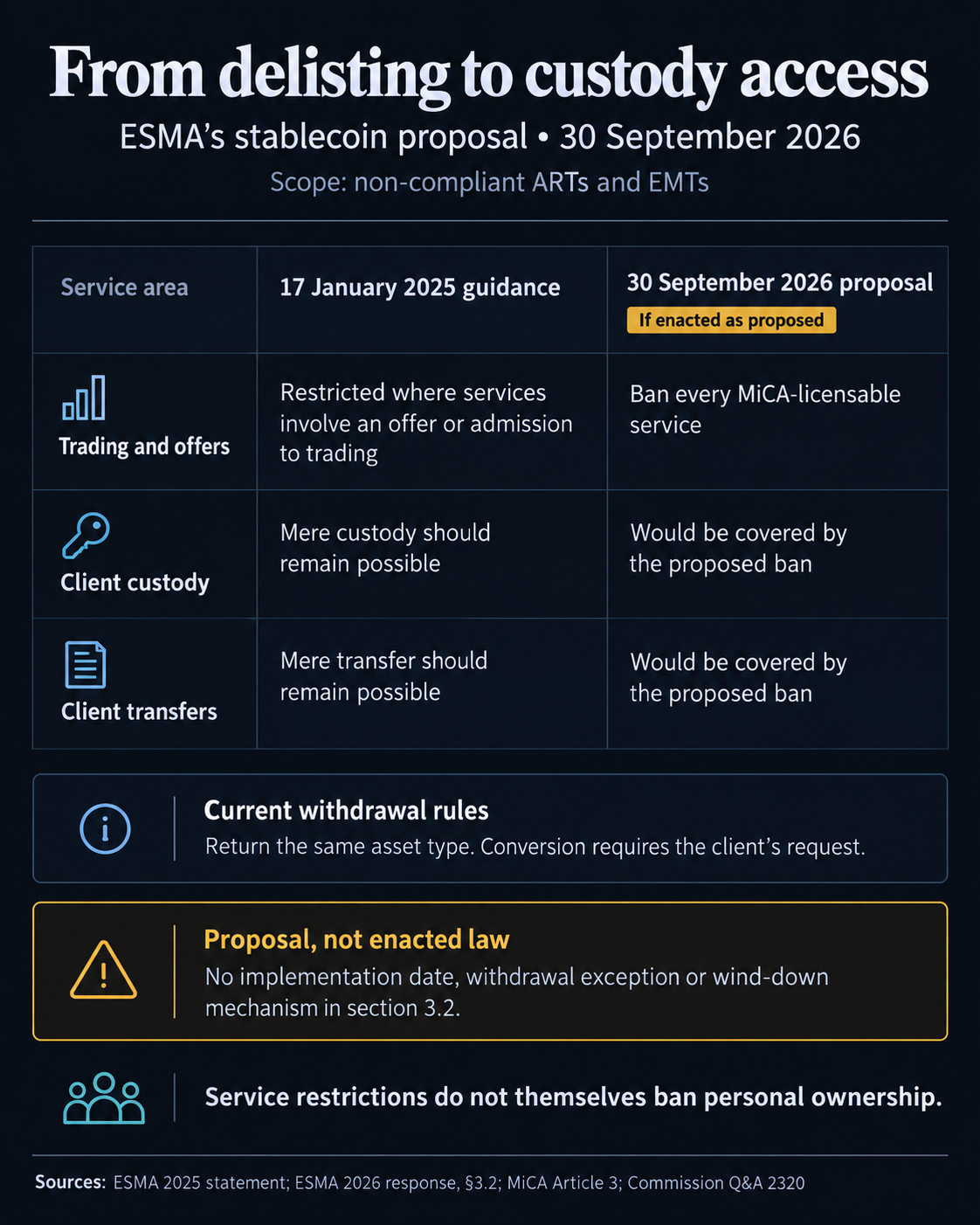
ESMA’s response is a policy submission, not an enacted amendment. The Commission’s consultation had a September 30 deadline, and its page says the resulting review report may, if warranted, be accompanied by a legislative proposal.
Section 3.2 of ESMA’s submission gives no implementation date, withdrawal exception or wind-down mechanism. That omission matters because ending custody requires a way to return assets that a provider already controls, while the proposed prohibition also reaches transfer services.
Current custody rules provide a relevant starting point. Article 75 requires procedures to return clients’ crypto-assets or their means of access as soon as possible. Client assets must also be segregated from the provider’s own holdings.
An answer from the European Commission via ESMA, dated February 18, 2026, further says the assets returned must be the same type held when the client requests withdrawal. A provider may offer conversion into fiat or another crypto-asset, but the client must request it at withdrawal and the provider must have permission for the additional service.
That existing interpretation does not settle how a future blanket service restriction would handle exits. It does explain why delisting, termination of custody and compulsory conversion cannot be treated as interchangeable outcomes. Legislators would need to resolve how any new prohibition fits the obligation to return assets.
The stablecoin proposal targets those professional services. It does not itself ban personal ownership, order tokens frozen or prescribe compulsory conversion. A holder’s ability to retain an asset and a licensed business’s ability to hold or move it for that customer are different questions.
Trading shares do not measure custody exposure
The earlier delistings show how trading can change at European-facing venues without a comparable shift across a wider market.
In a July 2026 paper, Nicola Borri and Kirill Shakhnov examine trading in the dollar-linked tokens USDT and USDC across 14 exchanges selected from CoinMarketCap’s top 30 centralized venues. Their daily pair-volume data from CryptoCompare run from January 1, 2024, through December 7, 2025.
The authors classify Bitstamp, Coinbase, Gemini and Kraken as “regulated-facing” because their Similarweb EU audience shares exceed 10%; all four also have US audience shares above 10%. The other 10 venues are classified as globally oriented, including Binance despite its EEA delistings. The audience proxy identifies neither individual EU-resident trades nor a clean division of legal exposure.
Around the study’s April 1, 2025 event date, the authors estimate that USDC’s share of combined USDT and USDC trading rose by about six percentage points on regulated-facing exchanges relative to global exchanges. The estimate covers a 30-day window and uses smoothed, detrended data; it measures a relative trading shift across venue groups.
The authors estimate USDT trading volume fell about 20% on regulated-facing exchanges relative to global venues, while the USDC-volume estimate was not statistically significant. USDC gained share primarily because USDT trading contracted in that comparison, not because the study established a corresponding expansion in USDC trading.
Aggregate USDC-to-USDT trading-volume ratios across the sample stayed nearly flat around the event. That describes sampled exchange turnover, not worldwide demand or EU custodial balances. The legal documents and study provide no total for the holdings that a future custody restriction could affect.
If the proposal became law in its present form, compliant tokens could retain access to regulated custody and transfer channels that non-compliant tokens would lose. For customers who want a provider to safeguard and move a dollar-linked balance, compliance could affect the usefulness of that asset beyond the availability of a trading pair.
The next consequential text would be a legislative amendment, particularly its scope, application date and treatment of existing balances. How it reconciles an end to custody with the return of clients’ assets would determine whether and how existing holders must leave regulated services.
Source: CryptoSlate